Paper II — Q4
(a) Discuss the evolution and development of rule relating to 'No-fault liability' in India with help of decided cases. 20 (b)…
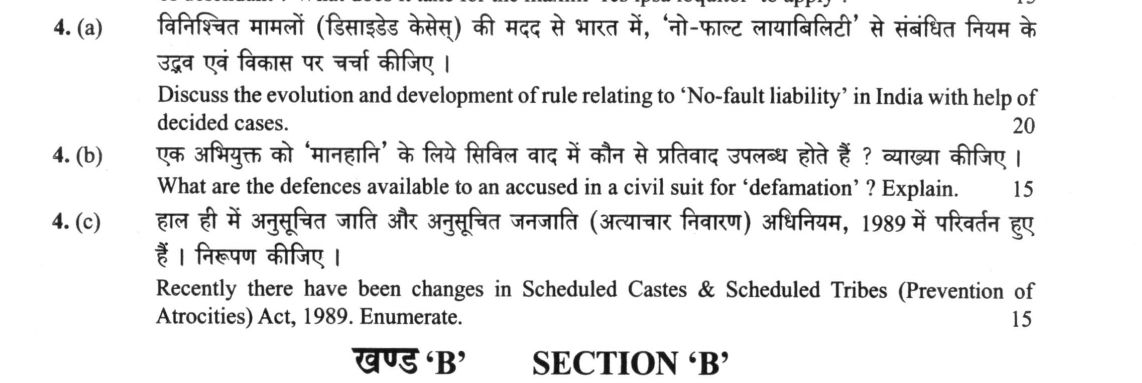
Discuss the evolution and development of rule relating to 'No-fault liability' in India with help of decided cases. 20 marks
What are the defences available to an accused in a civil suit for 'defamation' ? Explain. 15 marks
Recently there have been changes in Scheduled Castes & Scheduled Tribes (Prevention of Atrocities) Act, 1989. Enumerate. 15 marks
हिंदी में प्रश्न पढ़ें
विविधित मामलों (डिसाइडेड केसेस) की मदद से भारत में, 'नो-फॉल्ट लायबिलिटी' से संबंधित नियम के उद्भव एवं विकास पर चर्चा कीजिए। 20
एक अभियुक्त को 'मानहानि' के लिए सिविल वाद में कौन से प्रतिवाद उपलब्ध होते हैं ? व्याख्या कीजिए। 15
हाल ही में अनुसूचित जाति और अनुसूचित जनजाति (अत्याचार निवारण) अधिनियम, 1989 में परिवर्तन हुए हैं। निरूपण कीजिए। 15
Model answer
Written by UPSC Answer Check against this question's marking rubric, to the expected length. UPSC does not publish answers for Mains — this is one way to score well, not an official key.
No-fault liability. No-fault liability in India has evolved from a tort rule into a broader social-risk doctrine. Rylands v Fletcher (1868) imposed strict liability on a person who brings a dangerous thing onto land and causes it to escape, but allowed defences such as act of God. In M.C. Mehta v Union of India (1987), after the Oleum gas leak, the Supreme Court laid down absolute liability for hazardous industries: no exception for act of God, accident or third-party fault, and compensation must be proportional to enterprise’s capacity. This was reinforced in Indian Council for Enviro-Legal Action v Union of India (1996), where the Court applied polluter pays to the Bhopal gas tragedy, holding that a polluter must pay full compensation for environmental damage. Alongside tort, no-fault liability developed statutorily in motor accidents. Sections 140 and 161 of the Motor Vehicles Act, 1988 make the insurer (and, under Section 140, the owner) liable for death, personal injury and property damage without proof of negligence; in Kaushnuma Begum v. New India Assurance Co. Ltd. (2001), the Court affirmed that the insurer’s liability under Section 140 is no-fault and cannot be defeated by showing that the driver was not negligent. Thus, the Indian trajectory is from strict liability for dangerous things, to absolute liability for hazardous enterprises, to statutory no-fault compensation for victims of accidents and pollution.
Defamation defences. In a civil defamation suit, the defendant may rely on the defences recognised under Sections 499-502 IPC, which inform the civil tort. The principal defences are: truth for public good; fair comment on public figures or public affairs; publication of matter concerning public interest; fair reports of judicial, legislative and other public proceedings; caution given in good faith; and self-defence. These are supplemented by common-law privilege: absolute privilege for statements made in parliamentary or judicial proceedings, and qualified privilege for statements made in good faith on matters of duty or public interest, which fails if malice is shown. The civil suit differs from criminal defamation under Section 500 IPC as it seeks damages, not punishment, but the same statutory exceptions and Article 19(2) guide the court: speech may be restricted only where reasonably related to public order, decency, morality or defamation, among other grounds. Thus, the defence is not merely truth, but a protected context, fair comment, or legitimate public purpose.
SC/ST Act amendments. The Scheduled Castes and Scheduled Tribes (Prevention of Atrocities) (Amendment) Act, 2018 made key changes. It inserted Section 18A, requiring prior approval of the appointing authority, by way of preliminary screening, before an FIR is registered; this retained the screening mechanism but removed the Mahajan requirement that the approving officer be the Senior Superintendent of Police. It amended Section 4(2)(a) to bar anticipatory bail for an accused under the Act, and Section 4(2)(b) to require cognizance by a Special Court. It inserted Section 15A to protect victims and witnesses, to prevent intimidation and ensure safety. The 2018 amendments reversed the Supreme Court’s judgment in Subhash Kashinath Mahajan v State of Maharashtra (2018), which restricted FIR registration and anticipatory bail. In Prithvi Raj Chauhan v Union of India (2023), the Supreme Court upheld the amendments, holding them a valid response to misuse and the need to protect SC/ST victims. Together, they balance individual rights and social protection.
What "Discuss" is asking you to do
Lay the issue out from more than one side — how it arose, what is claimed for it, what is held against it, and where it now stands. UPSC attaches discuss to broad topics with several live dimensions, so coverage of the dimensions earns more than the strength of your opinion.
Structure that answers it
Set the issue up → the case as it is made → the case against → the dimension both sides leave out → where the balance now lies
Where marks are lost
Listing facts with no thread between them, or arguing one side throughout and calling it a discussion.
How this answer will be evaluated
Approach
Framework: Issue > Rule: statute or Article > Authority > Application and conclusion. (a) discuss: intro > 3-4 dimensions > example > balanced close | (b) explain: definition/context > points in order > small example > short close | (c) enumerate: list the items in order > one line each > no commentary Full marks: Precise statutory citations, clear distinction of legal concepts, and accurate enumeration of amendments.
Key points expected
- Distinguish Rylands v Fletcher strict liability from absolute liability
- Cite M.C. Mehta v Union of India (1987) for absolute liability
- Mention Public Liability Insurance Act, 1991
- Reference Indian Council for Enviro-Legal Action v Union of India
- Define Truth/Justification as a complete defence
- Explain Fair Comment and its requirements
- Distinguish Absolute Privilege from Qualified Privilege
- Mention Consent as a defence
Evaluation rubric
Each sub-part is marked on its own, against the marks and word limit printed on the paper.
- (a) Trace the legal evolution from strict to absolute liability in India. 20 marks
discuss— intro → 3-4 dimensions → example → balanced close
Must cover
- Distinguish Rylands v Fletcher strict liability from absolute liability
- Cite M.C. Mehta v Union of India (1987) for absolute liability
- Mention Public Liability Insurance Act, 1991
- Reference Indian Council for Enviro-Legal Action v Union of India
Loses marks
- Confusing strict liability with absolute liability
- Citing cases without stating their ratio
- Ignoring the shift from English to Indian law
Earns more
- Cite Union Carbide case (1984) as the factual trigger
- Mention Bhopal Gas Tragedy context
- Reference Vellore Citizens Welfare Forum v Union of India
- Mention State of Rajasthan v Videsh Kalyan
Extra mark
- Reference Law Commission Report on environmental liability
- Mention recent 2020s SC judgment on environmental torts
- (b) List and explain the legal defences available in a civil defamation suit. 15 marks
explain— definition/context → points in order → small example → short close
Must cover
- Define Truth/Justification as a complete defence
- Explain Fair Comment and its requirements
- Distinguish Absolute Privilege from Qualified Privilege
- Mention Consent as a defence
Loses marks
- Confusing criminal and civil defamation defences
- Failing to distinguish absolute from qualified privilege
- Listing defences without explaining their application
Earns more
- Cite specific case law for each defence
- Explain the 'fair and honest' test for comment
- Mention the 'public interest' element in qualified privilege
- Reference the Defamation Act, 1962
Extra mark
- Mention the 'fair report' defence
- Reference recent SC judgment on media defamation
- (c) List the specific changes made to the SC/ST (PoA) Act, 1989. 15 marks
enumerate— list the items in order → one line each → no commentary
Must cover
- Mention 2015 Amendment (effective 26 Jan 2016)
- Mention 2018 Amendment (effective 20 Aug 2018)
- List expanded Section 3 offences (e.g., tonsuring, manual scavenging)
- Mention Section 18A bar on anticipatory bail
Loses marks
- Inventing non-existent section numbers (e.g., 35A, 351A)
- Confusing 2015 and 2018 amendment provisions
- Failing to mention the bar on anticipatory bail
Earns more
- Mention Section 15A on rights of victims/witnesses
- Mention Section 14 mandatory Special Courts
- Mention 60-day trial requirement
- Reference Subhash Kashinath Mahajan (2018) reversal
Extra mark
- Mention Section 14A on appeals
- Mention Section 15 on Special Public Prosecutors
Practice this exact question
Write your answer and it is marked point by point against the model answer above — what you covered, what you missed, what you got wrong.
Evaluate my answer →More from Law 2021 Paper II
- Q1 Answer the following in about 150 words each. Support your answer with relevant provision…
- Q2 (a) Has 'Attempt' been defined anywhere in the IPC, 1860 ? What are the various tests for…
- Q3 (a) From 'Mathura' to 'Nirbhaya' and beyond, discuss the development of Rape laws in Indi…
- Q4 (a) Discuss the evolution and development of rule relating to 'No-fault liability' in Ind…
- Q5 Answer the following in about 150 words each. Support your answers with relevant provisio…
- Q6 (a) What are the various modes in which a contract may be discharged ? Explain in the lig…
- Q7 (a) Section 8 of the Arbitration and Conciliation Act, 1996 denotes a provision which lim…