Paper II — Q3
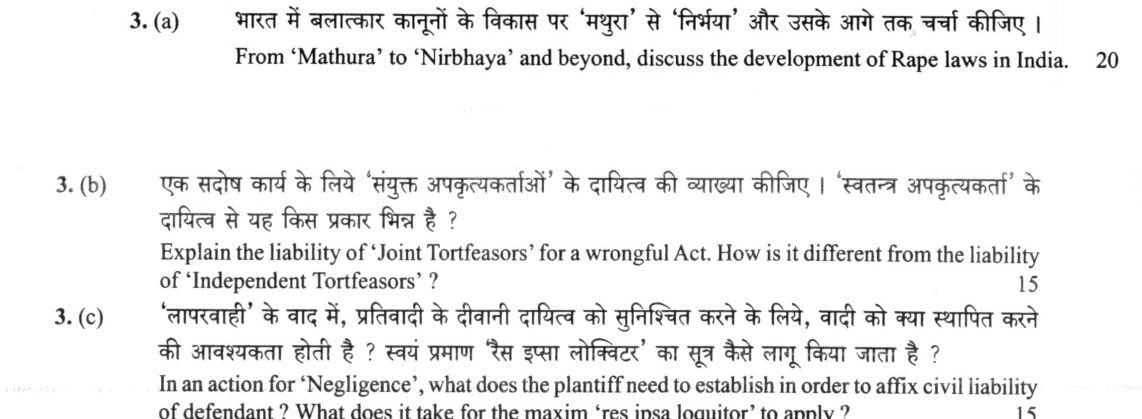
(a) From 'Mathura' to 'Nirbhaya' and beyond, discuss the development of Rape laws in India. 20 (b) Explain the liability of…
From 'Mathura' to 'Nirbhaya' and beyond, discuss the development of Rape laws in India. 20 marks
Explain the liability of 'Joint Tortfeasors' for a wrongful Act. How is it different from the liability of 'Independent Tortfeasors' ? 15 marks
In an action for 'Negligence', what does the plantiff need to establish in order to affix civil liability of defendant ? What does it take for the maxim 'res ipsa loquitor' to apply ? 15 marks
हिंदी में प्रश्न पढ़ें
भारत में बलात्कार कानूनों के विकास पर 'मथुरा' से 'निर्भया' और उसके आगे तक चर्चा कीजिए । 20
एक सदोष कार्य के लिए 'संयुक्त अपकृत्यकर्ताओं' के दायित्व की व्याख्या कीजिए। 'स्वतंत्र अपकृत्यकर्ता' के दायित्व से यह किस प्रकार भिन्न है ? 15 marks
'लापरवाही' के वाद में, प्रतिवादी के दीवानी दायित्व को सुनिश्चित करने के लिए, वादी को क्या स्थापित करने की आवश्यकता होती है ? स्वयं प्रमाण 'रेस इप्सा लोक्विटर' का सूत्र कैसे लागू किया जाता है ? 15 marks
Model answer
Written by UPSC Answer Check against this question's marking rubric, to the expected length. UPSC does not publish answers for Mains — this is one way to score well, not an official key.
The development of rape law in India shows a movement from formalistic consent rules to survivor-centric protection. In Tukaram v State of Maharashtra (1979), Mathura treated coerced silence as consent and used Section 155(4) of the Evidence Act to question the victim. This exposed the problem of consent under coercion and victim-blaming. The Criminal Law (Amendment) Act, 1983 responded by recognising custodial rape by public servants, police and military through Sections 376B–376D IPC and enhancing punishment for rape under Section 376(2); it also inserted Section 376A for marital rape during separation. The 2012 Nirbhaya case and the Justice Verma Committee accelerated reform. The 2013 Act expanded the law beyond penile-vaginal intercourse to include penetrative sexual assault, including oral, anal and object-based penetration; it added aggravated rape, gang rape, death penalty for gang rape and repeat offenders, acid attacks (Sections 326A–326B), voyeurism and stalking (Sections 354C–354D), while the POCSO Act, 2012 protected children. The 2018 amendment further extended death penalty for rape of children under 12 and aggravated rape of under 16. The marital rape exception in Section 375(2) remains contested; Joseph v State of Tamil Nadu (2017) upheld it, but the debate continues. The shift is from formal consent to contextual consent and from narrow punishment to protection of sexual autonomy.
Joint tortfeasors. Joint tortfeasors are persons who commit a single wrongful act in concert, by common design, or by aiding and abetting. Sections 43 and 44 IPC frame wrongful act and criminal omission, but tort liability is governed by common law. Their liability is joint and several: the plaintiff may recover the whole damage from any one of them. Merryweather v Nixan denied contribution, but modern law recognises it; England’s Law Reform (Married Women and Tortfeasors) Act, 1935 was replaced by the Civil Liability (Contribution) Act, 1978, and Indian courts recognised contribution in Kedar Nath v Sheo Narain. Independent tortfeasors, by contrast, act separately without common design and may have separate causes of action. If their breaches cause separate and quantifiable damage, each is liable for his own damage. However, if independent acts combine to produce a single indivisible injury, they may be concurrent tortfeasors and jointly and severally liable for the whole harm; it is not accurate to limit each to the portion attributable to his breach. Where the plaintiff’s own negligence is present, damages may be reduced on contributory negligence principles, as in the English Law Reform (Contributory Negligence) Act, 1945, but that is distinct from contribution among defendants.
Negligence and res ipsa loquitur. In negligence the plaintiff must establish duty of care, breach, causation and damage. Donoghue v Stevenson supplies the neighbour principle; remoteness is governed by Re Polemis and Wagon Mound (No.1), not Rookes v Barnard, which in Indian context concerns intimidation and exemplary damages. Res ipsa loquitur applies where the accident is of a kind that does not ordinarily happen without negligence, the instrumentality was within the defendant’s exclusive control, and the plaintiff’s conduct does not defeat the inference. The classic authority is Scott v London & St Katherine Docks Co.; Indian courts have applied it in Shyam Sunder v State of Rajasthan. It is not a substantive rule that the mere occurrence proves negligence; unlike ordinary negligence, where the plaintiff must prove the specific breach, it only permits an inference and shifts the evidential burden to the defendant to explain why the event did not result from negligence.
Indian law has thus moved from rigid formalism to protective criminal law and nuanced civil liability. Rape law now emphasises consent, survivor rights and expanded offences, while tort law distinguishes joint, concurrent and independent wrongdoers and uses res ipsa loquitur cautiously.
What "Discuss" is asking you to do
Lay the issue out from more than one side — how it arose, what is claimed for it, what is held against it, and where it now stands. UPSC attaches discuss to broad topics with several live dimensions, so coverage of the dimensions earns more than the strength of your opinion.
Structure that answers it
Set the issue up → the case as it is made → the case against → the dimension both sides leave out → where the balance now lies
Where marks are lost
Listing facts with no thread between them, or arguing one side throughout and calling it a discussion.
How this answer will be evaluated
Approach
Framework: Issue > Rule > Authority > Application. (a) discuss: intro > 3-4 dimensions > example > balanced close | (b) explain: definition/context > points in order > small example > short close | (c) explain: definition/context > points in order > small example > short close Full marks: Precise legal citations, clear distinctions, and comprehensive coverage of all required elements.
Key points expected
- Cite State of Haryana v. Gurcharan Singh (Mathura) ratio
- Detail 2013 Criminal Law Amendment Act (Section 375/376 IPC)
- Mention 2018 Amendment (Section 375/376 IPC) changes
- Reference 2023 Bharatiya Nyaya Sanhita (Section 63) reforms
- Define 'Joint Tortfeasors' (common design/act)
- Define 'Independent Tortfeasors' (separate acts, same damage)
- Explain 'joint and several' liability for joint tortfeasors
- Explain 'several' liability for independent tortfeasors
Evaluation rubric
Each sub-part is marked on its own, against the marks and word limit printed on the paper.
- (a) Chronological analysis of rape law evolution from Mathura to post-Nirbhaya reforms. 20 marks
discuss— intro → 3-4 dimensions → example → balanced close
Must cover
- Cite State of Haryana v. Gurcharan Singh (Mathura) ratio
- Detail 2013 Criminal Law Amendment Act (Section 375/376 IPC)
- Mention 2018 Amendment (Section 375/376 IPC) changes
- Reference 2023 Bharatiya Nyaya Sanhita (Section 63) reforms
Loses marks
- Focusing only on Mathura case without subsequent developments
- Ignoring the 2013 and 2018 Amendments
- Failing to mention the 2023 Bharatiya Nyaya Sanhita
Earns more
- Discuss 'rape by a husband' exception removal
- Mention 'death penalty' for aggravated rape
- Reference Law Commission Report No. 267
- Cite Independent Commission for Research on Women (ICRW) recommendations
Extra mark
- Reference 2024 Supreme Court judgment on 'rape by a husband'
- Mention 'death penalty' for aggravated rape
- (b) Definition and distinction between Joint and Independent Tortfeasors' liability. 15 marks
explain— definition/context → points in order → small example → short close
Must cover
- Define 'Joint Tortfeasors' (common design/act)
- Define 'Independent Tortfeasors' (separate acts, same damage)
- Explain 'joint and several' liability for joint tortfeasors
- Explain 'several' liability for independent tortfeasors
Loses marks
- Confusing 'joint' with 'several' liability
- Failing to distinguish between 'common design' and 'separate acts'
- Ignoring the 'same damage' requirement for independent tortfeasors
Earns more
- Cite 'Merryweather v. Nixan' for joint tortfeasors
- Cite 'Batten v. Murray' for independent tortfeasors
- Mention 'concurrent tortfeasors' concept
- Reference 'Section 43 of the Indian Contract Act, 1872'
Extra mark
- Reference 'Section 43 of the Indian Contract Act, 1872'
- Mention 'concurrent tortfeasors' concept
- (c) Elements of Negligence and application of 'res ipsa loquitur' maxim. 15 marks
explain— definition/context → points in order → small example → short close
Must cover
- List 4 elements of Negligence (Duty, Breach, Damage, Causation)
- Define 'res ipsa loquitur' (thing speaks for itself)
- Explain 'res ipsa loquitur' application (inference of negligence)
- Mention 'Blyth v. Birmingham Waterworks' for Negligence definition
Loses marks
- Failing to list all 4 elements of Negligence
- Confusing 'res ipsa loquitur' with 'res judicata'
- Ignoring the 'inference of negligence' aspect of 'res ipsa loquitur'
Earns more
- Cite 'Scott v. London & St. Katherine Docks' for 'res ipsa loquitur'
- Mention 'Novus actus interveniens' as a defense
- Reference 'Section 12 of the Consumer Protection Act, 2019'
- Mention 'Section 12 of the Consumer Protection Act, 2019'
Extra mark
- Reference 'Section 12 of the Consumer Protection Act, 2019'
- Mention 'Novus actus interveniens' as a defense
Practice this exact question
Write your answer and it is marked point by point against the model answer above — what you covered, what you missed, what you got wrong.
Evaluate my answer →More from Law 2021 Paper II
- Q1 Answer the following in about 150 words each. Support your answer with relevant provision…
- Q2 (a) Has 'Attempt' been defined anywhere in the IPC, 1860 ? What are the various tests for…
- Q3 (a) From 'Mathura' to 'Nirbhaya' and beyond, discuss the development of Rape laws in Indi…
- Q4 (a) Discuss the evolution and development of rule relating to 'No-fault liability' in Ind…
- Q5 Answer the following in about 150 words each. Support your answers with relevant provisio…
- Q6 (a) What are the various modes in which a contract may be discharged ? Explain in the lig…