Paper II — Q2
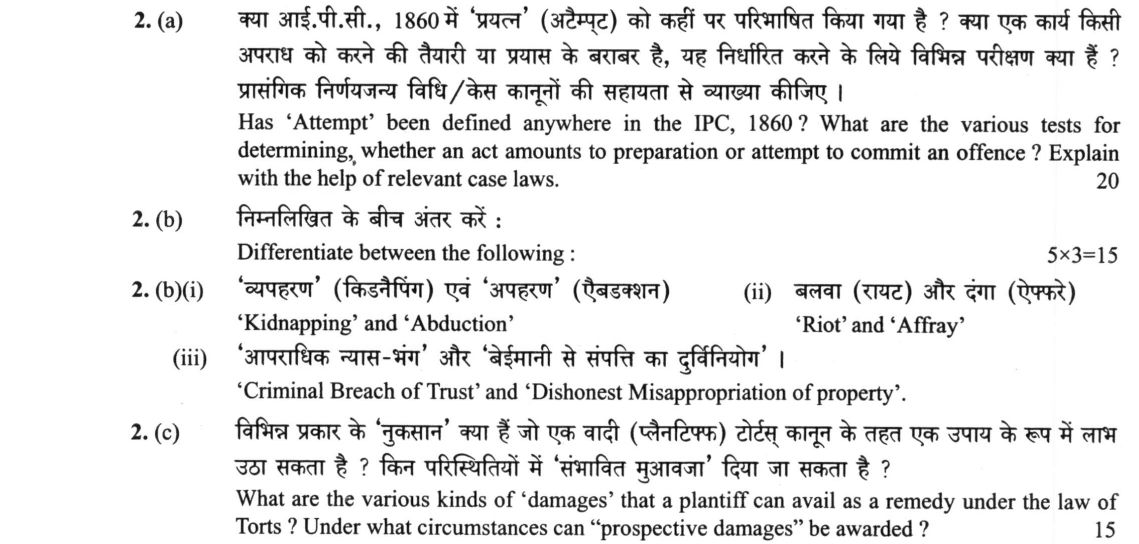
(a) Has 'Attempt' been defined anywhere in the IPC, 1860 ? What are the various tests for determining, whether an act amounts to…
Has 'Attempt' been defined anywhere in the IPC, 1860 ? What are the various tests for determining, whether an act amounts to preparation or attempt to commit an offence ? Explain with the help of relevant case laws. 20 marks
Differentiate between the following : 5×3=15
'Kidnapping' and 'Abduction'
'Riot' and 'Affray'
'Criminal Breach of Trust' and 'Dishonest Misappropriation of property'.
What are the various kinds of 'damages' that a plaintiff can avail as a remedy under the law of Torts ? Under what circumstances can "prospective damages" be awarded ? 15 marks
हिंदी में प्रश्न पढ़ें
क्या आई.पी.सी., 1860 में 'प्रयत्न' (अटेम्प्ट) को कहीं पर परिभाषित किया गया है ? क्या एक कार्य किसी अपराध को करने की तैयारी या प्रयास के बराबर है, यह निर्धारित करने के लिए विभिन्न परीक्षण क्या हैं ? प्रासंगिक निर्णयजन्य विधि/केस कानूनों की सहायता से व्याख्या कीजिए । 20
निम्नलिखित के बीच अंतर करें : 5×3=15
'अपहरण' (किडनैपिंग) एवं 'अपहरण' (एबडक्शन)
बलवा (रायट) और दंगा (एफ्रे)
'आपराधिक विश्वास-भंग' और 'बेईमानी से संपत्ति का दुर्विनियोग' ।
विभिन्न प्रकार के 'नुकसान' क्या हैं जो एक वादी (प्लेन्टिफ) टोर्ट्स कानून के तहत एक उपाय के रूप में लाभ उठा सकता है ? किन परिस्थितियों में 'संभावित मुआवजा' दिया जा सकता है ? 15 marks
Model answer
Written by UPSC Answer Check against this question's marking rubric, to the expected length. UPSC does not publish answers for Mains — this is one way to score well, not an official key.
Attempt The IPC does not define "attempt". Section 511 only prescribes punishment for attempt to certain offences; the distinction between preparation and attempt is judicial. Preparation is a step to facilitate an offence, such as buying a weapon or scouting a place; it is not punishable unless itself criminal. Attempt begins when the accused has crossed preparation and done an act in immediate connection with the offence. The law thus punishes conduct that sets the offence in motion, not mere intention.
Courts apply four tests. Proximity asks whether the act is the last step before completion; State of Maharashtra v. Mohd. Yakub and Aman Kumar v. State of Haryana hold that the act must be close to the substantive offence. Locus poenitentiae, in R v. Campbell, asks whether the accused could still withdraw; if he can, it is preparation, but once he passes the point of no return, it is attempt. Equivocality, illustrated in R v. Doolittle, requires an act unequivocally criminal and not capable of innocent explanation. Social danger, illustrated in R v. Miller, treats as attempt an act which, though not final, is dangerous to society and reveals settled criminal purpose. Together they locate the point where preparation becomes punishable attempt.
Distinctions (i) Kidnapping and abduction. Abduction under Section 362 is broader: it is compelling, detaining, or deceiving any person to go from any place. Kidnapping is narrower and has two forms. Kidnapping from India under Section 360 applies to any person taken, detained, or caused to go out of India, or detained outside India, with intent to send him out or prevent his leaving India. Kidnapping from lawful guardianship under Section 361 applies to a male under 16, female under 18, or a person of unsound mind, taken, enticed, or detained with intent to deprive lawful guardianship. Thus abduction may be committed against any person by force, fear, or deception, while kidnapping requires either the India element or deprivation of lawful guardianship without consent.
(ii) Riot and affray. Rioting under Section 146 requires an unlawful assembly, meaning five or more persons with a common object, and force or violence in pursuance of that object. Affray under Section 159 is a disturbance of peace in a public place by two or more persons fighting or quarrelling; it does not require an unlawful assembly or common object. Riot is thus a collective offence with common design; affray is a public disturbance by fighting persons.
(iii) Criminal breach of trust and dishonest misappropriation. CBT under Section 405 requires entrustment or dominion over property, followed by dishonest misappropriation, conversion, use, or disposal in violation of trust or legal direction. Dishonest misappropriation under Section 403 is dishonestly taking, removing, or converting movable property to own use out of another's possession without consent; it does not require entrustment or breach of trust. The difference is the presence of trust/dominion in CBT and its absence in mere misappropriation.
Tort damages Damages are the main tort remedy. Nominal damages are for a technical wrong without substantial loss. Contemptuous damages are small sums showing the defendant's conduct was trivial or insulting. Compensatory damages restore the plaintiff to the pre-tort position. Aggravated damages compensate injured feelings, reputation, or dignity. Exemplary damages are exceptional, awarded where conduct is oppressive, arbitrary, or unconstitutional, to punish and deter. Prospective damages are awarded when the tort is continuing or future loss is inevitable, such as permanent disability, loss of future earning capacity, future medical expenses, or ongoing nuisance. They must be reasonably certain, not speculative. Thus criminal law punishes the dangerous approach to an offence, while tort law compensates past and certain future harm.
What "Explain" is asking you to do
Make the working of something clear — what sets it off, what follows from what, and what it produces. Explain is the Commission's mechanism word: it dominates the technical papers and the “explain why” stems, where the marks sit in the causal chain and not in the label.
Structure that answers it
State what it is → the initiating condition → the chain of cause, step by step → an instance where it plays out → what the chain produces
Where marks are lost
Describing what something looks like instead of why it works that way. Naming the stages without linking them reads as description too.
How this answer will be evaluated
Approach
Framework: Issue > Rule > Authority > Application. (a) explain: definition/context > points in order > small example > short close | (b(i)) compare: paired headings or table > key differences > significance > conclusion | (b(ii)) compare: paired headings or table > key differences > significance > conclusion | (b(iii)) compare: paired headings or table > key differences > significance > conclusion | (c) explain: definition/context > points in order > small example > short close Full marks: Precise legal definitions, accurate case citations, clear distinctions, and balanced analysis.
Key points expected
- State absence of specific definition in IPC
- Cite Section 511 IPC for attempt
- Distinguish preparation vs attempt (proximity test)
- Cite relevant case law (e.g., R v. Eagleton)
- Define Abduction (Sec 362 IPC)
- Define Kidnapping (Sec 359/361 IPC)
- Highlight 'force or deceit' element
- Highlight 'intent' element
Evaluation rubric
Each sub-part is marked on its own, against the marks and word limit printed on the paper.
- (a) Define 'Attempt' and distinguish it from 'Preparation' using legal tests and case law. 20 marks
explain— definition/context → points in order → small example → short close
Must cover
- State absence of specific definition in IPC
- Cite Section 511 IPC for attempt
- Distinguish preparation vs attempt (proximity test)
- Cite relevant case law (e.g., R v. Eagleton)
Loses marks
- Confusing preparation with attempt
- Citing cases without stating ratio
- Failing to mention Section 511
Earns more
- Mention 'last act' test
- Reference R v. Doidy
- Reference R v. Jones
- Reference R v. Fost
Extra mark
- Reference Law Commission Report on attempt
- Reference recent Supreme Court judgment on attempt
- (b(i)) Differentiate between Kidnapping and Abduction. 5 marks
compare— paired headings or table → key differences → significance → conclusion
Must cover
- Define Abduction (Sec 362 IPC)
- Define Kidnapping (Sec 359/361 IPC)
- Highlight 'force or deceit' element
- Highlight 'intent' element
Loses marks
- Treating abduction as a form of kidnapping
- Failing to distinguish intent
- Failing to cite sections
Earns more
- Mention kidnapping from India
- Mention kidnapping from lawful guardianship
- Mention abduction without intent
- Mention abduction with intent
Extra mark
- Reference specific case law on abduction
- Reference specific case law on kidnapping
- (b(ii)) Differentiate between Riot and Affray. 5 marks
compare— paired headings or table → key differences → significance → conclusion
Must cover
- Define Affray (Sec 147 IPC)
- Define Riot (Sec 149 IPC)
- Highlight 'common intention' element
- Highlight 'public place' element
Loses marks
- Confusing affray with riot
- Failing to distinguish common intention
- Failing to cite sections
Earns more
- Mention 'two or more persons'
- Mention 'disturbance of public peace'
- Mention 'criminal force'
- Mention 'common object'
Extra mark
- Reference specific case law on affray
- Reference specific case law on riot
- (b(iii)) Differentiate between Criminal Breach of Trust and Dishonest Misappropriation. 5 marks
compare— paired headings or table → key differences → significance → conclusion
Must cover
- Define Criminal Breach of Trust (Sec 406 IPC)
- Define Dishonest Misappropriation (Sec 403 IPC)
- Highlight 'entrustment' element
- Highlight 'dishonesty' element
Loses marks
- Confusing breach of trust with misappropriation
- Failing to distinguish entrustment
- Failing to cite sections
Earns more
- Mention 'disposal' element
- Mention 'violation of trust'
- Mention 'dishonest intention'
- Mention 'property' element
Extra mark
- Reference specific case law on breach of trust
- Reference specific case law on misappropriation
- (c) Explain various kinds of damages in Torts and circumstances for prospective damages. 15 marks
explain— definition/context → points in order → small example → short close
Must cover
- List types of damages (compensatory, nominal, exemplary)
- Define 'prospective damages'
- Explain circumstances for prospective damages
- Cite relevant case law
Loses marks
- Failing to distinguish types of damages
- Failing to explain prospective damages
- Failing to cite case law
Earns more
- Mention 'punitive damages'
- Mention 'aggravated damages'
- Mention 'consequential damages'
- Mention 'special damages'
Extra mark
- Reference Law Commission Report on damages
- Reference recent Supreme Court judgment on damages
Practice this exact question
Write your answer and it is marked point by point against the model answer above — what you covered, what you missed, what you got wrong.
Evaluate my answer →More from Law 2021 Paper II
- Q1 Answer the following in about 150 words each. Support your answer with relevant provision…
- Q2 (a) Has 'Attempt' been defined anywhere in the IPC, 1860 ? What are the various tests for…
- Q3 (a) From 'Mathura' to 'Nirbhaya' and beyond, discuss the development of Rape laws in Indi…
- Q4 (a) Discuss the evolution and development of rule relating to 'No-fault liability' in Ind…
- Q5 Answer the following in about 150 words each. Support your answers with relevant provisio…