Paper II — Q8
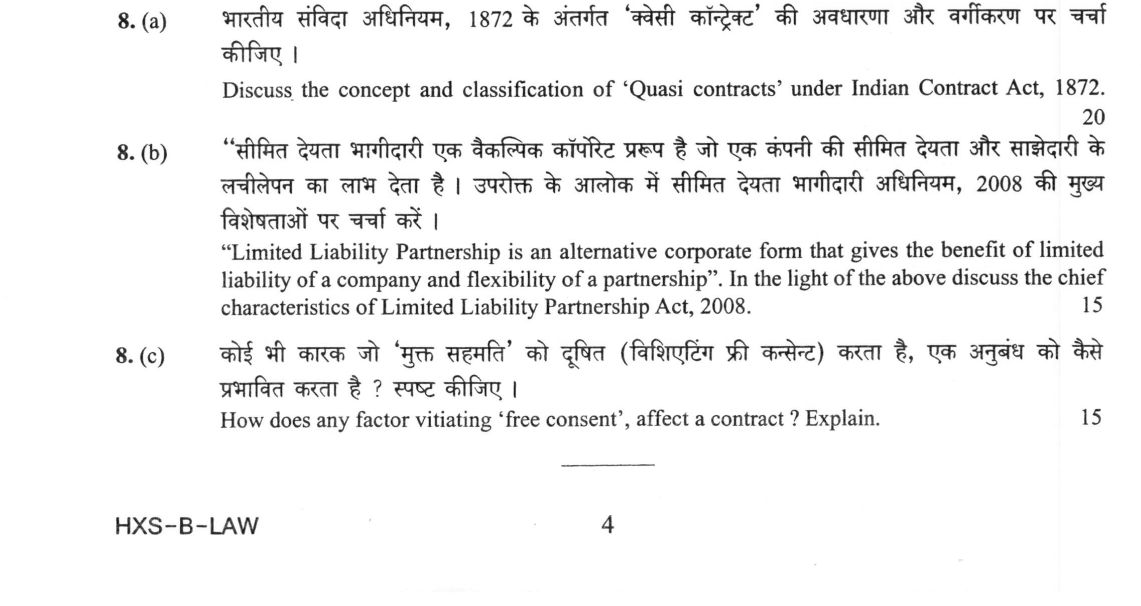
(a) Discuss the concept and classification of 'Quasi contracts' under Indian Contract Act, 1872. 20 (b) "Limited Liability…
Discuss the concept and classification of 'Quasi contracts' under Indian Contract Act, 1872. 20 marks
"Limited Liability Partnership is an alternative corporate form that gives the benefit of limited liability of a company and flexibility of a partnership". In the light of the above discuss the chief characteristics of Limited Liability Partnership Act, 2008. 15 marks
How does any factor vitiating 'free consent', affect a contract ? Explain. 15 marks
हिंदी में प्रश्न पढ़ें
भारतीय संविदा अधिनियम, 1872 के अंतर्गत 'क्वासी कॉन्ट्रैक्ट' की अवधारणा और वर्गीकरण पर चर्चा कीजिए । 20
"सीमित देयता भागीदारी एक वैकल्पिक कॉर्पोरेट प्ररूप है जो एक कंपनी की सीमित देयता और साझेदारी के लचीलेपन का लाभ देता है । उपरोक्त के आलोक में सीमित देयता भागीदारी अधिनियम, 2008 की मुख्य विशेषताओं पर चर्चा करें । 15
कोई भी कारक जो 'मुक्त सहमति' को दूषित (विशिएटिंग फ्री कन्सेंट) करता है, एक अनुबंध को कैसे प्रभावित करता है ? स्पष्ट कीजिए । 15
Model answer
Written by UPSC Answer Check against this question's marking rubric, to the expected length. UPSC does not publish answers for Mains — this is one way to score well, not an official key.
The three issues move from implied obligations, to hybrid business forms, to the quality of consent.
Quasi-contracts Quasi-contracts are not contracts in fact; they are constructive contracts or obligations imposed by law where, absent such an obligation, one party would be unjustly enriched at another’s expense. In the Indian Contract Act, 1872, they are mainly in Sections 68-72 and are classified by the type of benefit or payment. Section 68 gives a person who supplies necessaries to a minor or person of unsound mind, or to one chargeable for his maintenance, a right of recourse against that person’s property. Section 69 allows a person interested in the payment of money which another is bound to pay to recover from that other if he pays it. Section 70 requires a person who lawfully does something for another, or pays money in his interest, to be compensated or reimbursed. Section 71 extends this to one who enjoys the benefit of a non-gratuitous act. Section 72 requires restitution of money paid under a mistake of fact or under coercion. The finder-of-goods provisions (Sections 156-160), often discussed with quasi-contracts, impose duties to take care, find the owner and, if unknown, sell after notice, while giving the finder compensation and a lien. Unlike implied-in-fact contracts, which rest on conduct showing mutual assent, quasi-contracts rest on no meeting of minds; their theoretical basis is unjust enrichment and quantum meruit, though the Indian Act supplies specific statutory rules rather than a general doctrine.
LLP The Limited Liability Partnership Act, 2008 creates a hybrid form. It gives partners the limited liability of a company under Section 26, subject to agreed contribution, while retaining partnership flexibility. The LLP is a separate legal entity with capacity to contract, sue and hold property (Sections 3-5), and has perpetual succession (Section 4). Under Section 24, each partner is an agent of the LLP, not of the co-partners; there is no mutual agency, unlike the Indian Partnership Act, 1932, where partners are mutual agents and generally bear unlimited joint and several liability. Compared with a company under the Companies Act, 2013, an LLP has lighter compliance and can shape internal governance through its LLP agreement, including profit-sharing, management and capital. It therefore combines corporate protection with partnership adaptability, though it remains subject to statutory duties, filing requirements and exceptions for wrongful acts.
Vitiating consent Section 10 makes free consent an essential of a valid contract. Consent is free only if it is not caused by coercion, undue influence, fraud, misrepresentation or mistake (Sections 14-22). Coercion, undue influence, fraud and misrepresentation make the agreement voidable at the option of the party whose consent was not free (Section 19); the injured party may affirm it or rescind it. Mistake as to a matter of fact essential to the agreement makes the agreement void ab initio (Section 20). The law distinguishes the factors by their mental element: coercion involves threat; undue influence involves abuse of a position of dominance or confidence; fraud involves dishonest or deliberate deception; misrepresentation may be innocent but still induces consent; mistake negates true agreement. Burden of proof differs: the party alleging coercion, fraud or misrepresentation must prove it, while in undue influence the burden shifts to the person benefited to show that the transaction was fair and not influenced (Section 111). Where a voidable contract is rescinded, Section 64 requires the party who received a benefit to restore it; where a contract is discovered to be void, Section 65 imposes a similar restitutionary duty. Together, these provisions show the law balancing party autonomy, commercial flexibility and restitution, so that consent defects are remedied without allowing unjust enrichment.
What "Discuss" is asking you to do
Lay the issue out from more than one side — how it arose, what is claimed for it, what is held against it, and where it now stands. UPSC attaches discuss to broad topics with several live dimensions, so coverage of the dimensions earns more than the strength of your opinion.
Structure that answers it
Set the issue up → the case as it is made → the case against → the dimension both sides leave out → where the balance now lies
Where marks are lost
Listing facts with no thread between them, or arguing one side throughout and calling it a discussion.
How this answer will be evaluated
Approach
Framework: Issue > Rule > Authority > Application. (a) discuss: intro > 3-4 dimensions > example > balanced close | (b) discuss: intro > 3-4 dimensions > example > balanced close | (c) explain: definition/context > points in order > small example > short close Full marks: Precise statutory references, case law with ratio, clear application to facts, balanced analysis.
Key points expected
- Define Quasi contract (Section 68-72)
- Distinguish from true contract (no offer/acceptance)
- Classify: Money paid (68), Necessaries (69), Reimbursement (70-72)
- Cite relevant case law for each section
- Define LLP (Section 2 of LLP Act, 2008)
- Explain limited liability of partners
- Explain flexibility of partnership structure
- Mention separate legal entity status
Evaluation rubric
Each sub-part is marked on its own, against the marks and word limit printed on the paper.
- (a) Concept and classification of Quasi contracts under Indian Contract Act, 1872. 20 marks
discuss— intro → 3-4 dimensions → example → balanced close
Must cover
- Define Quasi contract (Section 68-72)
- Distinguish from true contract (no offer/acceptance)
- Classify: Money paid (68), Necessaries (69), Reimbursement (70-72)
- Cite relevant case law for each section
Loses marks
- Confusing quasi contract with true contract
- Missing statutory sections (68-72)
- No case law cited
Earns more
- Mention 'Equity and good conscience' basis
- Reference to restitution principles
- Comparison with unjust enrichment
- Specific examples for each section
Extra mark
- Reference to Law Commission report on restitution
- Recent Supreme Court judgment on Section 68
- (b) Chief characteristics of Limited Liability Partnership Act, 2008. 15 marks
discuss— intro → 3-4 dimensions → example → balanced close
Must cover
- Define LLP (Section 2 of LLP Act, 2008)
- Explain limited liability of partners
- Explain flexibility of partnership structure
- Mention separate legal entity status
Loses marks
- Confusing LLP with private limited company
- Missing key characteristics (limited liability, flexibility)
- No reference to LLP Act, 2008
Earns more
- Reference to LLP Agreement
- Mention of designated partners
- Comparison with company and partnership
- Compliance requirements (annual filing)
Extra mark
- Reference to Law Commission report on LLP
- Recent Supreme Court judgment on LLP liability
- (c) How factors vitiating free consent affect a contract. 15 marks
explain— definition/context → points in order → small example → short close
Must cover
- Define free consent (Section 14)
- List vitiating factors: coercion, undue influence, fraud, misrepresentation, mistake
- Explain effect: voidable (Section 19-22)
- Cite relevant case law for each factor
Loses marks
- Confusing void with voidable
- Missing vitiating factors (coercion, undue influence, fraud, misrepresentation, mistake)
- No case law cited
Earns more
- Mention Section 15-22 specifically
- Reference to 'free consent' definition
- Comparison of void vs voidable
- Specific examples for each vitiating factor
Extra mark
- Reference to Law Commission report on consent
- Recent Supreme Court judgment on undue influence
Practice this exact question
Write your answer and it is marked point by point against the model answer above — what you covered, what you missed, what you got wrong.
Evaluate my answer →More from Law 2021 Paper II
- Q5 Answer the following in about 150 words each. Support your answers with relevant provisio…
- Q6 (a) What are the various modes in which a contract may be discharged ? Explain in the lig…
- Q7 (a) Section 8 of the Arbitration and Conciliation Act, 1996 denotes a provision which lim…
- Q8 (a) Discuss the concept and classification of 'Quasi contracts' under Indian Contract Act…