Paper II — Q6
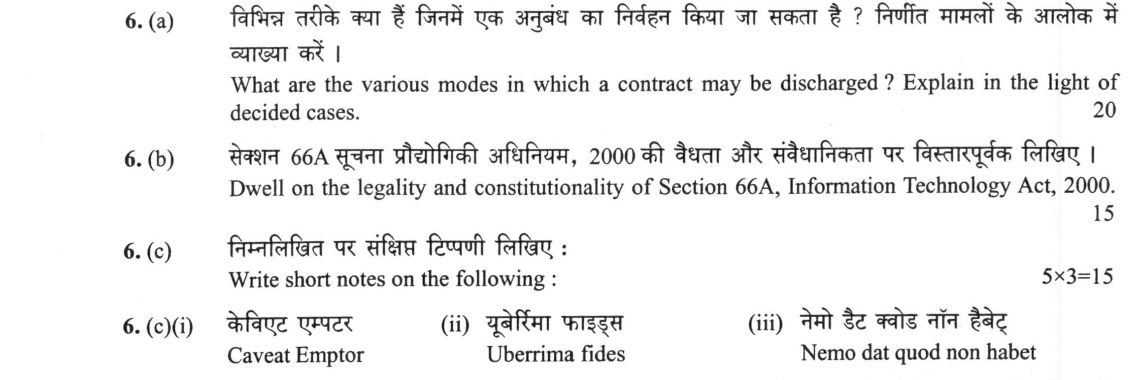
(a) What are the various modes in which a contract may be discharged ? Explain in the light of decided cases. 20 (b) Dwell on…
What are the various modes in which a contract may be discharged ? Explain in the light of decided cases. 20 marks
Dwell on the legality and constitutionality of Section 66A, Information Technology Act, 2000. 15 marks
Write short notes on the following : 5×3=15
Caveat Emptor
Uberrima fides
Nemo dat quod non habet
हिंदी में प्रश्न पढ़ें
विभिन्न तरीके क्या हैं जिनमें एक अनुबंध का निर्वहन किया जा सकता है ? निर्णीत मामलों के आलोक में व्याख्या करें । 20
सेक्शन 66A सूचना प्रौद्योगिकी अधिनियम, 2000 की वैधता और संवैधानिकता पर विस्तारपूर्वक लिखिए । 15
निम्नलिखित पर संक्षिप्ट टिप्पणी लिखिए : 5×3=15
केविएट एम्पटर
युबेरिमा फाइड्स
नेमो डैट क्वोड नॉन हैबेट
Model answer
Written by UPSC Answer Check against this question's marking rubric, to the expected length. UPSC does not publish answers for Mains — this is one way to score well, not an official key.
(a) Modes of discharge A contract is discharged when a legal event removes future duties. Performance under Ss.37-38 ICA ends it when tender and acceptance are proper; Alopi Parshad v Kalmadi Prasad requires tender giving the other a reasonable chance to accept. Mutual consent under Ss.62-63 discharges it because the parties substitute a new bargain. Impossibility/frustration under S.56 applies when an unforeseen event radically changes performance: Taylor v Caldwell made destruction of the subject matter without fault a discharge; Satyabrata Ghose v Mugneeram Bangur adopted frustration, not strict impossibility; Naihati Jute Mills v Kalyanji Airavtaram held self-induced impossibility is not excused. Breach discharges it: actual breach permits termination and damages; anticipatory breach, per Hochster v De La Tour, allows the innocent party to end the contract when repudiation is clear. Operation of law discharges through limitation, insolvency, merger or repeal, because law itself removes the right.
(b) Section 66A, IT Act Section 66A punished offensive, menacing or misleading electronic messages. In Shreya Singhal v Union of India (2015), the Supreme Court struck it down. The causal harm was a chilling effect on Article 19(1)(a): undefined terms such as “offensive” made lawful speech criminal, and prosecution risk suppressed expression. The Court applied vagueness and proportionality: a restriction must be reasonably related to a legitimate aim under Article 19(2), and must be necessary and proportionate. Section 66A failed because it swept in ordinary criticism without a clear nexus to public order or security. Severability removed the invalid clause without destroying the Act. This aligns with Brandenburg, punishing only speech directed to imminent lawless action and likely to produce it. Post-66A, online speech may still be regulated under IPC Sections 153A and 295A, but each must independently satisfy Article 19(2) and proportionality; they are not a blanket replacement.
(c) Short notes (i) Caveat Emptor means “let the buyer beware.” Under S.16 Sale of Goods Act, 1930, the seller is not liable for defects unless the contract provides otherwise. The rule reflects freedom of contract: the buyer must inspect. Exceptions include sale by description (S.15), fitness for a particular purpose and merchantable quality (S.16), sale by sample (S.17), and latent defects known to the seller and not to the buyer, as in Ward v Hobbs. The Consumer Protection Act, 2019 does not displace the Sale of Goods Act; it provides parallel consumer remedies, so caveat emptor persists in commercial sales but is moderated by consumer protection.
(ii) Uberrima fides means “utmost good faith.” Insurance contracts are governed by it because the insurer relies on the insured’s knowledge of risk. The insured must disclose material facts; Carter v Boehm held non-disclosure of a material circumstance voids the policy. LIC v Consumer Education & Research Centre emphasised that insurance is a social institution and good faith must be applied fairly, not as a technical trap. Concealment destroys the basis of risk assessment, allowing avoidance.
(iii) Nemo dat quod non habet means “no one can give what he does not have.” Under Ss.27-30 Sale of Goods Act, a seller without title generally passes only such title as he has. The rule protects ownership. Exceptions are narrow: consent (S.27) or estoppel, sale by a person who obtained possession by fraud or under a voidable title (S.28), joint owners (S.29), and buyer in possession (S.30). English law also recognises market overt and mercantile-agent sale under the Factors Act, as in Cahn v Pockett’s Bristol Channel Steam Packet Co; Indian law does not adopt the mercantile-agent sale exception, S.178 ICA permitting only pledge by a mercantile agent. Thus, the rule remains the default, and exceptions are strictly construed.
What "Explain" is asking you to do
Make the working of something clear — what sets it off, what follows from what, and what it produces. Explain is the Commission's mechanism word: it dominates the technical papers and the “explain why” stems, where the marks sit in the causal chain and not in the label.
Structure that answers it
State what it is → the initiating condition → the chain of cause, step by step → an instance where it plays out → what the chain produces
Where marks are lost
Describing what something looks like instead of why it works that way. Naming the stages without linking them reads as description too.
How this answer will be evaluated
Approach
Framework: Issue > Rule > Authority > Application. (a) explain: definition/context > points in order > small example > short close | (b) examine: intro > how/why with reasoning > evidence > conclusion | (c(i)) write short notes: define > 3-4 key features > one example > one-line significance | (c(ii)) write short notes: define > 3-4 key features > one example > one-line significance | (c(iii)) write short notes: define > 3-4 key features > one example > one-line significance Full marks: Precise legal language, correct case citations, clear application of law to facts, and balanced analysis.
Key points expected
- List modes: performance, agreement, frustration, breach, lapse
- Cite specific decided cases for each mode
- State the legal rule or section for each mode
- Apply the case ratio to the mode of discharge
- State the text or substance of Section 66A
- Cite the Supreme Court judgment striking it down
- Explain the constitutional provisions violated (Art 19)
- Discuss the reasoning of the court on vagueness
Evaluation rubric
Each sub-part is marked on its own, against the marks and word limit printed on the paper.
- (a) Enumerate modes of discharge and explain each with decided cases. 20 marks
explain— definition/context → points in order → small example → short close
Must cover
- List modes: performance, agreement, frustration, breach, lapse
- Cite specific decided cases for each mode
- State the legal rule or section for each mode
- Apply the case ratio to the mode of discharge
Loses marks
- Listing modes without citing any decided cases
- Restating case facts without stating the legal ratio
- Confusing discharge with termination or rescission
Earns more
- Mention Section 39 (Performance) of Contract Act
- Reference Section 56 (Frustration) of Contract Act
- Cite Satyabrata Ghose v. Mugni Memoon
- Reference M/s. Satyabrata Ghose v. Mugni Memoon
Extra mark
- Reference Law Commission Report on Contract Law
- Cite a recent Supreme Court judgment on frustration
- (b) Examine the legality and constitutionality of Section 66A of IT Act, 2000. 15 marks
examine— intro → how/why with reasoning → evidence → conclusion
Must cover
- State the text or substance of Section 66A
- Cite the Supreme Court judgment striking it down
- Explain the constitutional provisions violated (Art 19)
- Discuss the reasoning of the court on vagueness
Loses marks
- Discussing IT Act generally without focusing on 66A
- Citing the case outcome without the legal reasoning
- Confusing Section 66A with Section 66 or 67
Earns more
- Mention the 'chilling effect' on free speech
- Reference the 'overbreadth' doctrine
- Cite the specific bench or judge
- Mention the date of the judgment
Extra mark
- Reference the Law Commission's view on IT Act
- Mention the specific Article 19(1)(a) and (2) balance
- (c(i)) Define Caveat Emptor and list its key features and exceptions. 5 marks
write short notes— define → 3-4 key features → one example → one-line significance
Must cover
- Define 'Caveat Emptor' (Let the buyer beware)
- State the basic rule of buyer's duty to inspect
- Mention at least two exceptions (fraud, latent defects)
- Provide one example of its application
Loses marks
- Defining it as a seller's duty rather than buyer's
- Listing exceptions without explaining the basic rule
- Confusing it with 'Caveat Venditor'
Earns more
- Reference the Sale of Goods Act context
- Mention the 'latent defect' exception clearly
- Cite a case on latent defects
- Mention the 'fraud' exception clearly
Extra mark
- Reference the Consumer Protection Act context
- Mention the 'fitness for purpose' exception
- (c(ii)) Define Uberrima fides and explain its application in insurance. 5 marks
write short notes— define → 3-4 key features → one example → one-line significance
Must cover
- Define 'Uberrima fides' (Utmost good faith)
- State its application in insurance contracts
- Mention the duty of disclosure by the insured
- Provide one example of its application
Loses marks
- Defining it as a general contract principle only
- Failing to link it to insurance specifically
- Confusing it with 'good faith' in general contracts
Earns more
- Reference the Marine Insurance Act context
- Mention the 'duty of disclosure' clearly
- Cite a case on non-disclosure
- Mention the 'concealment' aspect
Extra mark
- Reference the Insurance Act, 1938 context
- Mention the 'material fact' requirement
- (c(iii)) Define Nemo dat quod non habet and list its exceptions. 5 marks
write short notes— define → 3-4 key features → one example → one-line significance
Must cover
- Define 'Nemo dat quod non habet'
- State the basic rule of title transfer
- Mention at least two exceptions (sale by mercantile agent)
- Provide one example of its application
Loses marks
- Defining it as a seller's duty only
- Listing exceptions without explaining the basic rule
- Confusing it with 'Caveat Emptor'
Earns more
- Reference the Sale of Goods Act context
- Mention the 'sale by mercantile agent' exception
- Cite a case on the rule
- Mention the 'estoppel' exception
Extra mark
- Reference the Consumer Protection Act context
- Mention the 'sale in market overt' exception
Practice this exact question
Write your answer and it is marked point by point against the model answer above — what you covered, what you missed, what you got wrong.
Evaluate my answer →More from Law 2021 Paper II
- Q3 (a) From 'Mathura' to 'Nirbhaya' and beyond, discuss the development of Rape laws in Indi…
- Q4 (a) Discuss the evolution and development of rule relating to 'No-fault liability' in Ind…
- Q5 Answer the following in about 150 words each. Support your answers with relevant provisio…
- Q6 (a) What are the various modes in which a contract may be discharged ? Explain in the lig…
- Q7 (a) Section 8 of the Arbitration and Conciliation Act, 1996 denotes a provision which lim…
- Q8 (a) Discuss the concept and classification of 'Quasi contracts' under Indian Contract Act…