Paper II — Q5
Answer the following in about 150 words each. Support your answers with relevant provisions and judicial pronouncements…
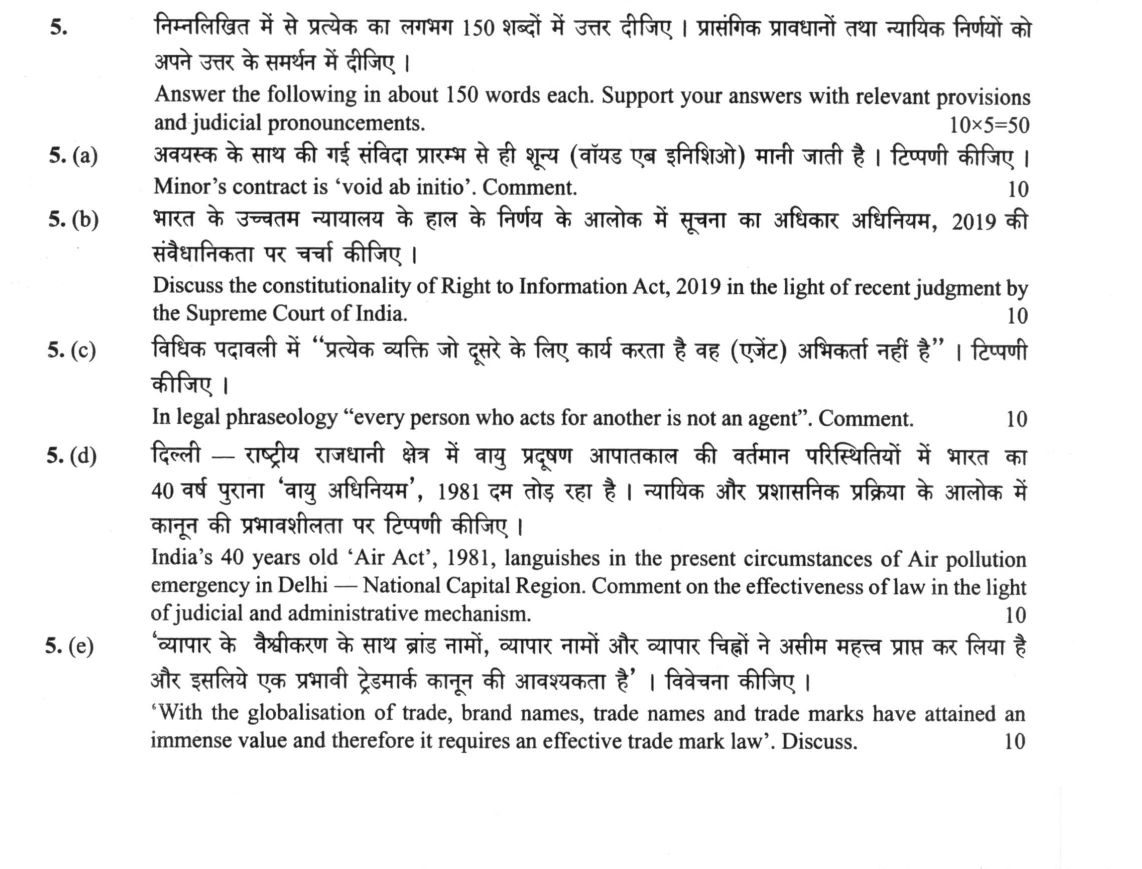
Answer the following in about 150 words each. Support your answers with relevant provisions and judicial pronouncements. 10×5=50
Minor's contract is 'void ab initio'. Comment. 10 marks
Discuss the constitutionality of Right to Information Act, 2019 in the light of recent judgment by the Supreme Court of India. 10 marks
In legal phraseology "every person who acts for another is not an agent". Comment. 10 marks
India's 40 years old 'Air Act', 1981, languishes in the present circumstances of Air pollution emergency in Delhi — National Capital Region. Comment on the effectiveness of law in the light of judicial and administrative mechanism. 10 marks
'With the globalisation of trade, brand names, trade names and trade marks have attained an immense value and therefore it requires an effective trade mark law'. Discuss. 10 marks
हिंदी में प्रश्न पढ़ें
निम्नलिखित में से प्रत्येक का लगभग 150 शब्दों में उत्तर दीजिए। प्रासंगिक प्रावधानों तथा न्यायिक निर्णयों को अपने उत्तर के समर्थन में दीजिए। 10×5=50
अवयस्क के साथ की गई संविदा प्रारंभ से ही शून्य (वॉयड एब इनिशियो) मानी जाती है। टिप्पणी कीजिए। 10
भारत के उच्चतम न्यायालय के हाल के निर्णय के आलोक में सूचना का अधिकार अधिनियम, 2019 की संवैधानिकता पर चर्चा कीजिए। 10
विधिक पदावली में "प्रत्येक व्यक्ति जो दूसरे के लिए कार्य करता है वह (एजेंट) अभिकर्ता नहीं है"। टिप्पणी कीजिए। 10
दिल्ली — राष्ट्रीय राजधानी क्षेत्र में वायु प्रदूषण आपातकाल की वर्तमान परिस्थितियों में भारत का 40 वर्ष पुराना 'वायु अधिनियम', 1981 दम तोड़ रहा है। न्यायिक और प्रशासनिक प्रक्रिया के आलोक में कानून की प्रभावशीलता पर टिप्पणी कीजिए। 10
'व्यापार के वैश्वीकरण के साथ ब्रांड नामों, व्यापार नामों और व्यापार चिह्नों ने असीम महत्व प्राप्त कर लिया है और इसलिए एक प्रभावी ट्रेडमार्क कानून की आवश्यकता है'। विवेचना कीजिए। 10
Model answer
Written by UPSC Answer Check against this question's marking rubric, to the 150-word length. UPSC does not publish answers for Mains — this is one way to score well, not an official key.
(a) Minor’s contract The statement is broadly correct but requires qualification. Under Section 11 of the Indian Contract Act, 1872, a minor is incompetent to contract, and Section 10 makes competence a condition of a valid contract. In Mohori Bibee v. Dharmodas Ghose (1903), the Privy Council held that an agreement with a minor is void ab initio, not merely voidable; it is a nullity from birth, and the minor may repudiate it at any time. “Void” and “void ab initio” are often used together, but the latter emphasises that no legal relation ever arose, so estoppel cannot bind the minor. The position is not absolute: a minor’s estate must reimburse for necessaries under Section 68, and contracts beneficial to the minor, such as employment, licence or scholarship, may be valid. Thus, while the general rule is that a minor’s contract is void ab initio, exceptions show that the law balances incapacity with practical protection.
(b) RTI Act, 2019 Right to Information is closely linked to Articles 19(1)(a) and 21, though the RTI Act, 2005 creates a statutory right. The 2019 amendments, which altered the appellate structure and the tenure, salary and service conditions of Information Commissioners, were challenged as impairing independence. In Anjali Bhardwaj v. Union of India (2023), the Supreme Court upheld the constitutional validity of the RTI (Amendment) Act, 2019, holding that the amendments do not violate Articles 14, 19(1)(a) or 21. The Court recognised that the right to information is a statutory right, but an important facet of free speech and democratic accountability. The decision is significant because it sustains the Act while leaving room for legislative regulation. Nevertheless, the judgment does not erase concerns that executive control over commissioners may weaken the institutional independence needed for effective transparency. The Act remains constitutional, but its efficacy depends on independent implementation.
(c) Agency The statement is correct. Agency is a legal relationship, not mere assistance. Section 182 of the Indian Contract Act defines an agent as a person authorised to act on behalf of a principal, and such authority must be capable of creating legal relations with third parties. In Lakshmi Narayan Ram Gopal v. State of Bombay, the Supreme Court emphasised that a person who merely performs work for another is not necessarily an agent; the decisive factor is the existence of authority to bind the principal. A servant may act under the master’s control without being an agent, while an independent contractor may perform services for another without creating agency. Similarly, a friend, volunteer or mere representative who lacks authority to negotiate or contract does not become an agent. Thus, “acting for another” is a factual description, whereas agency is a juridical status founded on authority and the capacity to affect legal relations.
(d) Air Act The Air (Prevention and Control of Pollution) Act, 1981 is not ineffective in principle, but it is inadequate in practice. Sections 19 to 22 provide penalties for contraventions, yet the penalties are low, and enforcement is fragmented among CPCA, EPCA, State Boards and local authorities. The Supreme Court in M.C. Mehta v. Union of India and the Delhi air pollution cases filled the gap by directing CNG, emission standards, closure of polluting industries and monitoring. EPCA recommendations and the Delhi-NCR Graded Response Action Plan (GRAP) have added administrative rigour by linking AQI thresholds to restrictions on construction, industry and vehicles. However, the Act lacks a comprehensive emergency framework, real-time compliance, and strong inter-state coordination. Judicial directions have been effective but episodic. The law must be modernised with stricter penalties, a unified command structure and enforceable standards to address Delhi-NCR’s recurring pollution emergencies.
(e) Trademark law Globalisation has made brand names, trade names and trademarks valuable assets, and India’s Trade Marks Act, 1999 responds to that reality. Section 2(1)(zb) defines a trademark broadly, Section 9 lays down absolute grounds for registration, and Section 11 deals with relative grounds, including conflict with earlier marks. The Supreme Court in N.R. Dongre v. Whirlpool Corporation (1996) recognised trans-border reputation, holding that a mark can acquire goodwill in India even through foreign use, preventing free-riding. Cadila Healthcare v. Cadila Pharmaceuticals (2001) strengthened the test for deceptive similarity and likelihood of confusion, especially in medicinal products. TRIPS compliance has further raised the standard by protecting well-known marks and requiring effective remedies. Passing off, a common-law tort protecting goodwill, complements statutory infringement, which is broader and does not always require proof of misrepresentation. An effective trademark law is therefore essential to protect brand value, consumer confidence and fair competition in a global market.
What "Comment" is asking you to do
Take a position on the statement and support it. Comment usually attaches to a quoted line in the short slots, so the reasoning must be compressed — an opening view, a few load-bearing reasons, and the limit of the claim.
Structure that answers it
Unpack what the statement asserts → your stance → two or three supporting reasons → the qualification that limits it
Where marks are lost
Neutral summary; a comment without a stance has not answered. Equally costly is accepting the quoted line wholesale and never testing where it fails.
How this answer will be evaluated
Approach
Framework: Issue > Rule > Authority > Application. (a) comment: context > arguments both sides > judgment > close | (b) discuss: intro > 3-4 dimensions > example > balanced close | (c) comment: context > arguments both sides > judgment > close | (d) comment: context > arguments both sides > judgment > close | (e) discuss: intro > 3-4 dimensions > example > balanced close Full marks: Precise statutory citations, relevant case law, balanced analysis, clear conclusion.
Key points expected
- Section 11, 2(g), 65 (Minor's contract)
- RTI (Amendment) Act, 2019, Article 19(1)(a), 32, 14
- Section 182, 185 (Agency)
- Air Act, 1981, Article 21, 48
- Trade Marks Act, 1999, TRIPS
Evaluation rubric
Each sub-part is marked on its own, against the marks and word limit printed on the paper.
- (a) Critique the 'void ab initio' status of minor's contracts under the Indian Contract Act. 10 marks · 150 words
comment— context → arguments both sides → judgment → close
Must cover
- Section 11 (competent to contract)
- Section 2(g) (void agreement)
- Mohan v. Lalugopal (void ab initio)
- Distinction: void vs voidable
Loses marks
- Treating minor's contract as voidable
- Ignoring Section 65 restitution
Earns more
- Kesho v. Gopal (ratification)
- Section 65 (restitution)
- Exception: contracts for benefit of minor
Extra mark
- Law Commission Report on minors' contracts
- (b) Analyze the constitutionality of the RTI (Amendment) Act, 2019 vis-à-vis the 2005 Act. 10 marks · 150 words
discuss— intro → 3-4 dimensions → example → balanced close
Must cover
- RTI (Amendment) Act, 2019
- Article 19(1)(a) (Right to Information)
- Article 32 (Writ Jurisdiction)
- Article 14 (Equality)
Loses marks
- Confusing 2005 Act with 2019 Amendment
- Ignoring Article 19(1)(a) link
Earns more
- Section 20 (Amendment) vs Section 20 (2005 Act)
- Section 18 (Amendment) vs Section 18 (2005 Act)
- Concept of 'subordinate legislation'
Extra mark
- Specific recent SC judgment on RTI
- (c) Distinguish 'acting for another' from the legal definition of an agent. 10 marks · 150 words
comment— context → arguments both sides → judgment → close
Must cover
- Section 182 (Definition of Agent)
- Section 185 (Authority of agent)
- Distinction: Agent vs Servant
- Distinction: Agent vs Messenger
Loses marks
- Equating 'acting for' with 'agency'
- Ignoring Section 182 definition
Earns more
- Distinction: Agent vs Broker
- Distinction: Agent vs Auctioneer
- Distinction: Agent vs Factor
Extra mark
- Case law on 'acting for another'
- (d) Evaluate the effectiveness of the Air (Prevention and Control of Pollution) Act, 1981. 10 marks · 150 words
comment— context → arguments both sides → judgment → close
Must cover
- Air (Prevention and Control of Pollution) Act, 1981
- Article 21 (Right to Life)
- Article 48 (State policy)
- Judicial vs Administrative mechanism
Loses marks
- Ignoring Article 21 link
- Focusing only on administrative failure
Earns more
- M.C. Mehta v. Union of India
- Vellore Citizens Welfare Forum v. Union of India
- National Green Tribunal (NGT) role
Extra mark
- Specific recent SC judgment on air pollution
- (e) Discuss the need for an effective trade mark law in the context of globalisation. 10 marks · 150 words
discuss— intro → 3-4 dimensions → example → balanced close
Must cover
- Trade Marks Act, 1999
- Definition of Trade Mark (Section 2(1)(zb))
- Globalisation and brand value
- Protection of intellectual property
Loses marks
- Ignoring globalisation context
- Focusing only on domestic law
Earns more
- TRIPS Agreement
- WIPO (World Intellectual Property Organization)
- Distinction: Trade Name vs Trade Mark
Extra mark
- Specific recent SC judgment on trade marks
Practice this exact question
Write your answer and it is marked point by point against the model answer above — what you covered, what you missed, what you got wrong.
Evaluate my answer →More from Law 2021 Paper II
- Q2 (a) Has 'Attempt' been defined anywhere in the IPC, 1860 ? What are the various tests for…
- Q3 (a) From 'Mathura' to 'Nirbhaya' and beyond, discuss the development of Rape laws in Indi…
- Q4 (a) Discuss the evolution and development of rule relating to 'No-fault liability' in Ind…
- Q5 Answer the following in about 150 words each. Support your answers with relevant provisio…
- Q6 (a) What are the various modes in which a contract may be discharged ? Explain in the lig…
- Q7 (a) Section 8 of the Arbitration and Conciliation Act, 1996 denotes a provision which lim…
- Q8 (a) Discuss the concept and classification of 'Quasi contracts' under Indian Contract Act…