Paper I — Q1
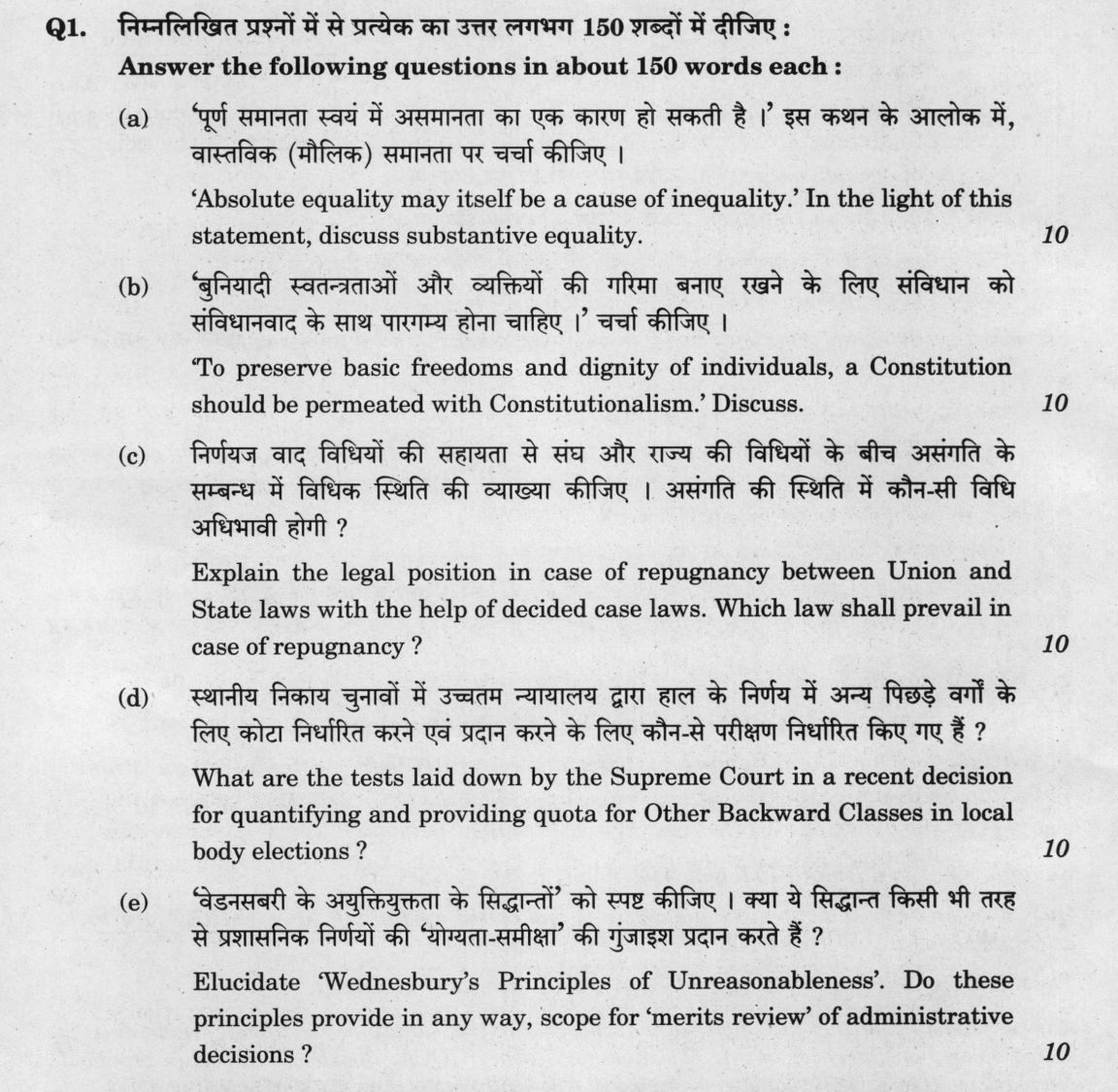
Answer the following questions in about 150 words each: (a) 'Absolute equality may itself be a cause of inequality.' In the…
Answer the following questions in about 150 words each:
'Absolute equality may itself be a cause of inequality.' In the light of this statement, discuss substantive equality. 10 marks
'To preserve basic freedoms and dignity of individuals, a Constitution should be permeated with Constitutionalism.' Discuss. 10 marks
Explain the legal position in case of repugnancy between Union and State laws with the help of decided case laws. Which law shall prevail in case of repugnancy? 10 marks
What are the tests laid down by the Supreme Court in a recent decision for quantifying and providing quota for Other Backward Classes in local body elections? 10 marks
Elucidate 'Wednesbury's Principles of Unreasonableness'. Do these principles provide in any way, scope for 'merits review' of administrative decisions? 10 marks
हिंदी में प्रश्न पढ़ें
निम्नलिखित प्रश्नों में से प्रत्येक का उत्तर लगभग 150 शब्दों में दीजिए :
'पूर्ण समानता स्वयं में असमानता का एक कारण हो सकती है।' इस कथन के आलोक में, वास्तविक (मौलिक) समानता पर चर्चा कीजिए। (10 अंक)
'बुनियादी स्वतंत्रताओं और व्यक्तियों की गरिमा बनाए रखने के लिए संविधान को संविधानवाद के साथ पारगम्य होना चाहिए।' चर्चा कीजिए। (10 अंक)
निर्णयज बाद विधियों की सहायता से संघ और राज्य की विधियों के बीच असंगति के संबंध में विधिक स्थिति की व्याख्या कीजिए। असंगति की स्थिति में कौन-सी विधि अधिभावी होगी? (10 अंक)
स्थानीय निकाय चुनावों में उच्चतम न्यायालय द्वारा हाल के निर्णय में अन्य पिछड़े वर्गों के लिए कोटा निधारित करने एवं प्रदान करने के लिए कौन-से परीक्षण निर्धारित किए गए हैं? (10 अंक)
'वेडन्सबरी के अयुक्तियुक्तता के सिद्धांतों' को स्पष्ट कीजिए। क्या ये सिद्धांत किसी भी तरह से प्रशासनिक निर्णयों की 'योग्यता-समीक्षा' की गुंजाइश प्रदान करते हैं? (10 अंक)
Model answer
Written by UPSC Answer Check against this question's marking rubric, to the 150-word length. UPSC does not publish answers for Mains — this is one way to score well, not an official key.
(a) Absolute Equality and Substantive Equality
The Aristotelian principle that justice requires treating equals equally and unequals unequally illustrates why absolute, formal equality often perpetuates structural injustice. Formal equality under Article 14 ensures equality before the law, yet applying identical standards to persons in disparate socio-economic conditions deepens existing inequalities.
To remedy this, Indian jurisprudence evolved towards substantive equality, which mandates affirmative state action to achieve real, de facto equality. The Supreme Court in E.P. Royappa v. State of Tamil Nadu dynamicized Article 14 as an antithesis to arbitrariness. In Maneka Gandhi v. Union of India, equality was linked with natural justice and fairness. Further, in Navtej Singh Johar v. Union of India, the Court embraced transformative constitutionalism, affirming that equality entails dismantling systemic hierarchies and recognizing differential vulnerabilities rather than enforcing formal sameness. Substantive equality thus legitimizes reasonable classification and protective discrimination under Articles 15 and 16, enabling the realization of egalitarian constitutional goals.
(b) Constitutionalism and the Preservation of Freedoms
A mere written Constitution does not guarantee freedom; it must be animated by 'Constitutionalism', which signifies limited government, rule of law, and checks and balances. While a Constitution establishes the legal organs of the State, Constitutionalism constitutes the normative philosophy that restrains those organs from exercising arbitrary authority, thereby safeguarding individual liberty and dignity.
Without constitutionalism, a State risks descending into majoritarian authoritarianism under the facade of constitutional legality. The Supreme Court recognized this distinction in Kesavananda Bharati v. State of Kerala, formulating the Basic Structure doctrine to prevent Parliament from destroying core constitutional principles. In I.R. Coelho v. State of Tamil Nadu, the Court reiterated that laws violating fundamental rights cannot be insulated via the Ninth Schedule, establishing that judicial review and the protection of basic freedoms form the essence of constitutionalism. Thus, constitutionalism ensures that state power serves individual dignity rather than eclipsing it.
(c) Repugnancy between Union and State Laws (Article 254)
Repugnancy arises under Article 254 when a State law and a Union law governing a subject in the Concurrent List (List III) present a direct, irreconcilable conflict. Under Article 254(1), the Union law prevails, and the State law is void to the extent of the repugnancy, unless the State law, having been reserved for the President's consideration, receives Presidential assent under Article 254(2).
In Deep Chand v. State of Uttar Pradesh, the Supreme Court laid down that repugnancy arises where there is direct conflict, where Parliament intended to occupy the entire field, or where compliance with one law results in breach of the other. In M. Karunanidhi v. Union of India, the Court held that repugnancy exists only where both provisions are fully inconsistent and cannot stand together. In T. Barai v. Henry Ah Hoe, it was affirmed that when Parliament amends or occupies a field previously occupied by a State law, the Central enactment supersedes the State enactment to that extent.
(d) Triple Test for OBC Quota in Local Bodies
The Supreme Court, in Vikas Kishanrao Gawali v. State of Maharashtra (reaffirming K. Krishna Murthy v. Union of India), held that political reservation under Articles 243D(6) and 243T(6) cannot be provided automatically on the same basis as reservations in education and public employment under Articles 15(4) and 16(4).
The Court mandated the rigorous 'triple test' before provisioning Other Backward Classes (OBC) quotas in local self-government: First, the State must set up a dedicated Commission to conduct a contemporaneous, empirical inquiry into the nature and implications of political backwardness in local bodies. Second, the State must specify the proportion of reservation required to be provisioned local body-wise in light of the Commission’s recommendations. Third, in no case shall such reservation exceed the aggregate ceiling of 50 percent of the total seats reserved in favor of SCs, STs, and OBCs combined. Absence of this empirical exercise invalidates local body OBC reservations.
(e) Wednesbury Principles and Merits Review
The principle of unreasonableness was established in Associated Provincial Picture Houses v. Wednesbury Corporation (1948). Lord Greene held that an administrative decision is subject to judicial review if the authority took into account irrelevant matters, failed to consider relevant factors, or made a decision so absurd that no sensible person could ever have dreamed that it lay within the powers of the authority. Lord Diplock in the CCSU case termed this standard 'irrationality'.
Wednesbury principles do not permit a 'merits review'. Judicial review examines the legality and fairness of the decision-making process, not the correctness of the decision itself; the court cannot substitute its view for that of the administrative authority. In Tata Cellular v. Union of India, the Supreme Court affirmed that judicial review under Wednesbury limits the court to correcting errors of law, procedural impropriety, and blatant arbitrariness, preserving administrative autonomy while restraining administrative abuse.
What "Discuss" is asking you to do
Lay the issue out from more than one side — how it arose, what is claimed for it, what is held against it, and where it now stands. UPSC attaches discuss to broad topics with several live dimensions, so coverage of the dimensions earns more than the strength of your opinion.
Structure that answers it
Set the issue up → the case as it is made → the case against → the dimension both sides leave out → where the balance now lies
Where marks are lost
Listing facts with no thread between them, or arguing one side throughout and calling it a discussion.
How this answer will be evaluated
Approach
Framework: Issue > Rule > Authority > Application. (a) discuss: intro > 3-4 dimensions > example > balanced close | (b) discuss: intro > 3-4 dimensions > example > balanced close | (c) explain: definition/context > points in order > small example > short close | (d) explain: definition/context > points in order > small example > short close | (e) explain: definition/context > points in order > small example > short close Full marks: Precise legal citations, clear distinction between concepts, direct answers to specific questions.
Key points expected
- Substantive equality vs formal equality
- Constitutionalism as rule of law
- Article 254 repugnancy rules
- Specific tests for OBC quota in local bodies
- Wednesbury unreasonableness and merits review
Evaluation rubric
Each sub-part is marked on its own, against the marks and word limit printed on the paper.
- (a) Distinguish formal from substantive equality using the prompt's paradox. 10 marks · 150 words
discuss— intro → 3-4 dimensions → example → balanced close
Must cover
- Define substantive equality (outcome-focused)
- Contrast with formal equality (form-focused)
- Explain why 'absolute equality' causes inequality
- Cite Article 14 or 15(4) context
Loses marks
- Defining equality only as 'sameness'
- Ignoring the 'absolute equality' paradox in the prompt
Earns more
- Reference to 'level playing field' concept
- Mention of positive discrimination/affirmative action
- Reference to 'equality of opportunity' vs 'equality of result'
Extra mark
- Cite Indira Sawhney or similar landmark case
- Reference to Law Commission report on equality
- (b) Link Constitutionalism to the protection of individual dignity and freedoms. 10 marks · 150 words
discuss— intro → 3-4 dimensions → example → balanced close
Must cover
- Define Constitutionalism (rule of law, limited govt)
- Connect to 'basic freedoms' (Fundamental Rights)
- Connect to 'dignity' (Article 21)
- Explain 'permeated' (pervasive nature)
Loses marks
- Treating Constitutionalism as just 'having a constitution'
- Ignoring the 'dignity' aspect of the prompt
Earns more
- Mention of Basic Structure Doctrine
- Reference to separation of powers
- Distinction between Constitution and Constitutionalism
Extra mark
- Cite Kesavananda Bharati case
- Reference to 'dignity' as a fundamental right
- (c) State the legal rule for repugnancy and identify the prevailing law. 10 marks · 150 words
explain— definition/context → points in order → small example → short close
Must cover
- Cite Article 254(1) (Union prevails)
- Cite Article 254(2) (State prevails if no Union law)
- Define 'repugnancy' (inconsistency/impossibility)
- Answer the specific question: Which law prevails?
Loses marks
- Failing to answer 'which law prevails' explicitly
- Confusing 'repugnancy' with 'inconsistency' without distinction
Earns more
- Cite V.K. Kapur v. State of UP
- Cite Zee Telefilms v. Union of India
- Mention 'field' of legislation (List I vs II)
Extra mark
- Reference to 'implied repeal' doctrine
- Mention of specific case on 'inconsistency' test
- (d) List the specific tests for OBC quota in local body elections. 10 marks · 150 words
explain— definition/context → points in order → small example → short close
Must cover
- Identify the 'recent decision' (case name)
- List the specific tests for quantification
- Mention the context of local body elections
- Explain the 'quota' aspect
Loses marks
- Generalizing about OBC quota without specific tests
- Ignoring the 'local body' context
Earns more
- Reference to 'social and educational backwardness'
- Mention of 'creamy layer' exclusion
- Reference to 102nd/103rd Amendment context
Extra mark
- Cite specific 2023/2024 judgment name
- Reference to specific High Court/SC order
- (e) Explain Wednesbury unreasonableness and its scope for merits review. 10 marks · 150 words
explain— definition/context → points in order → small example → short close
Must cover
- Define Wednesbury unreasonableness (irrationality)
- Explain the 'no reasonable authority' test
- Address the 'merits review' question directly
- Distinguish from 'reasonableness' in general
Loses marks
- Confusing Wednesbury with 'reasonableness' generally
- Failing to address the 'merits review' question
Earns more
- Cite Council of Civil Service v. Minister for the Civil Service
- Mention 'proportionality' as a modern development
- Reference to 'intensity of review'
Extra mark
- Cite specific case on 'merits review' scope
- Reference to 'structured proportionality' test
Practice this exact question
Write your answer and it is marked point by point against the model answer above — what you covered, what you missed, what you got wrong.
Evaluate my answer →More from Law 2022 Paper I
- Q1 Answer the following questions in about 150 words each: (a) 'Absolute equality may itself…
- Q2 (a) "Amending power does not extend to damaging or destroying the basic structure or fram…
- Q3 (a) Can the constitutional head of the State be truly described as the nerve-centre of th…
- Q4 (a) In the Parliamentary system, though there is no separation between the legislature an…