Paper I — Q7
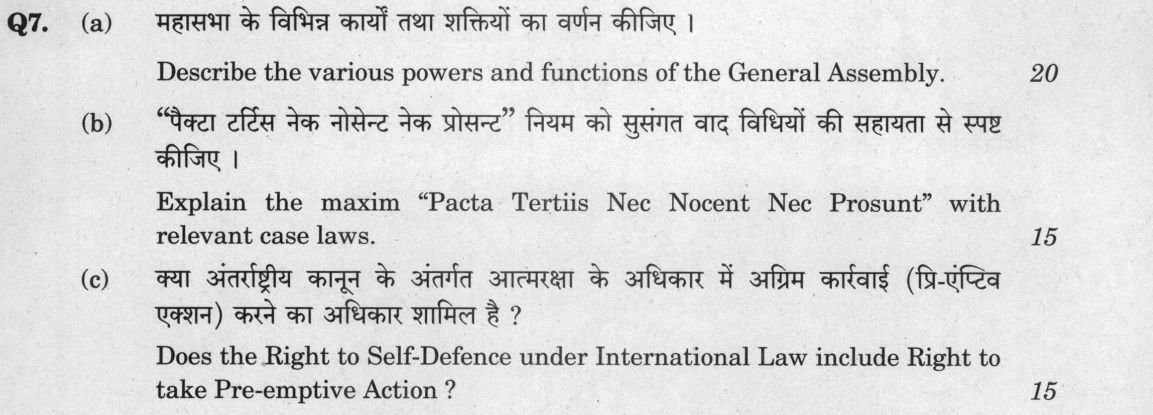
(a) Describe the various powers and functions of the General Assembly. (20 marks) (b) Explain the maxim "Pacta Tertiis Nec…
Describe the various powers and functions of the General Assembly. 20 marks
Explain the maxim "Pacta Tertiis Nec Nocent Nec Prosunt" with relevant case laws. 15 marks
Does the Right to Self-Defence under International Law include Right to take Pre-emptive Action? 15 marks
हिंदी में प्रश्न पढ़ें
महासभा के विभिन्न कार्यों तथा शक्तियों का वर्णन कीजिए। (20 अंक)
"पैक्टा टर्टिस नेक नोसेंट नेक प्रोसुंट" नियम को सुसंगत वाद विधियों की सहायता से स्पष्ट कीजिए। (15 अंक)
क्या अंतर्राष्ट्रीय कानून के अंतर्गत आत्मरक्षा के अधिकार में अग्रिम कार्रवाई (प्रि-एंप्टिव एक्शन) करने का अधिकार शामिल है? (15 अंक)
Model answer
Written by UPSC Answer Check against this question's marking rubric, to the expected length. UPSC does not publish answers for Mains — this is one way to score well, not an official key.
General Assembly The General Assembly is the UN’s principal deliberative organ. Under Articles 10–17 and related provisions, it may discuss any matter within the Charter and make recommendations, except when a matter is before the Security Council. It initiates studies, reports, and recommends measures for peaceful settlement. It considers Security Council and ICJ reports (Arts. 15–16). It controls the budget, assesses contributions, and may suspend voting rights for arrears. It recommends admission of new members, elects non-permanent Security Council members, and, with the Security Council, elects ICJ judges concurrently and independently, not jointly. Its resolutions are generally recommendatory, not binding; exceptions arise in internal UN matters such as budget decisions and elections. The Uniting for Peace Resolution 377(V) (1950) allowed it, in emergency special session, to recommend collective measures, including force, if the Security Council is paralysed. Its significance is political and normative, not a conversion of recommendations into binding obligations. Its recommendations may influence customary law and state practice.
Pacta tertiis Pacta tertiis nec nocent nec prosunt means a treaty neither creates obligations nor confers rights for a third state without consent. It is customary law codified in VCLT Articles 34–38. Article 34 states the rule; Articles 35–37 allow limited third-party beneficiary or intervener effects where the treaty intends them and the third state accepts. It distinguishes objective regimes, creating general norms for all states, from subjective regimes regulating only parties. Objective regimes may include human rights or environmental treaties with erga omnes-like effects. In Free Zones of Upper Savoy and Gex (PCIJ 1932), Switzerland could not claim rights under a France–Sardinia treaty. In Reparation for Injuries (ICJ 1949), the UN’s rights derived from the Charter, not automatically from member-state treaties. In North Sea Continental Shelf (ICJ 1969), the 1958 Convention did not bind Germany as a non-party. Nuclear Tests (ICJ 1974) is not a pacta tertiis exception; it shows France’s unilateral declarations could bind France, but did not create erga omnes obligations or third-state treaty rights.
Self-defence Article 51 preserves inherent individual or collective self-defence after an armed attack, until the Security Council acts. The Caroline formula (1837) requires necessity to be instant, overwhelming, and leave no choice of means or moment for deliberation, with proportionate response. The Caroline standard remains the customary baseline. Modern parameters are necessity, proportionality, and immediacy/imminence. Pre-emptive action against an imminent concrete armed attack may be defensible narrowly; preventive action against speculative threats is generally unlawful. In Nicaragua (ICJ 1986), self-defence required an armed attack of significant scale and did not cover mere support to insurgents. In Oil Platforms (ICJ 2003), the Court again tied self-defence to armed attack and proportionality. The 2003 Iraq intervention was widely treated as preventive, not lawful self-defence, because the threat was not imminent and the Security Council had not authorised force. Israel’s 1981 Osirak strike was strongly condemned by Security Council Resolution 487(1981) as a clear violation of the Charter, not a lawful pre-emptive act. The post-9/11 Bush Doctrine, advocating anticipatory force against imminent threats, was rejected by many states and not codified; some accommodate narrow imminence, but preventive self-defence remains controversial. India supports a narrow Article 51 position, invoking self-defence against cross-border terrorism after armed attacks, while rejecting broad preventive force; its 2019 Balakot strikes are framed as self-defence but remain legally contested. India’s position is relevant to debates on state-sponsored terrorism.
These areas intersect: the Assembly’s recommendatory role shapes norms, pacta tertiis limits treaty effects to consent, and self-defence is constrained by armed attack, necessity, and proportionality, preserving the Charter’s balance between sovereignty and collective security.
What "Describe" is asking you to do
Give a full, ordered account of the thing named — its parts, stages or mechanism — in the sequence in which it actually exists or occurs. Most describe questions come from the science optionals, where the marks sit in correct technical detail and, where the stem says so, a labelled diagram.
Structure that answers it
One-line identification of the subject → the parts or stages in their real order, each with its defining detail → labelled diagram where the subject is structural → closing line on function or significance
Where marks are lost
Loose general prose where the examiner is ticking named parts, correct terminology and their sequence; and in the General Studies papers, turning to evaluation before the description is finished.
How this answer will be evaluated
Approach
Framework: Issue > Rule > Authority > Application. (a) describe: define > structure or process in order > labelled diagram > significance | (b) explain: definition/context > points in order > small example > short close | (c) comment: context > arguments both sides > judgment > close Full marks: Precise legal terminology, accurate case citations, and clear application of principles to the specific question.
Key points expected
- Define GA as principal deliberative organ (Art 7)
- Distinguish legislative vs. advisory powers
- Cite specific functions (budget, membership, resolutions)
- Mention limitations (non-binding nature of resolutions)
- Define 'Pacta Tertiis Nec Nocent Nec Prosunt'
- Explain the principle of treaty relativity
- Cite relevant case law (e.g., Lotus case)
- Apply principle to the specific case facts
Evaluation rubric
Each sub-part is marked on its own, against the marks and word limit printed on the paper.
- (a) Define GA, structure, and categorize powers/functions with examples. 20 marks
describe— define → structure or process in order → labelled diagram → significance
Must cover
- Define GA as principal deliberative organ (Art 7)
- Distinguish legislative vs. advisory powers
- Cite specific functions (budget, membership, resolutions)
- Mention limitations (non-binding nature of resolutions)
Loses marks
- Confusing GA powers with Security Council powers
- Listing functions without categorization
- Ignoring the advisory nature of most resolutions
Earns more
- Reference to UN Charter Articles 10-14
- Mention of 'Uniting for Peace' resolution
- Distinction between GA and Security Council roles
Extra mark
- Reference to recent significant GA resolutions
- Mention of 'Uniting for Peace' mechanism
- (b) Define maxim, explain its meaning, and apply to case laws. 15 marks
explain— definition/context → points in order → small example → short close
Must cover
- Define 'Pacta Tertiis Nec Nocent Nec Prosunt'
- Explain the principle of treaty relativity
- Cite relevant case law (e.g., Lotus case)
- Apply principle to the specific case facts
Loses marks
- Defining the maxim incorrectly
- Citing cases without explaining their relevance
- Failing to apply the principle to the specific context
Earns more
- Reference to Article 34 of Vienna Convention
- Mention of exceptions (jus cogens, customary law)
- Clear distinction between 'nec nocent' and 'nec prosunt'
Extra mark
- Reference to specific dissenting opinions in cited cases
- Mention of modern developments in treaty law
- (c) Analyze if self-defense includes pre-emptive action, citing authority. 15 marks
comment— context → arguments both sides → judgment → close
Must cover
- Define Right to Self-Defence (Art 51)
- Distinguish between 'pre-emptive' and 'preventive' action
- Cite relevant authority (e.g., Caroline test, ICJ cases)
- Provide a balanced judgment on the inclusion
Loses marks
- Conflating 'pre-emptive' with 'preventive' without distinction
- Failing to cite Article 51 of the UN Charter
- Providing a one-sided argument without balancing
Earns more
- Reference to the 'Caroline' test (imminence, necessity)
- Mention of the ICJ's stance in the Nicaragua case
- Discussion of the 'imminence' requirement
Extra mark
- Reference to post-9/11 debates on preventive war
- Mention of specific UN Security Council resolutions
Practice this exact question
Write your answer and it is marked point by point against the model answer above — what you covered, what you missed, what you got wrong.
Evaluate my answer →More from Law 2022 Paper I
- Q4 (a) In the Parliamentary system, though there is no separation between the legislature an…
- Q5 Answer the following questions in about 150 words each: (a) Keeping in view the growth of…
- Q6 (a) Critically examine various theories relating to the relationship between Internationa…
- Q7 (a) Describe the various powers and functions of the General Assembly. (20 marks) (b) Exp…
- Q8 (a) When is an aircraft considered to be 'in flight' for the purposes of the Convention f…