Paper I — Q8
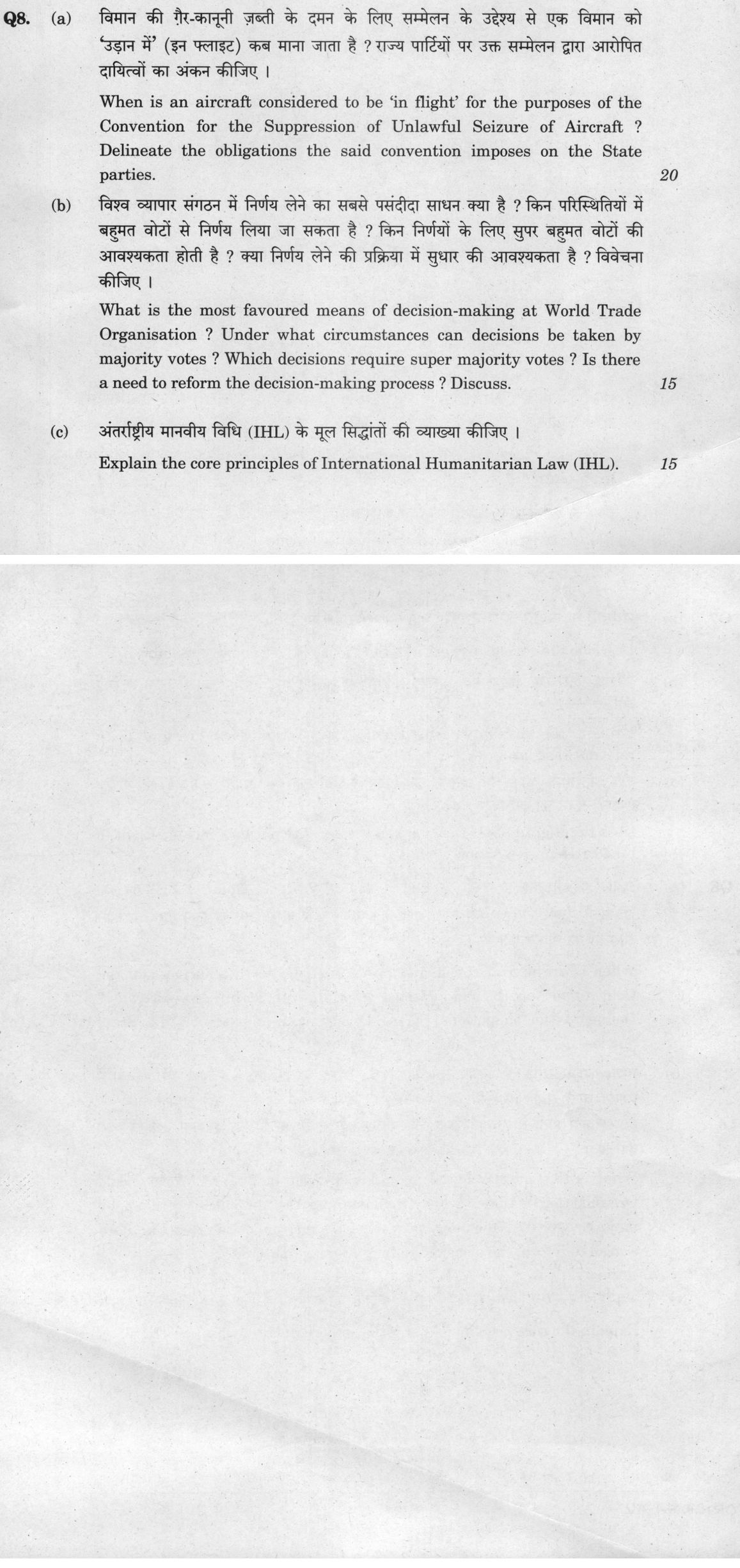
(a) When is an aircraft considered to be 'in flight' for the purposes of the Convention for the Suppression of Unlawful Seizure…
When is an aircraft considered to be 'in flight' for the purposes of the Convention for the Suppression of Unlawful Seizure of Aircraft? Delineate the obligations the said convention imposes on the State parties. 20 marks
What is the most favoured means of decision-making at World Trade Organisation? Under what circumstances can decisions be taken by majority votes? Which decisions require super majority votes? Is there a need to reform the decision-making process? Discuss. 15 marks
Explain the core principles of International Humanitarian Law (IHL). 15 marks
हिंदी में प्रश्न पढ़ें
विमान की गैर-कानूनी जब्ती के दमन के लिए सम्मेलन के उद्देश्य से एक विमान को 'उड़ान में' (इन फ्लाइट) कब माना जाता है? राज्य पार्टियों पर उक्त सम्मेलन द्वारा आरोपित दायित्वों का अंकन कीजिए। (20 अंक)
विश्व व्यापार संगठन में निर्णय लेने का सबसे पसंदीदा साधन क्या है? किन परिस्थितियों में बहुमत वोटों से निर्णय लिया जा सकता है? किन निर्णयों के लिए सुपर बहुमत वोटों की आवश्यकता होती है? क्या निर्णय लेने की प्रक्रिया में सुधार की आवश्यकता है? विवेचना कीजिए। (15 अंक)
अंतर्राष्ट्रीय मानवीय विधि (IHL) के मूल सिद्धांतों की व्याख्या कीजिए। (15 अंक)
Model answer
Written by UPSC Answer Check against this question's marking rubric, to the expected length. UPSC does not publish answers for Mains — this is one way to score well, not an official key.
In flight and State obligations. Under the Hague Convention 1970, Article 3 defines ‘in flight’ as from external doors closed after boarding until any door opened for disembarkation. Article 2 requires preventive measures. Article 4(1) requires jurisdiction where the offence is on board an aircraft registered in that State; where the aircraft lands there with the offender on board; or where it was leased without crew to a lessee whose principal place of business, or if none, permanent residence, is there. Article 5 requires the State where the offender is found to take custody and investigate if it has jurisdiction, or promptly decide whether to prosecute. Article 6(1) permits custody or other measures to ensure presence. If the State does not prosecute, Article 7 imposes aut dedere aut judicare: it must surrender the person for prosecution. Article 8 makes it extraditable; Article 10 requires mutual assistance; Article 11 requires ICAO reporting; Article 12 requires information. Article 9(1) obliges all Contracting States, not only the territorial State, to take appropriate measures to restore control of the aircraft to its lawful commander. Unlike the Tokyo Convention 1963, which addresses unlawful acts on board and the landing State’s powers, and the Montreal Convention 1971, which targets violent acts against aviation safety, the Hague Convention is centred on seizure. India implements it through the Aircraft (Prevention of Unlawful Seizure) Act, 1982, amended in 2016, which gives jurisdiction on registration, landing, lease, nationality or presence links, not pure universal jurisdiction.
WTO decision-making. The most favoured means is consensus under Article IX:1: a decision is valid if no Member formally objects. Formal voting is a fallback when consensus fails. Majority/supermajority apply in specified cases: waivers of obligations require three-fourths of Members (Article IX:2); accessions require two-thirds (Article XII); amendments to most provisions require two-thirds and bind only accepting Members (Article X), while amendments to basic/constitutional provisions such as MFN, national treatment, rules of origin, institutional provisions and dispute settlement require ratification by all Members. The problem is that consensus can become paralysis, as in the Doha Development Round, where any single objection blocked progress. Reforms proposed include critical-mass or plurilateral agreements among willing Members, and in some discussions weighted voting or qualified voting for narrow technical issues. India supports preserving consensus and special and differential treatment, opposes erosion of developing-country flexibility, and insists that any reform should not undermine food security, public health and S&D rights.
IHL principles. IHL regulates conduct of hostilities. Its core principles are distinction, proportionality, military necessity and humanity. Distinction requires parties to distinguish civilians/civilian objects from combatants/military objectives and direct attacks only at the latter. Proportionality prohibits attacks expected to cause civilian harm excessive in relation to concrete and direct military advantage. Military necessity permits only measures required to defeat the enemy, not unnecessary destruction. Humanity, reflected in the Martens Clause, imposes limits of public conscience, humanity and requirements of public morality even where rules are silent. These principles derive from the Geneva Conventions 1949 and Additional Protocols 1977, and customary IHL. In contemporary conflict, drones, cyber operations and non-state armed groups test them: remote strikes require real-time distinction and proportionality; cyber attacks may be use of force or hostilities; non-state groups must still respect IHL. India, a party to the Geneva Conventions, supports IHL and customary law but has not ratified Additional Protocol I; it emphasises compliance with IHL in counter-terrorism and internal security while protecting civilians. Together, these regimes show that international law depends on precise triggers, collective rules and limiting norms; their value now lies in aviation-security cooperation, WTO reform and IHL compliance in asymmetric warfare.
What "Explain" is asking you to do
Make the working of something clear — what sets it off, what follows from what, and what it produces. Explain is the Commission's mechanism word: it dominates the technical papers and the “explain why” stems, where the marks sit in the causal chain and not in the label.
Structure that answers it
State what it is → the initiating condition → the chain of cause, step by step → an instance where it plays out → what the chain produces
Where marks are lost
Describing what something looks like instead of why it works that way. Naming the stages without linking them reads as description too.
How this answer will be evaluated
Approach
Framework: Issue > Rule: statute or Article > Authority > Application and conclusion. (a) describe: define > structure or process in order > labelled diagram > significance | (b) discuss: intro > 3-4 dimensions > example > balanced close | (c) explain: definition/context > points in order > small example > short close Full marks: Precise Article citations, clear distinction between concepts, and balanced discussion of reform/limitations.
Key points expected
- Cite Article 3(2) definition of 'in flight'
- Obligation to establish criminal jurisdiction (Art 4)
- Obligation to prosecute or extradite (Art 7)
- Obligation to provide mutual legal assistance (Art 8)
- Identify 'consensus' as the primary method
- Explain 'negative consensus' (no formal vote)
- Cite Article IX:2 for majority voting (2/3 majority)
- Cite Article IX:3 for super-majority (3/4) on waivers
Evaluation rubric
Each sub-part is marked on its own, against the marks and word limit printed on the paper.
- (a) Define 'in flight' under the 1970 Hague Convention and list State party obligations. 20 marks
describe— define → structure or process in order → labelled diagram → significance
Must cover
- Cite Article 3(2) definition of 'in flight'
- Obligation to establish criminal jurisdiction (Art 4)
- Obligation to prosecute or extradite (Art 7)
- Obligation to provide mutual legal assistance (Art 8)
Loses marks
- Confusing 'in flight' with 'in service'
- Failing to distinguish extradition from prosecution
- Vague description of jurisdiction without Article numbers
Earns more
- Mention of 'landing' as end of flight
- Distinction from 1963 Tokyo Convention
- Reference to 'unlawful seizure' definition
Extra mark
- Citation of a specific case applying the Hague Convention
- Reference to ICAO Annex 17 security standards
- (b) Explain WTO decision-making methods, majority voting rules, and reform needs. 15 marks
discuss— intro → 3-4 dimensions → example → balanced close
Must cover
- Identify 'consensus' as the primary method
- Explain 'negative consensus' (no formal vote)
- Cite Article IX:2 for majority voting (2/3 majority)
- Cite Article IX:3 for super-majority (3/4) on waivers
Loses marks
- Confusing WTO voting with UN General Assembly voting
- Failing to distinguish between 2/3 and 3/4 majorities
- Ignoring the role of consensus in practice
Earns more
- Mention of 'constructive engagement' in negotiations
- Reference to the 'Singapore Ministerial Declaration'
- Discussion of the 'Green Room' process
Extra mark
- Reference to the 'MacBride Report' on WTO governance
- Citation of a specific WTO dispute settlement case
- (c) Outline the core principles of International Humanitarian Law (IHL). 15 marks
explain— definition/context → points in order → small example → short close
Must cover
- Principle of Distinction (combatants vs civilians)
- Principle of Proportionality (military advantage vs civilian harm)
- Principle of Military Necessity (only necessary force)
- Principle of Humanity (limiting suffering)
Loses marks
- Confusing IHL with International Human Rights Law
- Failing to define 'proportionality' correctly
- Listing principles without explaining their application
Earns more
- Reference to the 'Martens Clause'
- Mention of 'jus in bello' vs 'jus ad bellum'
- Citation of the Geneva Conventions or Hague Regulations
Extra mark
- Reference to the 'ICRC' as a guardian of IHL
- Citation of a specific ICJ advisory opinion on IHL
Practice this exact question
Write your answer and it is marked point by point against the model answer above — what you covered, what you missed, what you got wrong.
Evaluate my answer →More from Law 2022 Paper I
- Q5 Answer the following questions in about 150 words each: (a) Keeping in view the growth of…
- Q6 (a) Critically examine various theories relating to the relationship between Internationa…
- Q7 (a) Describe the various powers and functions of the General Assembly. (20 marks) (b) Exp…
- Q8 (a) When is an aircraft considered to be 'in flight' for the purposes of the Convention f…