Paper I — Q5
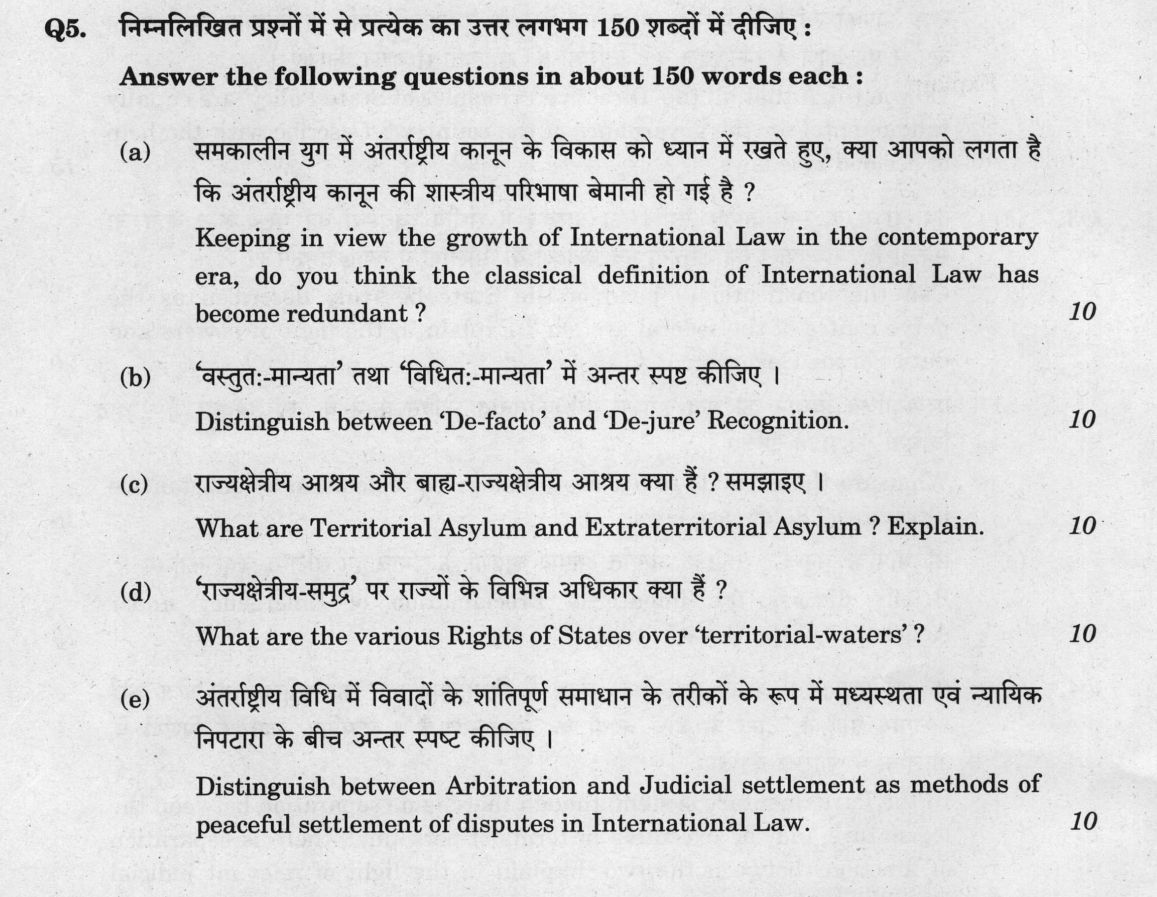
Answer the following questions in about 150 words each: (a) Keeping in view the growth of International Law in the contemporary…
Answer the following questions in about 150 words each:
Keeping in view the growth of International Law in the contemporary era, do you think the classical definition of International Law has become redundant? 10 marks
Distinguish between 'De-facto' and 'De-jure' Recognition. 10 marks
What are Territorial Asylum and Extraterritorial Asylum? Explain. 10 marks
What are the various Rights of States over 'territorial-waters'? 10 marks
Distinguish between Arbitration and Judicial settlement as methods of peaceful settlement of disputes in International Law. 10 marks
हिंदी में प्रश्न पढ़ें
निम्नलिखित प्रश्नों में से प्रत्येक का उत्तर लगभग 150 शब्दों में दीजिए :
समकालीन युग में अंतर्राष्ट्रीय कानून के विकास को ध्यान में रखते हुए, क्या आपको लगता है कि अंतर्राष्ट्रीय कानून की शास्त्रीय परिभाषा बेमानी हो गई है? (10 अंक)
'वस्तुतः-मान्यता' तथा 'विधितः-मान्यता' में अंतर स्पष्ट कीजिए। (10 अंक)
राज्यक्षेत्रीय आश्रय और बाह्य-राज्यक्षेत्रीय आश्रय क्या हैं? समझाइए। (10 अंक)
'राज्यक्षेत्रीय-समुद्र' पर राज्यों के विभिन्न अधिकार क्या हैं? (10 अंक)
अंतर्राष्ट्रीय विधि में विवादों के शांतिपूर्ण समाधान के तरीकों के रूप में मध्यस्थता एवं न्यायिक निपटारा के बीच अंतर स्पष्ट कीजिए। (10 अंक)
Model answer
Written by UPSC Answer Check against this question's marking rubric, to the 150-word length. UPSC does not publish answers for Mains — this is one way to score well, not an official key.
(a) Classical Definition of International Law and Contemporary Growth
Lassa Oppenheim classically defined International Law as the body of customary and treaty rules considered legally binding by civilized States in their intercourse with each other. This traditional doctrine treated sovereign states as the exclusive subjects of international law.
In the contemporary era, this classical formulation is not completely redundant, but it is incomplete. State sovereignty remains foundational, yet the subjects of international law have expanded substantially. Today, international legal personality extends to international organizations (UN, WTO), individuals (under International Human Rights Law and International Criminal Law), multinational corporations, and non-state actors. Furthermore, instruments such as the International Law Commission’s Articles on State Responsibility (notably Article 3, affirming the autonomy of international characterization over domestic law) and the proliferation of non-binding "soft law" instruments regulate matters far beyond inter-state relations, including climate change and global trade. Thus, the classical definition has evolved from an exclusive inter-state compact into a pluralistic, transnational legal order.
(b) Distinction between 'De-facto' and 'De-jure' Recognition
Recognition is the formal acknowledgment by an existing state of the international personality of a new state or government. The key distinctions are:
Nature and Permanence: De-facto recognition is provisional, conditional, and revocable. It is granted when an authority exercises effective control over territory, but doubts remain regarding its permanence. In contrast, de-jure recognition is definitive, complete, and irrevocable, granted when the state fulfills all legal criteria of statehood with established permanence.
Diplomatic Relations and Privileges: De-facto recognition creates informal or limited official relations, often lacking full diplomatic immunities and the capacity to conclude comprehensive bilateral treaties. De-jure recognition automatically accords full diplomatic exchange, complete diplomatic immunities, and treaty-making capacity.
Property and State Succession: A de-jure recognized entity enjoys full rights of state succession over public property situated within the recognizing state's jurisdiction, whereas a de-facto recognized entity's claims are limited and contested.
Illustration: The United Kingdom granted de-facto recognition to the Soviet Government in 1921 via a trade agreement, but delayed de-jure recognition until 1924 once the regime demonstrated political stability.
(c) Territorial Asylum and Extraterritorial Asylum
Asylum refers to the protection and shelter granted by a sovereign state to an individual fleeing persecution.
Territorial Asylum: It is granted by a state within its own physical borders. Flowing directly from territorial sovereignty, every state possesses the plenary right to admit or exclude aliens. It is recognized under Article 14 of the Universal Declaration of Human Rights (UDHR, 1948) and the 1951 Convention Relating to the Status of Refugees, anchored in the customary principle of non-refoulement.
Extraterritorial Asylum: Also known as diplomatic asylum, it is granted outside the physical territory of the asylum-granting state, specifically within its diplomatic missions, consulates, or warships located inside the territory of a foreign host state. Because this acts as an exceptional derogation from the host state's territorial sovereignty, it is not recognized as a general rule of customary international law (as affirmed by the International Court of Justice in the Asylum Case (Colombia v. Peru)). It exists primarily as a regional custom, codified under the Latin American Caracas Convention on Diplomatic Asylum (1954).
(d) Rights of States over Territorial Waters
Under the United Nations Convention on the Law of the Sea (UNCLOS, 1982) and customary international law, a coastal state exercises sovereignty over its territorial sea up to 12 nautical miles, covering the waters, airspace, seabed, and subsoil. The principal rights include:
Right of Innocent Passage (Article 17): While foreign vessels enjoy the right of innocent passage, the coastal state has the right to regulate it for safety and environmental protection, and may temporarily suspend it for security reasons (Article 25).
Jurisdictional Rights: The coastal state exercises criminal and civil jurisdiction over offences committed aboard foreign vessels within its waters if the consequences of the crime disturb the peace of the port or extend to the coastal state (reflecting the territorial principle in the SS Lotus case).
Right of Hot Pursuit (Article 111): The coastal state may pursue and arrest foreign vessels that violate its laws within its territorial waters or Contiguous Zone (Article 33).
Resource Exploitation: Exclusive sovereign rights to exploit living and mineral resources within these waters. In India, these rights are enacted under the Territorial Waters, Continental Shelf, EEZ and other Maritime Zones Act, 1976 (originating in the Territorial Waters Order, 1967).
(e) Distinction between Arbitration and Judicial Settlement
Both arbitration and judicial settlement are peaceful, binding methods of dispute resolution under Article 33 of the UN Charter, but they differ fundamentally in structure, procedure, and jurisdiction:
Composition and Tribunal Selection: In arbitration, the disputing parties select the arbitrators and determine the composition of an ad hoc tribunal or utilize institutional rosters like the Permanent Court of Arbitration (PCA), as seen in the Alabama Claims arbitration. In judicial settlement, cases are heard by a pre-constituted, permanent body of judges whose composition the parties cannot alter (such as the ICJ or ITLOS).
Procedure and Applicable Law: In arbitration, the parties retain autonomy to set procedural rules and specify the applicable law (or authorize decisions ex aequo et bono). In judicial settlement, procedures, evidence rules, and substantive laws are predetermined by statutory codes (e.g., Article 38 of the ICJ Statute).
Jurisdictional Basis: Arbitration relies exclusively on specific party consent through a compromis or arbitral clause. Judicial settlement can proceed on compulsory jurisdiction, such as declarations made under the Optional Clause of Article 36(2) of the ICJ Statute.
Precedent: Judicial settlements produce an institutional body of jurisprudence, whereas arbitral awards bind strictly the parties to that specific proceeding.
What "Distinguish" is asking you to do
Name the property that separates the items and say which side holds it. Distinguish is marked exactly as differentiate is, with no difference in expectation, but its stems more often line up three terms rather than two — gender equality, gender equity and empowerment — and every pair in the set has to be separated.
Structure that answers it
The category they all sit in → the property dividing the first pair → the second pair → the third → why the boundary matters in practice
Where marks are lost
Separating the two obviously different items and leaving the middle term unplaced. A description of each side from which the line must be inferred is marked as description, not as a distinction.
How this answer will be evaluated
Approach
Framework: Issue > Rule > Authority > Application. (a) discuss: intro > 3-4 dimensions > example > balanced close | (b) compare: paired headings or table > key differences > significance > conclusion | (c) explain: definition/context > points in order > small example > short close | (d) explain: definition/context > points in order > small example > short close | (e) compare: paired headings or table > key differences > significance > conclusion Full marks: Precise definitions, clear distinctions, relevant case law, balanced conclusion.
Key points expected
- Classical definition vs contemporary growth
- De-facto vs De-jure recognition
- Territorial vs Extraterritorial Asylum
- Rights over territorial waters
- Arbitration vs Judicial settlement
Evaluation rubric
Each sub-part is marked on its own, against the marks and word limit printed on the paper.
- (a) Evaluate if classical definition is redundant given contemporary growth. 10 marks · 150 words
discuss— intro → 3-4 dimensions → example → balanced close
Must cover
- Define classical definition (state-centric)
- Identify contemporary growth areas (human rights, environment)
- Mention role of international organizations
- Conclude on redundancy vs evolution
Loses marks
- Defining IL without addressing 'redundancy'
- Ignoring the 'contemporary era' context
Earns more
- Cite ICJ or UN Charter references
- Mention 'soft law' or non-state actors
Extra mark
- Reference specific recent ICJ judgment
- Mention Law Commission report on IL
- (b) Distinguish De-facto and De-jure recognition. 10 marks · 150 words
compare— paired headings or table → key differences → significance → conclusion
Must cover
- Define De-facto recognition (provisional)
- Define De-jure recognition (permanent)
- Contrast legal consequences of each
- Mention revocability of De-facto
Loses marks
- Defining without distinguishing consequences
- Confusing 'recognition' with 'diplomatic relations'
Earns more
- Cite specific case law on recognition
- Mention 'Tehran Case' (1928) if verified
Extra mark
- Reference specific ICJ judgment on recognition
- Mention specific treaty on recognition
- (c) Explain Territorial and Extraterritorial Asylum. 10 marks · 150 words
explain— definition/context → points in order → small example → short close
Must cover
- Define Territorial Asylum (within state)
- Define Extraterritorial Asylum (embassies)
- Mention 'Asylum Case' (ICJ 1950)
- Contrast legal status of both
Loses marks
- Defining without explaining legal basis
- Ignoring the 'Extraterritorial' aspect
Earns more
- Mention '1954 Caracas Convention' if verified
- Cite specific ICJ ruling on extraterritoriality
Extra mark
- Reference specific recent ICJ judgment
- Mention specific treaty on asylum
- (d) List rights of states over territorial waters. 10 marks · 150 words
explain— definition/context → points in order → small example → short close
Must cover
- Define territorial waters (12 nm)
- Mention '1958 Geneva Convention'
- List rights: navigation, fishing, law enforcement
- Mention 'innocent passage' exception
Loses marks
- Listing rights without legal basis
- Ignoring the 'innocent passage' exception
Earns more
- Cite specific ICJ case on territorial waters
- Mention 'UNCLOS' (1982) provisions
Extra mark
- Reference specific recent ICJ judgment
- Mention specific treaty on territorial waters
- (e) Distinguish Arbitration and Judicial settlement. 10 marks · 150 words
compare— paired headings or table → key differences → significance → conclusion
Must cover
- Define Arbitration (ad hoc)
- Define Judicial settlement (permanent court)
- Contrast composition of tribunal
- Mention binding nature of both
Loses marks
- Defining without distinguishing composition
- Ignoring the 'binding' nature of both
Earns more
- Cite specific ICJ case on arbitration
- Mention 'Permanent Court of Arbitration'
Extra mark
- Reference specific recent ICJ judgment
- Mention specific treaty on arbitration
Practice this exact question
Write your answer and it is marked point by point against the model answer above — what you covered, what you missed, what you got wrong.
Evaluate my answer →More from Law 2022 Paper I
- Q2 (a) "Amending power does not extend to damaging or destroying the basic structure or fram…
- Q3 (a) Can the constitutional head of the State be truly described as the nerve-centre of th…
- Q4 (a) In the Parliamentary system, though there is no separation between the legislature an…
- Q5 Answer the following questions in about 150 words each: (a) Keeping in view the growth of…
- Q6 (a) Critically examine various theories relating to the relationship between Internationa…
- Q7 (a) Describe the various powers and functions of the General Assembly. (20 marks) (b) Exp…
- Q8 (a) When is an aircraft considered to be 'in flight' for the purposes of the Convention f…