Paper I — Q3
(a) Can the constitutional head of the State be truly described as the nerve-centre of the federal system? Explain in the light…
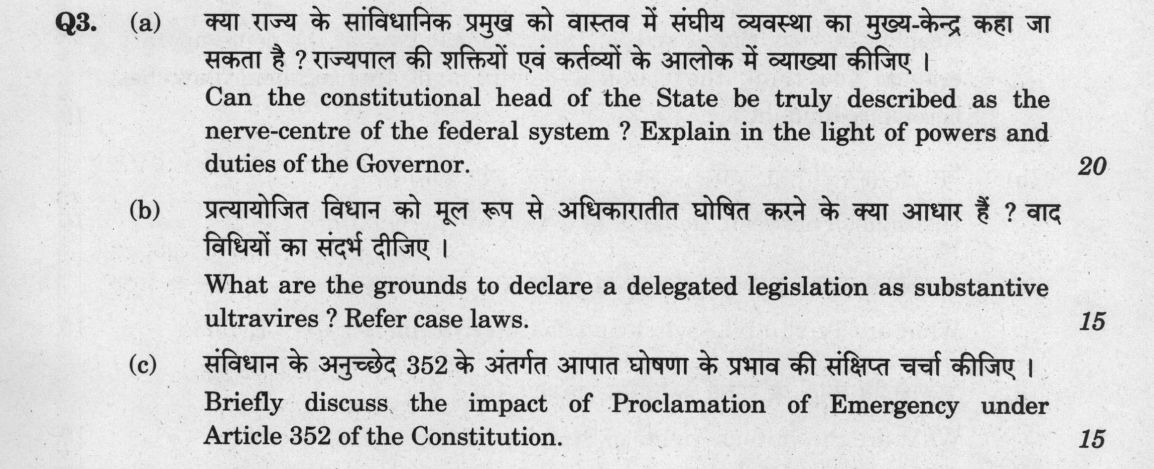
Can the constitutional head of the State be truly described as the nerve-centre of the federal system? Explain in the light of powers and duties of the Governor. 20 marks
What are the grounds to declare a delegated legislation as substantive ultravires? Refer case laws. 15 marks
Briefly discuss the impact of Proclamation of Emergency under Article 352 of the Constitution. 15 marks
हिंदी में प्रश्न पढ़ें
क्या राज्य के सांविधानिक प्रमुख को वास्तव में संघीय व्यवस्था का मुख्य-केंद्र कहा जा सकता है? राज्यपाल की शक्तियों एवं कर्तव्यों के आलोक में व्याख्या कीजिए। (20 अंक)
प्रत्यायोजित विधान को मूल रूप से अधिकारातीत घोषित करने के क्या आधार हैं? वाद विधियों का संदर्भ दीजिए। (15 अंक)
संविधान के अनुच्छेद 352 के अंतर्गत आपात घोषणा के प्रभाव की संक्षिप्त चर्चा कीजिए। (15 अंक)
Model answer
Written by UPSC Answer Check against this question's marking rubric, to the expected length. UPSC does not publish answers for Mains — this is one way to score well, not an official key.
The Governor as Federal Nexus and Constitutional Safeguards
The Indian Constitution establishes a federal structure with a strong Centre, where the Governor serves as the pivotal link between the Union and the States. While formally the constitutional head of the State, the Governor’s role extends beyond ceremonial duties, making the office a critical node in the federal machinery.
The Governor: Nerve-Centre of Federalism Under Articles 153 to 163, the Governor is the constitutional head of the State, exercising executive power in the name of the State. However, the Governor is also the agent of the Centre, appointed by the President. This dual status creates a tension: while the Governor must act on the aid and advice of the Council of Ministers (Article 163), specific discretionary powers allow for intervention in State affairs. Key powers include recommending the President for the imposition of President’s Rule under Article 356, reserving Bills for the President’s consideration under Article 200, and issuing ordinances under Article 201.
The claim that the Governor is the "nerve-centre" is valid only if these powers are exercised to maintain federal balance, not to undermine it. The Sarkaria Commission (1988) emphasized that the Governor should act as a neutral arbiter, not a partisan agent of the Centre. However, judicial scrutiny has highlighted the risk of abuse. In S.R. Bommai v. Union of India (1994), the Supreme Court held that the Governor’s recommendation under Article 356 must be based on objective materials, and the President’s satisfaction is subject to judicial review. Similarly, in Nabam Rebia v. Deputy Speaker (2016), the Court curtailed the Governor’s power to dissolve the assembly, reinforcing the primacy of the elected government. Thus, the Governor functions as a nerve-centre only when acting within constitutional limits; otherwise, the office becomes a tool for centralization, disrupting federalism. Comparative analysis with Australia and Canada, where Governors-General have strictly ceremonial roles, underscores the unique and potentially intrusive nature of the Indian Governor’s discretionary powers.
Substantive Ultra Vires in Delegated Legislation Delegated legislation is valid only if it remains within the scope of the enabling Act. It is substantively ultra vires if it exceeds the authority granted by the parent statute, violates fundamental rights, or is arbitrary. This is distinct from procedural ultra vires, which involves failure to follow mandatory procedures.
The grounds for substantive ultra vires include:
- Excess of Delegated Power: The subordinate legislation must not go beyond the subject matter or scope authorized by the parent Act. In Gwalior Rayon Silk (Mfg.) Co. Ltd. v. Assistant Labour Commissioner (1960), the Supreme Court held that a rule imposing a penalty not authorized by the parent Act was ultra vires.
- Violation of Fundamental Rights: Delegated legislation cannot abridge fundamental rights. In Hamdard Dawakhana v. Union of India (1960), the Court struck down a rule under the Drugs and Cosmetics Act as it violated Article 19(1)(g) (right to practice trade) and constituted excessive delegation, as it allowed arbitrary discretion without sufficient guidelines.
- Colourable Legislation: If the legislature uses delegation to achieve what it cannot do directly, it is void. The leading case is K.C. Gajapati Narayan Deo v. State of Orissa (1953), where the Court held that a rule imposing a tax on property was ultra vires as the parent Act did not authorize taxation.
- Uncertainty and Arbitrariness: Rules must be clear and not arbitrary. While Ajanta Industries is often cited in tax contexts, the principle of vagueness is better illustrated by cases where delegated rules are so ambiguous that they fail to provide a fair standard. The doctrine of arbitrariness, developed in E.P. Royappa and Maneka Gandhi, applies to delegated legislation that is capricious or irrational.
Impact of Proclamation of Emergency (Article 352) A Proclamation of Emergency under Article 352, issued on grounds of war, external aggression, or armed rebellion, transforms the federal structure into a unitary one. The impacts are profound:
- Legislative: Parliament gains the power to legislate on State List subjects (Article 248), effectively centralizing legislative authority.
- Executive: The Centre can issue directions to States on matters of executive importance (Article 355), overriding State autonomy.
- Fundamental Rights: Article 358 automatically suspends the right to move courts for enforcement of Articles 20 and 21 (right to life and personal liberty) only in cases of war or external aggression, and only for laws made in relation to the emergency. The 44th Amendment (1978) restricted this, ensuring that other rights are not automatically suspended. Article 359 allows the President to suspend the right to move courts for enforcement of other Fundamental Rights, including Article 19, but this is not automatic and requires a specific proclamation.
- Judicial Review: The Supreme Court in ADM Jabalpur v. Shivkant Shukla (1976) held that during an emergency, the right to life under Article 21 was suspended, a decision widely criticized. The 44th Amendment subsequently amended Article 21 to make the right to life non-derogable, even during an emergency.
Conclusion The Governor’s role as a federal nerve-centre is contingent on judicial checks and constitutional discipline. Delegated legislation must remain within substantive limits to prevent arbitrary governance. The emergency provisions, while necessary for national security, must be exercised with restraint to preserve the federal fabric and fundamental rights. The Constitution thus balances central authority with federal autonomy and individual liberties through these mechanisms.
What "Explain" is asking you to do
Make the working of something clear — what sets it off, what follows from what, and what it produces. Explain is the Commission's mechanism word: it dominates the technical papers and the “explain why” stems, where the marks sit in the causal chain and not in the label.
Structure that answers it
State what it is → the initiating condition → the chain of cause, step by step → an instance where it plays out → what the chain produces
Where marks are lost
Describing what something looks like instead of why it works that way. Naming the stages without linking them reads as description too.
How this answer will be evaluated
Approach
Framework: Issue > Rule > Authority > Application. (a) explain: definition/context > points in order > small example > short close | (b) examine: intro > how/why with reasoning > evidence > conclusion | (c) discuss: intro > 3-4 dimensions > example > balanced close Full marks: Precise Articles, case ratios, and balanced analysis of federalism/ultravires/emergency.
Key points expected
- Cite Art 153 (Federal duties)
- Cite Art 163 (Aid/Advice to CM)
- Cite Art 200 (Ordinances/Reserve Bills)
- Cite Art 356 (Constitutional crisis)
- Define substantive vs procedural delegation
- Cite A.K. Kraipak v. Union of India
- Cite State of Bombay v. Narasu Appa Mali
- Cite D. V. Cavale v. State of Punjab
Evaluation rubric
Each sub-part is marked on its own, against the marks and word limit printed on the paper.
- (a) Justify Governor as nerve-centre of federalism via powers/duties. 20 marks
explain— definition/context → points in order → small example → short close
Must cover
- Cite Art 153 (Federal duties)
- Cite Art 163 (Aid/Advice to CM)
- Cite Art 200 (Ordinances/Reserve Bills)
- Cite Art 356 (Constitutional crisis)
Loses marks
- Treating Governor as mere rubber stamp
- Ignoring discretionary powers (Art 163(1))
- Failing to link powers to federal balance
Earns more
- Mention Art 166 (Residual executive power)
- Mention Art 213 (State Ordinances)
- Mention Art 201 (Assent to Bills)
- Mention Art 175 (Policy direction)
Extra mark
- Cite Sarkaria Commission report
- Cite P. V. Narasimha Rao v. State of Tamil Nadu
- (b) Grounds for substantive ultravires in delegated legislation. 15 marks
examine— intro → how/why with reasoning → evidence → conclusion
Must cover
- Define substantive vs procedural delegation
- Cite A.K. Kraipak v. Union of India
- Cite State of Bombay v. Narasu Appa Mali
- Cite D. V. Cavale v. State of Punjab
Loses marks
- Confusing procedural with substantive delegation
- Citing cases without stating ratio
- Ignoring constitutional validity (Art 13)
Earns more
- Mention Art 12 (State includes authority)
- Mention Art 13 (Laws include delegated legislation)
- Mention Art 199 (High Court power)
- Mention Art 226 (Writ jurisdiction)
Extra mark
- Cite Maneka Gandhi v. Union of India
- Cite R. M. Chadha v. Union of India
- (c) Impact of Proclamation of Emergency under Art 352. 15 marks
discuss— intro → 3-4 dimensions → example → balanced close
Must cover
- Cite Art 352 (National Emergency)
- Cite Art 358 (Suspension of Fundamental Rights)
- Cite Art 359 (Suspension of remedies)
- Cite Art 360 (Financial Emergency)
Loses marks
- Ignoring 44th Amendment safeguards
- Confusing Art 352 with Art 356
- Failing to mention suspension of Art 21
Earns more
- Mention 44th Amendment (1978)
- Mention 56th Amendment (1987)
- Mention 42nd Amendment (1976)
- Mention 44th Amendment (1978)
Extra mark
- Cite ADM Jabalpur v. Shivkant Shukla
- Cite Kesavananda Bharati v. State of Kerala
Practice this exact question
Write your answer and it is marked point by point against the model answer above — what you covered, what you missed, what you got wrong.
Evaluate my answer →More from Law 2022 Paper I
- Q1 Answer the following questions in about 150 words each: (a) 'Absolute equality may itself…
- Q2 (a) "Amending power does not extend to damaging or destroying the basic structure or fram…
- Q3 (a) Can the constitutional head of the State be truly described as the nerve-centre of th…
- Q4 (a) In the Parliamentary system, though there is no separation between the legislature an…
- Q5 Answer the following questions in about 150 words each: (a) Keeping in view the growth of…
- Q6 (a) Critically examine various theories relating to the relationship between Internationa…