Paper I — Q2
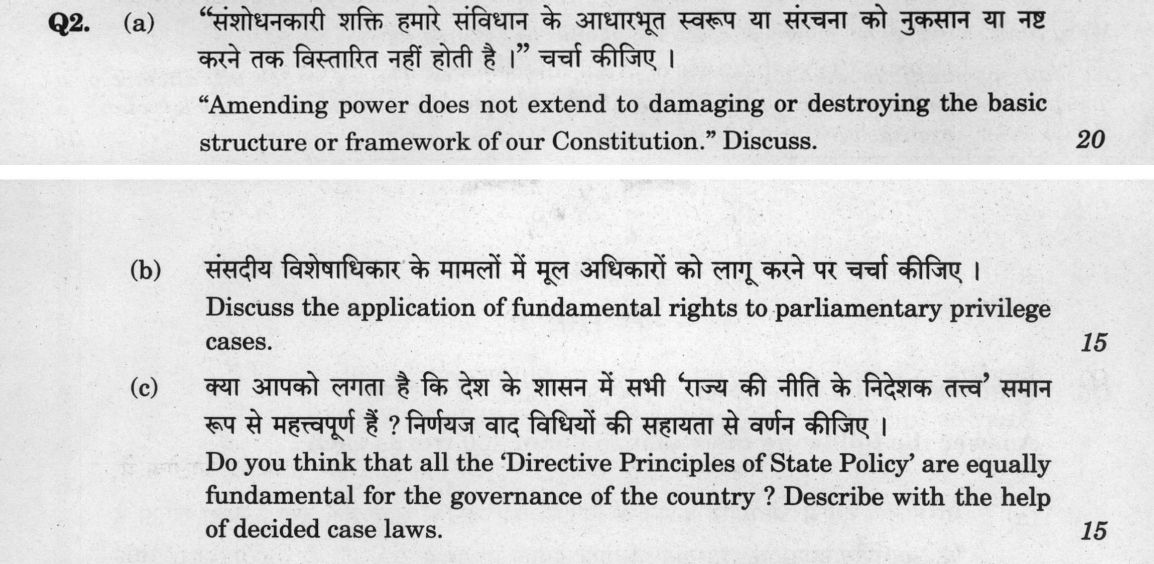
(a) "Amending power does not extend to damaging or destroying the basic structure or framework of our Constitution." Discuss. (20…
"Amending power does not extend to damaging or destroying the basic structure or framework of our Constitution." Discuss. 20 marks
Discuss the application of fundamental rights to parliamentary privilege cases. 15 marks
Do you think that all the 'Directive Principles of State Policy' are equally fundamental for the governance of the country? Describe with the help of decided case laws. 15 marks
हिंदी में प्रश्न पढ़ें
"संशोधनकारी शक्ति हमारे संविधान के आधारभूत स्वरूप या संरचना को नुकसान या नष्ट करने तक विस्तारित नहीं होती है।" चर्चा कीजिए। (20 अंक)
संसदीय विशेषाधिकार के मामलों में मूल अधिकारों को लागू करने पर चर्चा कीजिए। (15 अंक)
क्या आपको लगता है कि देश के शासन में सभी 'राज्य की नीति के निदेशक तत्त्व' समान रूप से महत्त्वपूर्ण हैं? निर्णयज वाद विधियों की सहायता से वर्णन कीजिए। (15 अंक)
Model answer
Written by UPSC Answer Check against this question's marking rubric, to the expected length. UPSC does not publish answers for Mains — this is one way to score well, not an official key.
The constituent power under Article 368 is a derivative and limited power, distinct from original plenary constituent power. The scope of amending power evolved through sustained judicial contestation: Shankari Prasad (1951) and Sajjan Singh (1965) accepted unlimited parliamentary amending power, which was reversed in Golak Nath (1967) by holding Fundamental Rights inviolable. This conflict culminated in Kesavananda Bharati (1973), where the Supreme Court ruled that while Parliament can amend any provision, it cannot alter the "basic structure" or essential framework of the Constitution. In Minerva Mills (1980), the Court held that a limited amending power is itself a basic feature. I.R. Coelho (2007) extended judicial review to Ninth Schedule laws using the "rights test" and "essence of rights test". Core components include democracy, secularism (S.R. Bommai), federalism, and judicial review (L. Chandra Kumar). Contemporary litigation, such as the challenge to the 103rd Constitutional Amendment in Janhit Abhiyan (2022), applies this test to ensure affirmative action does not destroy the constitutional identity. While critics argue that the doctrine is judicially created, inherently vague, and creates an unelected veto, it serves as the ultimate safeguard against legislative overreach and authoritarianism.
Parliamentary Privileges and Fundamental Rights
Articles 105(3) and 194(3) confer legislative privileges to secure institutional autonomy, frequently intersecting with Part III guarantees. Early jurisprudence in Gunupati Keshavram Reddy (1952) prioritized Article 22(2) over legislative arrest warrants. However, M.S.M. Sharma (Searchlight) (1959) applied harmonious construction, holding that general free speech under Article 19(1)(a) yielded to specific privileges. This was refined in the Keshav Singh Reference (1965), establishing that privileges remain subject to Articles 21, 32, and 226. In Raja Ram Pal (2007), the Supreme Court laid down a balancing test, ruling that the exercise of parliamentary privilege is subject to judicial review for patent illegality, perversity, or gross violation of fundamental rights. Recently, in Sita Soren (2024), an authoritative bench overruled P.V. Narasimha Rao (1998), holding that legislative immunity under Article 105(2) does not protect criminal acts like bribery. The recurring friction between legislative sovereignty and individual rights underscores the longstanding need to codify parliamentary privileges to ensure transparency and legal certainty.
Equality and Hierarchy Among Directive Principles
Article 37 declares Directive Principles of State Policy (DPSPs) "fundamental in the governance of the country," though explicitly non-justiciable. DPSPs are conventionally classified into socio-economic principles (Articles 38, 39, 41), Gandhian ideals (Articles 40, 43, 47), and liberal-intellectual principles (Articles 44, 45, 50). Despite Article 37’s uniform mandate, all DPSPs are not treated as equally fundamental in judicial enforcement or constitutional practice.
Early jurisprudence (State of Madras v. Champakam Dorairajan, 1951) subordinated all DPSPs to Fundamental Rights. Minerva Mills (1980) redefined their relationship as complementary, describing Parts III and IV as twin wheels of a constitutional chariot. However, an operational hierarchy exists. First, Articles 39(b) and (c) enjoy specific constitutional priority through Article 31C protection against Articles 14 and 19. Second, judicial activism has selectively integrated specific DPSPs into Article 21, creating directly enforceable rights—such as the right to education (Unni Krishnan, now Article 21A), livelihood (Olga Tellis), and a clean environment (M.C. Mehta). Conversely, other principles, such as a Uniform Civil Code (Article 44) or the separation of the judiciary from the executive (Article 50), have remained non-justiciable programmatic goals, demonstrating that their operational fundamentalness depends on legislative will and judicial interpretation.
Way Forward
Judicial review under the basic structure doctrine maintains the organic harmony between amending power, fundamental rights, and socio-economic directives. Moving forward, codifying parliamentary privileges, maintaining objective criteria for basic structure adjudication, and establishing structured legislative impact assessments to progressively realize non-enforceable DPSPs will reinforce Indian constitutionalism.
What "Discuss" is asking you to do
Lay the issue out from more than one side — how it arose, what is claimed for it, what is held against it, and where it now stands. UPSC attaches discuss to broad topics with several live dimensions, so coverage of the dimensions earns more than the strength of your opinion.
Structure that answers it
Set the issue up → the case as it is made → the case against → the dimension both sides leave out → where the balance now lies
Where marks are lost
Listing facts with no thread between them, or arguing one side throughout and calling it a discussion.
How this answer will be evaluated
Approach
Framework: Issue > Rule: statute or Article > Authority > Application and conclusion. (a) discuss: intro > 3-4 dimensions > example > balanced close | (b) discuss: intro > 3-4 dimensions > example > balanced close | (c) comment: context > arguments both sides > judgment > close Full marks: Precise citation of Articles and landmark cases with clear application to the specific legal issue.
Key points expected
- Cite Kesavananda Bharati v. State of Kerala (1973)
- Identify specific basic features (e.g., secularism, judicial review)
- Reference Article 368 and the 42nd Amendment context
- Mention Minerva Mills or Indira Sawhney for judicial application
- Cite Article 105 (Parliament) and Article 194 (State Legislature)
- Discuss the conflict between Article 19(1)(a) and privilege
- Cite Keshavan Madhava Rao v. State of Karnataka (2006)
- Mention the 1975 case (A.D.M. Jabalpur) or similar context
Evaluation rubric
Each sub-part is marked on its own, against the marks and word limit printed on the paper.
- (a) Explain the Basic Structure Doctrine and its limits on amending power. 20 marks
discuss— intro → 3-4 dimensions → example → balanced close
Must cover
- Cite Kesavananda Bharati v. State of Kerala (1973)
- Identify specific basic features (e.g., secularism, judicial review)
- Reference Article 368 and the 42nd Amendment context
- Mention Minerva Mills or Indira Sawhney for judicial application
Loses marks
- Failing to name Kesavananda Bharati case
- Listing features without explaining their constitutional basis
- Confusing basic structure with fundamental rights
Earns more
- Discuss the 'Golden Triangle' of Articles 14, 19, 21
- Reference the 24th Amendment Act (1971)
- Mention the dissenting views in Kesavananda Bharati
- Cite recent SC judgments on basic structure
Extra mark
- Reference Law Commission reports on constitutional amendments
- Mention the 99th Amendment (NJAC) case
- (b) Analyze the intersection of Fundamental Rights and Parliamentary Privileges. 15 marks
discuss— intro → 3-4 dimensions → example → balanced close
Must cover
- Cite Article 105 (Parliament) and Article 194 (State Legislature)
- Discuss the conflict between Article 19(1)(a) and privilege
- Cite Keshavan Madhava Rao v. State of Karnataka (2006)
- Mention the 1975 case (A.D.M. Jabalpur) or similar context
Loses marks
- Failing to cite Article 105 or 194
- Ignoring the judicial review aspect of privilege
- Confusing privilege with immunity from criminal law
Earns more
- Reference the 2010 Supreme Court ruling on contempt
- Discuss the 'absolute' nature of privilege vs. judicial review
- Mention the 1967 case (R.S. Nayak v. A.P. Bhattacharjee)
- Cite the 2017 case on media reporting of proceedings
Extra mark
- Reference Law Commission recommendations on privilege
- Mention the 2019 case on social media and privilege
- (c) Evaluate the relative importance of Directive Principles of State Policy. 15 marks
comment— context → arguments both sides → judgment → close
Must cover
- Cite Article 37 (Non-justiciable nature of DPSP)
- Cite Minerva Mills v. Union of India (1980)
- Cite Golaknath v. State of Punjab (1967) for conflict
- Discuss the 'Harmonious Construction' doctrine
Loses marks
- Failing to cite Article 37
- Ignoring the conflict with Fundamental Rights
- Treating all DPSP as equally justiciable
Earns more
- Reference the 44th Amendment (1978) adding Article 37(1)
- Mention the 1992 case (Virendra Gupta v. State of UP)
- Discuss the 'Fundamental Policy' status of DPSP
- Cite the 2011 case on right to food (Indira Sawhney)
Extra mark
- Reference Law Commission reports on DPSP implementation
- Mention the 2012 case on right to education (Article 21A)
Practice this exact question
Write your answer and it is marked point by point against the model answer above — what you covered, what you missed, what you got wrong.
Evaluate my answer →More from Law 2022 Paper I
- Q1 Answer the following questions in about 150 words each: (a) 'Absolute equality may itself…
- Q2 (a) "Amending power does not extend to damaging or destroying the basic structure or fram…
- Q3 (a) Can the constitutional head of the State be truly described as the nerve-centre of th…
- Q4 (a) In the Parliamentary system, though there is no separation between the legislature an…
- Q5 Answer the following questions in about 150 words each: (a) Keeping in view the growth of…