Paper I — Q4
(a) In the Parliamentary system, though there is no separation between the legislature and the executive in terms of personnel…
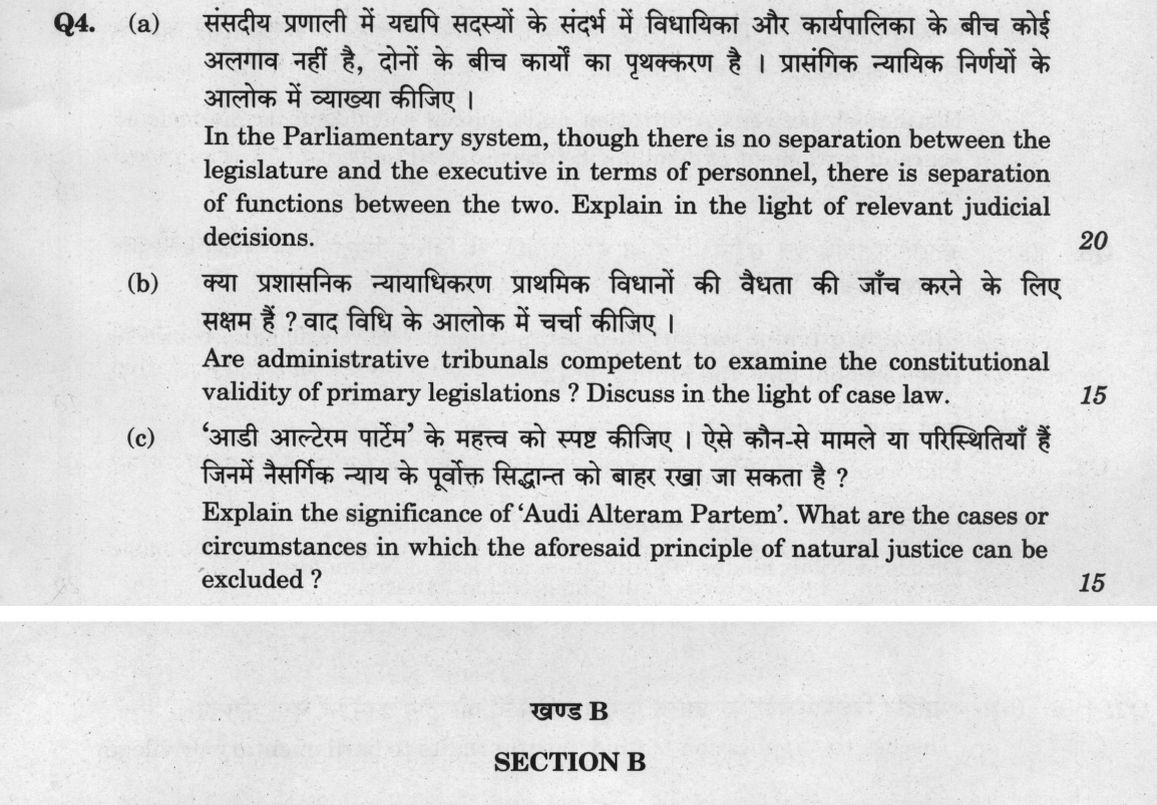
In the Parliamentary system, though there is no separation between the legislature and the executive in terms of personnel, there is separation of functions between the two. Explain in the light of relevant judicial decisions. 20 marks
Are administrative tribunals competent to examine the constitutional validity of primary legislations? Discuss in the light of case law. 15 marks
Explain the significance of 'Audi Alteram Partem'. What are the cases or circumstances in which the aforesaid principle of natural justice can be excluded? 15 marks
हिंदी में प्रश्न पढ़ें
संसदीय प्रणाली में यद्यपि सदस्यों के संदर्भ में विधायिका और कार्यपालिका के बीच कोई अलगाव नहीं है, दोनों के बीच कार्यों का पृथक्करण है। प्रासंगिक न्यायिक निर्णयों के आलोक में व्याख्या कीजिए। (20 अंक)
क्या प्रशासनिक न्यायाधिकरण प्राथमिक विधानों की वैधता की जांच करने के लिए सक्षम हैं? वाद विधि के आलोक में चर्चा कीजिए। (15 अंक)
'आडी अल्टरम पार्टेम' के महत्व को स्पष्ट कीजिए। ऐसे कौन-से मामले या परिस्थितियाँ हैं जिनमें नैसर्गिक न्याय के पूर्वोक्त सिद्धांत को बाहर रखा जा सकता है? (15 अंक)
Model answer
Written by UPSC Answer Check against this question's marking rubric, to the expected length. UPSC does not publish answers for Mains — this is one way to score well, not an official key.
Under the Indian constitutional scheme, the doctrine of separation of powers is accepted functionally rather than in its rigid, classical Montesquieuan sense. While the Westminster parliamentary model necessitates an overlap in personnel—ministers being drawn from and collectively responsible to the legislature under Articles 74 and 75—it strictly preserves a functional division of powers.
Functional Separation in the Parliamentary System
The Council of Ministers executes policy and administration, while Parliament retains the core function of enacting laws, scrutinising executive action, and voting supplies. In Ram Jawaya Kapur v. State of Punjab (1955), the Supreme Court clarified that the Indian Constitution does not recognise an absolute separation of powers in personnel, yet it clearly differentiates executive, legislative, and judicial functions to prevent concentration of unchecked power. In Kesavananda Bharati v. State of Kerala (1973) and Indira Nehru Gandhi v. Raj Narain (1975), the Court elevated this functional division and the system of checks and balances into the inviolable basic structure of the Constitution, holding that one organ cannot usurp the essential functions of another.
Tribunals and Constitutional Validity of Primary Legislation
Administrative tribunals are quasi-judicial bodies designed for specialised adjudication, not plenary constitutional courts. While S.P. Sampath Kumar v. Union of India (1987) initially viewed tribunals as effective substitutes for High Courts, this proposition was authoritatively recalibrated in L. Chandra Kumar v. Union of India (1997). The seven-judge bench held that while administrative tribunals can test the constitutional validity of subordinate or delegated legislation, they are strictly barred from examining the constitutional validity of their own parent primary legislation under which they are created.
Further, as reiterated in Union of India v. R. Gandhi (2010) and Ramesh Chandra Singhal v. Union of India, judicial review over primary legislation is a non-negotiable core of Constitutional Courts. Tribunal decisions remain subordinate to the supervisory jurisdiction of the High Courts under Articles 226/227 and the Supreme Court under Article 32, preserving the ultimate power of constitutional interpretation within constitutional courts.
Significance and Exclusion of Audi Alteram Partem
The principle of audi alteram partem (hear the other side) is an indispensable facet of natural justice, ensuring fair play, preventing arbitrariness, and preserving public trust in administrative decisions. Its core components include the issuance of adequate prior notice, a reasonable opportunity to present one's case, and the delivery of a reasoned speaking order. In A.K. Kraipak v. Union of India (1969) and Mohinder Singh Gill v. Chief Election Commissioner (1977), the Supreme Court observed that natural justice is not an unruly horse or rigid straitjacket, but a flexible instrument to secure justice, adaptable to administrative imperatives.
Consequently, audi alteram partem can be excluded in specific circumstances:
First, express or implied statutory exclusion, where the statute intentionally bars a pre-decisional hearing to achieve public objectives.
Second, situations of extreme urgency or national security, as seen in Maneka Gandhi v. Union of India (1978), where an immediate impounding of a passport excluded a pre-decisional hearing, though the Court mandated a post-decisional hearing to prevent injustice.
Third, purely legislative actions or general policy decisions, where individual hearings are administratively impossible (State of Punjab v. Sita Ram).
Fourth, academic disciplinary matters and mass malpractice, where conducting individual inquiries would frustrate the entire process (Bihar School Examination Board v. Subhas Chandra Sinha).
Fifth, cases where a hearing would be a "useless formality" because the admitted facts lead to only one inevitable legal conclusion.
Together, functional separation, guarded tribunal jurisdiction, and structured application of natural justice ensure that state power remains both effective and constitutionally disciplined.
What "Explain" is asking you to do
Make the working of something clear — what sets it off, what follows from what, and what it produces. Explain is the Commission's mechanism word: it dominates the technical papers and the “explain why” stems, where the marks sit in the causal chain and not in the label.
Structure that answers it
State what it is → the initiating condition → the chain of cause, step by step → an instance where it plays out → what the chain produces
Where marks are lost
Describing what something looks like instead of why it works that way. Naming the stages without linking them reads as description too.
How this answer will be evaluated
Approach
Framework: Issue > Rule > Authority > Application. (a) explain: definition/context > points in order > small example > short close | (b) discuss: intro > 3-4 dimensions > example > balanced close | (c) explain: definition/context > points in order > small example > short close Full marks: Precise legal definitions, accurate case citations with ratios, clear distinction between concepts, and logical application to the specific question.
Key points expected
- Define the fusion of personnel in the executive-legislature link
- Explain the functional separation of legislative and executive duties
- Cite relevant judicial decisions supporting the distinction
- Conclude on the practical reality of the separation
- State the general rule on tribunal jurisdiction
- Cite case law establishing the limit on tribunals
- Discuss the distinction between primary and subordinate legislation
- Conclude on the specific competence regarding primary legislation
Evaluation rubric
Each sub-part is marked on its own, against the marks and word limit printed on the paper.
- (a) Distinguish separation of personnel from separation of functions in the Parliamentary system. 20 marks
explain— definition/context → points in order → small example → short close
Must cover
- Define the fusion of personnel in the executive-legislature link
- Explain the functional separation of legislative and executive duties
- Cite relevant judicial decisions supporting the distinction
- Conclude on the practical reality of the separation
Loses marks
- Confusing separation of powers with separation of functions
- Citing cases without stating their ratio
- Ignoring the 'personnel' aspect of the question
Earns more
- Reference to the doctrine of collective responsibility
- Mention of the Prime Minister's dual role
- Citation of specific SC judgments on separation of powers
Extra mark
- Reference to Law Commission reports on separation of powers
- Comparison with the Presidential system
- (b) Determine the competence of administrative tribunals to test constitutional validity of laws. 15 marks
discuss— intro → 3-4 dimensions → example → balanced close
Must cover
- State the general rule on tribunal jurisdiction
- Cite case law establishing the limit on tribunals
- Discuss the distinction between primary and subordinate legislation
- Conclude on the specific competence regarding primary legislation
Loses marks
- Assuming tribunals have unlimited jurisdiction
- Failing to distinguish between primary and subordinate legislation
- Outcome-only case citation without legal reasoning
Earns more
- Reference to the doctrine of ultra vires
- Mention of the role of High Courts under Article 226
- Citation of specific cases like State of Rajasthan v. Gopichand
Extra mark
- Reference to recent amendments in tribunal laws
- Mention of the National Company Law Tribunal's specific powers
- (c) Define 'Audi Alteram Partem' and list circumstances where it is excluded. 15 marks
explain— definition/context → points in order → small example → short close
Must cover
- Define the principle of hearing the other side
- Explain its significance as a rule of natural justice
- List specific cases or circumstances where it is excluded
- Provide examples of such exclusions
Loses marks
- Defining the principle without explaining its significance
- Listing exclusions without providing examples
- Confusing 'Audi Alteram Partem' with the 'rule against bias'
Earns more
- Mention of the 'rule against bias' as a related principle
- Citation of cases like State of Punjab v. Ram Kumar
- Discussion of the 'public interest' exception
Extra mark
- Reference to the 'emergency' exception
- Mention of the 'security of the state' exception
Practice this exact question
Write your answer and it is marked point by point against the model answer above — what you covered, what you missed, what you got wrong.
Evaluate my answer →More from Law 2022 Paper I
- Q1 Answer the following questions in about 150 words each: (a) 'Absolute equality may itself…
- Q2 (a) "Amending power does not extend to damaging or destroying the basic structure or fram…
- Q3 (a) Can the constitutional head of the State be truly described as the nerve-centre of th…
- Q4 (a) In the Parliamentary system, though there is no separation between the legislature an…
- Q5 Answer the following questions in about 150 words each: (a) Keeping in view the growth of…
- Q6 (a) Critically examine various theories relating to the relationship between Internationa…
- Q7 (a) Describe the various powers and functions of the General Assembly. (20 marks) (b) Exp…