Paper I — Q6
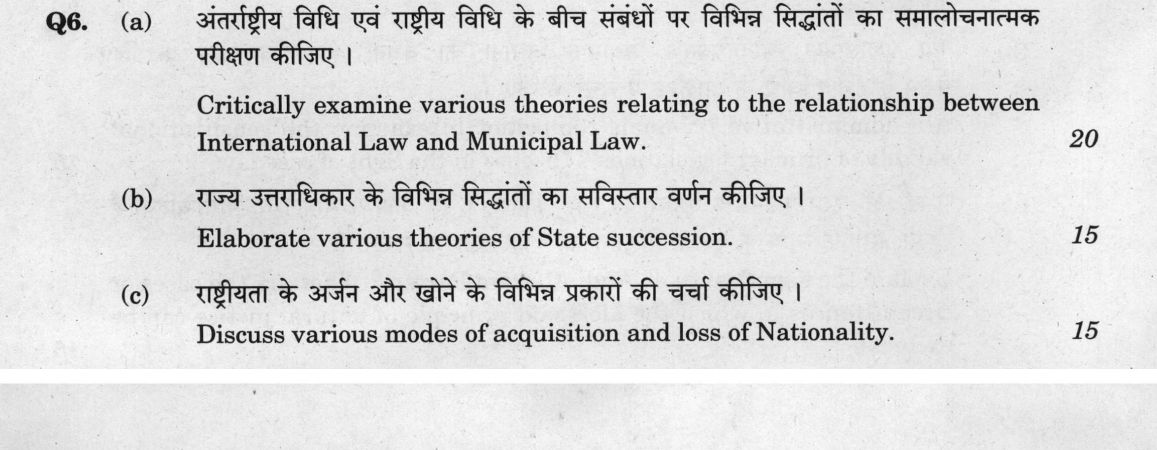
(a) Critically examine various theories relating to the relationship between International Law and Municipal Law. (20 marks) (b)…
Critically examine various theories relating to the relationship between International Law and Municipal Law. 20 marks
Elaborate various theories of State succession. 15 marks
Discuss various modes of acquisition and loss of Nationality. 15 marks
हिंदी में प्रश्न पढ़ें
अंतर्राष्ट्रीय विधि एवं राष्ट्रीय विधि के बीच संबंधों पर विभिन्न सिद्धांतों का समालोचनात्मक परीक्षण कीजिए। (20 अंक)
राज्य उत्तराधिकार के विभिन्न सिद्धांतों का सविस्तार वर्णन कीजिए। (15 अंक)
राष्ट्रीयता के अर्जन और खोने के विभिन्न प्रकारों की चर्चा कीजिए। (15 अंक)
Model answer
Written by UPSC Answer Check against this question's marking rubric, to the expected length. UPSC does not publish answers for Mains — this is one way to score well, not an official key.
International Law and Municipal Law
The relationship between international law and municipal law is governed by two competing classic paradigms. Monism (Kelsen, Scelle) views all law as a unified normative hierarchy where international law is inherently supreme. Dualism (Triepel, Anzilotti) posits that international and municipal laws are distinct systems operating on different sources, subjects, and sovereign spheres. Moderate variants qualify these extremes: moderate monism accepts municipal validity until invalidated, while moderate dualism acknowledges international obligations without automatic domestic effect.
These philosophies translate into the doctrines of Adoption/Incorporation (international law automatically forms part of domestic law) and Transformation (treaties require enabling national legislation). British practice adopts customary international law (CIL) automatically unless inconsistent with statutes, but applies transformation to treaties affecting private rights. American constitutional practice (Article VI) treats self-executing treaties as the supreme law of the land, while non-self-executing treaties require transformation.
India follows a dualist model anchored in Article 253 (exclusive parliamentary power to implement treaties) read with Article 51(c) of the Constitution. However, the Indian judiciary has progressively embraced the Harmonization Theory (Fitzmaurice, Rousseau). In Vishaka v. State of Rajasthan (1997) and PUCL v. Union of India, the Supreme Court held that international conventions not inconsistent with Fundamental Rights must be read into domestic law to fill statutory voids.
Critical Appraisal: Pure monism ignores democratic sovereignty, while rigid dualism fosters sovereign delinquency. As C. Wilfred Jenks noted in his Common Law of Mankind, absolute dualism is obsolete. The harmonisation approach rightly reconciles municipal sovereignty with international duties, though municipal courts maintain that where an irreconcilable statutory conflict arises, domestic law prevails.
Theories of State Succession
State succession arises upon a definitive change of sovereignty over territory, distinct from government succession, which merely alters political administration without affecting international personality.
Theoretical approaches range from the Universal Succession Theory (Grotius), which posits that the successor state inherits all rights, debts, and obligations of the predecessor, to the **Clean Slate (Tabula Rasa) Doctrine**, which asserts that newly emerged states begin free of prior obligations. Modern jurists (D.P. O'Connell, Ian Brownlie) reject these absolutes, advocating differentiated continuity: dispositive/localized treaties run with the land, while personal or political treaties lapse.
This nuanced position is codified in the Vienna Convention on Succession of States in Respect of Treaties (1978). Decolonized states enjoy the clean slate rule (Article 16), while boundary treaties endure (Articles 11 and 12). Succession to state property and public debt requires equitable distribution. Regarding nationality, international practice mandates continuity in cases of merger, dissolution, and secession to avoid mass statelessness.
State Practice: The 1971 secession of Bangladesh followed the clean slate approach, requiring fresh accessions to non-localized multilateral treaties. In contrast, the Jammu and Kashmir Reorganisation Act (2019) constitutes an internal, administrative reorganization of municipal governance within the uninterrupted sovereign identity of India, involving no international state succession.
Modes of Acquisition and Loss of Nationality
Nationality denotes the legal bond between an individual and a state. Under customary international law, primary modes of acquisition are jus soli (birth within territory) and jus sanguinis (birth by descent), supplemented by naturalization, registration, and cession/option of territory. Loss occurs through renunciation, deprivation (for disloyalty or fraud), substitution (acquiring another nationality), and prolonged residence abroad.
The International Court of Justice in the Nottebohm Case (1955) affirmed that international recognition of nationality requires a "genuine link" between the individual and the state. Procedural fairness against arbitrary deprivation was reinforced in Sarbah v. Home Office, aligning with the 1961 Convention on the Reduction of Statelessness.
The Indian Citizenship Act, 1955 originally reflected broad jus soli, but amendments in 1986 and 2003 progressively pivoted toward strict jus sanguinis to deter irregular migration by requiring that neither parent be an illegal migrant. The Citizenship (Amendment) Act, 2019 (CAA) created a fast-track naturalization pathway for specified persecuted minorities from Pakistan, Bangladesh, and Afghanistan. Contemporary exercises like the Assam National Register of Citizens (NRC) and the CAA underline the friction between sovereign discretion over citizenship and constitutional protections against non-discrimination and arbitrary statelessness.
Conclusion
International legal practice demonstrates that sovereign discretion over municipal integration, territory, and citizenship is increasingly conditioned by international human rights standards. Progressive judicial harmonization and multilateral codification ensure that the sovereign state functions not in isolation, but as the primary organ for upholding global rule-of-law norms.
What "Critically examine" is asking you to do
Test the proposition the question puts to you and return a finding on how far it holds. Examine stems carry a claim, or ask whether something has happened, and expect evidence weighed both ways before the extent is stated — often with remedial measures attached. “Critically” is not a section added at the end: name the yardstick you are judging by — the evidence, the stated objective, a constitutional principle, a rival explanation — and let a verdict close each part of the body. Where the question quotes a claim, that verdict must land on the claim itself, accepted, qualified or rejected, and not on the theme in general.
Structure that answers it
Restate the claim as the question frames it → evidence that supports it → evidence that undercuts it → the conditions under which it holds → verdict on how far it stands
Where marks are lost
Merits in one paragraph, demerits in the next, and a conclusion calling for a balanced and holistic approach. That is a survey with the judgement left out and it holds the answer in the middle band. The opposite error is reading “critically” as permission to attack — and with the odd pairings, critically describe or critically explain, the exposition still carries most of the marks, the judgement being a layer on it rather than a substitute for it.
How this answer will be evaluated
Approach
(a) examine: intro > how/why with reasoning > evidence > conclusion | (b) explain: definition/context > points in order > small example > short close | (c) discuss: intro > 3-4 dimensions > example > balanced close Full marks: Comprehensive, critical, and well-structured with precise legal citations and examples.
Key points expected
- Monist theory (Kelsen, Lauterpacht) explained
- Dualist theory (Oppenheim, Dicey) explained
- Transformation and Incorporation doctrines distinguished
- Critical evaluation of the theories provided
- Continuity theory (identity of state) explained
- Transmission theory (transfer of rights) explained
- Extinction and creation theory explained
- Distinction between universal and partial succession
Evaluation rubric
Each sub-part is marked on its own, against the marks and word limit printed on the paper.
- (a) Critical analysis of theories on the relationship between International and Municipal Law. 20 marks
examine— intro → how/why with reasoning → evidence → conclusion
Must cover
- Monist theory (Kelsen, Lauterpacht) explained
- Dualist theory (Oppenheim, Dicey) explained
- Transformation and Incorporation doctrines distinguished
- Critical evaluation of the theories provided
Loses marks
- Descriptive listing without critical analysis
- Confusing 'Municipal' with 'Municipal' (local) law
- Ignoring the 'critical' aspect of the command
Earns more
- Reference to ICJ cases (e.g., Nottebohm)
- Comparison of US and UK constitutional approaches
- Discussion of the 'priority' of law in conflicts
Extra mark
- Citation of the 'Vienna Convention on Succession'
- Reference to specific Law Commission reports
- (b) Elaboration of the various theories of State succession. 15 marks
explain— definition/context → points in order → small example → short close
Must cover
- Continuity theory (identity of state) explained
- Transmission theory (transfer of rights) explained
- Extinction and creation theory explained
- Distinction between universal and partial succession
Loses marks
- Confusing state succession with treaty succession
- Failing to distinguish between the theories
- Vague generalities without specific legal principles
Earns more
- Reference to the 1978 Vienna Convention
- Examples of state succession (e.g., USSR, India)
- Discussion of the 'clean slate' doctrine
Extra mark
- Citation of the 'Vienna Convention on Succession'
- Reference to specific Law Commission reports
- (c) Discussion of the various modes of acquisition and loss of nationality. 15 marks
discuss— intro → 3-4 dimensions → example → balanced close
Must cover
- Modes of acquisition (jus soli, jus sanguinis, naturalization) listed
- Modes of loss (renunciation, marriage, state succession) listed
- Distinction between voluntary and involuntary loss
- Reference to the 1999 Hague Convention
Loses marks
- Listing modes without explaining them
- Confusing nationality with citizenship
- Ignoring the 'loss' aspect of the question
Earns more
- Discussion of statelessness issues
- Examples of nationality laws from different countries
- Reference to the 'right to a nationality' in UDHR
Extra mark
- Citation of the 'Vienna Convention on Succession'
- Reference to specific Law Commission reports
Practice this exact question
Write your answer and it is marked point by point against the model answer above — what you covered, what you missed, what you got wrong.
Evaluate my answer →More from Law 2022 Paper I
- Q3 (a) Can the constitutional head of the State be truly described as the nerve-centre of th…
- Q4 (a) In the Parliamentary system, though there is no separation between the legislature an…
- Q5 Answer the following questions in about 150 words each: (a) Keeping in view the growth of…
- Q6 (a) Critically examine various theories relating to the relationship between Internationa…
- Q7 (a) Describe the various powers and functions of the General Assembly. (20 marks) (b) Exp…
- Q8 (a) When is an aircraft considered to be 'in flight' for the purposes of the Convention f…