Paper II — Q1
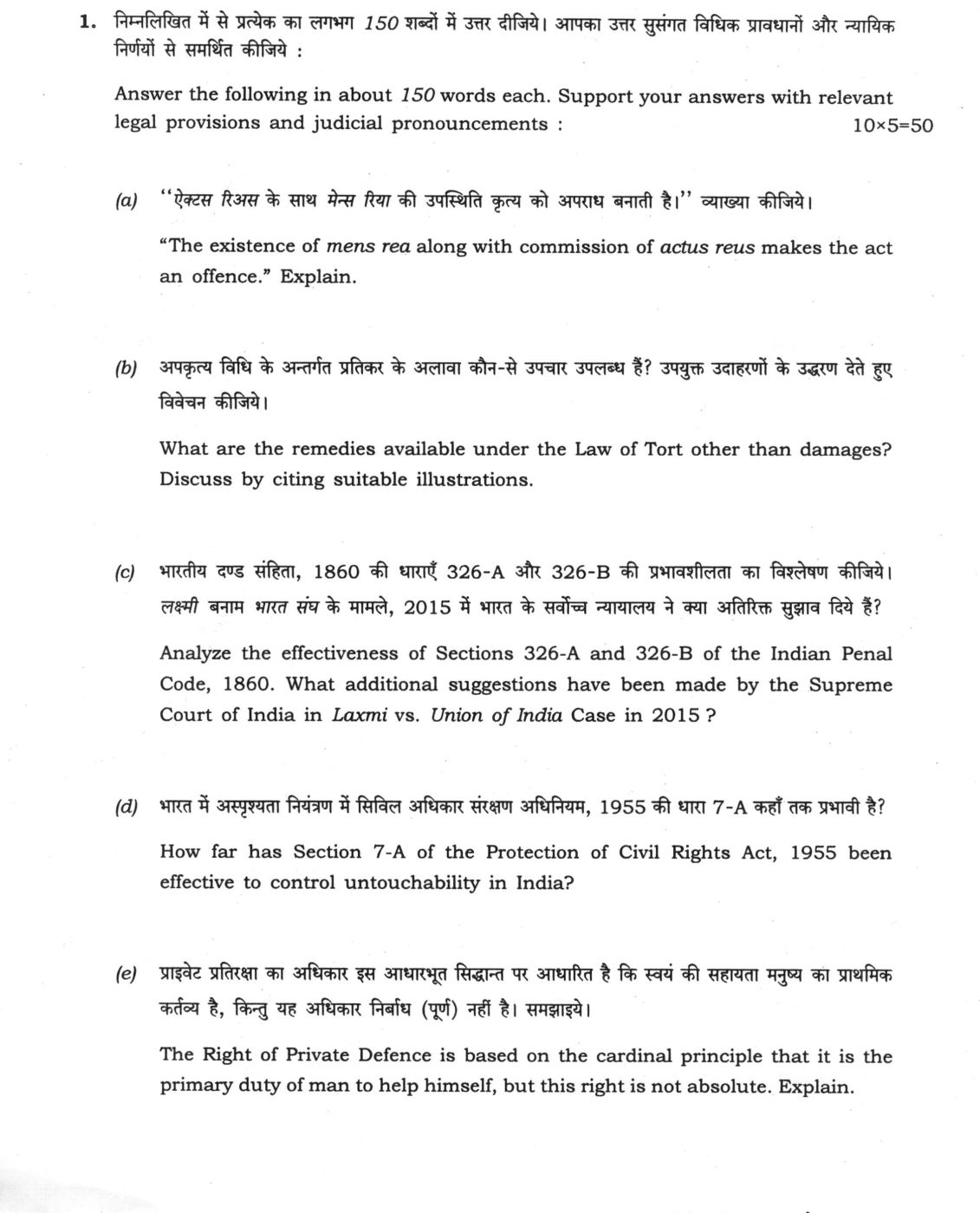
Answer the following in about 150 words each. Support your answers with relevant legal provisions and judicial pronouncements …
Answer the following in about 150 words each. Support your answers with relevant legal provisions and judicial pronouncements : 10×5=50
"The existence of mens rea along with commission of actus reus makes the act an offence." Explain. 10 marks
What are the remedies available under the Law of Tort other than damages? Discuss by citing suitable illustrations. 10 marks
Analyze the effectiveness of Sections 326-A and 326-B of the Indian Penal Code, 1860. What additional suggestions have been made by the Supreme Court of India in Laxmi vs. Union of India Case in 2015 ? 10 marks
How far has Section 7-A of the Protection of Civil Rights Act, 1955 been effective to control untouchability in India? 10 marks
The Right of Private Defence is based on the cardinal principle that it is the primary duty of man to help himself, but this right is not absolute. Explain. 10 marks
हिंदी में प्रश्न पढ़ें
निम्नलिखित में से प्रत्येक का लगभग 150 शब्दों में उत्तर दीजिये। आपका उत्तर सुसंगत विधिक प्रावधानों और न्यायिक निर्णयों से समर्थित कीजिये : 10×5=50
(क) "ऐक्टस रियस के साथ मेन्स रिया की उपस्थिति कृत्य को अपराध बनाती है।" व्याख्या कीजिये। (10 अंक)
(ख) अपकृत्य विधि के अन्तर्गत प्रतिकर के अलावा कौन-से उपचार उपलब्ध हैं? उपयुक्त उदाहरणों के उद्धरण देते हुए विवेचन कीजिये। (10 अंक)
(ग) भारतीय दण्ड संहिता, 1860 की धाराएँ 326-A और 326-B की प्रभावशीलता का विश्लेषण कीजिये। लक्ष्मी बनाम भारत संघ के मामले, 2015 में भारत के सर्वोच्च न्यायालय ने क्या अतिरिक्त सुझाव दिये हैं? (10 अंक)
(घ) भारत में अस्पृश्यता नियंत्रण में सिविल अधिकार संरक्षण अधिनियम, 1955 की धारा 7-A कहाँ तक प्रभावी है? (10 अंक)
(ङ) प्राइवेट प्रतिरक्षा का अधिकार इस आधारभूत सिद्धांत पर आधारित है कि स्वयं की सहायता मनुष्य का प्राथमिक कर्तव्य है, किन्तु यह अधिकार निर्बाध (पूर्ण) नहीं है। समझाइये। (10 अंक)
Model answer
Written by UPSC Answer Check against this question's marking rubric, to the 150-word length. UPSC does not publish answers for Mains — this is one way to score well, not an official key.
(a) The general criminal-law rule is that an offence is complete only when a prohibited act, actus reus, is accompanied by a culpable mental state, mens rea, at the same time. The causal mechanism is concurrence: the accused must do the act while possessing the required intention, knowledge, recklessness or negligence; without that mental state, the act is usually not criminal, because law punishes blameworthy conduct, not mere events. R v. Prince (1875) shows the exception where the statute makes the act itself criminal, so honest belief may not negate liability. Similarly, in State of Maharashtra v. Mayer Hans George (1965), the Supreme Court held that mens rea was excluded by necessary implication in the FERA offence, making it strict liability. Section 304-A IPC illustrates that the mental element need not be intent: negligence is itself a form of mens rea, so absence of intention does not mean absence of culpability.
(b) Tort law does not confine relief to compensation. Where damages are inadequate, courts may grant injunctions: perpetual injunctions to stop continuing wrongs, mandatory injunctions to restore a prior position, and, in urgent cases, interim or Mareva injunctions to preserve assets or prevent irreparable harm. Specific restitution requires return of property wrongfully taken, such as a stolen vehicle. Declaratory relief fixes legal rights, for example declaring that a neighbour’s wall encroaches on land. Self-help, such as abating a private nuisance by removing an encroaching tree, is permitted where delay would cause harm. The causal logic is that tort protects interests, not merely balances money: if the wrong is continuing, future-oriented relief is needed. Unlike Spring Meadows Hospital v. Harjol Ahluwalia, where the principal remedy was damages for medical negligence, these non-damages remedies protect rights, prevent repetition, restore status quo, or clarify legal positions where compensation cannot fully repair the injury caused.
(c) Sections 326-A and 326-B IPC were inserted to deter acid attacks. Section 326-A punishes voluntarily causing grievous hurt by throwing or administering acid or other corrosive substance, or making or attempting to make another do so, with rigorous imprisonment of at least ten years, extendable to life, and fine. Section 326-B penalises the attempt to throw or administer acid, including voluntary throwing where the completed offence is not established, with a minimum of five years. The effectiveness is mixed: the high minimum punishment signals seriousness and deters, but acid attacks persist due to easy availability, social impunity, and under-reporting. In Laxmi v. Union of India (2015), the Supreme Court added victim-centred measures: free and prompt medical treatment, compensation, regulation of acid sale, rehabilitation, fast-track courts for speedy trials, and direction that acid-attack victims be treated as disabled under the Persons with Disabilities Act, 1995, so they receive the statutory benefits.
(d) Section 7-A of the Protection of Civil Rights Act, 1955 criminalises compelling a person to practise untouchability, prescribing imprisonment and fine. Its effectiveness is limited, especially in rural areas where caste hierarchies remain strong. Article 17 of the Constitution abolishes untouchability and gives it constitutional status, but Section 7-A operates only where a person is compelled to observe a disability imposed because of Scheduled Caste status. In practice, enforcement is weak: many incidents occur in rural social settings where witnesses fear retaliation and victim intimidation, police registration is often delayed, and conviction rates remain persistently low. The offence is also difficult to prove because compulsion may be social, economic or customary rather than overt force. Thus, the provision deters only marginally; it is more symbolic than transformative. Real control requires stronger investigation, protection of complainants, public awareness, and linkage with welfare schemes, because criminal punishment alone cannot erase caste-based exclusion.
(e) The right of private defence under Sections 96-106 IPC rests on the principle that, when public protection is not immediately available, a person has a primary duty to help himself and may protect life or body. It is not absolute. The right arises only on reasonable apprehension of danger, as in Yogendra Moraji v. State of Gujarat, where the court emphasised that the apprehension must be reasonable and not imagined. The force used must be necessary and proportionate to the threat; excessive retaliation is not protected. R v. Clegg illustrates this: where force used was disproportionate to the danger, it could not be justified as reasonable self-defence. The causal limit is that the right exists to prevent imminent harm, not to punish; once the threat ends, the right ends. Hence, private defence is a shield, not a sword, and must be exercised with restraint, necessity, and proportionality of the force.
What "Explain" is asking you to do
Make the working of something clear — what sets it off, what follows from what, and what it produces. Explain is the Commission's mechanism word: it dominates the technical papers and the “explain why” stems, where the marks sit in the causal chain and not in the label.
Structure that answers it
State what it is → the initiating condition → the chain of cause, step by step → an instance where it plays out → what the chain produces
Where marks are lost
Describing what something looks like instead of why it works that way. Naming the stages without linking them reads as description too.
How this answer will be evaluated
Approach
Framework: Issue > Rule > Authority > Application. (a) explain: definition/context > points in order > small example > short close | (b) discuss: intro > 3-4 dimensions > example > balanced close | (c) analyse: intro > causes > effects > stakeholders/linkages > way forward | (d) evaluate: criteria > evidence > balanced judgment | (e) explain: definition/context > points in order > small example > short close Full marks: Comprehensive, well-structured, with precise legal references and critical analysis.
Key points expected
- Define mens rea (guilty mind) and actus reus (guilty act)
- Explain the maxim 'actus reus non facit reum nisi mens sit rea'
- Cite a case establishing the requirement of both elements
- Mention exceptions where mens rea is not required (strict liability)
- Identify at least three non-damages remedies (e.g., injunction, specific performance, restitution)
- Provide a suitable illustration for each remedy
- Explain the purpose of each remedy
- Distinguish these from damages
Evaluation rubric
Each sub-part is marked on its own, against the marks and word limit printed on the paper.
- (a) Define mens rea and actus reus and explain their joint necessity for criminal liability. · 150 words
explain— definition/context → points in order → small example → short close
Must cover
- Define mens rea (guilty mind) and actus reus (guilty act)
- Explain the maxim 'actus reus non facit reum nisi mens sit rea'
- Cite a case establishing the requirement of both elements
- Mention exceptions where mens rea is not required (strict liability)
Loses marks
- Defining only one of the two elements
- Failing to explain the relationship between the two
- No case law or statutory reference
Earns more
- Reference to R v. Prince or similar foundational case
- Distinction between strict liability and absolute liability
- Mention of statutory exceptions to the general rule
Extra mark
- Reference to Law Commission report on criminal law reform
- Citation of a recent Supreme Court judgment on mens rea
- (b) List and explain non-damages remedies in tort law with illustrations. · 150 words
discuss— intro → 3-4 dimensions → example → balanced close
Must cover
- Identify at least three non-damages remedies (e.g., injunction, specific performance, restitution)
- Provide a suitable illustration for each remedy
- Explain the purpose of each remedy
- Distinguish these from damages
Loses marks
- Listing remedies without illustrations
- Confusing non-damages remedies with damages
- No explanation of the purpose of each remedy
Earns more
- Reference to specific torts where these remedies apply
- Mention of equitable principles underlying these remedies
- Comparison with common law remedies
Extra mark
- Citation of a recent case on non-damages remedies
- Reference to statutory provisions enabling these remedies
- (c) Analyze effectiveness of IPC 326-A/B and summarize Laxmi v. UoI (2015) suggestions. · 150 words
analyse— intro → causes → effects → stakeholders/linkages → way forward
Must cover
- Explain the scope of Sections 326-A and 326-B IPC
- Analyze their effectiveness in addressing acid attacks
- Summarize the Supreme Court's suggestions in Laxmi v. UoI (2015)
- Evaluate the impact of these provisions
Loses marks
- Failing to analyze effectiveness
- Not summarizing the Laxmi v. UoI suggestions
- No discussion of the scope of the sections
Earns more
- Reference to the 2013 amendment to IPC
- Mention of specific guidelines from Laxmi v. UoI
- Discussion of implementation challenges
Extra mark
- Reference to Law Commission report on acid attacks
- Citation of a recent case on the application of these sections
- (d) Evaluate the effectiveness of Section 7-A of the Protection of Civil Rights Act, 1955. · 150 words
evaluate— criteria → evidence → balanced judgment
Must cover
- Explain the provisions of Section 7-A
- Evaluate its effectiveness in controlling untouchability
- Provide evidence of its impact or lack thereof
- Discuss any limitations or challenges
Loses marks
- Failing to evaluate effectiveness
- No evidence or examples provided
- Not discussing limitations or challenges
Earns more
- Reference to specific cases or incidents
- Mention of government reports or studies
- Comparison with other legal provisions
Extra mark
- Reference to a recent Supreme Court judgment
- Citation of a Law Commission report
- (e) Explain the principle of private defence and its limitations. · 150 words
explain— definition/context → points in order → small example → short close
Must cover
- Define the right of private defence
- Explain the principle of self-help
- Discuss the limitations of this right
- Provide an example illustrating the limitations
Loses marks
- Failing to explain the limitations
- No example provided
- Not discussing the balance between self-help and state authority
Earns more
- Reference to specific legal provisions
- Mention of case law on private defence
- Discussion of the balance between self-help and state authority
Extra mark
- Reference to a recent Supreme Court judgment
- Citation of a Law Commission report
Practice this exact question
Write your answer and it is marked point by point against the model answer above — what you covered, what you missed, what you got wrong.
Evaluate my answer →More from Law 2022 Paper II
- Q1 Answer the following in about 150 words each. Support your answers with relevant legal pr…
- Q2 (a) The 'State Liability' under the Law of Tort has undergone metamorphosis. Explain with…
- Q3 (a) What do you understand by an 'unlawful assembly'? Discuss the circumstances when a la…
- Q4 (a) Summarize the law relating to 'attempt to suicide' in India. How far the Mental Healt…