Paper II — Q7
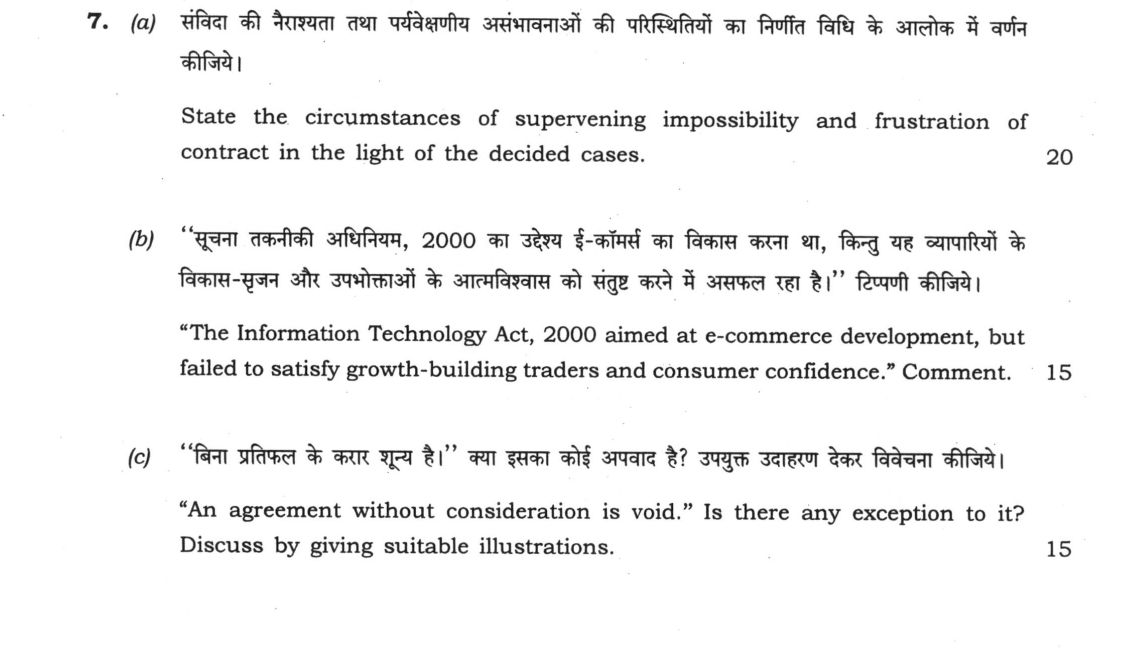
(a) State the circumstances of supervening impossibility and frustration of contract in the light of the decided cases. (20…
State the circumstances of supervening impossibility and frustration of contract in the light of the decided cases. 20 marks
"The Information Technology Act, 2000 aimed at e-commerce development, but failed to satisfy growth-building traders and consumer confidence." Comment. 15 marks
"An agreement without consideration is void." Is there any exception to it? Discuss by giving suitable illustrations. 15 marks
हिंदी में प्रश्न पढ़ें
(क) संविदा की नैराश्यता तथा पर्यवेक्षणीय असंभावनाओं की परिस्थितियों का निर्णीत विधि के आलोक में वर्णन कीजिये। (20 अंक)
(ख) "सूचना तकनीकी अधिनियम, 2000 का उद्देश्य ई-कॉमर्स का विकास करना था, किन्तु यह व्यापारियों के विकास-सृजन और उपभोक्ताओं के आत्मविश्वास को संतुष्ट करने में असफल रहा है।" टिप्पणी कीजिये। (15 अंक)
(ग) "बिना प्रतिफल के करार शून्य है।" क्या इसका कोई अपवाद है? उपयुक्त उदाहरण देकर विवेचना कीजिये। (15 अंक)
Model answer
Written by UPSC Answer Check against this question's marking rubric, to the expected length. UPSC does not publish answers for Mains — this is one way to score well, not an official key.
(a) Supervening impossibility and frustration Supervening impossibility under Section 56 discharges a contract when, after formation, an event beyond the parties’ control makes performance impossible or illegal, not merely difficult. An impossible agreement is void ab initio; a valid contract may become void when a supervening event destroys its foundation. The English coronation cases, including Krell v Henry, historically framed frustration through an implied term, but Satyabrata Ghose v Mugneeram Bangur & Co. held that Section 56 is a positive statutory rule and the implied-term theory is not applicable in India. The circumstances are: destruction of the subject matter (Taylor v Caldwell, music hall burned); death or permanent incapacity of a party whose personal skill is essential; government action such as requisition or legislation, which may frustrate if it makes performance impossible or illegal, though Satyabrata Ghose shows a wartime requisition did not itself frustrate the contract; non-existence of the state of things forming the contract’s foundation (Krell v Henry, coronation procession cancelled); outbreak of war, where it prevents or makes performance illegal; and failure of the source or essential object, as examined in Sushila Devi v Hari Singh, where damage to a painting showed that mere impairment is not enough. Frustration is thus a narrow statutory discharge, not an escape from hardship.
(b) IT Act, 2000 The Information Technology Act, 2000, aimed to promote e-commerce by giving legal recognition to electronic records and digital signatures and by creating a cyber-security framework. Its achievements are real: Sections 4 and 5 validate electronic records and digital signatures, while Sections 65 to 74 punish cyber offences, giving traders a basic legal infrastructure. But it did not fully build trader and consumer confidence. For much of its life, including before 2019, it lacked a comprehensive data-protection framework. Consumer protection in e-commerce remained inadequate, with no dedicated e-commerce dispute-resolution mechanism and serious jurisdictional difficulties in cyber crimes, where servers, sellers and buyers may be in different territories. Section 66A, intended to curb misuse, was misused against speech and struck down in Shreya Singhal v Union of India. Thus, the Act laid a necessary foundation but only partially satisfied its growth-building promise; stronger data protection, consumer redress and cyber-crime jurisdiction are needed.
(c) Consideration and exceptions Section 25 states the general rule: an agreement without consideration is void. Consideration is the price for a promise; without it, a contract is ordinarily unenforceable. Under Section 25(1), a written and registered promise on account of natural love and affection between near relations is valid; for example, a father’s registered written promise to pay his daughter ₹50,000. Under Section 25(2), a promise to compensate a person who has already voluntarily done something for the promisor or at his desire is valid; if A voluntarily saves B’s goods from fire, B’s promise to pay A ₹10,000 is valid. Under Section 25(3), a written and signed promise to pay a time-barred debt is valid; if A’s debt to B is barred by limitation, A’s signed promise to pay it creates a new obligation. Other recognised exceptions include agency under Section 185, which may be gratuitous; A may appoint B as agent without commission. A completed gift is valid without consideration; if A delivers a book to B as a gift, the transfer is complete. A gratuitous bailment is also valid; if A leaves a car with B for safekeeping without charge, B’s obligation arises. Finally, a promise made for a charitable purpose, such as A’s promise to pay B’s debt to a charitable hospital, is treated as valid without consideration. Thus, the rule is strict but not absolute, preserving fairness and public utility.
What "State" is asking you to do
Give the formulation itself — the theorem, rule, statutory provision or position — worded accurately. Precision of wording is the whole of the mark; no background or justification is being asked for.
Structure that answers it
The statement in full, complete in itself → the conditions under which it holds → an illustration only where the stem asks for one
Where marks are lost
Approximating the wording. A theorem or a provision stated loosely forfeits the mark that exact statement would have carried.
How this answer will be evaluated
Approach
Framework: Issue > Rule > Authority > Application. (a) explain: definition/context > points in order > small example > short close | (b) comment: context > arguments both sides > judgment > close | (c) discuss: intro > 3-4 dimensions > example > balanced close Full marks: Precise statutory references, accurate case ratios, and clear application to the specific issues raised.
Key points expected
- Define frustration under Section 56 of the Indian Contract Act, 1872.
- Cite Satyabrata Ghose v. Mugneeram Bangur & Co. (1954) ratio.
- Cite M/s. Satyabrata Ghose v. Mugneeram Bangur & Co. (1954) ratio.
- Distinguish supervening impossibility from supervening impracticability.
- Identify the primary objective of the IT Act, 2000.
- List specific gaps in the Act regarding e-commerce development.
- Explain why the Act failed to build trader confidence.
- Explain why the Act failed to build consumer confidence.
Evaluation rubric
Each sub-part is marked on its own, against the marks and word limit printed on the paper.
- (a) Circumstances of supervening impossibility and frustration via decided cases. 20 marks
explain— definition/context → points in order → small example → short close
Must cover
- Define frustration under Section 56 of the Indian Contract Act, 1872.
- Cite Satyabrata Ghose v. Mugneeram Bangur & Co. (1954) ratio.
- Cite M/s. Satyabrata Ghose v. Mugneeram Bangur & Co. (1954) ratio.
- Distinguish supervening impossibility from supervening impracticability.
Loses marks
- Citing case outcomes without stating the legal ratio.
- Confusing frustration with breach of contract.
- Failing to distinguish impossibility from impracticability.
Earns more
- Reference to Section 10 of the Indian Contract Act, 1872.
- Cite B.K. Mukherjee v. State of West Bengal (1963) ratio.
- Cite M/s. Satyabrata Ghose v. Mugneeram Bangur & Co. (1954) ratio.
- Mention the doctrine of frustration in English law.
Extra mark
- Reference to the Law Commission of India report on contract law.
- Cite a recent Supreme Court judgment on frustration.
- (b) Comment on IT Act 2000's failure to build trader/consumer confidence. 15 marks
comment— context → arguments both sides → judgment → close
Must cover
- Identify the primary objective of the IT Act, 2000.
- List specific gaps in the Act regarding e-commerce development.
- Explain why the Act failed to build trader confidence.
- Explain why the Act failed to build consumer confidence.
Loses marks
- General discussion without specific reference to the IT Act, 2000.
- Failing to distinguish between trader and consumer confidence issues.
- Ignoring the 'failed to satisfy' aspect of the prompt.
Earns more
- Reference to the IT (Amendment) Act, 2008.
- Mention the lack of a specific e-commerce regulatory framework.
- Cite the issue of cross-border data flow and jurisdiction.
- Reference to the lack of a specific e-commerce regulatory framework.
Extra mark
- Reference to the Law Commission of India report on IT law.
- Cite a specific case law on e-commerce disputes.
- (c) Exceptions to the rule that agreements without consideration are void. 15 marks
discuss— intro → 3-4 dimensions → example → balanced close
Must cover
- List the exceptions under Section 25 of the Indian Contract Act, 1872.
- Provide a suitable illustration for at least one exception.
- Explain the concept of 'natural love and affection'.
Loses marks
- Failing to list the specific exceptions under Section 25.
- Providing illustrations that do not clearly demonstrate the exception.
- Confusing 'consideration' with 'cause' or 'object'.
Earns more
- Reference to Section 25 of the Indian Contract Act, 1872.
- Mention the exception for voluntary payment of time-barred debt.
- Cite a case law illustrating an exception to the rule.
- Explain the concept of 'past consideration'.
Extra mark
- Reference to the Law Commission of India report on contract law.
- Cite a recent Supreme Court judgment on consideration.
Practice this exact question
Write your answer and it is marked point by point against the model answer above — what you covered, what you missed, what you got wrong.
Evaluate my answer →More from Law 2022 Paper II
- Q4 (a) Summarize the law relating to 'attempt to suicide' in India. How far the Mental Healt…
- Q5 Answer the following in about 150 words each. Support your answers with relevant legal pr…
- Q6 (a) "The liability of a surety is coextensive with principal debtor, unless it is otherwi…
- Q7 (a) State the circumstances of supervening impossibility and frustration of contract in t…
- Q8 (a) What are the essentials of an agency? How is an agency created and terminated under t…