Paper II — Q4
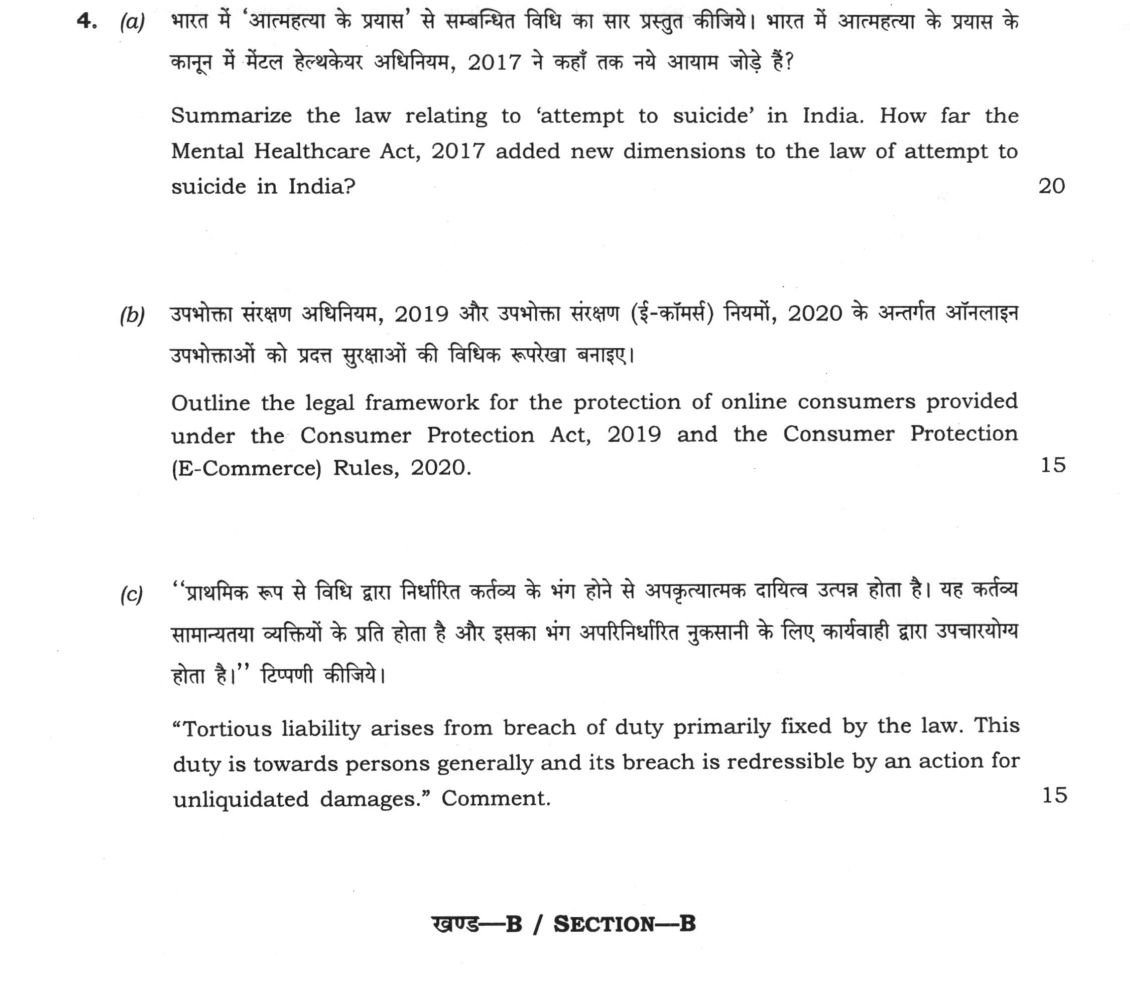
(a) Summarize the law relating to 'attempt to suicide' in India. How far the Mental Healthcare Act, 2017 added new dimensions to…
Summarize the law relating to 'attempt to suicide' in India. How far the Mental Healthcare Act, 2017 added new dimensions to the law of attempt to suicide in India? 20 marks
Outline the legal framework for the protection of online consumers provided under the Consumer Protection Act, 2019 and the Consumer Protection (E-Commerce) Rules, 2020. 15 marks
"Tortious liability arises from breach of duty primarily fixed by the law. This duty is towards persons generally and its breach is redressible by an action for unliquidated damages." Comment. 15 marks
हिंदी में प्रश्न पढ़ें
(क) भारत में 'आत्महत्या के प्रयास' से सम्बन्धित विधि का सार प्रस्तुत कीजिए। भारत में आत्महत्या के प्रयास के कानून में मैन्टल हेल्थकेयर अधिनियम, 2017 ने कहाँ तक नये आयाम जोड़े हैं? (20 अंक)
(ख) उपभोक्ता संरक्षण अधिनियम, 2019 और उपभोक्ता संरक्षण (ई-कॉमर्स) नियमों, 2020 के अन्तर्गत ऑनलाइन उपभोक्ताओं को प्रदत्त सुरक्षाओं की विधिक रूपरेखा बनाइए। (15 अंक)
(ग) "प्राथमिक रूप से विधि द्वारा निर्धारित कर्तव्य के भंग होने से अपकृत्यात्मक दायित्व उत्पन्न होता है। यह कर्तव्य सामान्यतया व्यक्तियों के प्रति होता है और इसका भंग अपरिनिधीरित नुकसानी के लिए कार्यवाही द्वारा उपचारयोग्य होता है।" टिप्पणी कीजिए। (15 अंक)
Model answer
Written by UPSC Answer Check against this question's marking rubric, to the expected length. UPSC does not publish answers for Mains — this is one way to score well, not an official key.
Attempt to suicide. The law on attempt to suicide in India has moved from criminal punishment to therapeutic protection. Section 309 IPC, once restored in Gulab Kaur, is now largely inoperative for ordinary attempts because the Mental Healthcare Act, 2017 decriminalized them. Section 115(1) provides that a person who attempts suicide shall be presumed, unless the contrary is proved, to have severe stress and shall not be tried or punished under Section 309 IPC. Section 115(2) requires the State to provide care and rehabilitation. This shifts the State’s role from punishment to healthcare and makes the presumption rebuttable. It is not absolute: Section 115(3) excludes attempts made in furtherance of a criminal offence or conspiracy. Pending Section 309 proceedings, absent that exception, should be disposed of in light of the bar to trial and punishment. Constitutionally, Article 21’s right to die with dignity, read with MHCA mental-health rights, supports treating suicidal behaviour as distress rather than crime. Common Cause v. Union of India (2018) recognized passive euthanasia and advance directives, reinforcing dignity and refusal of treatment, but did not decriminalize attempt to suicide; its interplay is to keep the law protective rather than punitive.
Online consumer protection. The Consumer Protection Act, 2019 defines e-commerce under Section 2(16) as buying or selling goods or services online. Section 2(7) enumerates consumer rights, while Section 2(42) defines unfair trade practice and Section 2(46) defines unfair contract, protecting online consumers from misleading or exploitative terms. Section 94 empowers the Central Consumer Protection Authority to inquire into unfair trade practices or false or misleading advertisements and to direct cessation, modification or correction. Product liability under the Act makes manufacturers, service providers and sellers liable for defective goods or services, including online sales. Consumer Commissions provide value-based redressal over e-commerce disputes and interim relief. The E-Commerce Rules, 2020 distinguish inventory entities, which buy and resell, from marketplace entities, which provide platforms for third-party sellers. They require sellers and entities to disclose name, address, contact and GSTIN; marketplace entities must verify sellers and display seller details. The Rules prohibit unfair trade practices, including manipulation of search results and misleading representations, require informed consent before sharing consumer data, and mandate grievance redressal through a Grievance Officer, response within 48 hours and resolution within 30 days. Non-compliance attracts penalties under Sections 103 and 104 of the Act.
Tortious liability. Winfield’s definition identifies tort as a civil wrong arising from breach of a duty fixed by law, owed to persons generally, and redressible by unliquidated damages. This distinguishes tort from contract, where duties arise from agreement and damages may be liquidated in advance, and from quasi-contract, which prevents unjust enrichment rather than punishing a wrongful act. The duty is not a proprietary right but a legal obligation to the world at large, enforceable by any person suffering legal injury. Donoghue v. Stevenson’s neighbour principle extends the duty to foreseeable persons, not only contractual parties. The essential elements are a wrongful act or omission, legal damage, and a remedy by damages. Legal damage means violation of a legal right: mere loss, damnum sine injuria, is not actionable, while infringement of a right without loss, injuria sine damno, may be. Damages are unliquidated because they are not fixed by the parties but assessed by the court according to loss, making judicial quantification central. Illustrations include Rylands v. Fletcher, where strict liability arises for escape of dangerous things; nuisance, which protects use and enjoyment of land; and negligence, which requires breach of a duty of care. In India, tort coexists with the Motor Vehicles Act, 1988, and product liability under the Consumer Protection Act, 2019, showing its continuing relevance.
What "Summarize" is asking you to do
Compress a body of material — a statute and the case law on it, a report, an argument — to its operative substance without losing the thread that holds it together. A summary that keeps every topic but drops the connection between them has lost the thing worth keeping.
Structure that answers it
What the body of material establishes → its operative elements in the order they work → the qualifications that survive compression → the position as it now stands
Where marks are lost
Adding your own assessment. A summary reports the position; judging it is a different directive.
How this answer will be evaluated
Approach
Framework: Issue > Rule > Authority > Application. (a) explain: definition/context > points in order > small example > short close | (b) explain: definition/context > points in order > small example > short close | (c) comment: context > arguments both sides > judgment > close Full marks: Precise statutory citations, clear case ratios, and a logical flow from issue to conclusion.
Key points expected
- Cite Section 309 IPC and its decriminalization status
- Reference P. Rathinam v. Union of India and its ratio
- Detail Section 115 of the Mental Healthcare Act, 2017
- Explain the shift from punishment to care and rehabilitation
- Define 'e-commerce entity' and 'platform' under the 2020 Rules
- Explain the 'grievance officer' and 'nodal officer' requirements
- Detail the 'right to return' and 'refund' provisions
- Mention the role of the Central Consumer Protection Authority (CCPA)
Evaluation rubric
Each sub-part is marked on its own, against the marks and word limit printed on the paper.
- (a) Summarize the legal evolution of suicide attempt laws and the specific changes introduced by the Mental Healthcare Act, 2017. 20 marks
explain— definition/context → points in order → small example → short close
Must cover
- Cite Section 309 IPC and its decriminalization status
- Reference P. Rathinam v. Union of India and its ratio
- Detail Section 115 of the Mental Healthcare Act, 2017
- Explain the shift from punishment to care and rehabilitation
Loses marks
- Failing to distinguish old IPC provisions from new Act
- Citing case outcomes without explaining the legal ratio
- Ignoring the 'care and rehabilitation' aspect of MHA 2017
Earns more
- Mention the 2015 Supreme Court judgment in Rameshwar v. State of Chhattisgarh
- Discuss the 'duty of care' for family and state
- Reference the Law Commission of India report on decriminalization
- Mention the 2018 amendment to Section 309 IPC
Extra mark
- Cite specific statistics on suicide rates in India
- Reference the National Suicide Prevention Strategy
- (b) Outline the legal framework for online consumer protection under the 2019 Act and 2020 E-Commerce Rules. 15 marks
explain— definition/context → points in order → small example → short close
Must cover
- Define 'e-commerce entity' and 'platform' under the 2020 Rules
- Explain the 'grievance officer' and 'nodal officer' requirements
- Detail the 'right to return' and 'refund' provisions
- Mention the role of the Central Consumer Protection Authority (CCPA)
Loses marks
- Confusing 'e-commerce entity' with 'platform' definitions
- Ignoring the 'grievance officer' requirement in the 2020 Rules
- Failing to link the 2019 Act to the 2020 Rules
Earns more
- Discuss the 'prohibition of unfair trade practices' in e-commerce
- Explain the 'product liability' for e-commerce entities
- Mention the 'consumer dispute redressal' mechanism for online issues
- Reference the 'data protection' aspects of the 2020 Rules
Extra mark
- Cite specific examples of CCPA actions against e-commerce platforms
- Reference the 'Consumer Protection (E-Commerce) Rules, 2020' notification date
- (c) Comment on the nature of tortious liability, specifically the breach of duty and unliquidated damages. 15 marks
comment— context → arguments both sides → judgment → close
Must cover
- Define 'tortious liability' and its distinction from contractual liability
- Explain 'breach of duty' as a primary element of tort
- Discuss 'unliquidated damages' and how they differ from liquidated damages
- Reference the 'duty of care' in negligence cases
Loses marks
- Confusing 'tortious liability' with 'contractual liability'
- Failing to explain 'unliquidated damages' clearly
- Ignoring the 'breach of duty' aspect in the comment
Earns more
- Cite Donoghue v. Stevenson and its ratio on duty of care
- Mention the 'neighbour principle' in tort law
- Discuss the 'remoteness of damage' in tortious liability
- Reference the 'defences' available in tort cases
Extra mark
- Cite a recent Supreme Court judgment on tortious liability
- Reference the 'Law Commission of India' report on tort law
Practice this exact question
Write your answer and it is marked point by point against the model answer above — what you covered, what you missed, what you got wrong.
Evaluate my answer →More from Law 2022 Paper II
- Q1 Answer the following in about 150 words each. Support your answers with relevant legal pr…
- Q2 (a) The 'State Liability' under the Law of Tort has undergone metamorphosis. Explain with…
- Q3 (a) What do you understand by an 'unlawful assembly'? Discuss the circumstances when a la…
- Q4 (a) Summarize the law relating to 'attempt to suicide' in India. How far the Mental Healt…
- Q5 Answer the following in about 150 words each. Support your answers with relevant legal pr…
- Q6 (a) "The liability of a surety is coextensive with principal debtor, unless it is otherwi…
- Q7 (a) State the circumstances of supervening impossibility and frustration of contract in t…