Paper II — Q2
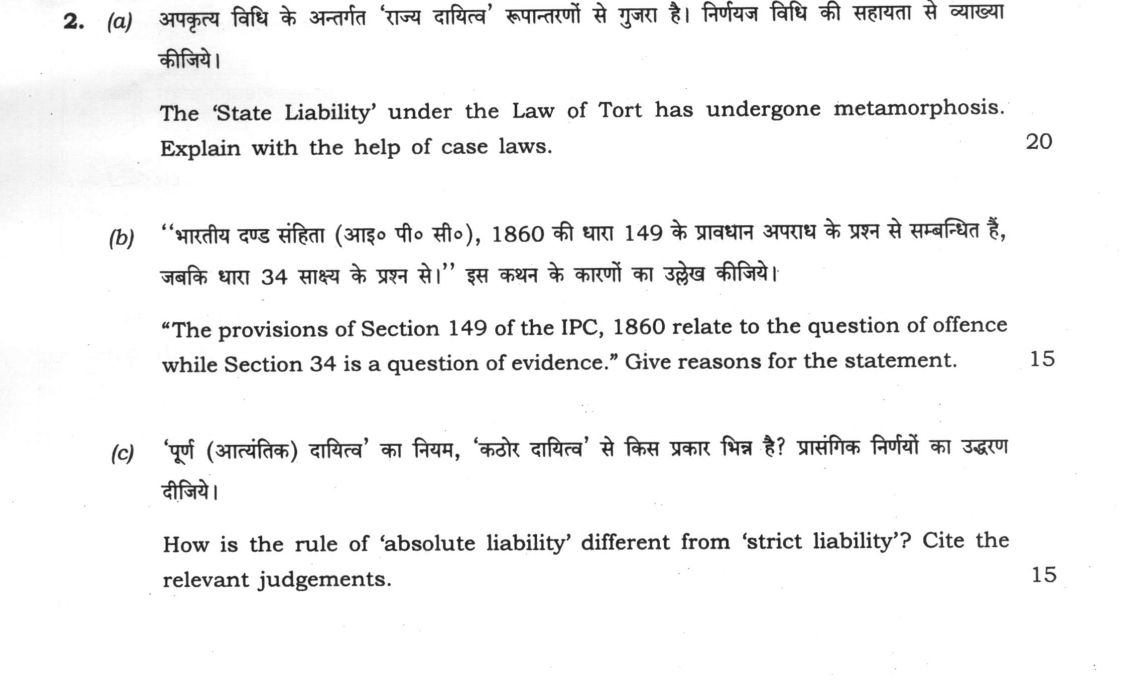
(a) The 'State Liability' under the Law of Tort has undergone metamorphosis. Explain with the help of case laws. (20 marks) (b)…
The 'State Liability' under the Law of Tort has undergone metamorphosis. Explain with the help of case laws. 20 marks
"The provisions of Section 149 of the IPC, 1860 relate to the question of offence while Section 34 is a question of evidence." Give reasons for the statement. 15 marks
How is the rule of 'absolute liability' different from 'strict liability'? Cite the relevant judgements. 15 marks
हिंदी में प्रश्न पढ़ें
(क) अपकृति विधि के अंतर्गत 'राज्य दायित्व' रूपान्तरणों से गुजरा है। निर्णय विधि की सहायता से व्याख्या कीजिये। (20 अंक)
(ख) "भारतीय दण्ड संहिता (आई० पी० सी०), 1860 की धारा 149 के प्रावधान अपराध के प्रश्न से सम्बन्धित हैं, जबकि धारा 34 साक्ष्य के प्रश्न से।" इस कथन के कारणों का उल्लेख कीजिये। (15 अंक)
(ग) 'पूर्ण (आत्यंतिक) दायित्व' का नियम, 'कठोर दायित्व' से किस प्रकार भिन्न है? प्रासांगिक निर्णयों का उद्धरण दीजिये। (15 अंक)
Model answer
Written by UPSC Answer Check against this question's marking rubric, to the expected length. UPSC does not publish answers for Mains — this is one way to score well, not an official key.
(a) State liability State liability has metamorphosed from feudal Crown immunity to constitutional accountability. Earlier, the State was not answerable for torts of its servants. In P&O Steam Navigation Co. v. Secretary of State (1861), decided by the Supreme Court at Calcutta, and Stanley v. Secretary of State, sovereign acts were treated as beyond private-law liability. Kishanchand v. State of Rajasthan continued this immunity approach. After independence, Article 300 made the State a legal person that can sue and be sued, but Kasturilal v. State of U.P. (1952) still drew a sovereign/non-sovereign divide, holding the State liable only for non-sovereign functions. Shyam Sunder v. State of Rajasthan (1974) widened liability by holding the State liable for a government vehicle accident as a non-sovereign activity. Nilabati Behera v. State of Orissa (1993) rejected the rigid sovereign/non-sovereign dichotomy as inconsistent with a welfare State, and Common Cause v. Union of India (1996) held the State liable for its servants’ torts like a private employer. The mechanism is causal: when the State performs public and welfare functions, immunity would make citizens bear State negligence; modern law therefore rejects feudal immunity and makes the State answerable under Article 300.
(b) Sections 34 and 149 IPC Section 34 is a rule of evidence, not a substantive offence. It creates no new crime; it merely makes each person liable for an act done by several persons in furtherance of a common intention. The common intention may be pre-existing or formed on the spot, as in Kripal Singh v. State of Rajasthan; prior concert is not indispensable, but participation in the common act is necessary. Its function is evidentiary: from acts, omissions and conduct, the court infers shared intention. Section 149, by contrast, relates to the question of offence. It makes every member of an unlawful assembly liable for an offence committed by any member in prosecution of the common object, even if the particular act was not specifically agreed. The substantive ingredient is membership in an unlawful assembly with a common object; presence suffices for constructive liability. Thus Section 34 proves joint liability for a particular act; Section 149 creates statutory liability for offences flowing from the common object, making it wider.
(c) Strict and absolute liability Strict liability in Rylands v. Fletcher (1868) makes a person liable for escape of a dangerous thing brought onto land, but defences exist: Act of God, third-party act, plaintiff’s fault. M.C. Mehta v. Union of India (1987) discussed these limits in the hazardous-industry context. Absolute liability emerged in the same Oleum Gas Leak case: an enterprise carrying on inherently dangerous activity is absolutely liable for harm caused by its operations, with no exceptions such as Act of God or third-party fault. It must bear the risk because it chose the hazardous activity and is best placed to prevent it. In M.C. Mehta, the Court also held that compensation should be proportionate to the capacity and financial magnitude of the enterprise, and exemplary damages may be awarded. Indian Council for Enviro-Legal Action v. Union of India reaffirmed this no-exception position for hazardous industries. The key differences are: strict liability requires escape and permits exceptions; absolute liability requires no escape and permits none; strict liability may limit compensation to actual loss, while absolute liability can impose exemplary, capacity-based damages in hazardous industries.
Thus, these doctrines reflect modern constitutional values: the State is accountable for public functions, criminal liability follows shared intention or common object, and hazardous enterprises bear the full risk of their operations. This shift from immunity to accountability ensures that public power is exercised with responsibility, and that victims are not left without remedy.
What "Explain" is asking you to do
Make the working of something clear — what sets it off, what follows from what, and what it produces. Explain is the Commission's mechanism word: it dominates the technical papers and the “explain why” stems, where the marks sit in the causal chain and not in the label.
Structure that answers it
State what it is → the initiating condition → the chain of cause, step by step → an instance where it plays out → what the chain produces
Where marks are lost
Describing what something looks like instead of why it works that way. Naming the stages without linking them reads as description too.
How this answer will be evaluated
Approach
Framework: Issue > Rule > Authority > Application. (a) explain: definition/context > points in order > small example > short close | (b) justify: claim > 3-4 reasons > evidence > conclusion | (c) compare: paired headings or table > key differences > significance > conclusion Full marks: Precise legal reasoning, accurate case citations, clear distinction between concepts, and balanced analysis.
Key points expected
- Cite the rule of sovereign immunity (King can do no wrong)
- Distinguish between sovereign and non-sovereign functions
- Cite the ratio of State of Rajasthan v. Gundu
- Cite the ratio of Union of India v. State of Punjab
- Define common intention under Section 34 IPC
- Define common object under Section 149 IPC
- Explain that Section 34 requires pre-arranged plan
- Explain that Section 149 requires active participation in common object
Evaluation rubric
Each sub-part is marked on its own, against the marks and word limit printed on the paper.
- (a) Trace the evolution of State Liability in Tort Law through case law. 20 marks
explain— definition/context → points in order → small example → short close
Must cover
- Cite the rule of sovereign immunity (King can do no wrong)
- Distinguish between sovereign and non-sovereign functions
- Cite the ratio of State of Rajasthan v. Gundu
- Cite the ratio of Union of India v. State of Punjab
Loses marks
- Restating facts of cases without stating the legal ratio
- Failing to distinguish between sovereign and non-sovereign acts
- Discussing State Liability without citing specific case laws
Earns more
- Mention the 1950 Constitution (74th Amendment) impact
- Discuss the shift from absolute to vicarious liability
Extra mark
- Reference the Law Commission of India report on State Liability
- (b) Justify the distinction between Section 149 (offence) and Section 34 (evidence). 15 marks
justify— claim → 3-4 reasons → evidence → conclusion
Must cover
- Define common intention under Section 34 IPC
- Define common object under Section 149 IPC
- Explain that Section 34 requires pre-arranged plan
- Explain that Section 149 requires active participation in common object
Loses marks
- Confusing common intention with common object
- Failing to distinguish the evidentiary nature of Section 34
- Discussing the sections without citing relevant case law
Earns more
- Cite the ratio in Barendra Kumar Ghosh v. Emperor
- Cite the ratio in Keshav Singh v. State of M.P.
- Mention the difference in mens rea requirements
Extra mark
- Reference the Law Commission of India report on IPC
- (c) Compare absolute liability and strict liability, citing relevant judgements. 15 marks
compare— paired headings or table → key differences → significance → conclusion
Must cover
- Define strict liability (Rylands v. Fletcher)
- Define absolute liability (M.C. Mehta v. Union of India)
- Explain that strict liability has defenses (act of God, etc.)
- Explain that absolute liability has no defenses
Loses marks
- Confusing strict liability with absolute liability
- Failing to cite the M.C. Mehta case for absolute liability
- Discussing the rules without citing relevant case law
Earns more
- Cite the ratio in M.C. Mehta v. Union of India
- Cite the ratio in Rylands v. Fletcher
- Mention the application of absolute liability in environmental cases
Extra mark
- Reference the Law Commission of India report on Environmental Law
Practice this exact question
Write your answer and it is marked point by point against the model answer above — what you covered, what you missed, what you got wrong.
Evaluate my answer →More from Law 2022 Paper II
- Q1 Answer the following in about 150 words each. Support your answers with relevant legal pr…
- Q2 (a) The 'State Liability' under the Law of Tort has undergone metamorphosis. Explain with…
- Q3 (a) What do you understand by an 'unlawful assembly'? Discuss the circumstances when a la…
- Q4 (a) Summarize the law relating to 'attempt to suicide' in India. How far the Mental Healt…
- Q5 Answer the following in about 150 words each. Support your answers with relevant legal pr…