Paper II — Q3
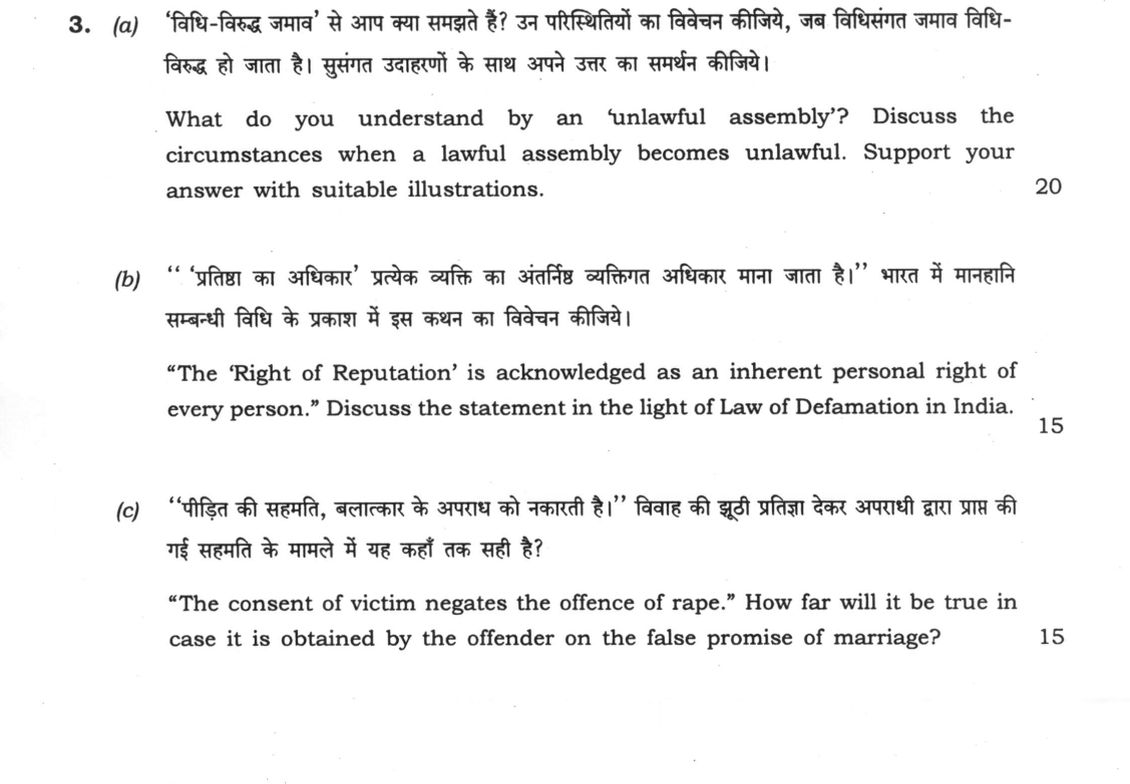
(a) What do you understand by an 'unlawful assembly'? Discuss the circumstances when a lawful assembly becomes unlawful. Support…
What do you understand by an 'unlawful assembly'? Discuss the circumstances when a lawful assembly becomes unlawful. Support your answer with suitable illustrations. 20 marks
"The 'Right of Reputation' is acknowledged as an inherent personal right of every person." Discuss the statement in the light of Law of Defamation in India. 15 marks
"The consent of victim negates the offence of rape." How far will it be true in case it is obtained by the offender on the false promise of marriage? 15 marks
हिंदी में प्रश्न पढ़ें
(क) 'विधि-विरुद्ध जमाव' से आप क्या समझते हैं? उन परिस्थितियों का विवेचन कीजिये, जब विधिसंगत जमाव विधि-विरुद्ध हो जाता है। सुसंगत उदाहरणों के साथ अपने उत्तर का समर्थन कीजिये। (20 अंक)
(ख) "'प्रतिष्ठा का अधिकार' प्रत्येक व्यक्ति का अंतर्निहित व्यक्तिगत अधिकार माना जाता है।" भारत में मानहानि सम्बन्धी विधि के प्रकाश में इस कथन का विवेचन कीजिये। (15 अंक)
(ग) "'पीड़ित की सहमति, बलात्कार के अपराध को नकारती है।' विवाह की झूठी प्रतिज्ञा देकर अपराधी द्वारा प्राप्त की गई सहमति के मामले में यह कहाँ तक सही है? (15 अंक)
Model answer
Written by UPSC Answer Check against this question's marking rubric, to the expected length. UPSC does not publish answers for Mains — this is one way to score well, not an official key.
Unlawful assembly An unlawful assembly under Section 141 IPC is an assembly of five or more persons having a common object which is one of five statutory objects: to overawe the Legislature, courts or public servants; to compel a public servant to omit an act; to commit mischief, rioting or dacoity; to take possession of property by criminal force or intimidation; or to assert or demand a right by criminal force or intimidation. The ingredients are numerical strength, common object and one of the enumerated illegal objects. A lawful assembly becomes unlawful when the common object changes to an illegal one, when members use criminal force or intimidation, or when they continue after a lawful dispersal order under Section 144 CrPC. Illustration: a peaceful march becomes unlawful if participants suddenly decide to storm a government building; another: a lawful meeting becomes unlawful if, after a 144 order, they persist. Liability under Section 149 attaches to each member for offences committed in prosecution of the common object, but not for mere presence; Bhanwar Singh v State of Rajasthan and Masalti v State of U.P. require common object and participation. It differs from rioting under Section 146, where three or more persons with a common object use criminal force or intimidation, and affray under Section 159, where two or more persons fight in a public place disturbing peace.
Reputation and defamation The right of reputation is an inherent personal right, constitutionally protected as part of Article 21’s dignity and privacy; reputation also forms a ground for reasonable restriction under Article 19(2). In K.S. Puttaswamy v Union of India, the Supreme Court recognised privacy, autonomy and dignity, bringing reputation within the protective ambit of Article 21. In R. Rajagopal v State of Tamil Nadu, the Court linked reputation to privacy while balancing public interest and free speech, especially for public officials. Defamation by a private person remains a common-law tort and a criminal offence under Sections 499-502 IPC; it is not a constitutional tort. Section 499 defines defamation as making or publishing an imputation, spoken or written, that harms reputation, subject to exceptions such as truth, fair comment and public interest. The law balances Article 19(1)(a) with reputation: speech may be protected where it serves public interest, but false, malicious imputations can be restrained. Indian law does not maintain the English libel/slander distinction; spoken and written defamatory statements are treated within the same statutory framework.
Consent and false promise of marriage The statement is partly true: consent generally negates rape, but consent obtained by a false promise of marriage may be vitiated. Section 375 IPC, read with Explanation 2, treats consent as free assent; consent obtained by fear, deception, or a misconception of fact is not valid. Uday v State of Karnataka, Deelip Singh v State of Bihar and Pramod Suryabhan Pawar v State of Maharashtra held that a promise made with no intention to perform can amount to rape. The crucial distinction is between a false promise, where mens rea exists from the beginning, and a mere breach of promise, where the promisor later changes mind; the latter does not automatically amount to rape. Courts examine the totality: conduct before and after, capacity to marry, repeated assurances, and mala fide intent. Dharambir v State of Haryana cautions against treating every broken promise as rape and requires proof that the promise was false from the outset. Thus, consent is not a blanket defence where it is procured by deliberate deception.
Conclusion These provisions show that criminal law protects collective order, personal reputation and sexual autonomy. A balanced approach requires objective proof of common object, reputation balanced with free speech, and genuine consent free from deception.
What "Discuss" is asking you to do
Lay the issue out from more than one side — how it arose, what is claimed for it, what is held against it, and where it now stands. UPSC attaches discuss to broad topics with several live dimensions, so coverage of the dimensions earns more than the strength of your opinion.
Structure that answers it
Set the issue up → the case as it is made → the case against → the dimension both sides leave out → where the balance now lies
Where marks are lost
Listing facts with no thread between them, or arguing one side throughout and calling it a discussion.
How this answer will be evaluated
Approach
Framework: Issue > Rule > Authority > Application. (a) discuss: intro > 3-4 dimensions > example > balanced close | (b) discuss: intro > 3-4 dimensions > example > balanced close | (c) comment: context > arguments both sides > judgment > close Full marks: Precise statutory citations, clear application of law to facts, balanced discussion with case law.
Key points expected
- Define 'unlawful assembly' under Section 141 IPC
- List the five common objects under Section 141
- Explain 'mutability' of assembly (Section 149 IPC)
- Provide illustrations of lawful turning unlawful
- Define defamation under Section 499 IPC
- Distinguish civil and criminal defamation
- Discuss 'inherent personal right' aspect
- Mention exceptions under Section 499
Evaluation rubric
Each sub-part is marked on its own, against the marks and word limit printed on the paper.
- (a) Define unlawful assembly and analyze the transition from lawful to unlawful status. 20 marks
discuss— intro → 3-4 dimensions → example → balanced close
Must cover
- Define 'unlawful assembly' under Section 141 IPC
- List the five common objects under Section 141
- Explain 'mutability' of assembly (Section 149 IPC)
- Provide illustrations of lawful turning unlawful
Loses marks
- Defining assembly without Section 141
- Listing objects without 'common' intent
- No illustrations of transition
Earns more
- Cite Section 142 IPC (criminal force)
- Reference Section 143 IPC (punishment)
- Mention Section 149 IPC (common intention)
- Cite relevant Supreme Court case law
Extra mark
- Reference Law Commission report on IPC
- Cite recent Supreme Court judgment on mutability
- (b) Analyze the 'Right of Reputation' as an inherent right under Indian defamation law. 15 marks
discuss— intro → 3-4 dimensions → example → balanced close
Must cover
- Define defamation under Section 499 IPC
- Distinguish civil and criminal defamation
- Discuss 'inherent personal right' aspect
- Mention exceptions under Section 499
Loses marks
- Defining defamation without Section 499
- Ignoring civil/criminal distinction
- No discussion of 'inherent right' aspect
Earns more
- Reference Article 21 (Right to Life)
- Cite Subramanian Swamy v. Union of India
- Discuss Section 500 IPC (punishment)
- Mention Section 499 exceptions (truth, public interest)
Extra mark
- Reference Law Commission report on defamation
- Cite recent Supreme Court judgment on reputation
- (c) Evaluate the validity of consent obtained through false promise of marriage in rape cases. 15 marks
comment— context → arguments both sides → judgment → close
Must cover
- Define rape under Section 375 IPC
- Analyze 'consent' definition in Section 375
- Discuss 'false promise of marriage' exception
- Apply law to the specific scenario
Loses marks
- Defining rape without Section 375
- Ignoring 'false promise' exception
- No application to the specific scenario
Earns more
- Cite Section 375(9) (false promise)
- Reference Section 376 IPC (punishment)
- Discuss 'free consent' requirement
- Mention relevant case law on consent
Extra mark
- Reference Law Commission report on sexual offenses
- Cite recent Supreme Court judgment on consent
Practice this exact question
Write your answer and it is marked point by point against the model answer above — what you covered, what you missed, what you got wrong.
Evaluate my answer →More from Law 2022 Paper II
- Q1 Answer the following in about 150 words each. Support your answers with relevant legal pr…
- Q2 (a) The 'State Liability' under the Law of Tort has undergone metamorphosis. Explain with…
- Q3 (a) What do you understand by an 'unlawful assembly'? Discuss the circumstances when a la…
- Q4 (a) Summarize the law relating to 'attempt to suicide' in India. How far the Mental Healt…
- Q5 Answer the following in about 150 words each. Support your answers with relevant legal pr…
- Q6 (a) "The liability of a surety is coextensive with principal debtor, unless it is otherwi…