Paper II — Q6
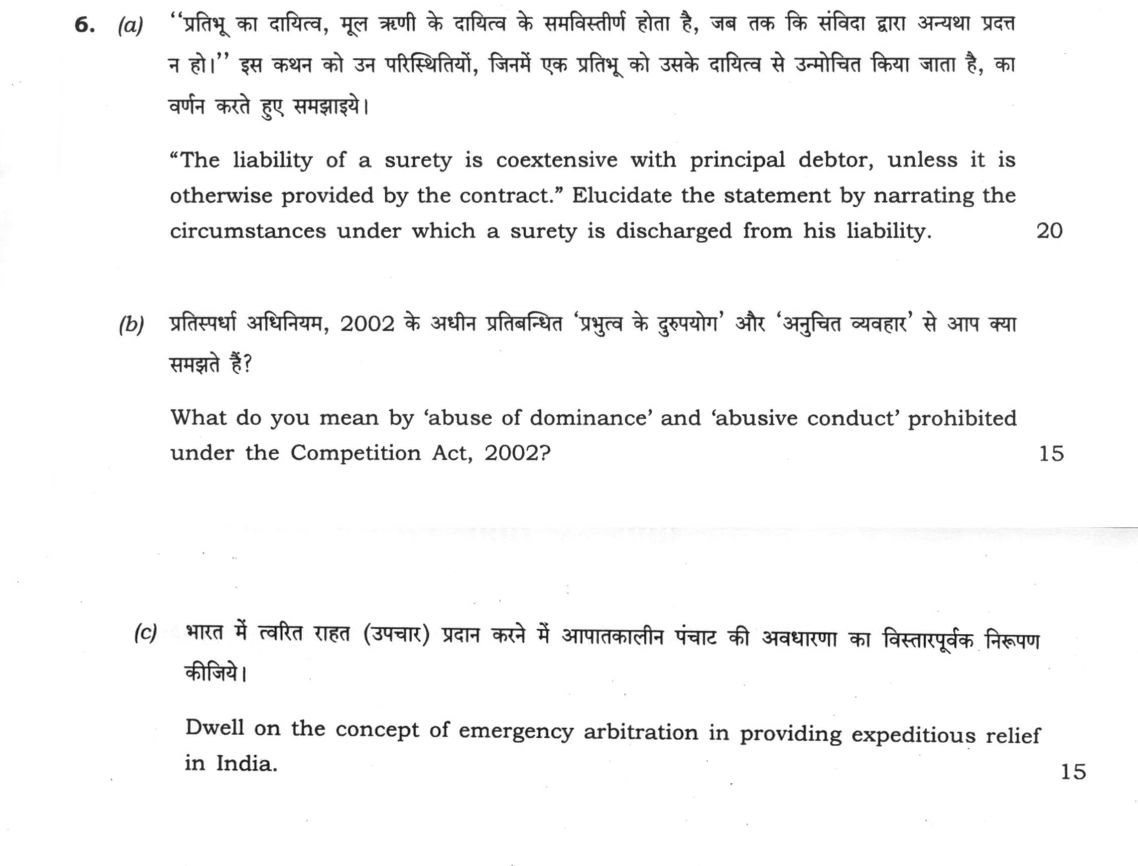
(a) "The liability of a surety is coextensive with principal debtor, unless it is otherwise provided by the contract." Elucidate…
"The liability of a surety is coextensive with principal debtor, unless it is otherwise provided by the contract." Elucidate the statement by narrating the circumstances under which a surety is discharged from his liability. 20 marks
What do you mean by 'abuse of dominance' and 'abusive conduct' prohibited under the Competition Act, 2002? 15 marks
Dwell on the concept of emergency arbitration in providing expeditious relief in India. 15 marks
हिंदी में प्रश्न पढ़ें
(क) "प्रतिभू का दायित्व, मूल ऋणी के दायित्व के समविस्तीर्ण होता है, जब तक कि संविदा द्वारा अन्यथा प्रदत्त न हो।" इस कथन को उन परिस्थितियों, जिनमें एक प्रतिभू को उसके दायित्व से उन्मोचित किया जाता है, का वर्णन करते हुए समझाइये। (20 अंक)
(ख) प्रतिस्पर्धा अधिनियम, 2002 के अधीन प्रतिबंधित 'प्रभुत्व के दुरुपयोग' और 'अनुचित व्यवहार' से आप क्या समझते हैं? (15 अंक)
(ग) भारत में त्वरित राहत (उपचार) प्रदान करने में आपातकालीन पंचाट की अवधारणा का विस्तारपूर्वक निरूपण कीजिये। (15 अंक)
Model answer
Written by UPSC Answer Check against this question's marking rubric, to the expected length. UPSC does not publish answers for Mains — this is one way to score well, not an official key.
Part (a) The statement restates Section 128 of the Indian Contract Act, 1872: a surety’s liability is coextensive with the principal debtor’s unless the guarantee contract provides otherwise. A guarantee is a secondary promise to answer for the principal debtor’s default, whereas an indemnity is a primary promise to compensate loss; in a guarantee the creditor’s primary recourse is against the debtor. Coextensive liability means the surety is liable for the same debt, interest and costs, subject to the guarantee’s terms. The principle is qualified by limited guarantees, which fix a sum or period; continuing guarantees, which cover future transactions until revoked; and conditional guarantees, where liability arises only on a condition. SBI v Premco Saw Mill (1983) and K. Surendran v Punjab National Bank (2018) illustrate that courts enforce the guarantee according to its terms and apply statutory discharges only where the contract does not otherwise provide.
A surety is discharged where a condition precedent or contingency does not happen (Section 132), and under the guarantee provisions where the creditor varies the terms without consent, releases or discharges the principal debtor, impairs the surety’s remedy by act or omission, loses or impairs security, or where a continuing guarantee is revoked by notice or the surety dies (Sections 133–139 and related provisions). Variance discharges the surety as to subsequent transactions; release of the principal debtor discharges the surety; impairment of remedy or loss of security discharges to the extent of the loss; revocation of a continuing guarantee by notice affects future transactions; and death discharges the surety unless the contract provides otherwise.
Part (b) Under Section 4(1) of the Competition Act, 2002, an enterprise or group is prohibited from abusing its dominant position in a relevant market. Dominant position is a position of strength enabling the enterprise to affect market terms, exclude competitors or act independently of competitive forces. Section 19(4) factors include market share, size and resources, vertical integration, consumer dependence, entry barriers and access to finance or technology. Section 4(2) lists abusive conduct: imposing unfair or discriminatory conditions, denial of market access by limiting production, distribution or withholding services, granting exclusive deals, predatory pricing, leveraging dominance in one market to enter or protect another, and abuse in related markets. Tying arrangements fall within unfair or discriminatory conditions. CCI decisions such as DLF v Belaire (2011) illustrate abuse through unfair conditions, while Google Search (2018) shows Section 4 applied to a dominant online search engine market.
Part (c) Emergency arbitration provides expeditious interim relief before the full tribunal is constituted. Under SIAC, ICC and LCIA rules, a party may apply for an emergency arbitrator, who is appointed urgently and may order interim measures for a limited period. It differs from Section 9 of the Arbitration and Conciliation Act, 1996, where courts grant interim measures; emergency arbitration is institution-based and tribunal-oriented, but its enforceability is uncertain because the Act does not expressly recognise it. In Raffles Design v Educomp (2016), the court treated an emergency arbitrator’s order as enforceable under Section 17, and in Ashwarya Housing v DLF (2017) the court specifically held that an emergency arbitrator’s order was enforceable under Section 17. The main challenge is that Section 17 ordinarily empowers the arbitral tribunal, not an emergency arbitrator, creating a conceptual conflict. The 246th Law Commission Report recommended statutory recognition and a clear enforcement mechanism. The 2019 amendments have not expressly codified emergency arbitration, but institutional practice and judicial acceptance point towards future legislative clarification.
The three topics regulate liability differently: guarantee law confines secondary liability, competition law polices market power, and arbitration law balances speed with enforceability.
What "Elucidate" is asking you to do
Make a stated proposition plain and then prove it with instances. Elucidate stems almost always carry a claim or a named concept, and very often the words “with examples” or “with suitable diagrams” — the illustration is part of the directive, not decoration.
Structure that answers it
Plain-language statement of what the proposition means → the part that is obscure, resolved → first illustration → second illustration → why the proposition holds
Where marks are lost
Adding terminology; elucidate rewards removing it. The commoner loss is a clean explanation with no example, when the stem asked for examples.
How this answer will be evaluated
Approach
Framework: Issue > Rule: statute or Article > Authority > Application and conclusion. (a) explain: definition/context > points in order > small example > short close | (b) define: precise definition > the distinguishing feature > one example | (c) discuss: intro > 3-4 dimensions > example > balanced close Full marks: Precise statutory citations, clear definitions, relevant case law, and balanced analysis.
Key points expected
- Cite Section 128 of the Indian Contract Act, 1872
- Define coextensive liability as identical to principal debtor
- List specific grounds for discharge (e.g., Section 133, 135, 137)
- Cite a relevant case law on surety's discharge
- Cite Section 4 of the Competition Act, 2002
- Define 'abuse of dominant position' (Section 4(1))
- Define 'abusive conduct' (Section 4(2))
- Distinguish between the two concepts clearly
Evaluation rubric
Each sub-part is marked on its own, against the marks and word limit printed on the paper.
- (a) Elucidate coextensive liability and narrate circumstances of surety's discharge. 20 marks
explain— definition/context → points in order → small example → short close
Must cover
- Cite Section 128 of the Indian Contract Act, 1872
- Define coextensive liability as identical to principal debtor
- List specific grounds for discharge (e.g., Section 133, 135, 137)
- Cite a relevant case law on surety's discharge
Loses marks
- Restating facts without applying legal principles
- Citing case outcomes without stating the ratio
- Failing to name the specific statutory section
Earns more
- Mention discharge by release of principal debtor
- Mention discharge by material alteration in contract
- Mention discharge by death of surety
- Mention discharge by creditor's act/omission
Extra mark
- Reference to Law Commission report on surety law
- Cite a recent Supreme Court judgment on surety liability
- (b) Define 'abuse of dominance' and 'abusive conduct' under the Competition Act, 2002. 15 marks
define— precise definition → the distinguishing feature → one example
Must cover
- Cite Section 4 of the Competition Act, 2002
- Define 'abuse of dominant position' (Section 4(1))
- Define 'abusive conduct' (Section 4(2))
- Distinguish between the two concepts clearly
Loses marks
- Confusing 'abuse of dominance' with 'abusive conduct'
- Failing to cite the specific section numbers
- Providing only general definitions without statutory basis
Earns more
- Mention 'dominant position' definition under Section 4(1)
- Give examples of abusive conduct (e.g., predatory pricing)
- Mention the role of the CCI in enforcement
- Reference to the 2002 Act's objective of fair competition
Extra mark
- Cite a specific CCI order on abuse of dominance
- Reference to the 2011 Amendment Act changes
- (c) Discuss the concept of emergency arbitration for expeditious relief in India. 15 marks
discuss— intro → 3-4 dimensions → example → balanced close
Must cover
- Define emergency arbitration and its purpose
- Cite Section 11(6) of the Arbitration and Conciliation Act, 1996
- Explain the role of the court in appointing arbitrators
- Discuss the concept of interim measures under Section 9
Loses marks
- Confusing emergency arbitration with ordinary arbitration
- Failing to cite the specific statutory provisions
- Discussing only the concept without legal basis
Earns more
- Mention the 2015 Amendment Act changes
- Discuss the role of the arbitral tribunal in interim relief
- Mention the concept of 'expeditious relief' in arbitration
- Reference to the Supreme Court's stance on emergency arbitration
Extra mark
- Cite the Supreme Court judgment in 'Sundaram Finance'
- Reference to the Law Commission report on arbitration
Practice this exact question
Write your answer and it is marked point by point against the model answer above — what you covered, what you missed, what you got wrong.
Evaluate my answer →More from Law 2022 Paper II
- Q3 (a) What do you understand by an 'unlawful assembly'? Discuss the circumstances when a la…
- Q4 (a) Summarize the law relating to 'attempt to suicide' in India. How far the Mental Healt…
- Q5 Answer the following in about 150 words each. Support your answers with relevant legal pr…
- Q6 (a) "The liability of a surety is coextensive with principal debtor, unless it is otherwi…
- Q7 (a) State the circumstances of supervening impossibility and frustration of contract in t…
- Q8 (a) What are the essentials of an agency? How is an agency created and terminated under t…