Paper II — Q8
(a) What are the essentials of an agency? How is an agency created and terminated under the Indian Contract Act, 1872? (20…
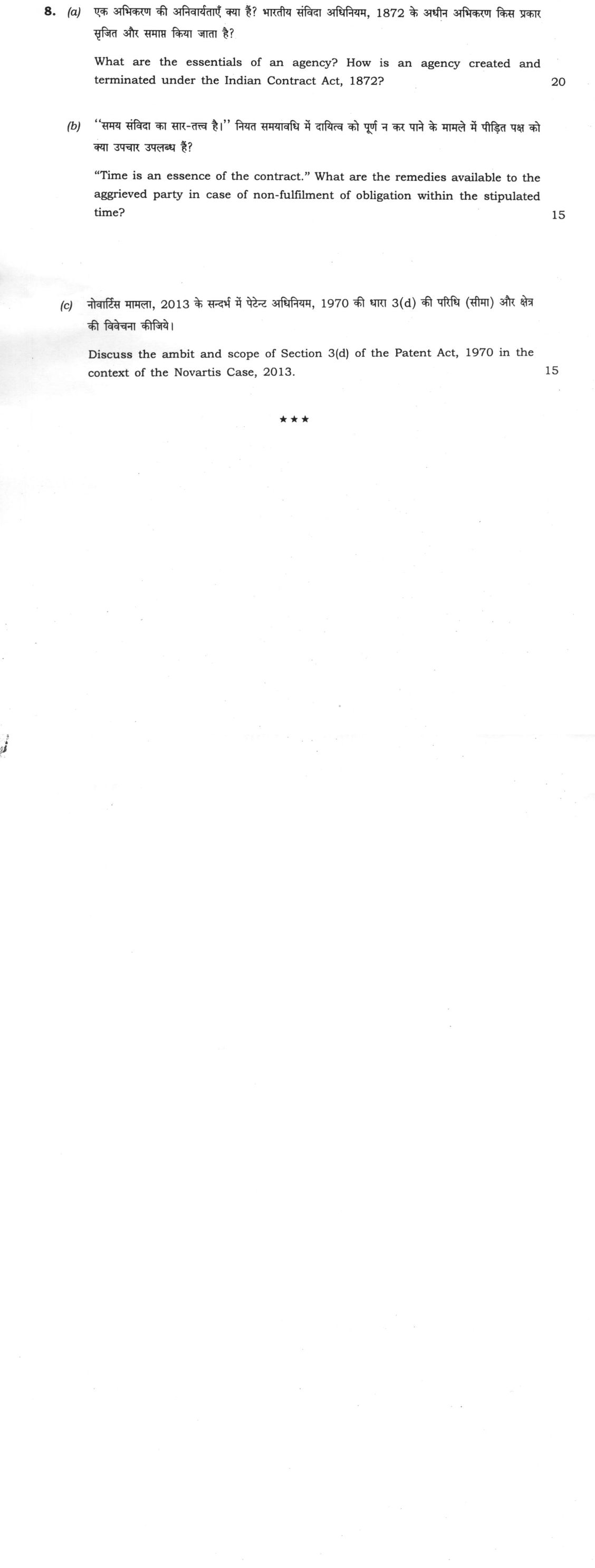
What are the essentials of an agency? How is an agency created and terminated under the Indian Contract Act, 1872? 20 marks
"Time is an essence of the contract." What are the remedies available to the aggrieved party in case of non-fulfilment of obligation within the stipulated time? 15 marks
Discuss the ambit and scope of Section 3(d) of the Patent Act, 1970 in the context of the Novartis Case, 2013. 15 marks
हिंदी में प्रश्न पढ़ें
(क) एक अभिकरण की अनिवार्यताएं क्या हैं? भारतीय संविदा अधिनियम, 1872 के अधीन अभिकरण किस प्रकार सृजित और समाप्त किया जाता है? (20 अंक)
(ख) "समय संविदा का सार-तत्त्व है।" नियत समयावधि में दायित्व को पूर्ण न कर पाने के मामले में पीड़ित पक्ष को क्या उपचार उपलब्ध हैं? (15 अंक)
(ग) नोवार्टिस मामला, 2013 के संदर्भ में पेटेंट अधिनियम, 1970 की धारा 3(d) की परिधि (सीमा) और क्षेत्र की विवेचना कीजिए। (15 अंक)
Model answer
Written by UPSC Answer Check against this question's marking rubric, to the expected length. UPSC does not publish answers for Mains — this is one way to score well, not an official key.
Indian commercial law balances private autonomy, punctuality and public welfare. Agency, contractual time and patentability regulate how private rights are created, performed and limited.
Agency Agency is a contract under Sections 182-238 of the Indian Contract Act, 1872, where one person (agent) is authorised to represent another (principal) in dealings with third parties. Its essentials are consent, competent parties, lawful object and consideration, and authority coupled with fiduciary duty. The agent must act within authority, avoid conflict of interest, and account for profits. It may be created expressly, impliedly by conduct, by ratification, estoppel where the principal holds out another as agent, or necessity where the principal cannot be reached. Termination follows by revocation by the principal, renunciation by the agent, death or insanity of the principal, adjudication of the principal as insolvent under Section 201, death of the agent, completion of the business, or destruction of the subject-matter; the agent’s insolvency is not a ground under Section 201. The agent differs from a servant: the agent acts with discretion and can bind the principal within authority, while a servant works under control and binds the master only through vicarious liability or ostensible authority. Thus agency depends on conferred authority, not mere employment.
Time as essence Under Section 55, if a party fails to perform at the stipulated time and time is of the essence, the promisee may rescind; if time is not of the essence, the contract survives and the defaulting party pays damages. The distinction is between mandatory time, where delay defeats the commercial purpose, and directory time, where delay is excused with compensation. The aggrieved party may claim rescission or damages; where time is not essential, he may seek specific performance, but the court may refuse it against the defaulting party if delay defeats the commercial purpose. Rescission must be communicated, and damages under Section 73 cover loss naturally arising or foreseen by the parties. The parties may also extend time by waiver or fresh agreement. Judicial discretion under Section 55(2) and the commercial-purpose test require courts to examine whether the contract was made for a particular date, season, market or transaction, as in shipping, sale of perishables, or time-bound tenders.
Section 3(d) and Novartis Section 3(d) of the Patent Act, 1970 provides that a new form of a known substance is patentable only if it results in enhanced efficacy; it is an anti-evergreening provision. It also bars patents for new uses or improved methods unless there is enhanced efficacy, preventing minor modifications from extending monopoly. In Novartis AG v. Union of India (2013) 6 SCC 1, the Supreme Court held that imatinib mesylate, a salt of known imatinib, was not patentable because “enhanced efficacy” means a significant improvement in therapeutic efficacy, not merely bioavailability or a new salt. The case arose after India’s 2005 amendment replaced process-only patents with product patents to comply with TRIPS, while retaining public-health safeguards. The debate is between rewarding innovation and ensuring access to affordable medicines; the Doha Declaration supports TRIPS flexibilities for public health. The compliance debate is framed against TRIPS Article 27(1) and the Doha Declaration. Section 3(d) thus balances incentives with access.
These doctrines are interconnected. Agency law evolved from common-law fiduciary principles into statutory codification; contract law treats time as reflecting commercial urgency; patent law moved from process to product patents and back to efficacy-based limits. Together, fiduciary agency, sanctity of contractual time and public-interest patent balancing show how Indian commercial law regulates private rights while protecting third parties and the public.
What "Discuss" is asking you to do
Lay the issue out from more than one side — how it arose, what is claimed for it, what is held against it, and where it now stands. UPSC attaches discuss to broad topics with several live dimensions, so coverage of the dimensions earns more than the strength of your opinion.
Structure that answers it
Set the issue up → the case as it is made → the case against → the dimension both sides leave out → where the balance now lies
Where marks are lost
Listing facts with no thread between them, or arguing one side throughout and calling it a discussion.
How this answer will be evaluated
Approach
Framework: Issue > Rule > Authority > Application. (a) explain: definition/context > points in order > small example > short close | (b) explain: definition/context > points in order > small example > short close | (c) discuss: intro > 3-4 dimensions > example > balanced close Full marks: Precise statutory citations, clear application of law to facts, and balanced discussion of authorities.
Key points expected
- Define agency under Section 182 of the Act
- List essentials: consent, capacity, and lawful object
- Detail creation modes: express, implied, and estoppel
- List termination grounds under Sections 185-187
- Define 'time is of the essence' clause
- Explain right to terminate the contract
- Explain right to claim damages for delay
- Mention the effect of waiver or extension
Evaluation rubric
Each sub-part is marked on its own, against the marks and word limit printed on the paper.
- (a) Essentials, creation, and termination of agency under the Indian Contract Act, 1872. 20 marks
explain— definition/context → points in order → small example → short close
Must cover
- Define agency under Section 182 of the Act
- List essentials: consent, capacity, and lawful object
- Detail creation modes: express, implied, and estoppel
- List termination grounds under Sections 185-187
Loses marks
- Defining agency without citing Section 182
- Listing termination grounds without statutory reference
- Confusing agency with partnership or employment
Earns more
- Distinguish between express and implied agency
- Mention agency by estoppel (Section 183)
- Cite a case on termination by death
- Reference the Law Commission report on agency
Extra mark
- Cite a recent Supreme Court judgment on agency
- Reference a specific Law Commission report
- (b) Remedies for non-fulfilment of obligation within stipulated time. 15 marks
explain— definition/context → points in order → small example → short close
Must cover
- Define 'time is of the essence' clause
- Explain right to terminate the contract
- Explain right to claim damages for delay
- Mention the effect of waiver or extension
Loses marks
- Discussing remedies without defining the clause
- Confusing delay with total non-performance
- Ignoring the right to terminate the contract
Earns more
- Distinguish 'time is of the essence' from delay
- Cite a case on remedies for delay
- Mention the role of specific performance
- Reference the Indian Contract Act sections
Extra mark
- Cite a specific case on time essence
- Reference a Law Commission report on contracts
- (c) Ambit and scope of Section 3(d) of the Patent Act, 1970 in the Novartis Case, 2013. 15 marks
discuss— intro → 3-4 dimensions → example → balanced close
Must cover
- State the text of Section 3(d) of the Act
- Summarize the Novartis Case, 2013 facts and issue
- Explain the Supreme Court's interpretation of Section 3(d)
- Discuss the impact on pharmaceutical patents in India
Loses marks
- Discussing the case without citing Section 3(d)
- Confusing Section 3(d) with other patent exclusions
- Ignoring the public health policy context
Earns more
- Mention the concept of 'enhancement of known efficacy'
- Reference the public health policy behind Section 3(d)
- Cite the dissenting opinion in the Novartis Case
- Mention the impact on drug prices in India
Extra mark
- Cite a recent Supreme Court judgment on patents
- Reference a Law Commission report on IP law
Practice this exact question
Write your answer and it is marked point by point against the model answer above — what you covered, what you missed, what you got wrong.
Evaluate my answer →More from Law 2022 Paper II
- Q5 Answer the following in about 150 words each. Support your answers with relevant legal pr…
- Q6 (a) "The liability of a surety is coextensive with principal debtor, unless it is otherwi…
- Q7 (a) State the circumstances of supervening impossibility and frustration of contract in t…
- Q8 (a) What are the essentials of an agency? How is an agency created and terminated under t…