Paper II — Q5
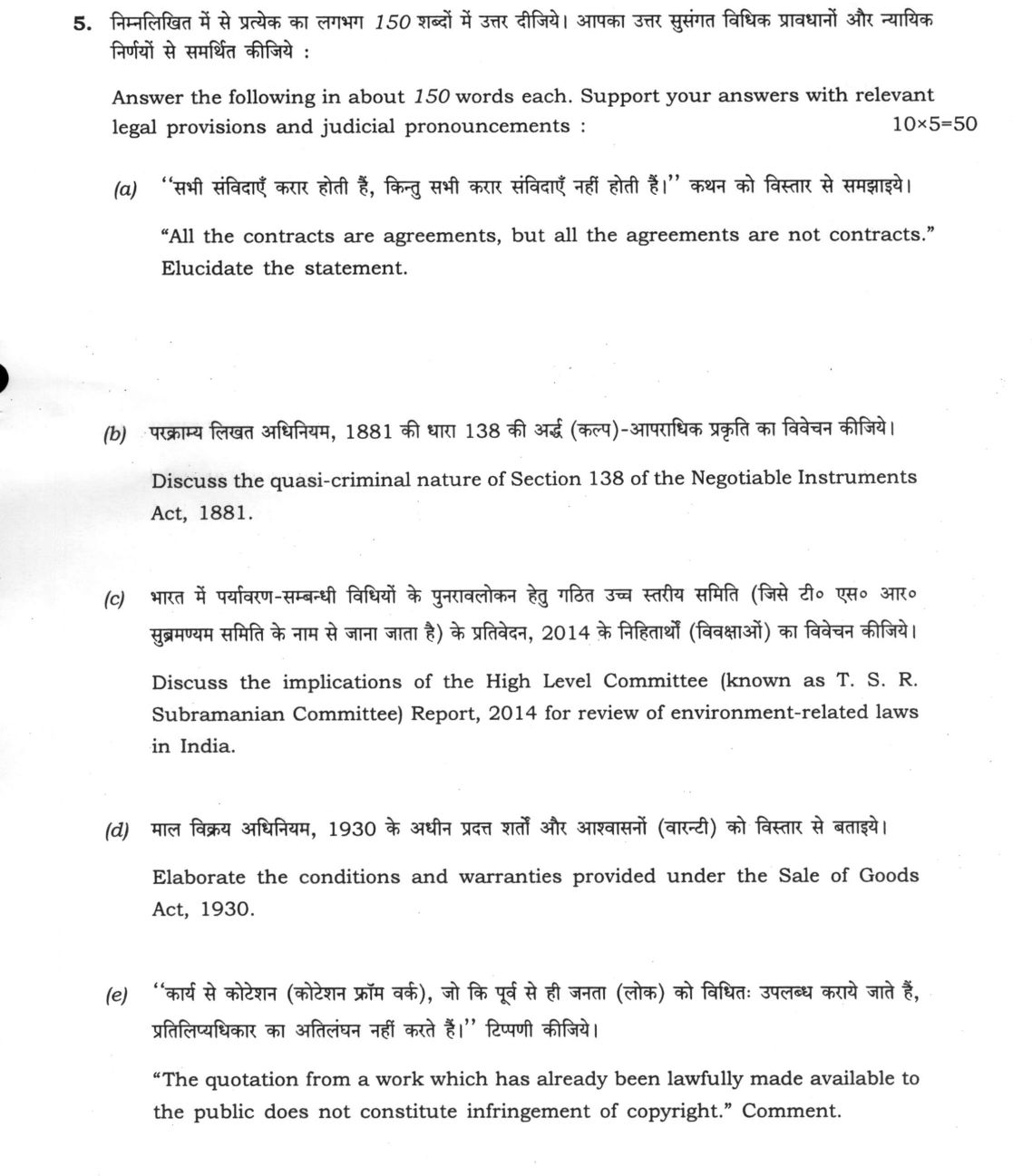
Answer the following in about 150 words each. Support your answers with relevant legal provisions and judicial pronouncements …
Answer the following in about 150 words each. Support your answers with relevant legal provisions and judicial pronouncements : 10×5=50
"All the contracts are agreements, but all the agreements are not contracts." Elucidate the statement. 10 marks
Discuss the quasi-criminal nature of Section 138 of the Negotiable Instruments Act, 1881. 10 marks
Discuss the implications of the High Level Committee (known as T. S. R. Subramanian Committee) Report, 2014 for review of environment-related laws in India. 10 marks
Elaborate the conditions and warranties provided under the Sale of Goods Act, 1930. 10 marks
"The quotation from a work which has already been lawfully made available to the public does not constitute infringement of copyright." Comment. 10 marks
हिंदी में प्रश्न पढ़ें
निम्नलिखित में से प्रत्येक का लगभग 150 शब्दों में उत्तर दीजिये। आपका उत्तर सुसंगत विधिक प्रावधानों और न्यायिक निर्णयों से समर्थित कीजिये : 10×5=50
(क) "सभी संविदाएँ करार होती हैं, किन्तु सभी करार संविदाएँ नहीं होती हैं।" कथन को विस्तार से समझाइये। (10 अंक)
(ख) परक्राम्य लिखत अधिनियम, 1881 की धारा 138 की अर्द्ध (कल्प)-आपराधिक प्रकृति का विवेचन कीजिये। (10 अंक)
(ग) भारत में पर्यावरण-संबंधी विधियों के पुनरावलोकन हेतु गठित उच्च स्तरीय समिति (जिसे टी० एस० आर० सुब्रमण्यम समिति के नाम से जाना जाता है) के प्रतिवेदन, 2014 के निहितार्थों (विवक्षाओं) का विवेचन कीजिये। (10 अंक)
(घ) माल विक्रय अधिनियम, 1930 के अधीन प्रदत्त शर्तों और आश्वासनों (वारंटी) को विस्तार से बताइये। (10 अंक)
(ङ) "कार्य से कोटेशन (कोटेशन फ्रॉम वर्क), जो कि पूर्व से ही जनता (लोक) को विधितः उपलब्ध कराये जाते हैं, प्रतिलिप्यधिकार का अतिलंघन नहीं करते हैं।" टिप्पणी कीजिये। (10 अंक)
Model answer
Written by UPSC Answer Check against this question's marking rubric, to the 150-word length. UPSC does not publish answers for Mains — this is one way to score well, not an official key.
(a) The statement is true because an agreement becomes a contract only when it satisfies Section 10 of the Indian Contract Act, 1872: free consent, competent parties, lawful consideration, lawful object, and that it is not expressly declared void. Section 2(e) defines an agreement as every promise and set of promises forming consideration; Section 2(h) defines a contract as an agreement enforceable by law. Thus, a contract is a legally operative agreement, but an agreement may remain unenforceable. The requirement of consensus ad idem means the parties must intend the same thing in the same sense. If consent is vitiated, as in Mohori Bibee v. Dharmodas Ghose, where a minor’s contract is void, the agreement is not a contract. Similarly, social or domestic arrangements generally lack intent to create legal relations, as in Balfour v. Balfour, whereas commercial agreements usually carry that intent. Hence, all contracts are agreements, but all agreements are not contracts.
(b) Section 138 of the Negotiable Instruments Act, 1881 makes dishonour of a cheque a criminal offence, punishable with imprisonment up to two years, or fine up to twice the amount, or both. Its quasi-criminal nature is that it arises from a civil debt but is prosecuted under criminal procedure, with the Criminal Procedure Code applying. Section 139 presumes that the payee or holder in due course received the cheque in discharge of a debt or liability, shifting the burden to the drawer. In D. Vinod Shivappa v. Nanda Motor Co., the Supreme Court held that mens rea is not an ingredient of the offence, reinforcing its strict-liability character. The offence is compoundable under Section 142, permitting settlement. In Damodar S. Prabhu v. Sayed Babalal H, the Court laid down sentencing guidelines, emphasising proportionality, the amount involved, and the drawer’s conduct. Thus, Section 138 blends civil recovery with criminal deterrence, but its quasi-criminal character requires judicial restraint to prevent misuse.
(c) The T. S. R. Subramanian Committee Report, 2014, recommended a rational review of India’s environment-related laws to reduce procedural delays while preserving ecological protection. Its central implication is institutional and procedural reform: environmental clearances should be streamlined through single-window clearance, reducing multiple overlapping approvals by central and state agencies. The Report also advocated an independent regulator to ensure technical, consistent and accountable decision-making, rather than ad hoc ministerial or departmental approvals. This would promote legal certainty, ease of doing business, and faster project clearance, especially for infrastructure and energy. However, such consolidation must be reconciled with the National Green Tribunal’s structure under the NGT Act, 2010, which already provides a specialized, speedy and statutory forum for environmental disputes. If the proposed independent regulator overlaps with NGT’s jurisdiction, it may create institutional conflict, duplication or delay. Therefore, the Report’s implications are significant but require careful statutory integration to avoid weakening environmental governance.
(d) Under the Sale of Goods Act, 1930, a condition is a stipulation essential to the main purpose of the contract, while a warranty is a collateral stipulation, as defined in Section 12. Sections 11 to 17 frame the parties’ obligations; Section 11 deals with stipulations as to time, while Sections 13 to 17 supply implied conditions in sale, such as sale by description, sale by sample, merchantable quality, fitness for a particular purpose, and freedom from encumbrances and latent defects. Section 30 adds the warranty of quiet possession. The Indian Act was based on the UK Sale of Goods Act, 1893, not the later UK Sale of Goods Act, 1979. Breach of a condition entitles the innocent party to treat the contract as repudiated, return the goods and claim damages; breach of a warranty generally gives only a claim for damages. A condition may be treated as a warranty by waiver or election.
(e) The statement is broadly correct but qualified. Section 52(1)(a) of the Copyright Act, 1957 permits fair dealing for criticism or review, including quotation from a work lawfully made available to the public. It does not make every quotation immune. Fairness depends on purpose, character, amount, nature, source and market effect, as in CCH Canadian Ltd. v. Law Society of Upper Canada, which examined fair dealing and transformative use. In Hubbard v. Vosper, substantiality depends not only on quantity but on the quality and importance of the part taken. A short, non-commercial quotation for criticism or research is more likely to be fair than a long commercial appropriation that substitutes for the original. Attribution is not an express condition in Section 52(1)(a), though it is required by Berne Convention practice and protected as a moral right under Section 57. Thus, lawful availability and fair dealing, not mere quotation, determine infringement.
What "Elucidate" is asking you to do
Make a stated proposition plain and then prove it with instances. Elucidate stems almost always carry a claim or a named concept, and very often the words “with examples” or “with suitable diagrams” — the illustration is part of the directive, not decoration.
Structure that answers it
Plain-language statement of what the proposition means → the part that is obscure, resolved → first illustration → second illustration → why the proposition holds
Where marks are lost
Adding terminology; elucidate rewards removing it. The commoner loss is a clean explanation with no example, when the stem asked for examples.
How this answer will be evaluated
Approach
Framework: Issue > Rule > Authority > Application. (a) explain: definition/context > points in order > small example > short close | (b) discuss: intro > 3-4 dimensions > example > balanced close | (c) discuss: intro > 3-4 dimensions > example > balanced close | (d) explain: definition/context > points in order > small example > short close | (e) comment: context > arguments both sides > judgment > close Full marks: Precise legal provisions, relevant case law, clear application to the question, and balanced analysis.
Key points expected
- Define 'agreement' under Section 2(e) of the Indian Contract Act, 1872
- Define 'contract' under Section 2(h) of the Indian Contract Act, 1872
- List essential elements of a valid contract under Section 10
- Provide an example of an agreement that is not a contract
- Define 'quasi-criminal' nature in the context of Section 138
- Explain the presumption of dishonesty under Section 138
- Discuss the burden of proof shifting to the accused
- Mention the requirement of 'dishonesty or criminal intent'
Evaluation rubric
Each sub-part is marked on its own, against the marks and word limit printed on the paper.
- (a) Distinguish agreement from contract using Indian Contract Act, 1872. · 150 words
explain— definition/context → points in order → small example → short close
Must cover
- Define 'agreement' under Section 2(e) of the Indian Contract Act, 1872
- Define 'contract' under Section 2(h) of the Indian Contract Act, 1872
- List essential elements of a valid contract under Section 10
- Provide an example of an agreement that is not a contract
Loses marks
- Confusing 'agreement' with 'promise'
- Failing to cite Section 10 of the Indian Contract Act, 1872
Earns more
- Mention 'social or domestic agreements' as non-contracts
- Cite a case law illustrating the distinction
Extra mark
- Reference to specific judicial pronouncement on 'intention to create legal relations'
- (b) Analyze the quasi-criminal nature of Section 138 of the Negotiable Instruments Act, 1881. · 150 words
discuss— intro → 3-4 dimensions → example → balanced close
Must cover
- Define 'quasi-criminal' nature in the context of Section 138
- Explain the presumption of dishonesty under Section 138
- Discuss the burden of proof shifting to the accused
- Mention the requirement of 'dishonesty or criminal intent'
Loses marks
- Treating Section 138 as a purely civil matter
- Failing to explain the shift in burden of proof
Earns more
- Cite a Supreme Court judgment on the interpretation of Section 138
- Discuss the procedural safeguards for the accused
Extra mark
- Reference to Law Commission report on criminalization of civil disputes
- (c) Discuss the implications of the T.S.R. Subramanian Committee Report, 2014 on environment laws. · 150 words
discuss— intro → 3-4 dimensions → example → balanced close
Must cover
- Identify the T.S.R. Subramanian Committee Report, 2014
- Summarize the key recommendations of the report
- Discuss the impact on existing environmental laws in India
- Mention the proposed changes in regulatory framework
Loses marks
- Failing to identify the committee or its report
- General discussion without specific reference to the 2014 report
Earns more
- Reference to specific environmental laws reviewed by the committee
- Discuss the balance between development and environmental protection
Extra mark
- Mention specific judicial pronouncements on environmental law
- (d) Elaborate on conditions and warranties under the Sale of Goods Act, 1930. · 150 words
explain— definition/context → points in order → small example → short close
Must cover
- Define 'condition' and 'warranty' under the Sale of Goods Act, 1930
- List the implied conditions (e.g., sale by description, fitness for purpose)
- List the implied warranties (e.g., quiet possession, freedom from encumbrances)
- Explain the legal consequences of breach of condition vs. warranty
Loses marks
- Confusing conditions with warranties
- Failing to mention the legal consequences of breach
Earns more
- Cite a case law illustrating the difference between condition and warranty
- Mention the right to reject goods for breach of condition
Extra mark
- Reference to specific judicial interpretation of 'fitness for purpose'
- (e) Comment on the statement regarding quotation from a lawfully available work. · 150 words
comment— context → arguments both sides → judgment → close
Must cover
- Define 'fair dealing' or 'fair use' in the context of copyright
- Explain the conditions under which quotation is permitted
- Discuss the requirement of 'lawfully made available to the public'
- Mention the purpose of the quotation (e.g., criticism, review, news reporting)
Loses marks
- Failing to explain the conditions for fair dealing
- Treating all quotations as non-infringing without conditions
Earns more
- Cite a case law on fair dealing in copyright
- Discuss the balance between copyright protection and public interest
Extra mark
- Reference to specific provisions of the Copyright Act, 1957
Practice this exact question
Write your answer and it is marked point by point against the model answer above — what you covered, what you missed, what you got wrong.
Evaluate my answer →More from Law 2022 Paper II
- Q2 (a) The 'State Liability' under the Law of Tort has undergone metamorphosis. Explain with…
- Q3 (a) What do you understand by an 'unlawful assembly'? Discuss the circumstances when a la…
- Q4 (a) Summarize the law relating to 'attempt to suicide' in India. How far the Mental Healt…
- Q5 Answer the following in about 150 words each. Support your answers with relevant legal pr…
- Q6 (a) "The liability of a surety is coextensive with principal debtor, unless it is otherwi…
- Q7 (a) State the circumstances of supervening impossibility and frustration of contract in t…
- Q8 (a) What are the essentials of an agency? How is an agency created and terminated under t…