Paper I — Q1
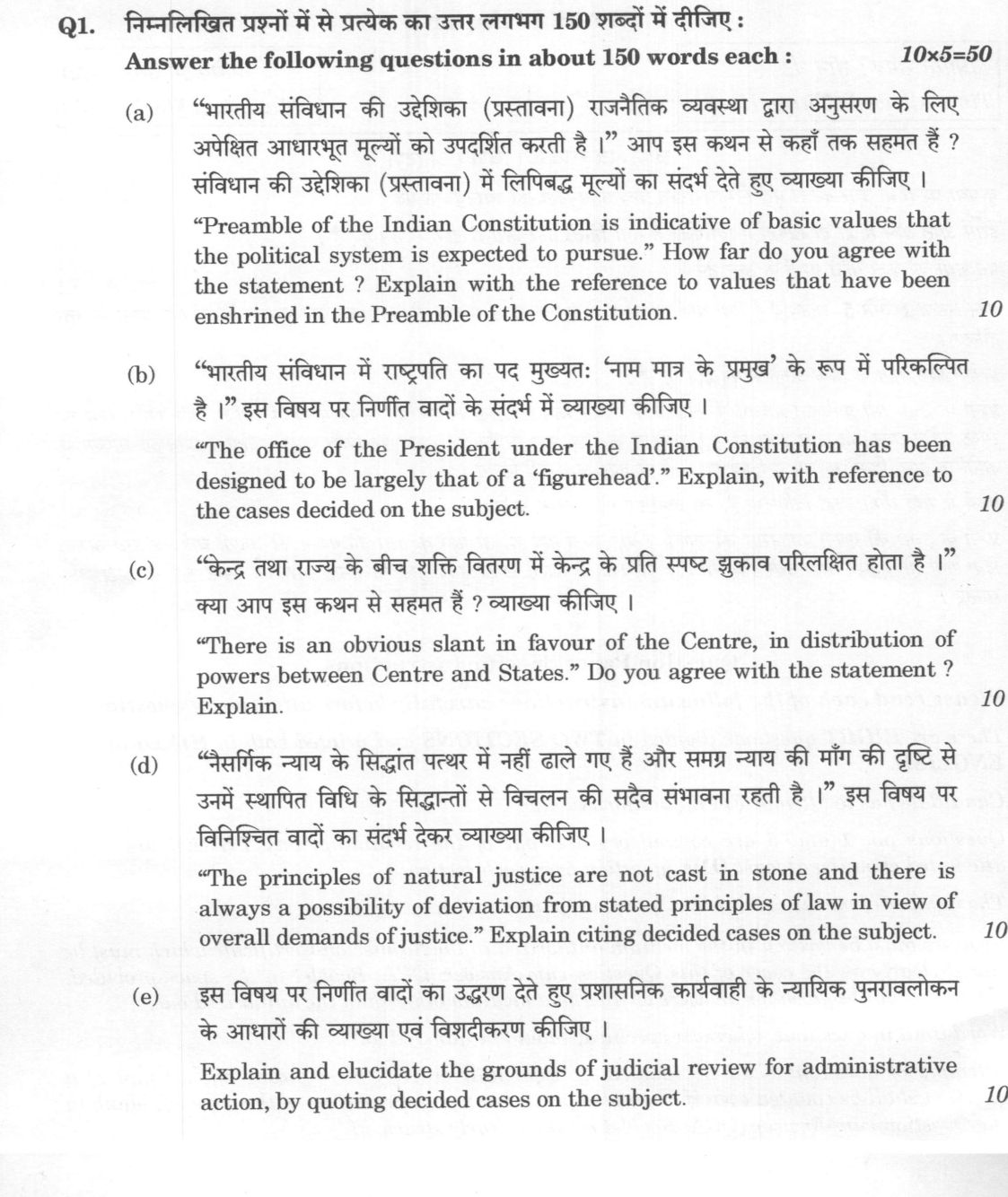
Answer the following questions in about 150 words each : 10×5=50 (a) "Preamble of the Indian Constitution is indicative of basic…
Answer the following questions in about 150 words each : 10×5=50
"Preamble of the Indian Constitution is indicative of basic values that the political system is expected to pursue." How far do you agree with the statement ? Explain with the reference to values that have been enshrined in the Preamble of the Constitution. 10 marks
"The office of the President under the Indian Constitution has been designed to be largely that of a 'figurehead'." Explain, with reference to the cases decided on the subject. 10 marks
"There is an obvious slant in favour of the Centre, in distribution of powers between Centre and States." Do you agree with the statement ? Explain. 10 marks
"The principles of natural justice are not cast in stone and there is always a possibility of deviation from stated principles of law in view of overall demands of justice." Explain citing decided cases on the subject. 10 marks
Explain and elucidate the grounds of judicial review for administrative action, by quoting decided cases on the subject. 10 marks
हिंदी में प्रश्न पढ़ें
निम्नलिखित प्रश्नों में से प्रत्येक का उत्तर लगभग 150 शब्दों में दीजिए : 10×5=50
"भारतीय संविधान की उद्देशिका (प्रस्तावना) राजनीतिक व्यवस्था द्वारा अनुसरण के लिए अपेक्षित आधारभूत मूल्यों को उपदर्शित करती है।" आप इस कथन से कहाँ तक सहमत हैं ? संविधान की उद्देशिका (प्रस्तावना) में लिपिबद्ध मूल्यों का संदर्भ देते हुए व्याख्या कीजिए। 10
"भारतीय संविधान में राष्ट्रपति का पद मुख्यतः 'नाम मात्र के प्रमुख' के रूप में परिकल्पित है।" इस विषय पर निर्णीत वादों के संदर्भ में व्याख्या कीजिए। 10
"केंद्र तथा राज्य के बीच शक्ति वितरण में केंद्र के प्रति स्पष्ट झुकाव परिलक्षित होता है।" क्या आप इस कथन से सहमत हैं ? व्याख्या कीजिए। 10
"नैसर्गिक न्याय के सिद्धांत पत्थर में नहीं ढाले गए हैं और समग्र न्याय की माँग की दृष्टि से उनमें स्थापित विधि के सिद्धांतों से विचलन की सदैव संभावना रहती है।" इस विषय पर विनिश्चित वादों का संदर्भ देकर व्याख्या कीजिए। 10
इस विषय पर निर्णीत वादों का उद्धरण देते हुए प्रशासनिक कार्यवाही के न्यायिक पुनरावलोकन के आधारों की व्याख्या एवं विशदीकरण कीजिए। 10
Model answer
Written by UPSC Answer Check against this question's marking rubric, to the 150-word length. UPSC does not publish answers for Mains — this is one way to score well, not an official key.
(a) The Preamble serves as the ideological compass of the Indian Constitution, embodying the fundamental philosophy and normative goals of the political system. In Re Berubari Union (1960), the Supreme Court described it as a "key to open the mind of the makers," while Kesavananda Bharati (1973) established it as an integral part of the constitutional text, reflecting the foundational values of the basic structure. Originating from "We, the People" as the ultimate source of authority, it commits the state to secure four core values. First, Justice (social, economic, and political), directing the state to eliminate structural inequities through fundamental rights and directive principles. Second, Liberty (of thought, expression, belief, faith, and worship), safeguarding democratic existence. Third, Equality (of status and opportunity), eradicating arbitrary discrimination. Fourth, Fraternity, assuring individual dignity and the unity and integrity of the Nation. These values function as an overarching normative framework binding all organs of the state.
(b) The constitutional design of the Indian Presidency is that of a formal, constitutional head within a Westminster parliamentary democracy, rather than an independent executive. Article 53 vests Union executive power in the President, but Article 74(1) mandates its exercise only on the "aid and advice" of the Council of Ministers. The 42nd Constitutional Amendment Act (1976) made this ministerial advice explicitly binding, though the 44th Amendment Act (1978) introduced a limited check allowing the President to return advice once for ministerial reconsideration. In Ram Jawaya Kapur v. State of Punjab (1955), the Supreme Court held that the President occupies a position analogous to the British Crown, where real executive power resides in the Cabinet. In Shamsher Singh v. State of Punjab (1974), the Court reaffirmed that presidential "satisfaction" under the Constitution is not personal satisfaction, but the constitutional satisfaction of the Council of Ministers, rendering the office primarily a figurehead save for rare, exceptional situational discretions.
(c) The Indian constitutional framework contains an unmistakable structural slant in favour of the Centre to maintain national integrity and socio-economic cohesion. In the legislative realm, Union List supremacy (Article 246) gives Parliament dominance with 100 entries compared to the States' 61. Residuary powers are allocated exclusively to Parliament under Article 248 and Entry 97 of List I, complemented by Articles 249, 250, 252, and 253, which permit Union legislation on State subjects. Administratively, Articles 256 and 257 empower the Centre to issue binding executive directions to States, backed by the sanction of Article 365. Financially, under Articles 268 to 293, States remain dependent on Union revenue assignments and Finance Commission recommendations (Article 280), alongside strict borrowing limitations (Article 293). Finally, Emergency provisions under Articles 352, 356, and 360 enable the Centre to unilaterally transform the federal polity into a unitary system, confirming the constitutional tilt.
(d) The principles of natural justice—principally nemo judex in causa sua (rule against bias) and audi alteram partem (rule of fair hearing)—are flexible standards rather than rigid, unbending rules. In A.K. Kraipak v. Union of India (1969), the Supreme Court held that the aim of natural justice is to prevent miscarriage of justice, and its application depends on the statutory framework, subject-matter, and context. Absolute adherence can be excluded or modified in situations of public interest, emergency, or absolute impracticability. In Maneka Gandhi v. Union of India (1978), the Court ruled that emergent impounding of a passport justified dispensing with a prior hearing, provided a prompt post-decisional hearing was afforded. Similarly, in Union of India v. T.R. Verma (1957), technical rules of evidence were held inapplicable where substantial justice was met, while Hussainara Khatoon affirmed that procedural formality must yield to substantive fairness to serve the overall demands of justice.
(e) Judicial review of administrative action controls excess, abuse, or arbitrary exercise of executive power. Lord Diplock codified the primary grounds in the GCHQ case (Council of Civil Service Unions v. Minister for Civil Service, 1985), which form the bedrock of Indian administrative law. First, Illegality, where the decision-maker acts ultra vires, misconstrues the law, or exceeds jurisdiction. Second, Irrationality, measured by Wednesbury unreasonableness (Associated Provincial Picture Houses v. Wednesbury Corporation, 1948), applying to decisions so outrageous in logic that no sensible authority could have made them. Third, Procedural Impropriety, encompassing breaches of statutory procedures and principles of natural justice (A.K. Kraipak v. Union of India). Additionally, Indian courts have recognized Proportionality as an independent ground (Ranjit Thakur v. Union of India, 1987), ensuring that administrative sanctions and restrictions are not disproportionate to the legitimate ends sought to be achieved.
What "Explain" is asking you to do
Make the working of something clear — what sets it off, what follows from what, and what it produces. Explain is the Commission's mechanism word: it dominates the technical papers and the “explain why” stems, where the marks sit in the causal chain and not in the label.
Structure that answers it
State what it is → the initiating condition → the chain of cause, step by step → an instance where it plays out → what the chain produces
Where marks are lost
Describing what something looks like instead of why it works that way. Naming the stages without linking them reads as description too.
How this answer will be evaluated
Approach
Framework: Issue > Rule > Authority > Application. (a) explain: definition/context > points in order > small example > short close | (b) explain: definition/context > points in order > small example > short close | (c) explain: definition/context > points in order > small example > short close | (d) explain: definition/context > points in order > small example > short close | (e) explain: definition/context > points in order > small example > short close Full marks: Precise legal reasoning, specific case citations, and clear application of law to the question.
Key points expected
- Identify specific values (e.g., Justice, Liberty, Equality, Fraternity)
- Link values to the political system's expected pursuit
- Reference the 42nd Amendment (1976) additions
- Mention the Preamble's role in interpretation (Kesavananda Bharati)
- Define the President's role as a constitutional head
- Cite specific cases (e.g., Samsher Singh v. State of Punjab)
- Explain the President's discretionary powers (Art 72, 111)
- Discuss the President's role in the appointment of PM
Evaluation rubric
Each sub-part is marked on its own, against the marks and word limit printed on the paper.
- (a) Justify the Preamble as a repository of basic values with specific references. 10 marks · 150 words
explain— definition/context → points in order → small example → short close
Must cover
- Identify specific values (e.g., Justice, Liberty, Equality, Fraternity)
- Link values to the political system's expected pursuit
- Reference the 42nd Amendment (1976) additions
- Mention the Preamble's role in interpretation (Kesavananda Bharati)
Loses marks
- Listing values without explaining their political significance
- Ignoring the 1976 amendment to the Preamble
- Treating the Preamble as merely historical
Earns more
- Mention Berubari Union case (pre-amendment view)
- Discuss the Preamble as a key to understanding the Constitution
- Reference the 'We the People' concept
Extra mark
- Cite specific Supreme Court judgment on Preamble's status
- Reference Law Commission report on Preamble
- (b) Explain the President's role as a figurehead with reference to decided cases. 10 marks · 150 words
explain— definition/context → points in order → small example → short close
Must cover
- Define the President's role as a constitutional head
- Cite specific cases (e.g., Samsher Singh v. State of Punjab)
- Explain the President's discretionary powers (Art 72, 111)
- Discuss the President's role in the appointment of PM
Loses marks
- Ignoring the President's discretionary powers
- Failing to cite specific cases
- Treating the President as a purely ceremonial figure
Earns more
- Mention the President's role in the appointment of the PM
- Discuss the President's power to dissolve the Lok Sabha
- Reference the President's role in the appointment of the CAG
Extra mark
- Cite a recent Supreme Court judgment on the President's role
- Reference a Law Commission report on the President's powers
- (c) Explain the slant in favour of the Centre in the distribution of powers. 10 marks · 150 words
explain— definition/context → points in order → small example → short close
Must cover
- Identify the Union List and its dominance
- Discuss the Residuary Powers (Art 248)
- Mention the Emergency Provisions (Art 352-360)
- Explain the Governor's role in state governance
Loses marks
- Ignoring the Residuary Powers
- Failing to mention the Emergency Provisions
- Treating the distribution of powers as balanced
Earns more
- Mention the Concurrent List and its limited scope
- Discuss the Centre's financial control over states
- Reference the Centre's power to legislate on state subjects
Extra mark
- Cite a specific Supreme Court judgment on Centre-State relations
- Reference a Law Commission report on federalism
- (d) Explain the flexibility of natural justice principles with decided cases. 10 marks · 150 words
explain— definition/context → points in order → small example → short close
Must cover
- Define the principles of natural justice
- Cite specific cases (e.g., Maneka Gandhi v. Union of India)
- Explain the concept of 'audi alteram partem'
- Discuss the 'nemo judex in causa sua' principle
Loses marks
- Ignoring the flexibility of natural justice principles
- Failing to cite specific cases
- Treating natural justice as rigid and unchanging
Earns more
- Mention the concept of 'procedural fairness'
- Discuss the role of natural justice in administrative law
- Reference the concept of 'substantive justice'
Extra mark
- Cite a recent Supreme Court judgment on natural justice
- Reference a Law Commission report on natural justice
- (e) Explain the grounds of judicial review for administrative action with cases. 10 marks · 150 words
explain— definition/context → points in order → small example → short close
Must cover
- Define judicial review
- Cite specific cases (e.g., State of Punjab v. Davinder Singh)
- Explain the grounds of illegality, irrationality, and procedural impropriety
- Discuss the role of the courts in reviewing administrative action
Loses marks
- Ignoring the grounds of judicial review
- Failing to cite specific cases
- Treating judicial review as a purely theoretical concept
Earns more
- Mention the concept of 'ultra vires'
- Discuss the role of the courts in ensuring accountability
- Reference the concept of 'proportionality'
Extra mark
- Cite a recent Supreme Court judgment on judicial review
- Reference a Law Commission report on judicial review
Practice this exact question
Write your answer and it is marked point by point against the model answer above — what you covered, what you missed, what you got wrong.
Evaluate my answer →More from Law 2023 Paper I
- Q1 Answer the following questions in about 150 words each : 10×5=50 (a) "Preamble of the Ind…
- Q2 (a) "The Constitution of India has provided for a clear-cut distinction between civil and…
- Q3 (a) "Superintendence, direction and control of elections is vested in the office of the E…
- Q4 (a) What do you understand by breakdown of constitutional machinery in a State ? Critical…