Paper I — Q8
(a) "WTO provides a platform for agreements amongst its members which form the legal foundation of global trade." Critically…
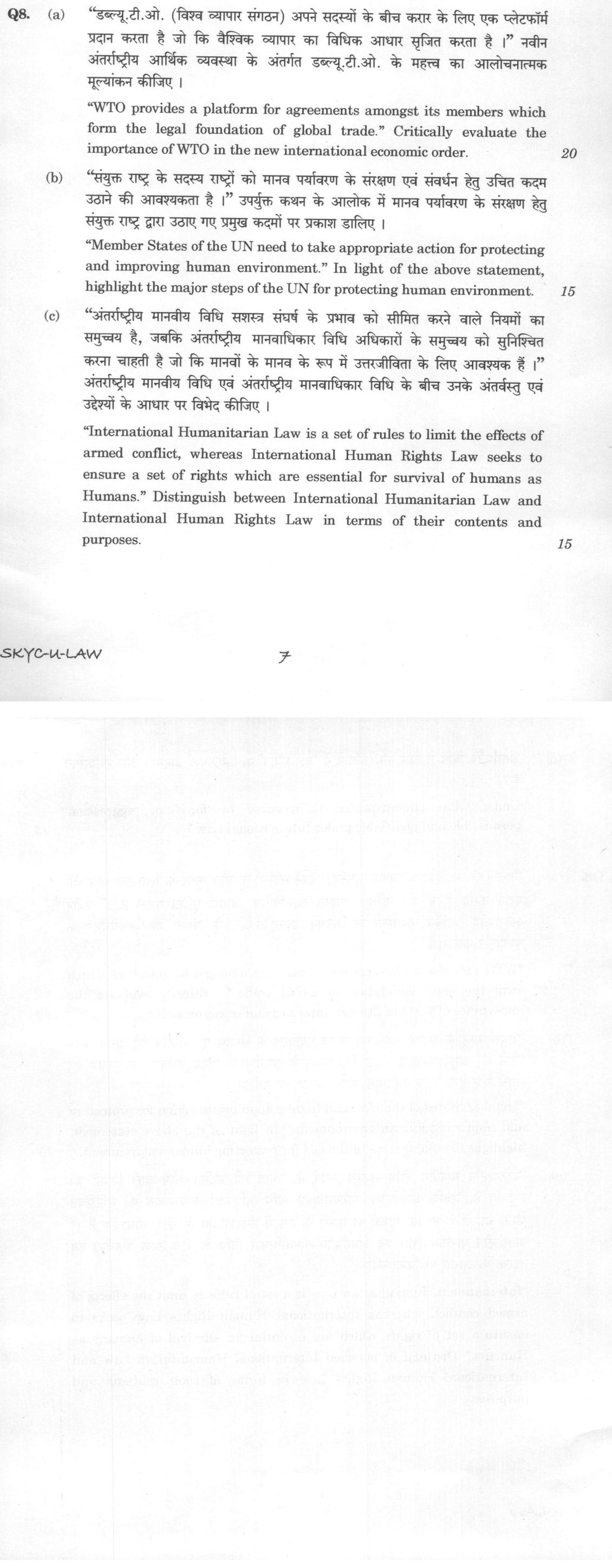
"WTO provides a platform for agreements amongst its members which form the legal foundation of global trade." Critically evaluate the importance of WTO in the new international economic order. 20 marks
"Member States of the UN need to take appropriate action for protecting and improving human environment." In light of the above statement, highlight the major steps of the UN for protecting human environment. 15 marks
"International Humanitarian Law is a set of rules to limit the effects of armed conflict, whereas International Human Rights Law seeks to ensure a set of rights which are essential for survival of humans as Humans." Distinguish between International Humanitarian Law and International Human Rights Law in terms of their contents and purposes. 15 marks
हिंदी में प्रश्न पढ़ें
"डब्ल्यू.टी.ओ. (विश्व व्यापार संगठन) अपने सदस्यों के बीच करार के लिए एक प्लेटफार्म प्रदान करता है जो कि वैश्विक व्यापार का विधिक आधार सृजित करता है।" नवीन अंतर्राष्ट्रीय आर्थिक व्यवस्था के अंतर्गत डब्ल्यू.टी.ओ. के महत्व का आलोचनात्मक मूल्यांकन कीजिए । 20
"संयुक्त राष्ट्र के सदस्य राष्ट्रों को मानव पर्यावरण के संरक्षण एवं संवर्धन हेतु उचित कदम उठाने की आवश्यकता है ।" उपर्युक्त कथन के आलोक में मानव पर्यावरण के संरक्षण हेतु संयुक्त राष्ट्र द्वारा उठाए गए प्रमुख कदमों पर प्रकाश डालिए । 15
"अंतर्राष्ट्रीय मानवीय विधि सशस्त्र संघर्ष के प्रभाव को सीमित करने वाले नियमों का समुच्चय है, जबकि अंतर्राष्ट्रीय मानवाधिकार विधि अधिकारों के समुच्चय को सुनिश्चित करना चाहती है जो कि मानवों के मानव के रूप में उत्तरजीविता के लिए आवश्यक हैं ।" अंतर्राष्ट्रीय मानवीय विधि एवं अंतर्राष्ट्रीय मानवाधिकार विधि के बीच उनके अंतर्वस्तु एवं उद्देश्यों के आधार पर विभेद कीजिए । 15
Model answer
Written by UPSC Answer Check against this question's marking rubric, to the expected length. UPSC does not publish answers for Mains — this is one way to score well, not an official key.
The contemporary international legal order rests upon specialised regimes governing commerce, environmental stewardship, and human protection. These frameworks operationalise state obligations across global economic and humanitarian spheres.
WTO in the New International Economic Order
The World Trade Organization (WTO) provides the legal bedrock for international commerce through covered agreements including GATT 1994 for trade in goods, GATS for services, TRIPS for intellectual property, and the Dispute Settlement Understanding (DSU). By establishing binding non-discrimination principles (Most-Favoured-Nation and National Treatment) alongside an enforceable dispute mechanism, the WTO substantially lowered tariffs and curbed unilateral mercantilism.
However, its efficacy in the contemporary economic order is severely challenged. The Appellate Body remains paralyzed due to judicial appointment blockades, crippling the DSU. Deep structural asymmetries persist between developed and developing members. Developing nations, led by India, contest agricultural subsidy regimes, demanding a permanent solution for Public Stockholding (PSH) for food security and an effective Special Safeguard Mechanism (SSM) to protect vulnerable farmers against import surges. Furthermore, ongoing tensions regarding plurilateral pacts, digital trade governance, and the extension of the e-commerce moratorium underscore institutional fragmentation.
Verdict: While the WTO suffers from governance deficits and negotiating deadlocks, it remains an indispensable, rule-based multilateral counterweight to geo-economic coercion, provided comprehensive institutional reforms restore the Appellate Body and honour development-centric mandates.
UN Measures for Protecting the Human Environment
The United Nations has structured international environmental law through progressive normative milestones. The 1972 Stockholm Declaration placed human environment on the global agenda and founded the United Nations Environment Programme (UNEP), which has evolved to anchor the United Nations Environment Assembly (UNEA). The 1992 Rio Earth Summit produced the Rio Declaration and Agenda 21, institutionalising the precautionary principle, polluter-pays doctrine, and Common But Differentiated Responsibilities (CBDR).
Under UN auspices, treaty frameworks emerged to tackle systemic planetary degradation: the Vienna Convention and Montreal Protocol for ozone protection; the Convention on Biological Diversity (CBD); and the UNFCCC, which generated the Kyoto Protocol and the landmark 2015 Paris Agreement aimed at limiting global temperature rise.
India has aligned domestic policy with these UN mandates through its National Action Plan on Climate Change (NAPCC) and ambitious updated Nationally Determined Contributions (NDCs). Externally, India demonstrates multilateral leadership by co-founding the International Solar Alliance (ISA) and the Coalition for Disaster Resilient Infrastructure (CDRI) to advance global climate resilience.
Distinction and Convergence: IHL and IHRL
International Humanitarian Law (IHL) and International Human Rights Law (IHRL) differ in their foundational contents, purposes, and operational scopes:
Temporal and Personal Scope: IHL (lex specialis) applies exclusively during armed conflicts (international and non-international), codified in the Hague Regulations, four Geneva Conventions of 1949, and their 1977 Additional Protocols. It protects non-combatants (civilians, prisoners of war, wounded personnel) and restricts methods of warfare. IHRL applies at all times—in peace and war—codified in the UDHR 1948, ICCPR, and ICESCR, safeguarding inherent individual liberties against state infringement.
Derogation and Enforcement: IHL admits no derogation during war; its provisions are absolute in bello. IHRL allows calibrated derogations from certain civil rights during declared public emergencies, though non-derogable rights (e.g., right to life, freedom from torture) remain intact. For implementation, IHL relies on the International Committee of the Red Cross (ICRC) and universal jurisdiction mechanisms, whereas IHRL utilizes the UN Human Rights Council, treaty-monitoring committees, and regional human rights courts.
Complementarity: Despite structural distinctions, the two regimes converge on preserving fundamental human dignity. The International Court of Justice affirmed in the Israeli Wall Advisory Opinion (2004) that IHRL protections do not cease in armed conflict, operating alongside IHL. Similarly, the ICTY in Prosecutor v. Tadić (1995) integrated human rights standards to interpret customary humanitarian law, cementing their mutual reinforcement.
What "Critically evaluate" is asking you to do
Judge how well something has performed against the standard it set for itself — its stated aim, mandate or promise — and commit to a verdict. Name the yardstick before you judge; an unanchored judgement reads as opinion. “Critically” is not a section added at the end: name the yardstick you are judging by — the evidence, the stated objective, a constitutional principle, a rival explanation — and let a verdict close each part of the body. Where the question quotes a claim, that verdict must land on the claim itself, accepted, qualified or rejected, and not on the theme in general.
Structure that answers it
Name the yardstick — stated aim, mandate or benchmark → performance against it → shortfall against it → why the gap exists → verdict
Where marks are lost
Merits in one paragraph, demerits in the next, and a conclusion calling for a balanced and holistic approach. That is a survey with the judgement left out and it holds the answer in the middle band. The opposite error is reading “critically” as permission to attack — and with the odd pairings, critically describe or critically explain, the exposition still carries most of the marks, the judgement being a layer on it rather than a substitute for it.
How this answer will be evaluated
Approach
Framework: Issue > Rule > Authority > Application. (a) critically evaluate: positives > negatives/limits > conditions/safeguards > conclusion | (b) highlight: name the salient points > one line of substance each > close | (c) compare: paired headings or table > key differences > significance > conclusion Full marks: Comprehensive, critical, and well-supported with specific examples and legal references.
Key points expected
- Identify WTO as the legal foundation of global trade
- Explain the platform for member agreements
- Critically evaluate the importance in the new order
- Discuss limitations or challenges of the WTO
- Identify the UN's role in environmental protection
- List major steps or initiatives by the UN
- Explain the significance of these steps
- Connect steps to protecting and improving the human environment
Evaluation rubric
Each sub-part is marked on its own, against the marks and word limit printed on the paper.
- (a) Assess WTO's role in the new international economic order, weighing its legal foundation against its limitations. 20 marks
critically evaluate— positives → negatives/limits → conditions/safeguards → conclusion
Must cover
- Identify WTO as the legal foundation of global trade
- Explain the platform for member agreements
- Critically evaluate the importance in the new order
- Discuss limitations or challenges of the WTO
Loses marks
- Descriptive answer without critical evaluation
- Ignoring the 'new international economic order' context
- Failing to mention the legal foundation aspect
Earns more
- Mention specific WTO agreements (e.g., GATT, GATS)
- Reference the dispute settlement mechanism
- Discuss the role in the new international economic order
- Mention the impact on developing nations
Extra mark
- Cite a specific WTO dispute case
- Reference a recent WTO ministerial conference
- (b) List and explain the major steps taken by the UN to protect the human environment. 15 marks
highlight— name the salient points → one line of substance each → close
Must cover
- Identify the UN's role in environmental protection
- List major steps or initiatives by the UN
- Explain the significance of these steps
- Connect steps to protecting and improving the human environment
Loses marks
- Listing steps without explaining their significance
- Ignoring the 'human environment' aspect
- Failing to connect steps to the UN's role
Earns more
- Mention the UNFCCC (United Nations Framework Convention on Climate Change)
- Reference the Paris Agreement
- Discuss the role of UNEP (United Nations Environment Programme)
- Mention the Sustainable Development Goals (SDGs)
Extra mark
- Cite a specific UN environmental report
- Reference a specific UN environmental resolution
- (c) Differentiate between International Humanitarian Law and International Human Rights Law based on content and purpose. 15 marks
compare— paired headings or table → key differences → significance → conclusion
Must cover
- Define International Humanitarian Law (IHL)
- Define International Human Rights Law (IHRL)
- Distinguish IHL and IHRL in terms of content
- Distinguish IHL and IHRL in terms of purpose
Loses marks
- Confusing the definitions of IHL and IHRL
- Failing to distinguish based on content and purpose
- Ignoring the specific context of armed conflict for IHL
Earns more
- Mention the Geneva Conventions for IHL
- Reference the Universal Declaration of Human Rights for IHRL
- Discuss the applicability of IHL during armed conflict
- Discuss the applicability of IHRL in peacetime and wartime
Extra mark
- Cite a specific IHL convention
- Reference a specific IHRL treaty
Practice this exact question
Write your answer and it is marked point by point against the model answer above — what you covered, what you missed, what you got wrong.
Evaluate my answer →More from Law 2023 Paper I
- Q5 Answer the following questions in about 150 words each : 10×5=50 (a) "Triumph of Positivi…
- Q6 (a) "Law must be stable, and yet it cannot stand still, as it needs to reconcile the conf…
- Q7 (a) "Preamble of the UN Charter is representative of the aspirations of humanity in ensur…
- Q8 (a) "WTO provides a platform for agreements amongst its members which form the legal foun…