Paper I — Q3
(a) "Superintendence, direction and control of elections is vested in the office of the Election Commission and therefore, the…
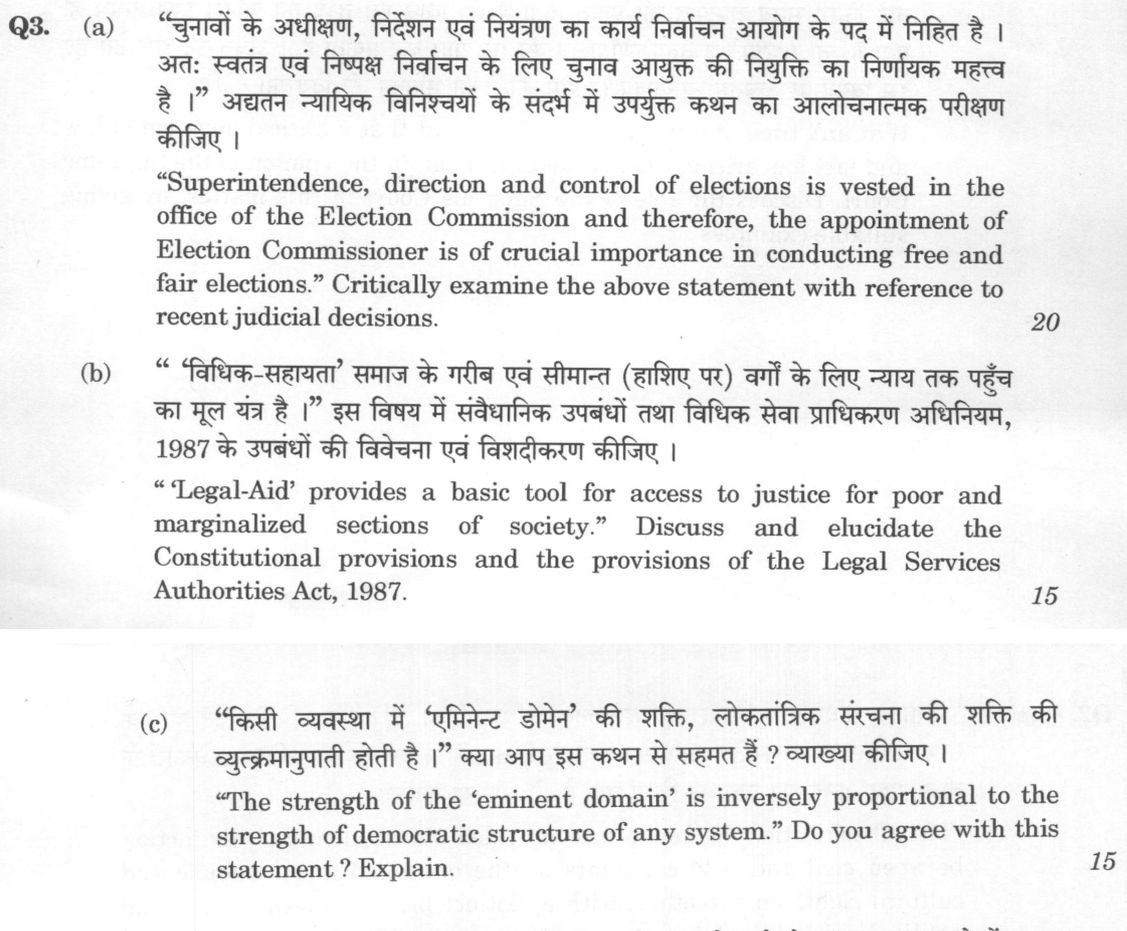
"Superintendence, direction and control of elections is vested in the office of the Election Commission and therefore, the appointment of Election Commissioner is of crucial importance in conducting free and fair elections." Critically examine the above statement with reference to recent judicial decisions. 20 marks
"'Legal-Aid' provides a basic tool for access to justice for poor and marginalized sections of society." Discuss and elucidate the Constitutional provisions and the provisions of the Legal Services Authorities Act, 1987. 15 marks
"The strength of the 'eminent domain' is inversely proportional to the strength of democratic structure of any system." Do you agree with this statement ? Explain. 15 marks
हिंदी में प्रश्न पढ़ें
"चुनावों के अधीक्षण, निर्देशन एवं नियंत्रण का कार्य निर्वाचन आयोग के पद में निहित है। अतः स्वतंत्र एवं निष्पक्ष निर्वाचन के लिए चुनाव आयुक्त की नियुक्ति का निर्णायक महत्व है।" अद्यतन न्यायिक विनिश्चयों के संदर्भ में उपर्युक्त कथन का आलोचनात्मक परीक्षण कीजिए। 20
" 'विधिक-सहायता' समाज के गरीब एवं सीमांत (हाशिए पर) वर्गों के लिए न्याय तक पहुँच का मूल यंत्र है।" इस विषय में संवैधानिक उपबंधों तथा विधिक सेवा प्राधिकरण अधिनियम, 1987 के उपबंधों की विवेचना एवं विशदीकरण कीजिए। 15
"किसी व्यवस्था में 'एमिनेंट डोमेन' की शक्ति, लोकतांत्रिक संरचना की शक्ति की व्युत्क्रमानुपाती होती है।" क्या आप इस कथन से सहमत हैं ? व्याख्या कीजिए । 15
Model answer
Written by UPSC Answer Check against this question's marking rubric, to the expected length. UPSC does not publish answers for Mains — this is one way to score well, not an official key.
Election Commission and Electoral Integrity
Article 324 vests the plenary power of "superintendence, direction, and control" of elections in the Election Commission of India (ECI). As held in Mohinder Singh Gill and reinforced in Association for Democratic Reforms, this vast power necessitates complete institutional autonomy to ensure free and fair elections. However, the appointment mechanism historically remained an exclusive executive prerogative, creating inherent systemic vulnerability.
In Anoop Baranwal v. Union of India (2023), the Supreme Court addressed this democratic deficit by reading independence into the institutional design, directing that appointments be made on the advice of a committee comprising the Prime Minister, the Chief Justice of India, and the Leader of the Opposition until Parliament enacted a law. While Parliament subsequently replaced the CJI with a nominated Union Cabinet Minister in the 2023 legislation, the judicial stance firmly established that non-partisan selection is indispensable to electoral integrity.
A critical institutional infirmity remains in the security of tenure. Under Article 324(5), the Chief Election Commissioner (CEC) enjoys removal protections equivalent to a Supreme Court judge, whereas Election Commissioners (ECs) can be removed on the CEC's recommendation. S.S. Dhanoa v. Union of India (1991) and T.N. Seshan (1995) affirmed that while ECs share equal decision-making power, this structural disparity in tenure security compromises individual independence. Therefore, genuine electoral purity requires not merely a balanced selection process, but complete statutory tenure parity and institutional insulation across all Commissioners.
Legal Aid: Constitutional Mandate and the LSA Act, 1987
Legal aid operationalises the promise of substantive equality. Constitutionally, Article 39A directs the State to secure equal justice through free legal aid, which the Supreme Court in Hussainara Khatoon and Suk Das recognized as an integral component of Articles 14 and 21.
The Legal Services Authorities Act, 1987 establishes a statutory mechanism to deliver this right across a multi-tiered hierarchy: the National Legal Services Authority (NALSA) at the apex, State Legal Services Authorities (SLSA), District Legal Services Authorities (DLSA), and Taluk Legal Services Committees.
Section 12 of the Act provides the entitlement criteria for free legal services in both civil and criminal proceedings to vulnerable groups, including Scheduled Castes, Scheduled Tribes, women, children, persons with disabilities, undertrials, and individuals within statutory income limits. Functionally, the Act institutionalises alternate dispute redressal through Lok Adalats under Section 19, whose awards have the decree of a civil court and are non-appealable, and Permanent Lok Adalats under Section 22B for compulsory pre-litigation conciliation and adjudication of public utility disputes. The statutory scheme thus translates a constitutional directive into an enforceable socio-legal remedy.
Eminent Domain and Democratic Governance
The doctrine of eminent domain recognizes the inherent sovereign power to expropriate private property, founded on the maxims salus populi suprema lex and necessitas publica major est quam privata. Following the 44th Constitutional Amendment, the fundamental right to property was substituted with Article 300A, guaranteeing that no person shall be deprived of property save by authority of law.
The thesis that eminent domain is inversely proportional to democracy is accurate only when sovereign power operates without procedural fetters. In authoritarian systems, expropriation is uninhibited; in robust constitutional democracies, eminent domain is strictly conditioned by "public purpose" and just compensation. As observed in the US Supreme Court's Kelo v. City of New London (2005), expanding public purpose to include private economic development triggered democratic and legislative pushback.
In India, judicial review has actively constrained state takings. In R.L. Arora v. State of U.P. (1962), the Supreme Court invalidated acquisitions that served private profit rather than genuine public interest, while Sooraram Reddy v. District Collector (2008) affirmed that acquisitions remain subject to review for colorable exercise of power. The Right to Fair Compensation and Transparency in Land Acquisition, Rehabilitation and Resettlement Act, 2013 (LARR Act) codified democratic principles by mandating Social Impact Assessments and informed consent. Thus, strong democratic structures do not abolish eminent domain, but discipline it through due process, proportionality, and equitable compensation.
Conclusion
Electoral integrity (Anoop Baranwal), access to justice (NALSA), and regulated sovereign powers (Article 300A) constitute the triadic foundation of substantive constitutional democracy. A mature democratic system demands independent arbiters to conduct elections, accessible courts to enforce rights, and procedural safeguards that reconcile sovereign development with individual liberties.
What "Critically examine" is asking you to do
Test the proposition the question puts to you and return a finding on how far it holds. Examine stems carry a claim, or ask whether something has happened, and expect evidence weighed both ways before the extent is stated — often with remedial measures attached. “Critically” is not a section added at the end: name the yardstick you are judging by — the evidence, the stated objective, a constitutional principle, a rival explanation — and let a verdict close each part of the body. Where the question quotes a claim, that verdict must land on the claim itself, accepted, qualified or rejected, and not on the theme in general.
Structure that answers it
Restate the claim as the question frames it → evidence that supports it → evidence that undercuts it → the conditions under which it holds → verdict on how far it stands
Where marks are lost
Merits in one paragraph, demerits in the next, and a conclusion calling for a balanced and holistic approach. That is a survey with the judgement left out and it holds the answer in the middle band. The opposite error is reading “critically” as permission to attack — and with the odd pairings, critically describe or critically explain, the exposition still carries most of the marks, the judgement being a layer on it rather than a substitute for it.
How this answer will be evaluated
Approach
Framework: Issue > Rule > Authority > Application. (a) critique: the claim > its strengths > its weaknesses > your judgment | (b) discuss: intro > 3-4 dimensions > example > balanced close | (c) comment: context > arguments both sides > judgment > close Full marks: Comprehensive, well-structured, with precise legal citations and critical analysis.
Key points expected
- Cite Article 324 of the Constitution
- Reference recent Supreme Court judgments on EC independence
- Analyze the impact of appointment process on election integrity
- Discuss the role of EC in superintendence and control
- Cite relevant Constitutional provisions (e.g., Article 39A)
- Elucidate provisions of Legal Services Authorities Act, 1987
- Explain the role of Legal Aid in ensuring access to justice
- Discuss the scope and limitations of Legal Aid
Evaluation rubric
Each sub-part is marked on its own, against the marks and word limit printed on the paper.
- (a) Critical examination of the importance of Election Commissioner appointment for free and fair elections. 20 marks
critique— the claim → its strengths → its weaknesses → your judgment
Must cover
- Cite Article 324 of the Constitution
- Reference recent Supreme Court judgments on EC independence
- Analyze the impact of appointment process on election integrity
- Discuss the role of EC in superintendence and control
Loses marks
- Generic discussion without specific judicial references
- Failure to link appointment process to election fairness
- Ignoring the constitutional basis of EC powers
Earns more
- Mention specific recent judicial decisions
- Discuss the independence of the Election Commission
- Analyze the appointment mechanism and its implications
- Reference the role of the President in appointments
Extra mark
- Cite specific recent Supreme Court case names
- Reference Law Commission reports on election reforms
- (b) Discussion of Legal Aid as a tool for access to justice for poor and marginalized sections. 15 marks
discuss— intro → 3-4 dimensions → example → balanced close
Must cover
- Cite relevant Constitutional provisions (e.g., Article 39A)
- Elucidate provisions of Legal Services Authorities Act, 1987
- Explain the role of Legal Aid in ensuring access to justice
- Discuss the scope and limitations of Legal Aid
Loses marks
- Vague discussion without specific legal provisions
- Failure to connect Legal Aid to access to justice
- Ignoring the constitutional mandate for Legal Aid
Earns more
- Mention specific sections of the Legal Services Authorities Act
- Discuss the role of District Legal Services Authorities
- Analyze the effectiveness of Legal Aid in practice
- Reference specific cases or examples
Extra mark
- Cite specific recent Supreme Court judgments on Legal Aid
- Reference Law Commission reports on Legal Aid
- (c) Comment on the inverse relationship between eminent domain and democratic structure. 15 marks
comment— context → arguments both sides → judgment → close
Must cover
- Define eminent domain and its legal basis
- Analyze the relationship between eminent domain and democracy
- Provide arguments for and against the statement
- Conclude with a balanced judgment
Loses marks
- One-sided argument without considering both perspectives
- Failure to define eminent domain clearly
- Ignoring the role of democratic institutions in checking eminent domain
Earns more
- Cite specific examples of eminent domain usage
- Discuss the role of judicial review in limiting eminent domain
- Analyze the impact of eminent domain on property rights
- Reference specific cases or examples
Extra mark
- Cite specific recent Supreme Court judgments on eminent domain
- Reference Law Commission reports on property rights
Practice this exact question
Write your answer and it is marked point by point against the model answer above — what you covered, what you missed, what you got wrong.
Evaluate my answer →More from Law 2023 Paper I
- Q1 Answer the following questions in about 150 words each : 10×5=50 (a) "Preamble of the Ind…
- Q2 (a) "The Constitution of India has provided for a clear-cut distinction between civil and…
- Q3 (a) "Superintendence, direction and control of elections is vested in the office of the E…
- Q4 (a) What do you understand by breakdown of constitutional machinery in a State ? Critical…
- Q5 Answer the following questions in about 150 words each : 10×5=50 (a) "Triumph of Positivi…
- Q6 (a) "Law must be stable, and yet it cannot stand still, as it needs to reconcile the conf…