Paper I — Q5
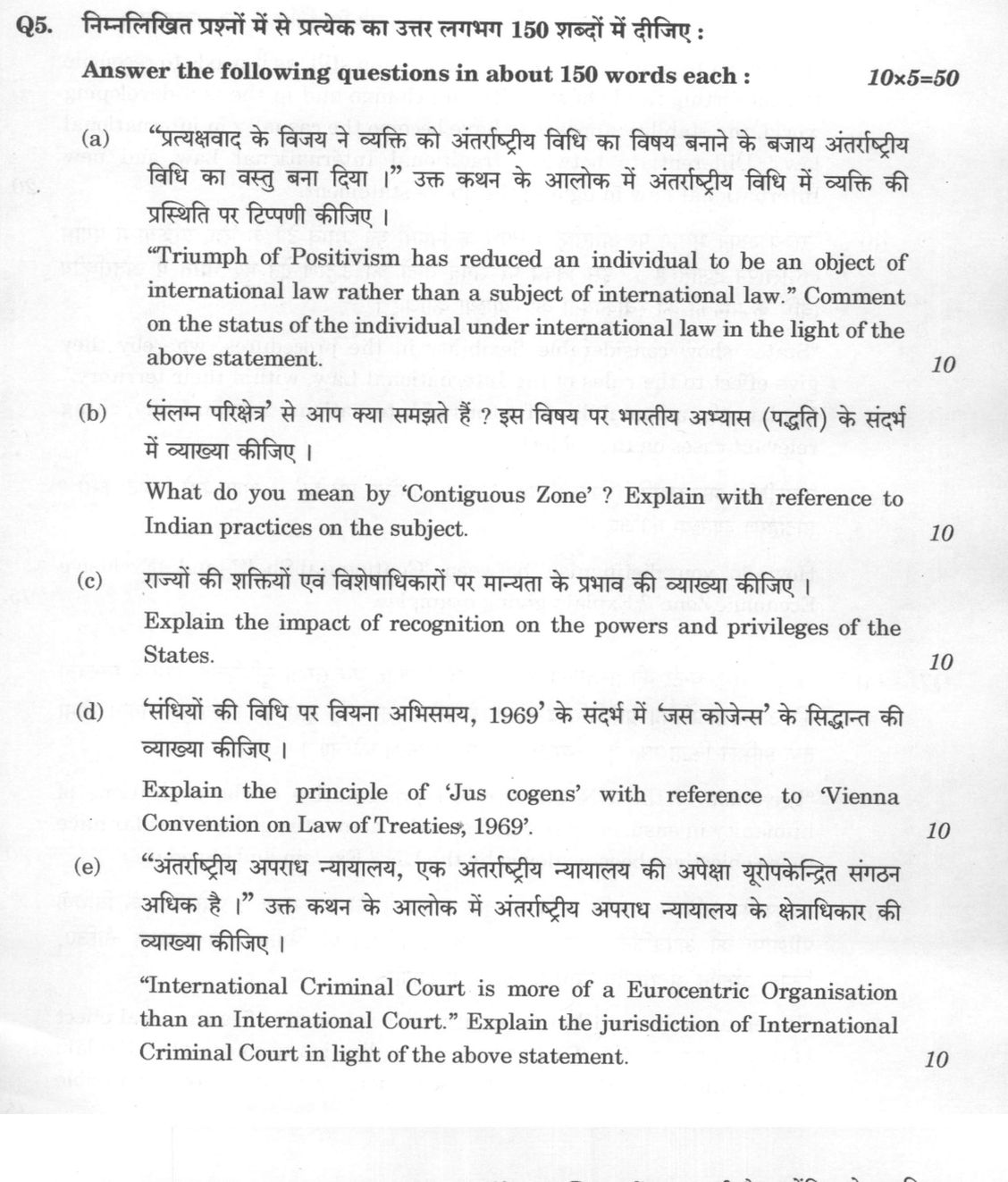
Answer the following questions in about 150 words each : 10×5=50 (a) "Triumph of Positivism has reduced an individual to be an…
Answer the following questions in about 150 words each : 10×5=50
"Triumph of Positivism has reduced an individual to be an object of international law rather than a subject of international law." Comment on the status of the individual under international law in the light of the above statement. 10 marks
What do you mean by 'Contiguous Zone' ? Explain with reference to Indian practices on the subject. 10 marks
Explain the impact of recognition on the powers and privileges of the States. 10 marks
Explain the principle of 'Jus cogens' with reference to 'Vienna Convention on Law of Treaties, 1969'. 10 marks
"International Criminal Court is more of a Eurocentric Organisation than an International Court." Explain the jurisdiction of International Criminal Court in light of the above statement. 10 marks
हिंदी में प्रश्न पढ़ें
निम्नलिखित प्रश्नों में से प्रत्येक का उत्तर लगभग 150 शब्दों में दीजिए : 10×5=50
"प्रत्यक्षवाद के विजय ने व्यक्ति को अंतर्राष्ट्रीय विधि का विषय बनाने के बजाय अंतर्राष्ट्रीय विधि का वस्तु बना दिया ।" उक्त कथन के आलोक में अंतर्राष्ट्रीय विधि में व्यक्ति की प्रस्थिति पर टिप्पणी कीजिए । 10
'संलग्न परिक्षेत्र' से आप क्या समझते हैं ? इस विषय पर भारतीय अभ्यास (पद्धति) के संदर्भ में व्याख्या कीजिए । 10
राज्यों की शक्तियों एवं विशेषाधिकारों पर मान्यता के प्रभाव की व्याख्या कीजिए । 10
'संधियों की विधि पर वियना अभिसमय, 1969' के संदर्भ में 'जस कोजेन्स' के सिद्धांत की व्याख्या कीजिए । 10
"अंतर्राष्ट्रीय अपराध न्यायालय, एक अंतर्राष्ट्रीय न्यायालय की अपेक्षा यूरोपकेन्द्रित संगठन अधिक है ।" उक्त कथन के आलोक में अंतर्राष्ट्रीय अपराध न्यायालय के क्षेत्राधिकार की व्याख्या कीजिए । 10
Model answer
Written by UPSC Answer Check against this question's marking rubric, to the 150-word length. UPSC does not publish answers for Mains — this is one way to score well, not an official key.
Part (a) The statement is partly correct but now overstated. Classical positivism, associated with Austin and Kelsen, treated international law as law between states; the individual was an object, not a subject, because rights and duties flowed from state consent. Natural law and later human-rights thought challenged this by locating dignity and fundamental rights in the individual. Modern international law has given the individual limited subjectivity: human-rights treaties create direct obligations owed to persons, international criminal law imposes individual responsibility for genocide, crimes against humanity and war crimes, and the ICJ’s Barcelona Traction dictum recognised obligations owed to the international community as a whole. Yet the individual remains not a full subject: most rights are enforced through states, and international criminal jurisdiction is complementary. This limited subjectivity is procedural and institutional, not full state-like personality. Thus positivism’s triumph has been qualified, not reversed; the individual is now a partial subject, not merely an object.
Part (b) The contiguous zone is a maritime belt beyond the territorial sea, extending up to 24 nautical miles from the baselines under UNCLOS Article 33. The zone does not extend the territorial sea. It is not a zone of plenary regulatory power. Coastal-state jurisdiction is limited to preventing and punishing infringements of customs, fiscal, immigration or sanitary laws and regulations committed in its territory or territorial sea. India gives effect to this regime through the Maritime Zones Act, 1976, as amended in 2002, which defines the contiguous zone and authorises enforcement of CFIS laws. In practice, the Indian Coast Guard, Navy and Customs authorities patrol the zone and may board, inspect or detain vessels where there are reasonable grounds to suspect smuggling, fiscal evasion, illegal immigration or sanitary violations connected with India’s territory or territorial sea. The power is therefore preventive and punitive, not a general right to regulate all maritime activity.
Part (c) Recognition affects a state’s powers and privileges by determining whether other states treat it as a legal person in international law. Under the constitutive theory, recognition creates or confirms statehood; a newly recognised state gains practical capacity to conclude treaties, receive and send diplomatic missions, claim diplomatic immunity, seek UN membership and appear before the ICJ. Under the declaratory theory, statehood exists independently of recognition; recognition merely acknowledges facts, so legal capacity is not created by it. In practice, recognition is still important: it shapes treaty-making relations, diplomatic protection, immunity from foreign jurisdiction, Security Council recommendation for UN admission, and standing as a state party to the ICJ Statute. The Mexican Estrada doctrine contrasts with constitutive recognition by refusing explicit recognition and treating diplomatic relations as continuing, thereby avoiding the legal consequences of non-recognition while preserving state-to-state dealings. Thus recognition is both a legal and political instrument.
Part (d) Jus cogens, or peremptory norms, are norms accepted and recognised by the international community of states as a whole as norms from which no derogation is permitted. Article 53 of the Vienna Convention on the Law of Treaties, 1969, provides that a treaty is void if, at the time of its conclusion, it is incompatible with such a norm. The consequence is void ab initio: the treaty has no legal effect because it offends a higher norm. Article 64 adds that if a new peremptory norm emerges, any existing treaty incompatible with it becomes void and terminates. Peremptory norms are hierarchical, non-derogable and binding on all states. Accepted examples include prohibitions of genocide, slavery, torture and aggression. The doctrine thus limits treaty freedom, ensuring that state consent cannot validate conduct that the international community regards as fundamentally unlawful.
Part (e) The ICC’s jurisdiction is treaty-based and limited. Under Articles 5 to 12 of the Rome Statute, it is confined to genocide, crimes against humanity, war crimes and aggression, and generally requires a territorial or personal link to a state party; a non-party may accept jurisdiction ad hoc under Article 12(3). Jurisdiction is triggered in three ways: a state party may refer a situation under Article 13(a); the UN Security Council may refer a situation under Article 13(b); and the Prosecutor may initiate an investigation proprio motu under Article 13(c), subject to Pre-Trial Chamber authorisation. The complementarity principle, reflected in Article 17, means the ICC acts only when states are unable or unwilling to prosecute genuinely. The Eurocentric critique arises because early cases were concentrated in Africa, while the US, China, Russia and India are not parties, and because ASP composition and prosecutorial discretion can reflect political influence. The Court is not inherently Eurocentric, but its practice has reinforced that perception.
What "Comment" is asking you to do
Take a position on the statement and support it. Comment usually attaches to a quoted line in the short slots, so the reasoning must be compressed — an opening view, a few load-bearing reasons, and the limit of the claim.
Structure that answers it
Unpack what the statement asserts → your stance → two or three supporting reasons → the qualification that limits it
Where marks are lost
Neutral summary; a comment without a stance has not answered. Equally costly is accepting the quoted line wholesale and never testing where it fails.
How this answer will be evaluated
Approach
Framework: Issue > Rule > Authority > Application. (a) comment: context > arguments both sides > judgment > close | (b) explain: definition/context > points in order > small example > short close | (c) explain: definition/context > points in order > small example > short close | (d) explain: definition/context > points in order > small example > short close | (e) explain: definition/context > points in order > small example > short close Full marks: Precise legal terminology, specific Article citations, balanced argumentation, clear structure.
Key points expected
- Define Positivism's view of state-centric law
- Distinguish between 'subject' and 'object' of law
- Cite specific rights/duties of individuals (e.g., human rights)
- Conclude on the shift in legal status
- Define Contiguous Zone (24 nautical miles)
- State the UNCLOS basis (Article 33)
- Mention India's specific legislation (Contiguous Zone Act)
- List specific powers (customs, fiscal, immigration)
Evaluation rubric
Each sub-part is marked on its own, against the marks and word limit printed on the paper.
- (a) Assess the status of the individual in international law vis-a-vis Positivism. 10 marks · 150 words
comment— context → arguments both sides → judgment → close
Must cover
- Define Positivism's view of state-centric law
- Distinguish between 'subject' and 'object' of law
- Cite specific rights/duties of individuals (e.g., human rights)
- Conclude on the shift in legal status
Loses marks
- Defining Positivism without linking to individuals
- Ignoring the 'object' vs 'subject' distinction
Earns more
- Reference to Natural Law theory
- Mention of specific treaties (e.g., UDHR)
- Discussion of individual criminal responsibility
Extra mark
- Citation of a specific ICJ or ITLOS case
- Reference to a specific scholar (e.g., Kelsen)
- (b) Define Contiguous Zone and detail Indian practices regarding it. 10 marks · 150 words
explain— definition/context → points in order → small example → short close
Must cover
- Define Contiguous Zone (24 nautical miles)
- State the UNCLOS basis (Article 33)
- Mention India's specific legislation (Contiguous Zone Act)
- List specific powers (customs, fiscal, immigration)
Loses marks
- Confusing Contiguous Zone with EEZ
- Failing to mention the 24nm limit
Earns more
- Mention of the 1982 UNCLOS
- Reference to the 1986 Indian Act
- Distinction from Territorial Sea
Extra mark
- Specific example of Indian enforcement action
- Reference to the 12nm baseline
- (c) Explain how recognition affects the powers and privileges of States. 10 marks · 150 words
explain— definition/context → points in order → small example → short close
Must cover
- Distinguish between De jure and De facto recognition
- Explain the Constitutive vs Declaratory theory
- Link recognition to diplomatic immunity
- Link recognition to treaty-making capacity
Loses marks
- Treating recognition as purely political
- Ignoring the legal consequences of non-recognition
Earns more
- Mention of the Barcelona Convention (1920)
- Reference to UN membership requirements
- Discussion of state immunity
Extra mark
- Citation of a specific state recognition case
- Reference to the 'effective control' test
- (d) Explain Jus cogens with reference to the Vienna Convention 1969. 10 marks · 150 words
explain— definition/context → points in order → small example → short close
Must cover
- Define Jus cogens (peremptory norms)
- Cite Article 53 of the Vienna Convention
- Cite Article 64 of the Vienna Convention
- Give examples (e.g., prohibition of genocide)
Loses marks
- Confusing Jus cogens with Jus dispositivum
- Failing to cite the specific Articles (53/64)
Earns more
- Mention of the 'overriding' nature of the norm
- Reference to the 'non-derogable' character
- Mention of the 1969 VCLT specifically
Extra mark
- Citation of a specific ICJ case on Jus cogens
- Reference to the 'public order' of the international community
- (e) Explain ICC jurisdiction in light of the 'Eurocentric' claim. 10 marks · 150 words
explain— definition/context → points in order → small example → short close
Must cover
- Define the ICC's jurisdiction (Rome Statute)
- Address the 'Eurocentric' argument (e.g., Africa cases)
- Mention the Security Council referral power
- Discuss the complementarity principle
Loses marks
- Ignoring the 'Eurocentric' claim entirely
- Failing to explain the jurisdictional basis
Earns more
- Reference to the Rome Statute (1998)
- Mention of specific non-European cases (e.g., Libya, Sudan)
- Discussion of the 'non-state party' issue
Extra mark
- Citation of a specific ICC ruling
- Reference to the 'universal jurisdiction' debate
Practice this exact question
Write your answer and it is marked point by point against the model answer above — what you covered, what you missed, what you got wrong.
Evaluate my answer →More from Law 2023 Paper I
- Q2 (a) "The Constitution of India has provided for a clear-cut distinction between civil and…
- Q3 (a) "Superintendence, direction and control of elections is vested in the office of the E…
- Q4 (a) What do you understand by breakdown of constitutional machinery in a State ? Critical…
- Q5 Answer the following questions in about 150 words each : 10×5=50 (a) "Triumph of Positivi…
- Q6 (a) "Law must be stable, and yet it cannot stand still, as it needs to reconcile the conf…
- Q7 (a) "Preamble of the UN Charter is representative of the aspirations of humanity in ensur…
- Q8 (a) "WTO provides a platform for agreements amongst its members which form the legal foun…