Paper I — Q2
(a) "The Constitution of India has provided for a clear-cut distinction between civil and political rights on the one hand and…
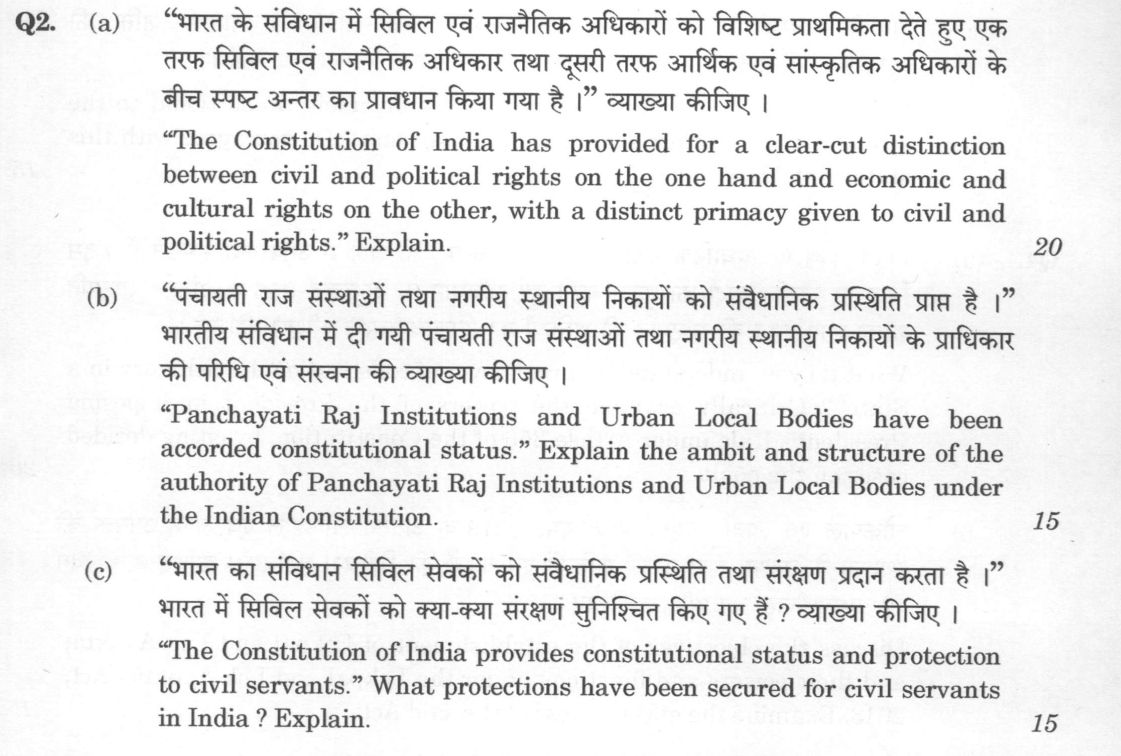
"The Constitution of India has provided for a clear-cut distinction between civil and political rights on the one hand and economic and cultural rights on the other, with a distinct primacy given to civil and political rights." Explain. 20 marks
"Panchayati Raj Institutions and Urban Local Bodies have been accorded constitutional status." Explain the ambit and structure of the authority of Panchayati Raj Institutions and Urban Local Bodies under the Indian Constitution. 15 marks
"The Constitution of India provides constitutional status and protection to civil servants." What protections have been secured for civil servants in India ? Explain. 15 marks
हिंदी में प्रश्न पढ़ें
"भारत के संविधान में सिविल एवं राजनीतिक अधिकारों को विशिष्ट प्राथमिकता देते हुए एक तरफ सिविल एवं राजनीतिक अधिकार तथा दूसरी तरफ आर्थिक एवं सांस्कृतिक अधिकारों के बीच स्पष्ट अंतर का प्रावधान किया गया है।" व्याख्या कीजिए। 20
"पंचायती राज संस्थाओं तथा नगरीय स्थानीय निकायों को संवैधानिक प्रतिष्ठा प्राप्त है।" भारतीय संविधान में दी गयी पंचायती राज संस्थाओं तथा नगरीय स्थानीय निकायों के प्राधिकार की परिधि एवं संरचना की व्याख्या कीजिए। 15
"भारत का संविधान सिविल सेवकों को संवैधानिक प्रतिष्ठा तथा संरक्षण प्रदान करता है।" भारत में सिविल सेवकों को क्या-क्या संरक्षण सुनिश्चित किए गए हैं ? व्याख्या कीजिए। 15
Model answer
Written by UPSC Answer Check against this question's marking rubric, to the expected length. UPSC does not publish answers for Mains — this is one way to score well, not an official key.
(a) The Constitution organises rights and governance through a layered architecture. In part (a), the distinction is visible in Part III and Part IV. Articles 12–35 create justiciable Fundamental Rights, mostly civil and political: equality, liberty, speech, religion, constitutional remedies. Articles 36–51 contain Directive Principles, which are economic and cultural in emphasis: welfare, work, education, environment, cultural heritage. Article 37 makes DPSPs non-justiciable, though fundamental in governance. This gives civil and political rights a formal primacy because courts can enforce them, while DPSPs guide policy and legislation. The primacy is not absolute. Kesavananda Bharati (1973) established the basic structure doctrine, protecting the Constitution’s identity from amendment. Minerva Mills (1980) later held that the balance and harmony between Fundamental Rights and Directive Principles is itself a basic feature, so neither can devour the other. Post-1971 jurisprudence has therefore used the harmonisation principle: courts read Part III and Part IV together, allowing reasonable restrictions on rights when they serve DPSPs, while using rights to test excessive state action. The debate over hierarchy is thus resolved as a judicially managed balance, not supremacy of one part over the other.
(b) Panchayati Raj Institutions and Urban Local Bodies gained constitutional status through the 73rd and 74th Amendments of 1992. Part IX and Part IXA treat them as institutions of self-government, not merely statutory creations. Article 243B provides a three-tier Panchayati Raj system: Gram Panchayat, Panchayat Samiti, and Zila Parishad, subject to omission of the intermediate tier in small States. Article 243A gives Gram Sabha constitutional importance as the foundation of rural self-governance. Article 243Q does not create a three-tier hierarchy for urban bodies; it provides three categories of municipalities—Nagar Panchayat, Municipal Council, and Municipal Corporation—based on population and revenue. Their authority is defined by devolution of powers, functions, and funds. Eleventh and Twelfth Schedules assign subjects such as agriculture, water supply, roads, urban planning, public health, and slum improvement. Elections, reservations for SC/ST and one-third women, and chairperson provisions ensure representative legitimacy. Financial devolution is reinforced by Article 280 and the State Finance Commission, while Articles 243I and 243Y require State Panchayati Raj and Municipal Finance Commissions to review fiscal position and recommend grants. This makes PRIs and ULBs constitutionally protected local governments with defined authority, though actual power depends on State implementation.
(c) Civil servants receive constitutional status and protection because administrative continuity requires security of tenure. Article 310 provides that office under the Union or a State is held during the pleasure of the President or Governor, but this pleasure is not arbitrary. Article 311 protects persons in civil posts from dismissal, removal, or reduction in rank except after an inquiry with reasonable opportunity to be heard. Exceptions exist for conviction on criminal misconduct, preventive detention, or where inquiry is impracticable and the authority is satisfied after giving an opportunity to show cause. Article 312 permits All India Services, ensuring a common cadre for Union and States. These safeguards are supplemented by service rules, especially the Central Civil Services (Classification, Control and Appeal) Rules, which provide appeal and revision against adverse orders. Courts review disciplinary proceedings for procedural fairness, mala fides, or perversity. The balance is between security of tenure and administrative efficiency: protection prevents capricious victimisation, while exceptions preserve the State’s ability to act against serious misconduct or security threats.
Together, these provisions show a Constitution that privileges justiciable civil and political rights, institutionalises local self-government, and protects the administrative machinery. The result is a governed balance: rights constrain power, local bodies channel participation, and service safeguards maintain an impartial bureaucracy.
What "Explain" is asking you to do
Make the working of something clear — what sets it off, what follows from what, and what it produces. Explain is the Commission's mechanism word: it dominates the technical papers and the “explain why” stems, where the marks sit in the causal chain and not in the label.
Structure that answers it
State what it is → the initiating condition → the chain of cause, step by step → an instance where it plays out → what the chain produces
Where marks are lost
Describing what something looks like instead of why it works that way. Naming the stages without linking them reads as description too.
How this answer will be evaluated
Approach
Framework: Issue > Rule: statute or Article > Authority > Application and conclusion. (a) explain: definition/context > points in order > small example > short close | (b) explain: definition/context > points in order > small example > short close | (c) explain: definition/context > points in order > small example > short close Full marks: Precise Article citations, clear distinction between justiciable/non-justiciable, detailed structure of Panchayats/ULBs, and specific protections for civil servants.
Key points expected
- Identify Fundamental Rights (Part III) as justiciable civil/political rights
- Identify DPSP (Part IV) as non-justiciable economic/cultural rights
- Explain the 'primacy' via Article 37 (DPSP not enforceable)
- Discuss the 'clear-cut distinction' in enforceability and judicial review
- Cite 73rd Amendment (Part IX) for Panchayati Raj Institutions
- Cite 74th Amendment (Part IXA) for Urban Local Bodies
- Describe the three-tier structure (Village, Intermediate, District)
- Explain the 'ambit' via 11th and 12th Schedules
Evaluation rubric
Each sub-part is marked on its own, against the marks and word limit printed on the paper.
- (a) Explain the distinction and primacy of civil/political rights over economic/cultural rights. 20 marks
explain— definition/context → points in order → small example → short close
Must cover
- Identify Fundamental Rights (Part III) as justiciable civil/political rights
- Identify DPSP (Part IV) as non-justiciable economic/cultural rights
- Explain the 'primacy' via Article 37 (DPSP not enforceable)
- Discuss the 'clear-cut distinction' in enforceability and judicial review
Loses marks
- Treating DPSP as justiciable without qualification
- Ignoring the distinction between justiciable and non-justiciable
- Failing to address the 'primacy' aspect of the question
Earns more
- Mention Article 32 (Right to Constitutional Remedies)
- Reference the 'Basic Structure' doctrine (Kesavananda Bharati)
- Discuss the 'Harmonious Construction' of Part III and IV
- Cite the 42nd Amendment (1976) changes to Article 37
Extra mark
- Cite Minerva Mills case (1980) on balance
- Reference Law Commission Report on Fundamental Rights
- (b) Explain the ambit and structure of authority of Panchayats and ULBs. 15 marks
explain— definition/context → points in order → small example → short close
Must cover
- Cite 73rd Amendment (Part IX) for Panchayati Raj Institutions
- Cite 74th Amendment (Part IXA) for Urban Local Bodies
- Describe the three-tier structure (Village, Intermediate, District)
- Explain the 'ambit' via 11th and 12th Schedules
Loses marks
- Confusing the 11th and 12th Schedules
- Failing to mention the constitutional status (Part IX/IXA)
- Ignoring the 'structure' aspect (three-tier system)
Earns more
- Mention the role of State Election Commission (Art 243K)
- Discuss the 'Gram Sabha' as the foundation (Art 243A)
- Reference the 11th Schedule (29 subjects) and 12th Schedule (18 subjects)
- Mention the role of State Legislature in making laws
Extra mark
- Cite the 74th Amendment's specific provisions for ULBs
- Reference the 'Panchayati Raj' resolution of 1959
- (c) Explain the constitutional protections secured for civil servants in India. 15 marks
explain— definition/context → points in order → small example → short close
Must cover
- Cite Article 310 (Conditions of service)
- Cite Article 311 (Inquiry before dismissal/removal)
- Cite Article 312 (Appeal to Central Administrative Tribunal)
- Mention the 'security of tenure' principle
Loses marks
- Confusing civil servant protections with fundamental rights
- Failing to mention the 'inquiry' requirement
- Ignoring the 'security of tenure' principle
Earns more
- Discuss the 'inquiry' requirement under Art 311(2)
- Mention the 'exception' for criminal conviction (Art 311(2)(b))
- Reference the 'protection against arbitrary dismissal'
- Mention the role of the Central Administrative Tribunal (CAT)
Extra mark
- Cite the 'S.P. Anand v. Union of India' case
- Reference the 'protection against arbitrary dismissal'
Practice this exact question
Write your answer and it is marked point by point against the model answer above — what you covered, what you missed, what you got wrong.
Evaluate my answer →More from Law 2023 Paper I
- Q1 Answer the following questions in about 150 words each : 10×5=50 (a) "Preamble of the Ind…
- Q2 (a) "The Constitution of India has provided for a clear-cut distinction between civil and…
- Q3 (a) "Superintendence, direction and control of elections is vested in the office of the E…
- Q4 (a) What do you understand by breakdown of constitutional machinery in a State ? Critical…
- Q5 Answer the following questions in about 150 words each : 10×5=50 (a) "Triumph of Positivi…