Paper I — Q4
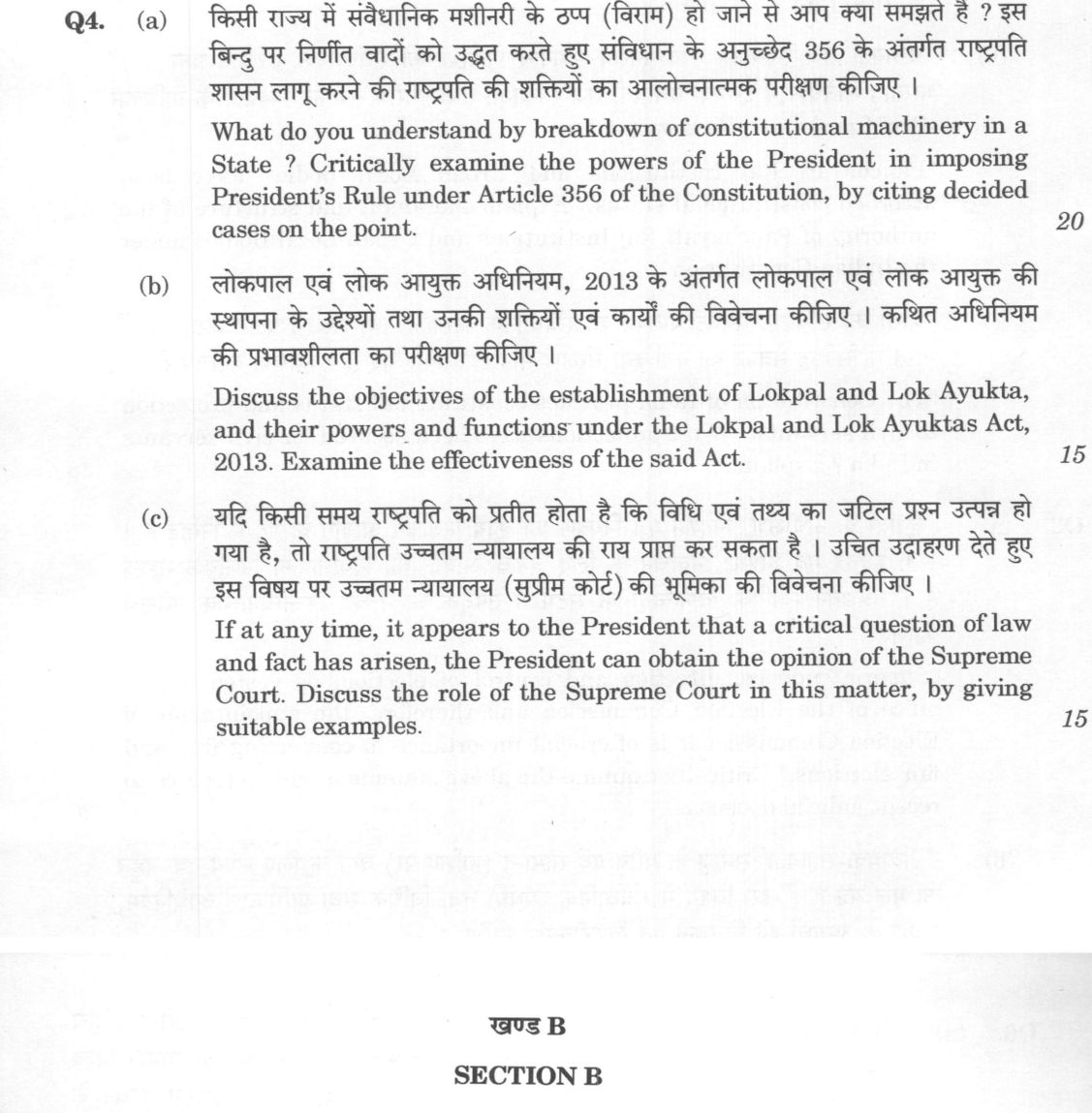
(a) What do you understand by breakdown of constitutional machinery in a State ? Critically examine the powers of the President…
What do you understand by breakdown of constitutional machinery in a State ? Critically examine the powers of the President in imposing President's Rule under Article 356 of the Constitution, by citing decided cases on the point. 20 marks
Discuss the objectives of the establishment of Lokpal and Lok Ayukta, and their powers and functions under the Lokpal and Lok Ayuktas Act, 2013. Examine the effectiveness of the said Act. 15 marks
If at any time, it appears to the President that a critical question of law and fact has arisen, the President can obtain the opinion of the Supreme Court. Discuss the role of the Supreme Court in this matter, by giving suitable examples. 15 marks
हिंदी में प्रश्न पढ़ें
किसी राज्य में संवैधानिक मशीनरी के ठप्प (विराम) हो जाने से आप क्या समझते हैं ? इस बिन्दु पर निर्णीत वादों को उद्धृत करते हुए संविधान के अनुच्छेद 356 के अंतर्गत राष्ट्रपति शासन लागू करने की राष्ट्रपति की शक्तियों का आलोचनात्मक परीक्षण कीजिए । 20
लोकपाल एवं लोक आयुक्त अधिनियम, 2013 के अंतर्गत लोकपाल एवं लोक आयुक्त की स्थापना के उद्देश्यों तथा उनकी शक्तियों एवं कार्यों की विवेचना कीजिए । कथित अधिनियम की प्रभावशीलता का परीक्षण कीजिए । 15
यदि किसी समय राष्ट्रपति को प्रतीत होता है कि विधि एवं तथ्य का जटिल प्रश्न उत्पन्न हो गया है, तो राष्ट्रपति उच्चतम न्यायालय की राय प्राप्त कर सकता है । उचित उदाहरण देते हुए इस विषय पर उच्चतम न्यायालय (सुप्रीम कोर्ट) की भूमिका की विवेचना कीजिए । 15
Model answer
Written by UPSC Answer Check against this question's marking rubric, to the expected length. UPSC does not publish answers for Mains — this is one way to score well, not an official key.
President’s Rule Breakdown of constitutional machinery under Article 356 means the state government cannot be carried on in accordance with the Constitution, such as loss of majority, violation of fundamental rules, or persistent defiance of constitutional norms; it is not mere political instability. It is distinct from Article 365, where the President may assume state functions if the state fails to comply with Union directions. The President may issue a proclamation, assume all or any state executive functions, suspend or dissolve the Assembly, and vest legislative authority in Parliament or under its authority. The proclamation lapses after six months unless approved by both Houses within two months, may continue for further six-month periods by resolutions, and may be revoked by the President or if the Court declares it invalid.
Critically, the President’s satisfaction is subjective in form but objective in substance. In State of Rajasthan v Union (1977), the Court treated the power as political, but S.R. Bommai v Union (1994) made it justiciable, requiring material, an opportunity for the state to show it can govern, and dissolution only as a last resort. Rameshwar Prasad v Union (2006) struck down the Bihar proclamation for lack of valid material. Thus, Article 356 is a federal emergency power, but Bommai’s dissolution test prevents its use as a political weapon.
Lokpal and Lokayuktas The Lokpal and Lokayuktas Act, 2013 aims to create an effective institutional ombudsman for preventing and inquiring into corruption in high public offices. The Lokpal inquires into corruption against Union public functionaries, including the Prime Minister under special safeguards, while the Lokayuktas are state-level counterparts for state public functionaries, ensuring local accountability. Under the Act, both receive complaints, conduct preliminary inquiry, investigate, prosecute, summon witnesses, search and seize, attach property, and recommend disciplinary action; the Lokpal may refer matters to the CBI, and the Lokayukta performs analogous functions at state level.
Their effectiveness is limited. The judiciary is excluded, the CBI’s bifurcation into investigation and prosecution wings has not been fully operationalised, the Lokpal has suffered long delays in constitution and functioning, and many states have not appointed Lokayuktas. Hence the Act is a strong framework but its impact depends on timely appointments and institutional independence.
Advisory Jurisdiction Article 143 allows the Supreme Court to advise on questions of law. Under 143(1), any court other than a High Court may refer a question of law of public importance; the Court may answer or decline, and its opinion is persuasive, not binding. Under 143(2), the President may refer a question of public importance; the Court must answer, but the opinion is not binding, though highly persuasive. Its role is advisory, not adjudicative, but it guides the executive. In re Delhi Laws Act (1951) and In re Kerala Education Bill (1957) show its role in examining constitutional validity and fundamental rights. In re Cauvery Water Disputes Tribunal (1992) clarified the limits of advisory reference in inter-state water disputes. In re Special Reference No. 1 of 2002 examined the postponement of Gujarat Assembly elections and the scope of Article 174(1) and the Election Commission’s powers, holding that dissolution before completion of term is exceptional and must be justified.
Conclusion Together, these provisions show a design of safeguards: Article 356 is a federal emergency power now disciplined by judicial review; Article 143 provides a constitutional check on executive uncertainty; the Lokpal and Lokayuktas strengthen accountability. Yet their effectiveness depends on political will, timely appointments, and disciplined use. The verdict is that the Constitution contains adequate safeguards, but they are not self-executing; misuse of 356, delayed anti-corruption institutions, and the non-binding nature of advisory opinions reveal tensions in federalism and separation of powers.
What "Critically examine" is asking you to do
Test the proposition the question puts to you and return a finding on how far it holds. Examine stems carry a claim, or ask whether something has happened, and expect evidence weighed both ways before the extent is stated — often with remedial measures attached. “Critically” is not a section added at the end: name the yardstick you are judging by — the evidence, the stated objective, a constitutional principle, a rival explanation — and let a verdict close each part of the body. Where the question quotes a claim, that verdict must land on the claim itself, accepted, qualified or rejected, and not on the theme in general.
Structure that answers it
Restate the claim as the question frames it → evidence that supports it → evidence that undercuts it → the conditions under which it holds → verdict on how far it stands
Where marks are lost
Merits in one paragraph, demerits in the next, and a conclusion calling for a balanced and holistic approach. That is a survey with the judgement left out and it holds the answer in the middle band. The opposite error is reading “critically” as permission to attack — and with the odd pairings, critically describe or critically explain, the exposition still carries most of the marks, the judgement being a layer on it rather than a substitute for it.
How this answer will be evaluated
Approach
Framework: Issue > Rule > Authority > Application. (a) critically evaluate: positives > negatives/limits > conditions/safeguards > conclusion | (b) discuss: intro > 3-4 dimensions > example > balanced close | (c) discuss: intro > 3-4 dimensions > example > balanced close Full marks: Comprehensive, well-structured, cites specific cases and articles, critically evaluates, and provides relevant examples.
Key points expected
- Define 'breakdown of constitutional machinery' (Art 356(1))
- Cite S.R. Bommai v. Union of India (1994) ratio
- Discuss procedural safeguards (Governor's report, Presidential Proclamation)
- Critically evaluate the misuse of Article 356 powers
- State objectives of Lokpal and Lok Ayukta
- Detail powers and functions under the 2013 Act
- Examine the effectiveness of the Act
- Mention the Lokpal and Lok Ayuktas Act, 2013
Evaluation rubric
Each sub-part is marked on its own, against the marks and word limit printed on the paper.
- (a) Define breakdown of constitutional machinery and critically examine President's powers under Article 356. 20 marks
critically evaluate— positives → negatives/limits → conditions/safeguards → conclusion
Must cover
- Define 'breakdown of constitutional machinery' (Art 356(1))
- Cite S.R. Bommai v. Union of India (1994) ratio
- Discuss procedural safeguards (Governor's report, Presidential Proclamation)
- Critically evaluate the misuse of Article 356 powers
Loses marks
- Outcome-only case citation without ratio
- Ignoring the 'critical' aspect of the command word
- Failing to define 'breakdown of constitutional machinery'
Earns more
- Mention 56th Amendment (1987) changes
- Reference 14th Law Commission Report
- Cite Kihoto Hollohan v. Zachillu (1992)
- Discuss the role of the Supreme Court in judicial review
Extra mark
- Reference recent SC judgment on Art 356
- Mention specific state examples (e.g., Kerala, Maharashtra)
- (b) Discuss objectives, powers, and functions of Lokpal/Lok Ayukta and examine the Act's effectiveness. 15 marks
discuss— intro → 3-4 dimensions → example → balanced close
Must cover
- State objectives of Lokpal and Lok Ayukta
- Detail powers and functions under the 2013 Act
- Examine the effectiveness of the Act
- Mention the Lokpal and Lok Ayuktas Act, 2013
Loses marks
- Confusing Lokpal with Lok Ayukta
- Failing to examine the 'effectiveness' of the Act
- Ignoring the 2013 Act specifics
Earns more
- Reference the 2G/Coalgate scams as context
- Mention the role of the Selection Committee
- Discuss the jurisdiction of Lokpal vs Lok Ayukta
- Reference the 2nd Administrative Reforms Commission
Extra mark
- Mention specific provisions of the 2013 Act
- Reference the Lokpal Bill, 2011 (draft)
- (c) Discuss the role of the Supreme Court in providing advisory opinions to the President. 15 marks
discuss— intro → 3-4 dimensions → example → balanced close
Must cover
- Explain the President's power to seek SC opinion (Art 143)
- Discuss the role of the Supreme Court in this matter
- Provide suitable examples of advisory opinions
- Mention the non-binding nature of advisory opinions
Loses marks
- Failing to provide 'suitable examples' as requested
- Confusing advisory jurisdiction with original jurisdiction
- Ignoring the 'role' of the Supreme Court
Earns more
- Cite the Berubari Union case (1960)
- Cite the Kerala Education Bill case (1958)
- Mention the distinction between Art 143(1) and 143(2)
- Reference the E.P. Royappa v. State of Tamil Nadu case
Extra mark
- Mention the recent SC advisory opinion on the National Judicial Appointments Commission
- Reference the 2015 SC judgment on the NJAC
Practice this exact question
Write your answer and it is marked point by point against the model answer above — what you covered, what you missed, what you got wrong.
Evaluate my answer →More from Law 2023 Paper I
- Q1 Answer the following questions in about 150 words each : 10×5=50 (a) "Preamble of the Ind…
- Q2 (a) "The Constitution of India has provided for a clear-cut distinction between civil and…
- Q3 (a) "Superintendence, direction and control of elections is vested in the office of the E…
- Q4 (a) What do you understand by breakdown of constitutional machinery in a State ? Critical…
- Q5 Answer the following questions in about 150 words each : 10×5=50 (a) "Triumph of Positivi…
- Q6 (a) "Law must be stable, and yet it cannot stand still, as it needs to reconcile the conf…
- Q7 (a) "Preamble of the UN Charter is representative of the aspirations of humanity in ensur…