Paper I — Q7
(a) "Preamble of the UN Charter is representative of the aspirations of humanity in ensuring peace and security across the…
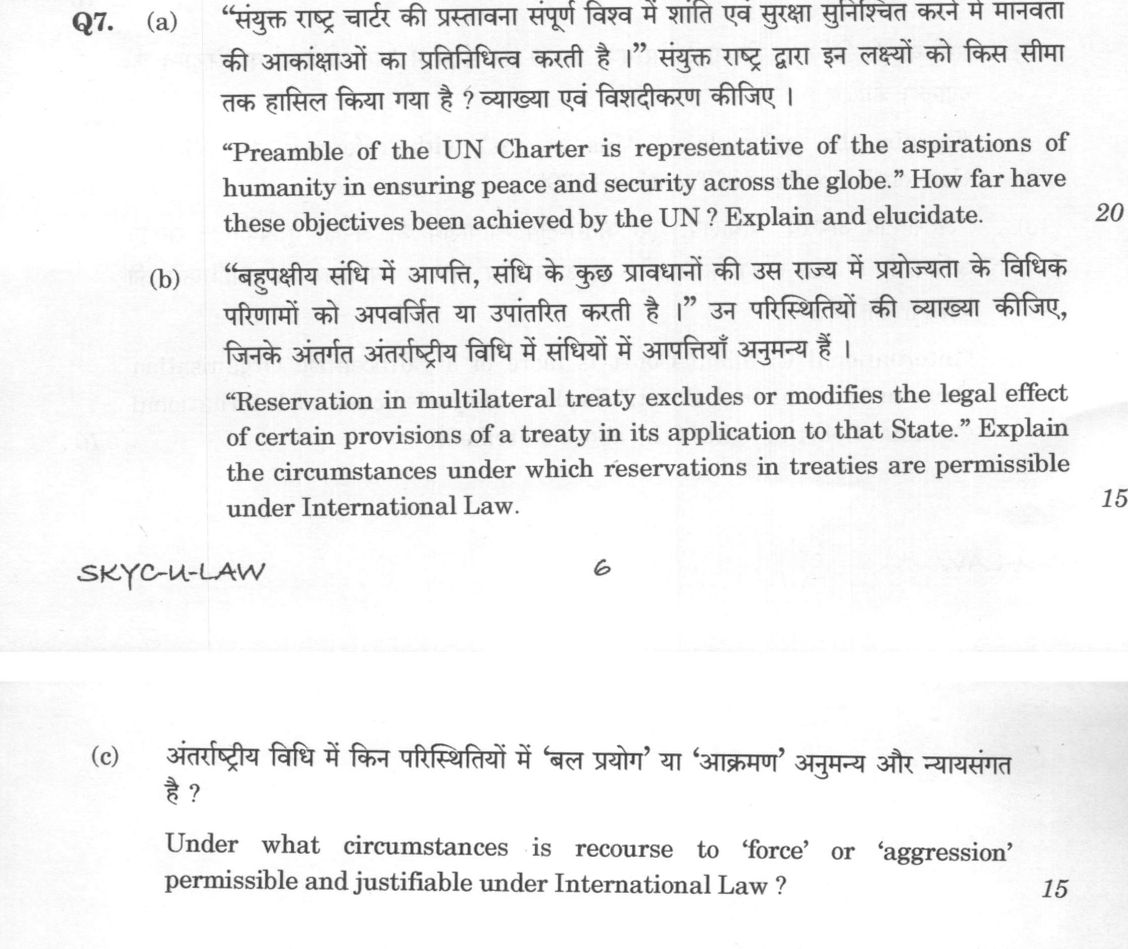
"Preamble of the UN Charter is representative of the aspirations of humanity in ensuring peace and security across the globe." How far have these objectives been achieved by the UN? Explain and elucidate. 20 marks
"Reservation in multilateral treaty excludes or modifies the legal effect of certain provisions of a treaty in its application to that State." Explain the circumstances under which reservations in treaties are permissible under International Law. 15 marks
Under what circumstances is recourse to 'force' or 'aggression' permissible and justifiable under International Law ? 15 marks
हिंदी में प्रश्न पढ़ें
"संयुक्त राष्ट्र चार्टर की प्रस्तावना संपूर्ण विश्व में शांति एवं सुरक्षा सुनिश्चित करने में मानवता की आकांक्षाओं का प्रतिनिधित्व करती है ।" संयुक्त राष्ट्र द्वारा इन लक्ष्यों को किस सीमा तक हासिल किया गया है ? व्याख्या एवं विशदीकरण कीजिए । 20
"बहुपक्षीय संधि में आपत्ति, संधि के कुछ प्रावधानों की उस राज्य में प्रयोज्यता के विधिक परिणामों को अपवर्जित या उपांतरित करती है ।" उन परिस्थितियों की व्याख्या कीजिए, जिनके अंतर्गत अंतर्राष्ट्रीय विधि में संधियों में आपत्तियाँ अनुमन्य हैं । 15
अंतर्राष्ट्रीय विधि में किन परिस्थितियों में 'बल प्रयोग' या 'आक्रमण' अनुमन्य और न्यायसंगत है ? 15 marks
Model answer
Written by UPSC Answer Check against this question's marking rubric, to the expected length. UPSC does not publish answers for Mains — this is one way to score well, not an official key.
The Preamble, read with Article 1(2), frames the UN’s core aspirations: saving generations from war, ensuring international security, promoting human rights, and supporting self-determination. Its achievement is mixed. The UN has helped end colonial empires, built a human-rights system, and conducted peacekeeping operations such as UNFICYP and UNDOF, which reduced interstate violence and gave diplomacy space. India’s sustained participation in peacekeeping reflects this utility. The Preamble’s human-rights aspiration is visible in the Universal Declaration and the two international covenants, while self-determination became a General Assembly principle during decolonization. Yet the Charter’s central promise remains constrained by the Security Council’s 1945 structure. Veto abuse in Syria and Ukraine, paralysis over mass atrocities, and Cold War proxy conflicts show that collective security is selective. The G4 (Germany, Japan, Brazil, India) proposal to expand the Council and India’s claim for permanent membership address this mismatch, but reform is difficult because the existing permanent members control the veto. The Responsibility to Protect doctrine, adopted in 2005, has been limited by inconsistent application, sovereignty objections and veto politics.
Permissible reservations in multilateral treaties Under the Vienna Convention on the Law of Treaties, 1969, a reservation is a unilateral statement, however formulated, made when signing, ratifying or acceding, by which a State seeks to exclude or modify the legal effect of certain provisions in its application to that State. Articles 19–23 make reservations permissible unless the treaty prohibits them, allows only specified reservations, or the reservation is incompatible with the treaty’s object and purpose. The ICJ’s 1951 advisory opinion on Reservations to the Genocide Convention established this object-and-purpose test and rejected the idea that every State must accept every reservation. The 1996 Legality of Use of Nuclear Weapons opinion, though not a reservations case, illustrates the Court’s interpretive method: treaty and Charter obligations are read in context, with customary law and peremptory norms. Reservations derogating from jus cogens are impermissible, as Articles 53 and 64 make peremptory norms non-derogable and void or terminate conflicting treaties. In practice, an objecting State may object within twelve months; if none, the reservation is deemed accepted. If it does, the reserving and objecting States may decide whether treaty relations exist, while the reserving State remains bound vis-à-vis accepting States.
Force, aggression and justifiable exceptions Article 2(4) prohibits the threat or use of force against territorial integrity or political independence. “Aggression” is a distinct and graver concept: UNGA Resolution 3314 (1974) defines it as invasion, attack, bombardment, blockade, allowing one’s territory to be used for hostile acts, or sending armed bands; the Nuremberg principles treated it as a crime against peace, and the ICC’s Rome Statute now criminalizes it for individuals. Aggression is not a lawful recourse; it is criminal. The principal Charter exceptions are self-defence under Article 51, individual or collective, until the Security Council acts, and Chapter VII, especially Article 42, where the Council authorizes enforcement action. Humanitarian intervention remains debated; it is not a clear right and is usually framed through R2P rather than unilateral force. In Nicaragua v. United States (1986), the ICJ held that an “armed attack” requires substantial force, not merely support to insurgents; in Oil Platforms (2003), it stressed necessity and proportionality. Contemporary issues—pre-emptive or anticipatory self-defence, as in the 2003 Iraq war, cyber warfare, and drone strikes—remain contested; the Caroline test of imminent necessity is not uniformly accepted, and cyber/drone cases raise attribution, threshold and proportionality problems.
Thus, the Charter’s objectives remain a normative compass, but require Security Council reform, disciplined treaty practice, and strict adherence to the prohibition on force, with aggression treated as criminal.
What "Elucidate" is asking you to do
Make a stated proposition plain and then prove it with instances. Elucidate stems almost always carry a claim or a named concept, and very often the words “with examples” or “with suitable diagrams” — the illustration is part of the directive, not decoration.
Structure that answers it
Plain-language statement of what the proposition means → the part that is obscure, resolved → first illustration → second illustration → why the proposition holds
Where marks are lost
Adding terminology; elucidate rewards removing it. The commoner loss is a clean explanation with no example, when the stem asked for examples.
How this answer will be evaluated
Approach
Framework: Issue > Rule > Authority > Application. (a) examine: intro > how/why with reasoning > evidence > conclusion | (b) explain: definition/context > points in order > small example > short close | (c) justify: claim > 3-4 reasons > evidence > conclusion Full marks: Precise legal citations, balanced analysis, and clear application of law to the specific question.
Key points expected
- Cite specific Preamble clauses on peace and security
- Provide examples of UN success in conflict resolution
- Provide examples of UN failure or limitations
- Conclude with a balanced assessment of achievement
- Define 'reservation' per the Vienna Convention
- Explain the 'object and purpose' test
- Distinguish between permissible and impermissible reservations
- Mention the role of other contracting states
Evaluation rubric
Each sub-part is marked on its own, against the marks and word limit printed on the paper.
- (a) Assess the extent to which the UN has achieved the Preamble's goals of peace and security. 20 marks
examine— intro → how/why with reasoning → evidence → conclusion
Must cover
- Cite specific Preamble clauses on peace and security
- Provide examples of UN success in conflict resolution
- Provide examples of UN failure or limitations
- Conclude with a balanced assessment of achievement
Loses marks
- General statements without specific examples
- Ignoring the 'how far' aspect of the question
- Focusing only on successes or only on failures
Earns more
- Reference to specific UN Security Council resolutions
- Mention of specific peacekeeping operations
- Discussion of the veto power's impact
- Reference to the UN Charter's enforcement mechanisms
Extra mark
- Citation of a specific recent UN report
- Reference to a specific ICJ judgment on peace
- (b) Explain the legal conditions under which treaty reservations are permissible. 15 marks
explain— definition/context → points in order → small example → short close
Must cover
- Define 'reservation' per the Vienna Convention
- Explain the 'object and purpose' test
- Distinguish between permissible and impermissible reservations
- Mention the role of other contracting states
Loses marks
- Confusing reservations with interpretative declarations
- Failing to mention the 'object and purpose' test
- Ignoring the role of other states in accepting reservations
Earns more
- Reference to the 1969 Vienna Convention on the Law of Treaties
- Citation of the ICJ 'Reservations to the Genocide Convention' case
- Discussion of the 'loose' vs 'strict' approach
- Mention of the ILC Articles on Reservations
Extra mark
- Reference to a specific recent treaty reservation dispute
- Mention of the 'object and purpose' test's evolution
- (c) Justify the limited circumstances where the use of force is permissible under international law. 15 marks
justify— claim → 3-4 reasons → evidence → conclusion
Must cover
- State the general prohibition on the use of force
- Explain the right of self-defence (Article 51)
- Explain the Security Council's role in authorising force
- Mention the conditions for lawful self-defence
Loses marks
- Failing to state the general prohibition first
- Confusing 'force' with 'aggression' without distinction
- Ignoring the Security Council's primary role
Earns more
- Reference to the UN Charter Articles 2(4) and 51
- Citation of the 'Caroline' test for self-defence
- Discussion of the 'necessity' and 'proportionality' principles
- Mention of the 'Responsibility to Protect' (R2P) doctrine
Extra mark
- Reference to the ICJ 'Nicaragua' case
- Mention of the 'humanitarian intervention' debate
Practice this exact question
Write your answer and it is marked point by point against the model answer above — what you covered, what you missed, what you got wrong.
Evaluate my answer →More from Law 2023 Paper I
- Q4 (a) What do you understand by breakdown of constitutional machinery in a State ? Critical…
- Q5 Answer the following questions in about 150 words each : 10×5=50 (a) "Triumph of Positivi…
- Q6 (a) "Law must be stable, and yet it cannot stand still, as it needs to reconcile the conf…
- Q7 (a) "Preamble of the UN Charter is representative of the aspirations of humanity in ensur…
- Q8 (a) "WTO provides a platform for agreements amongst its members which form the legal foun…