Paper I — Q6
(a) "Law must be stable, and yet it cannot stand still, as it needs to reconcile the conflicting needs of stability and change…
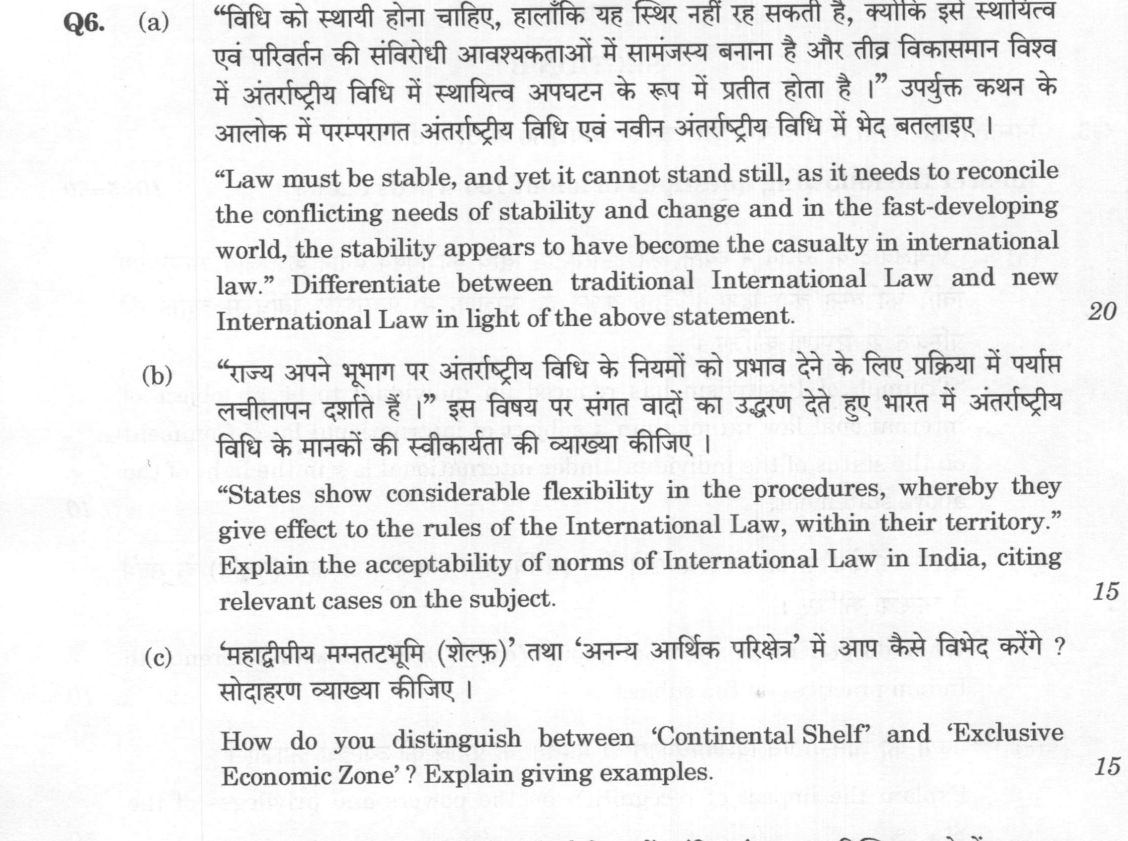
"Law must be stable, and yet it cannot stand still, as it needs to reconcile the conflicting needs of stability and change and in the fast-developing world, the stability appears to have become the casualty in international law." Differentiate between traditional International Law and new International Law in light of the above statement. 20 marks
"States show considerable flexibility in the procedures, whereby they give effect to the rules of the International Law, within their territory." Explain the acceptability of norms of International Law in India, citing relevant cases on the subject. 15 marks
How do you distinguish between 'Continental Shelf' and 'Exclusive Economic Zone'? Explain giving examples. 15 marks
हिंदी में प्रश्न पढ़ें
"विधि को स्थायी होना चाहिए, हालांकि यह स्थिर नहीं रह सकती है, क्योंकि इसे स्थायित्व एवं परिवर्तन की संविरोधी आवश्यकताओं में सामंजस्य बनाना है और तीव्र विकासमान विश्व में अंतर्राष्ट्रीय विधि में स्थायित्व अपघटन के रूप में प्रतीत होता है ।" उपर्युक्त कथन के आलोक में परम्परागत अंतर्राष्ट्रीय विधि एवं नवीन अंतर्राष्ट्रीय विधि में भेद बतलाइए । 20
"राज्य अपने भूभाग पर अंतर्राष्ट्रीय विधि के नियमों को प्रभाव देने के लिए प्रक्रिया में पर्याप्त लचीलापन दर्शाते हैं ।" इस विषय पर संगत वादों का उद्धरण देते हुए भारत में अंतर्राष्ट्रीय विधि के मानकों की स्वीकार्यता की व्याख्या कीजिए । 15
'महाद्वीपीय ममतटभूमि (शेल्फ)' तथा 'अनन्य आर्थिक परिक्षेत्र' में आप कैसे विभेद करेंगे ? सोदाहरण व्याख्या कीजिए । 15
Model answer
Written by UPSC Answer Check against this question's marking rubric, to the expected length. UPSC does not publish answers for Mains — this is one way to score well, not an official key.
Traditional International Law versus New International Law
International law constantly navigates the tension between legal predictability and societal evolution. Traditional international law was fundamentally state-centric, Eurocentric, and strictly consent-based, rooted in absolute sovereignty as articulated in the S.S. Lotus Case (1927). It governed bilateral diplomatic relations, recognized the sovereign prerogative of war, and maintained static rules where states were the exclusive subjects.
In contrast, modern international law embraces dynamic multilateralism, recognizing individuals, international organizations, and non-state actors as legitimate subjects. It shifts from purely consent-based bilateralism to erga omnes obligations (Barcelona Traction Case, 1970) and non-derogable jus cogens norms. The post-UN Charter regime fundamentally altered the normative structure by prohibiting the unilateral use of force under Article 2(4).
However, stability appears as a casualty because rapid norm creation through "soft law," evolving principles like the Responsibility to Protect (R2P), and fast-moving international environmental frameworks outpace the traditional formation of customary international law based on consistent state practice and opinio juris. This creates normative fluidity, challenging structural legal certainty.
Acceptability of International Law Norms in India
India follows a dualist model where international treaties do not automatically become part of municipal law without legislative transformation. Under the Constitution, Article 51(c) directs the State to foster respect for international law and treaty obligations, while Article 253 confers plenary power upon Parliament to enact legislation implementing international treaties and conventions.
The Indian judiciary has adopted a progressive approach by harmonizing municipal jurisprudence with international customary norms and treaty provisions, provided they do not conflict with domestic statutes or the Constitution.
In Vishaka v. State of Rajasthan (1997), the Supreme Court relied on the Convention on the Elimination of All Forms of Discrimination Against Women (CEDAW) to formulate guidelines against workplace sexual harassment in the absence of enacted legislation, reading treaty obligations directly into Articles 14, 19, and 21. Similarly, in PUCL v. Union of India (1997), the Court interpreted the right to privacy under Article 21 in light of Article 17 of the International Covenant on Civil and Political Rights (ICCPR). In the environmental sphere, Vellore Citizens' Welfare Forum (1996) and Narmada Bachao Andolan v. Union of India (2000) incorporated customary international environmental principles—such as the Precautionary Principle, Polluter Pays Principle, and Sustainable Development from the Stockholm and Rio Declarations—as integral components of domestic environmental jurisprudence.
Distinction Between Continental Shelf and Exclusive Economic Zone
While both maritime zones confer functional sovereign rights rather than territorial sovereignty, they are distinguished by legal regime, scope, and spatial limits under the UN Convention on the Law of the Sea (UNCLOS), 1982:
Legal Regime and Scope: The Exclusive Economic Zone (EEZ) under UNCLOS Part V encompasses the entire water column, the seabed, and its subsoil. It grants sovereign rights for exploring, exploiting, conserving, and managing all living and non-living natural resources, as well as economic activities like energy production from water, currents, and winds. In contrast, the Continental Shelf under UNCLOS Part VI is confined strictly to the seabed and subsoil. It confers rights exclusively over non-living mineral resources and sedentary species, without affecting the legal status of the superjacent waters. Rights over the continental shelf exist ipso facto and ab initio, requiring no express proclamation.
Spatial Limits: An EEZ cannot extend beyond 200 nautical miles (nm) from the coastal baseline. Conversely, an extended Continental Shelf can project beyond 200 nm up to the outer edge of the continental margin—capped at 350 nm from baselines or 100 nm from the 2,500-meter isobath.
Illustrations: The dispute over the Enrica Lexie Incident (2012) off Kerala's coast highlighted issues of EEZ resource jurisdiction versus high seas navigation freedoms. In contrast, the Bangladesh v. Myanmar (ITLOS, 2012) adjudication and India's scientific submissions to the Commission on the Limits of the Continental Shelf (CLCS) over the Bay of Bengal illustrate outer continental shelf claims extending well beyond 200 nautical miles.
Thus, international law reconciles stability with progressive development by providing structured maritime zones and allowing domestic legal systems, such as India's, to harmoniously absorb global norms without violating sovereign constitutional limits.
What "Differentiate" is asking you to do
Fix the criteria on which the two differ and apply each criterion to both, so the pair can no longer be mixed up. Differentiate stems usually carry a further task attached — describe the mechanism, set out the principles, discuss the applications — and that task carries its own marks.
Structure that answers it
Criterion 1 applied to both → criterion 2 → criterion 3 → summary line or table → the attached second demand answered in full
Where marks are lost
Two standalone definitions placed side by side, leaving the reader to extract the difference. The second common loss is running out of space before the attached task, which is often worth as much as the differentiation.
How this answer will be evaluated
Approach
Framework: Issue > Rule > Authority > Application. (a) compare: paired headings or table > key differences > significance > conclusion | (b) explain: definition/context > points in order > small example > short close | (c) compare: paired headings or table > key differences > significance > conclusion Full marks: Precise legal distinctions, relevant case law, and clear application to the prompt.
Key points expected
- Define traditional IL as static and state-centric
- Define new IL as dynamic and multi-actor
- Address the 'stability vs change' conflict in the quote
- Provide specific examples of evolving norms
- Explain the dualist approach in India
- Cite relevant cases on incorporation vs adoption
- Discuss the role of the Indian Parliament
- Address the 'flexibility' mentioned in the quote
Evaluation rubric
Each sub-part is marked on its own, against the marks and word limit printed on the paper.
- (a) Differentiate traditional and new International Law regarding stability vs change. 20 marks
compare— paired headings or table → key differences → significance → conclusion
Must cover
- Define traditional IL as static and state-centric
- Define new IL as dynamic and multi-actor
- Address the 'stability vs change' conflict in the quote
- Provide specific examples of evolving norms
Loses marks
- Restating the quote without analysis
- Failing to distinguish between the two eras
- Ignoring the 'stability' aspect of the prompt
Earns more
- Mention the role of international organizations
- Reference the shift from power politics to law
- Discuss the impact of globalization on legal stability
- Cite specific treaties showing rapid development
Extra mark
- Reference the Law Commission of India report
- Cite a recent Supreme Court judgment on IL
- (b) Explain India's flexibility in adopting International Law norms. 15 marks
explain— definition/context → points in order → small example → short close
Must cover
- Explain the dualist approach in India
- Cite relevant cases on incorporation vs adoption
- Discuss the role of the Indian Parliament
- Address the 'flexibility' mentioned in the quote
Loses marks
- Outcome-only case citation without ratio
- Failing to link flexibility to specific procedures
- General discussion without Indian context
Earns more
- Mention the Vellore Citizens Welfare Trust case
- Reference the Vishaka Guidelines
- Discuss the role of the Executive in treaties
- Cite the Berubari Union case
Extra mark
- Reference a specific Law Commission report
- Cite a recent Supreme Court judgment
- (c) Distinguish between Continental Shelf and Exclusive Economic Zone. 15 marks
compare— paired headings or table → key differences → significance → conclusion
Must cover
- Define Continental Shelf (geological vs legal)
- Define Exclusive Economic Zone (EEZ)
- Compare the rights (sovereign vs sovereign rights)
- Provide examples of resource exploitation
Loses marks
- Confusing the legal definitions of the zones
- Failing to distinguish the nature of rights
- Ignoring the 'examples' requirement
Earns more
- Mention the 1982 UNCLOS
- Cite the role of the CLCS
- Discuss the 200-nautical-mile limit
- Reference the difference in resource types
Extra mark
- Reference a specific Law Commission report
- Cite a recent Supreme Court judgment
Practice this exact question
Write your answer and it is marked point by point against the model answer above — what you covered, what you missed, what you got wrong.
Evaluate my answer →More from Law 2023 Paper I
- Q3 (a) "Superintendence, direction and control of elections is vested in the office of the E…
- Q4 (a) What do you understand by breakdown of constitutional machinery in a State ? Critical…
- Q5 Answer the following questions in about 150 words each : 10×5=50 (a) "Triumph of Positivi…
- Q6 (a) "Law must be stable, and yet it cannot stand still, as it needs to reconcile the conf…
- Q7 (a) "Preamble of the UN Charter is representative of the aspirations of humanity in ensur…
- Q8 (a) "WTO provides a platform for agreements amongst its members which form the legal foun…