Paper II — Q1
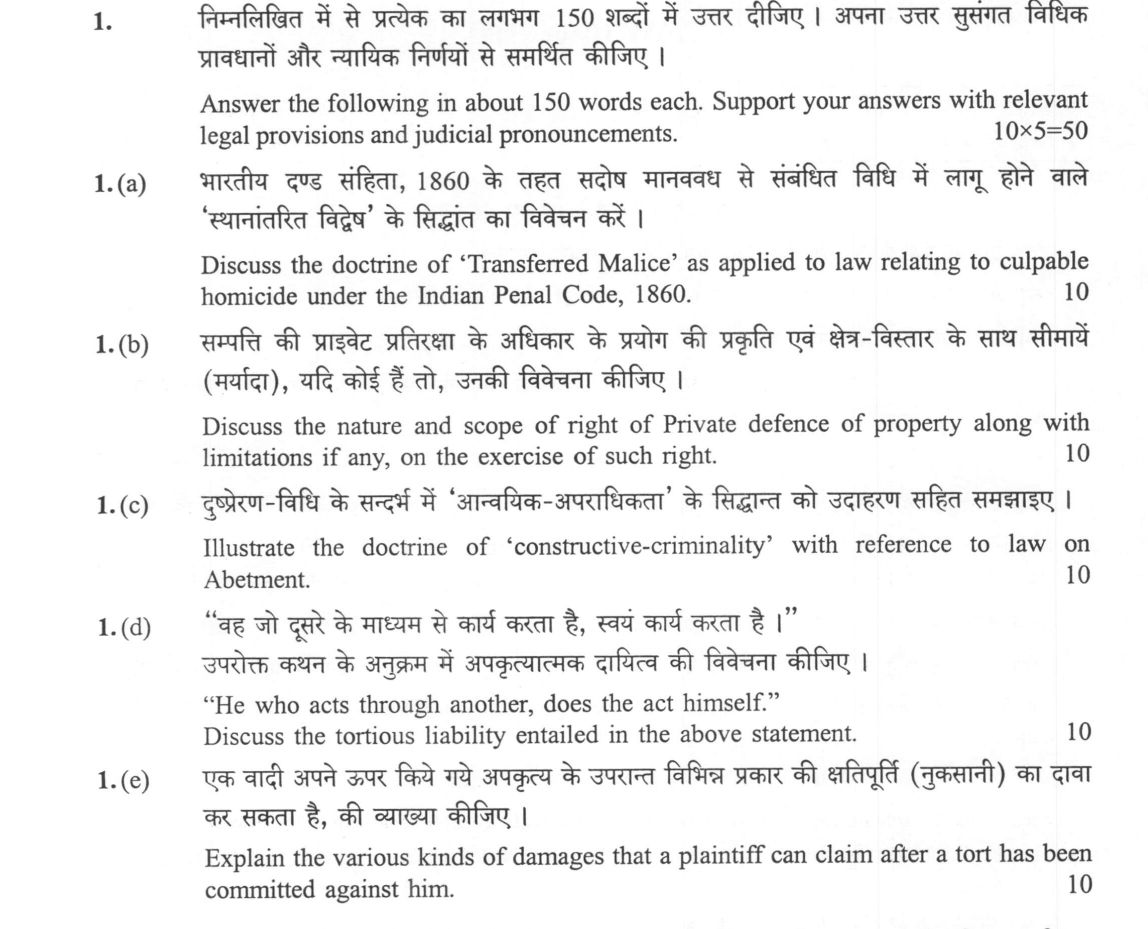
Answer the following in about 150 words each. Support your answers with relevant legal provisions and judicial pronouncements…
Answer the following in about 150 words each. Support your answers with relevant legal provisions and judicial pronouncements. 10×5=50
Discuss the doctrine of 'Transferred Malice' as applied to law relating to culpable homicide under the Indian Penal Code, 1860. 10 marks
Discuss the nature and scope of right of Private defence of property along with limitations if any, on the exercise of such right. 10 marks
Illustrate the doctrine of 'constructive-criminality' with reference to law on Abetment. 10 marks
"He who acts through another, does the act himself." Discuss the tortious liability entailed in the above statement. 10 marks
Explain the various kinds of damages that a plaintiff can claim after a tort has been committed against him. 10 marks
हिंदी में प्रश्न पढ़ें
निम्नलिखित में से प्रत्येक का लगभग 150 शब्दों में उत्तर दीजिए। अपना उत्तर सुसंगत विधिक प्रावधानों और न्यायिक निर्णयों से समर्थित कीजिए। 10×5=50
भारतीय दण्ड संहिता, 1860 के तहत सदोष मानवध से संबंधित विधि में लागू होने वाले 'स्थानांतरित विद्वेष' के सिद्धांत का विवेचन करें। 10
सम्पत्ति की प्राइवेट प्रतिरक्षा के अधिकार के प्रयोग की प्रकृति एवं क्षेत्र-विस्तार के साथ सीमायें (मर्यादा), यदि कोई है तो, उनकी विवेचना कीजिए। 10
दुष्प्रेरण-विधि के संदर्भ में 'आवयिक-अपराधिकता' के सिद्धांत को उदाहरण सहित समझाइए। 10
"वह जो दूसरे के माध्यम से कार्य करता है, स्वयं कार्य करता है।" उपरोक्त कथन के अनुक्रम में अपकृत्यात्मक दायित्व की विवेचना कीजिए। 10
एक वादी अपने ऊपर किये गये अपकृत्य के उपरान्त विभिन्न प्रकार की क्षतिपूर्ति (नुकसानी) का दावा कर सकता है, की व्याख्या कीजिए। 10
Model answer
Written by UPSC Answer Check against this question's marking rubric, to the 150-word length. UPSC does not publish answers for Mains — this is one way to score well, not an official key.
a) Transferred Malice The doctrine of transferred malice, codified in Section 301 of the Indian Penal Code, 1860, addresses situations where a person intends to cause death or grievous hurt to one individual but inadvertently causes death to another. The provision stipulates that if the act is done with the intention of causing death or grievous hurt, and the death of a person other than that to whom it was intended is caused, the offender is guilty of culpable homicide. This principle, rooted in common law as seen in R. v. Saunders (1573), ensures that the criminal liability follows the act rather than the specific victim. In State of Rajasthan v. Kalka, the Supreme Court affirmed that the malice transfers from the intended victim to the actual victim, provided the act was directed with the requisite intent. The doctrine prevents offenders from escaping liability by claiming a mistake in identity, thereby upholding the principle that the gravity of the intent determines the nature of the offence.
b) Private Defence of Property The right of private defence of property is governed by Sections 97 to 106 of the IPC. Section 97 grants this right to every person in possession of property and those in privity of contract with them. However, Section 99 imposes limitations: the right cannot be exercised against the act of a public servant acting in good faith under colour of office, unless the act reasonably causes apprehension of death or grievous hurt. Furthermore, the right does not exist if there is time to have recourse to the protection of the public authorities. Section 103 outlines the extent of the right to cause death. It permits causing death for house-breaking by night, robbery, or theft/mischief/house-trespass under circumstances causing apprehension of death or grievous hurt. Section 104 specifically allows causing death for house-breaking by night or robbery. The right continues under Section 105 until the act is completed or the offender retreats with the property, or in the case of house-breaking by night, until the house-trespass is ended. Proportionality is key; excessive force beyond what is necessary to protect the property is not justified.
c) Constructive Criminality in Abetment Constructive criminality in abetment is primarily illustrated by Section 109 of the IPC. This section provides that if a distinct offence is committed in the act of abetting another offence, the abettor is liable to punishment for the distinct offence. This doctrine extends liability beyond the specific act abetted to include unintended but consequential crimes. For instance, if A abets B to commit theft, and B commits robbery in the process, A is liable for robbery under Section 109, even if A did not intend the use of force. This is distinct from abetment by conspiracy under Section 120B, which punishes the criminal conspiracy itself. The rationale is that the abettor sets in motion a chain of events and is responsible for the natural and probable consequences of those acts. This principle ensures that those who facilitate criminal activity cannot shield themselves from liability for the more serious crimes that result from their instigation.
d) Vicarious Liability in Torts The maxim qui facit per alium facit per se ("he who acts through another, does the act himself") underpins vicarious liability in torts. This doctrine holds that a master is liable for the torts committed by his servant in the course of employment. The key test is whether the act was done in the course of employment, not necessarily if it was authorized. In Limpus v. London General Omnibus Co., the employer was held liable for the servant's negligence while driving. However, liability does not extend to acts done on a "frolic of one's own," where the servant departs from their duties. It is crucial to distinguish this from the liability of a principal for an agent’s torts. While a master is liable for a servant’s torts within the scope of employment, a principal is only liable for an agent’s torts if the agent acted within the scope of their actual or apparent authority. This distinction highlights that vicarious liability in the master-servant relationship is stricter and broader than in principal-agent relationships.
e) Kinds of Damages Damages in tort are monetary compensation awarded to restore the plaintiff to their pre-tort position. General damages, also known as compensatory damages, are awarded for pain, suffering, and loss of amenities, as seen in Maynard v. West Midlands Regional Health Authority. Special damages cover specific, quantifiable pecuniary losses such as medical expenses or loss of earnings. Nominal damages are a small sum awarded when a tort is proven but no significant loss is established, serving as a legal acknowledgment of the violation of rights. Exemplary or punitive damages are awarded not to compensate the plaintiff but to punish the defendant for malicious, oppressive, or high-handed conduct, as outlined in Rookes v. Barnard. Aggravated damages, distinct from punitive damages, are awarded for the defendant’s conduct which aggravates the plaintiff’s injury, such as in Mitford v. Reynolds. The choice of damages depends on the nature of the tort and the defendant’s conduct, ensuring that the law serves both compensatory and deterrent functions.
What "Discuss" is asking you to do
Lay the issue out from more than one side — how it arose, what is claimed for it, what is held against it, and where it now stands. UPSC attaches discuss to broad topics with several live dimensions, so coverage of the dimensions earns more than the strength of your opinion.
Structure that answers it
Set the issue up → the case as it is made → the case against → the dimension both sides leave out → where the balance now lies
Where marks are lost
Listing facts with no thread between them, or arguing one side throughout and calling it a discussion.
How this answer will be evaluated
Approach
Framework: Issue > Rule > Authority > Application. (a) discuss: intro > 3-4 dimensions > example > balanced close | (b) discuss: intro > 3-4 dimensions > example > balanced close | (c) explain: definition/context > points in order > small example > short close | (d) discuss: intro > 3-4 dimensions > example > balanced close | (e) explain: definition/context > points in order > small example > short close Full marks: Precise legal provisions, relevant case law with ratio, clear application to the specific question, and a balanced conclusion.
Key points expected
- Define the doctrine of Transferred Malice
- Link doctrine to IPC Sections 299-304
- Cite relevant judicial pronouncement
- Provide a factual example
- Cite IPC Sections 429-440
- Distinguish property defence from person defence
- Detail specific limitations (e.g., Section 436)
- Discuss the scope of force allowed
Evaluation rubric
Each sub-part is marked on its own, against the marks and word limit printed on the paper.
- (a) Explain the doctrine of Transferred Malice in the context of culpable homicide under IPC. 10 marks · 150 words
discuss— intro → 3-4 dimensions → example → balanced close
Must cover
- Define the doctrine of Transferred Malice
- Link doctrine to IPC Sections 299-304
- Cite relevant judicial pronouncement
- Provide a factual example
Loses marks
- Defining malice without legal context
- Citing cases without stating the ratio
- Ignoring the specific IPC context
Earns more
- Mention limitations of the doctrine
- Reference specific IPC sections
- Distinguish from direct intent
- Balanced conclusion on applicability
Extra mark
- Cite a recent Supreme Court judgment
- Reference a Law Commission report
- (b) Analyze the nature, scope, and limitations of the right of Private Defence of Property. 10 marks · 150 words
discuss— intro → 3-4 dimensions → example → balanced close
Must cover
- Cite IPC Sections 429-440
- Distinguish property defence from person defence
- Detail specific limitations (e.g., Section 436)
- Discuss the scope of force allowed
Loses marks
- Confusing property defence with person defence
- Failing to mention specific limitations
- Ignoring the statutory basis
Earns more
- Mention the requirement of imminent danger
- Reference judicial interpretation of 'property'
- Discuss the right to use deadly force
- Balanced view on proportionality
Extra mark
- Cite a recent Supreme Court judgment
- Reference a Law Commission report
- (c) Explain the doctrine of constructive-criminality using the law on Abetment. 10 marks · 150 words
explain— definition/context → points in order → small example → short close
Must cover
- Define constructive criminality
- Link to IPC Section 107 (Abetment)
- Provide a clear illustration
- Explain the legal consequence
Loses marks
- Defining abetment without the doctrine
- Failing to provide an illustration
- Ignoring the 'constructive' aspect
Earns more
- Mention Section 114 (Punishment for abetment)
- Distinguish abettor from principal
- Reference judicial pronouncement
- Explain the 'constructive' nature
Extra mark
- Cite a recent Supreme Court judgment
- Reference a Law Commission report
- (d) Discuss the tortious liability of a principal for the acts of an agent. 10 marks · 150 words
discuss— intro → 3-4 dimensions → example → balanced close
Must cover
- Explain the maxim 'He who acts through another'
- Define the relationship (Master-Servant/Principal-Agent)
- Cite the legal principle of vicarious liability
- Provide a relevant case law
Loses marks
- Ignoring the specific maxim
- Failing to define the relationship
- Citing cases without the ratio
Earns more
- Mention the 'scope of employment' test
- Reference specific torts (e.g., negligence, trespass)
- Discuss exceptions to the rule
- Balanced conclusion on liability
Extra mark
- Cite a recent Supreme Court judgment
- Reference a Law Commission report
- (e) Explain the various kinds of damages a plaintiff can claim in a tort. 10 marks · 150 words
explain— definition/context → points in order → small example → short close
Must cover
- Define 'damages' in tort
- List and explain compensatory damages
- List and explain exemplary/punitive damages
- Mention nominal damages
Loses marks
- Listing types without explanation
- Ignoring the purpose of damages
- Failing to distinguish between types
Earns more
- Distinguish between direct and indirect damages
- Reference specific torts (e.g., defamation, negligence)
- Mention the purpose of each type
- Balanced conclusion on the role of damages
Extra mark
- Cite a recent Supreme Court judgment
- Reference a Law Commission report
Practice this exact question
Write your answer and it is marked point by point against the model answer above — what you covered, what you missed, what you got wrong.
Evaluate my answer →More from Law 2023 Paper II
- Q1 Answer the following in about 150 words each. Support your answers with relevant legal pr…
- Q2 (a) A twenty year old girl 'G' was coming back to home after attending college. A man 'M'…
- Q3 (a) Discuss the law relating to 'Assault or Criminal force' to woman with intent to 'Outr…
- Q4 (a) "Dishonest Intention is the gist of the offence of Theft." Examine the above statemen…