Paper II — Q4
(a) "Dishonest Intention is the gist of the offence of Theft." Examine the above statement with the help of relevant…
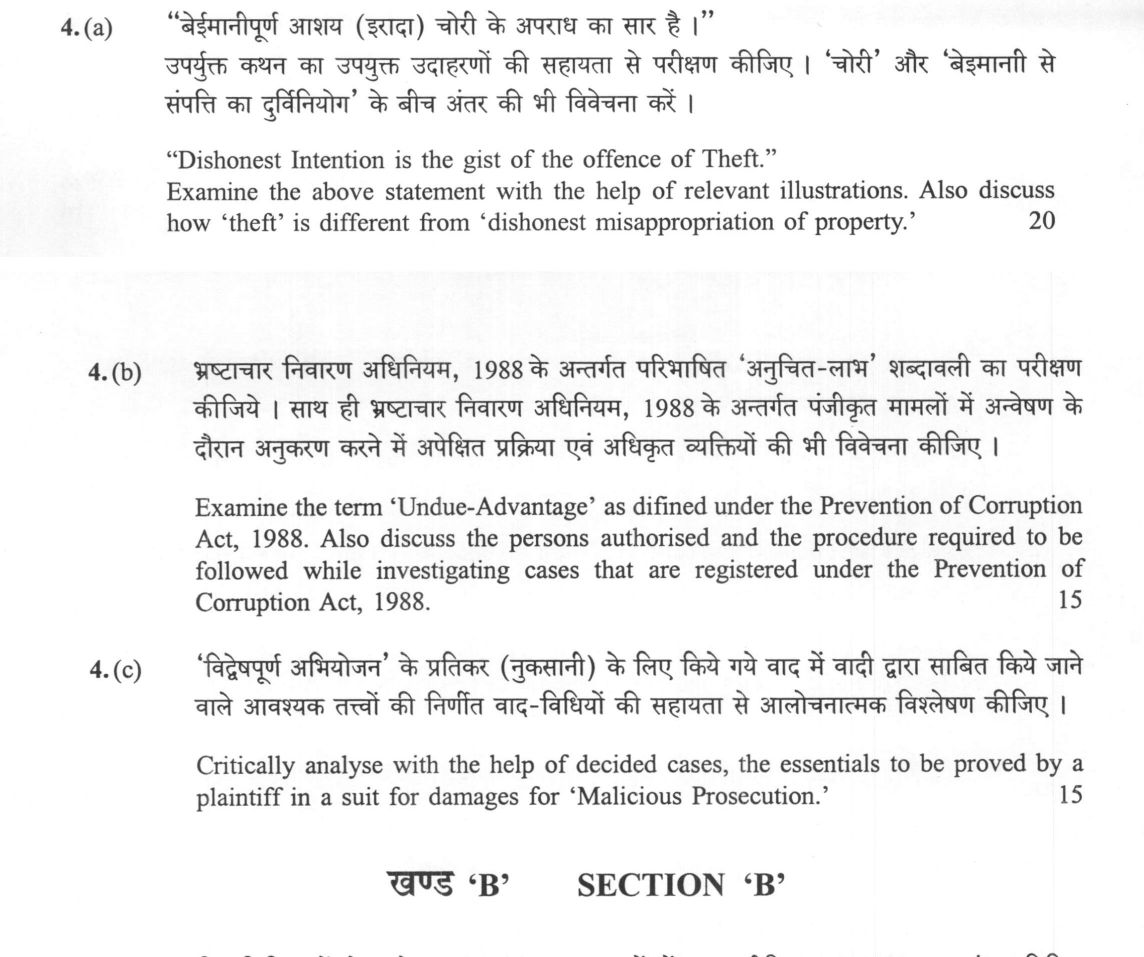
"Dishonest Intention is the gist of the offence of Theft." Examine the above statement with the help of relevant illustrations. Also discuss how 'theft' is different from 'dishonest misappropriation of property.' 20
Examine the term 'Undue-Advantage' as defined under the Prevention of Corruption Act, 1988. Also discuss the persons authorised and the procedure required to be followed while investigating cases that are registered under the Prevention of Corruption Act, 1988. 15 marks
Critically analyse with the help of decided cases, the essentials to be proved by a plaintiff in a suit for damages for 'Malicious Prosecution.' 15
हिंदी में प्रश्न पढ़ें
"बेईमानीपूर्ण आशय (इरादा) चोरी के अपराध का सार है।" उपर्युक्त कथन का उपयुक्त उदाहरणों की सहायता से परीक्षण कीजिए। 'चोरी' और 'बेईमानी से संपत्ति का दुर्विनियोग' के बीच अंतर की भी विवेचना करें। 20
भ्रष्टाचार निवारण अधिनियम, 1988 के अंतर्गत परिभाषित 'अनुचित-लाभ' शब्दावली का परीक्षण कीजिये । साथ ही भ्रष्टाचार निवारण अधिनियम, 1988 के अंतर्गत पंजीकृत मामलों में अन्वेषण के दौरान अनुकरण करने में अपेक्षित प्रक्रिया एवं अधिकृत व्यक्तियों की भी विवेचना कीजिए । 15
'विद्वेषपूर्ण अभियोजन' के प्रतिकर (नुकसानी) के लिए किये गये वाद में वादी द्वारा साबित किये जाने वाले आवश्यक तत्त्वों की निर्णीत वाद-विधियों की सहायता से आलोचनात्मक विश्लेषण कीजिए । 15
Model answer
Written by UPSC Answer Check against this question's marking rubric, to the expected length. UPSC does not publish answers for Mains — this is one way to score well, not an official key.
(a) Theft and dishonest intention. Section 378 IPC makes theft the dishonest taking or causing to be moved of movable property out of another's possession without consent. "Dishonestly" under Section 24 means intention to cause wrongful gain to oneself or wrongful loss to another; this mens rea is the gist. Illustration: A takes B's watch believing in good faith it is his own; absence of dishonest intention negates theft. Conversely, A removes B's ring intending to keep it permanently; dishonest intention makes it theft. A good-faith claim of right negates dishonest intention, though civil liability may remain. Theft differs from dishonest misappropriation under Section 403 IPC. Theft is instantaneous, completed when property is moved out of possession with dishonest intent. Misappropriation is continuous: the accused already has lawful possession and converts it to his own use or disposes of it contrary to the owner's direction. The distinction matters because the burden and mode of proof differ: the prosecution must show the accused moved the property with dishonest intent, not merely that he later used it wrongly. Thus theft attacks possession by taking; misappropriation abuses possession already held.
(b) Undue advantage and investigation. Section 2(c) PCA 1988 defines "undue advantage" as any gratification other than legal remuneration in the possession of a public servant or of a person on whose behalf he acts or in which he is interested. It is not merely a cash bribe; the Explanation to "gratification" in Section 2(b) states that gratification is not limited to pecuniary gratification or gratification estimable in money. Investigation is regulated by Sections 17 and 17A. CBI, State ACB and police may investigate, but under Section 17, no police officer below Inspector in the Delhi Special Police Establishment, Assistant Commissioner in a metropolitan area, or Deputy Superintendent elsewhere may investigate without a Magistrate's order. Section 17A requires prior approval of the competent authority for investigation by an officer below Deputy Superintendent or equivalent rank, but the proviso dispenses with approval in on-spot arrest for accepting or attempting to accept undue advantage. For prosecution, prior sanction of the appropriate Government is required under Sections 18 and 19 for specified offences. In trap cases, the on-spot proviso enables immediate investigation. Under Section 13(1)(b), assets disproportionate to known sources of income raise a presumption that the public servant has intentionally enriched himself illicitly, casting a burden on him to satisfactorily account for them; this is evidential, not conclusive.
(c) Malicious prosecution. The plaintiff must prove four essentials. First, the defendant instituted or continued a criminal prosecution against the plaintiff. Second, the prosecution terminated in the plaintiff's favour; a discharge is sufficient only if it is on the merits, not merely procedural. Third, there was no reasonable and probable cause. In Hicks v. Faulkner, the test is objective: whether the facts would lead a reasonable and prudent person to believe the accused guilty. Fourth, the prosecution was actuated by malice, i.e. an improper motive such as spite, not merely a desire to punish. Khagendra Nath v. Jacob Chandra applies these essentials in the Indian context. The tort is distinct from false imprisonment: false imprisonment is an unlawful restraint of liberty and does not require termination of a prosecution or proof of absence of reasonable cause; malicious prosecution is the intentional infliction of harm by pursuing a false criminal charge. Damages are compensatory for loss of liberty, legal expenses, injury to reputation and mental suffering, and may be exemplary where oppressive.
The law thus balances protection of property and public office against individual liberty: theft and corruption require proof of dishonest or illicit intent, while malicious prosecution protects citizens from abuse of criminal process.
What "Examine" is asking you to do
Test the proposition the question puts to you and return a finding on how far it holds. Examine stems carry a claim, or ask whether something has happened, and expect evidence weighed both ways before the extent is stated — often with remedial measures attached.
Structure that answers it
Restate the claim as the question frames it → evidence that supports it → evidence that undercuts it → the conditions under which it holds → verdict on how far it stands
Where marks are lost
Stopping at description. An examination has to reach a finding, and “examine with justification” means the extent must be stated, not implied.
How this answer will be evaluated
Approach
Framework: Issue > Rule > Authority > Application. (a) examine: intro > how/why with reasoning > evidence > conclusion | (b) examine: intro > how/why with reasoning > evidence > conclusion | (c) analyse: intro > causes > effects > stakeholders/linkages > way forward Full marks: Precise legal definitions, relevant case law, clear application to the question, and balanced analysis.
Key points expected
- Define theft under Section 378 IPC
- Define dishonest intention under Section 24 IPC
- Define dishonest misappropriation under Section 403 IPC
- Distinguish theft from misappropriation of property
- Define 'Undue-Advantage' under Section 2(1)(x) PCA 1988
- Identify persons authorised to investigate under PCA 1988
- Describe the procedure for investigating PCA cases
- Mention the role of the Special Judge
Evaluation rubric
Each sub-part is marked on its own, against the marks and word limit printed on the paper.
- (a) Examine the role of dishonest intention in theft and distinguish it from misappropriation. 20 marks
examine— intro → how/why with reasoning → evidence → conclusion
Must cover
- Define theft under Section 378 IPC
- Define dishonest intention under Section 24 IPC
- Define dishonest misappropriation under Section 403 IPC
- Distinguish theft from misappropriation of property
Loses marks
- Failing to distinguish theft from misappropriation
- Defining theft without mentioning dishonest intention
- Restating facts without applying legal principles
Earns more
- Cite relevant illustrations from Section 378
- Discuss the element of 'taking' in theft
- Discuss the element of 'possession' in misappropriation
- Reference relevant case law on theft
Extra mark
- Cite a recent Supreme Court judgment on theft
- Reference a Law Commission report on property offences
- (b) Examine 'Undue-Advantage' under PCA 1988 and discuss investigation procedures. 15 marks
examine— intro → how/why with reasoning → evidence → conclusion
Must cover
- Define 'Undue-Advantage' under Section 2(1)(x) PCA 1988
- Identify persons authorised to investigate under PCA 1988
- Describe the procedure for investigating PCA cases
- Mention the role of the Special Judge
Loses marks
- Failing to define 'Undue-Advantage' precisely
- Omitting the procedure for investigation
- Confusing PCA 1988 with other anti-corruption laws
Earns more
- Discuss the elements of 'Undue-Advantage'
- Reference the role of CBI in PCA investigations
- Mention the requirement of prior sanction
- Cite relevant case law on 'Undue-Advantage'
Extra mark
- Cite a recent Supreme Court judgment on PCA 1988
- Reference a Law Commission report on corruption
- (c) Critically analyse the essentials to be proved in a suit for malicious prosecution. 15 marks
analyse— intro → causes → effects → stakeholders/linkages → way forward
Must cover
- List the essentials of malicious prosecution
- Discuss the requirement of malice
- Discuss the requirement of absence of probable cause
- Discuss the requirement of termination in favour of the plaintiff
Loses marks
- Failing to list all essentials of malicious prosecution
- Discussing malice without reference to decided cases
- Confusing malicious prosecution with other torts
Earns more
- Cite relevant decided cases on malicious prosecution
- Discuss the burden of proof on the plaintiff
- Mention the elements of damages in malicious prosecution
- Reference the distinction between civil and criminal malicious prosecution
Extra mark
- Cite a recent Supreme Court judgment on malicious prosecution
- Reference a Law Commission report on civil remedies
Practice this exact question
Write your answer and it is marked point by point against the model answer above — what you covered, what you missed, what you got wrong.
Evaluate my answer →More from Law 2023 Paper II
- Q1 Answer the following in about 150 words each. Support your answers with relevant legal pr…
- Q2 (a) A twenty year old girl 'G' was coming back to home after attending college. A man 'M'…
- Q3 (a) Discuss the law relating to 'Assault or Criminal force' to woman with intent to 'Outr…
- Q4 (a) "Dishonest Intention is the gist of the offence of Theft." Examine the above statemen…
- Q5 Answer the following in about 150 words each. Support your answer with relevant legal pro…
- Q6 (a) "The Constitutional courts through their judicial activism have made substantial cont…
- Q7 (a) "'Standard-contracts' contain a large number of terms and conditions in 'fine print'…