Paper II — Q7
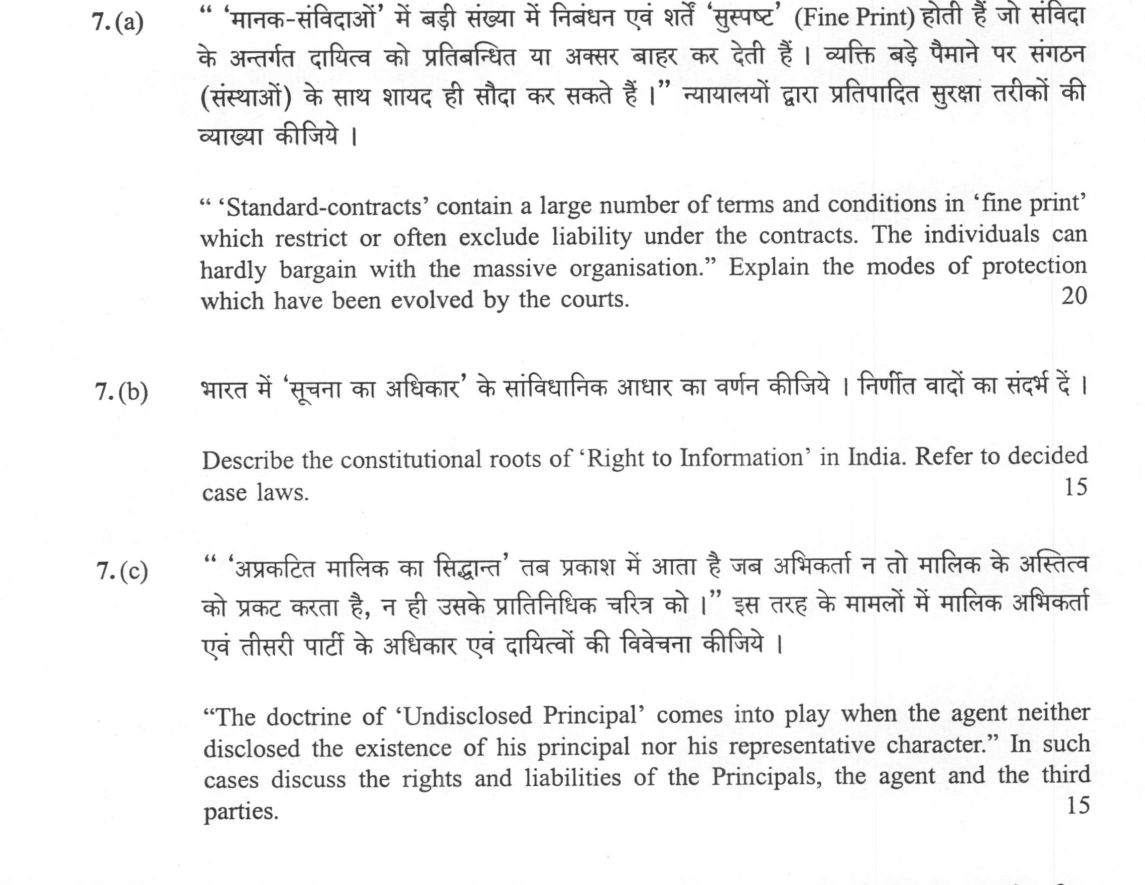
(a) "'Standard-contracts' contain a large number of terms and conditions in 'fine print' which restrict or often exclude…
"'Standard-contracts' contain a large number of terms and conditions in 'fine print' which restrict or often exclude liability under the contracts. The individuals can hardly bargain with the massive organisation." Explain the modes of protection which have been evolved by the courts. 20 marks
Describe the constitutional roots of 'Right to Information' in India. Refer to decided case laws. 15 marks
"The doctrine of 'Undisclosed Principal' comes into play when the agent neither disclosed the existence of his principal nor his representative character." In such cases discuss the rights and liabilities of the Principals, the agent and the third parties. 15 marks
हिंदी में प्रश्न पढ़ें
"'मानक-संविदाओं' में बड़ी संख्या में निबंधन एवं शर्तें 'सुस्पष्ट' (Fine Print) होती हैं जो संविदा के अंतर्गत दायित्व को प्रतिबंधित या अक्सर बाहर कर देती हैं। व्यक्ति बड़े पैमाने पर संगठन (संस्थाओं) के साथ शायद ही सौदा कर सकते हैं।" न्यायालयों द्वारा प्रतिपादित सुरक्षा तरीकों की व्याख्या कीजिये। 20
भारत में 'सूचना का अधिकार' के सांविधानिक आधार का वर्णन कीजिये। निर्णीत वादों का संदर्भ दें। 15
"'अप्रकटित मालिक का सिद्धांत' तब प्रकाश में आता है जब अभिकर्ता न तो मालिक के अस्तित्व को प्रकट करता है, न ही उसके प्रतिनिधिक चरित्र को।" इस तरह के मामलों में मालिक अभिकर्ता एवं तीसरी पार्टी के अधिकार एवं दायित्वों की विवेचना कीजिये। 15
Model answer
Written by UPSC Answer Check against this question's marking rubric, to the expected length. UPSC does not publish answers for Mains — this is one way to score well, not an official key.
(a) Standard-form contracts Standard-form contracts arise because large organisations fix terms that many individuals cannot negotiate. Courts protect the weaker party at formation, construction and enforcement. The rule in L'Estrange v Graucob that a signed document binds the signatory is tempered by fraud, misrepresentation and non-incorporation. The contra proferentem rule construes ambiguous exclusion clauses against the drafter, because he controls the language. The red-hand rule in Thornton v Shoe Lane Parking requires conspicuous notice of especially onerous terms; a fine-print clause shocking conscience may not be incorporated. Fundamental breach was used to prevent exclusion of liability for repudiatory breach, but now it is mainly a rule of construction, not an automatic trump, and Bharathi Knitting v DHL Worldwide Express has doubted its independent survival. Statutorily, the Indian Contract Act's Section 16 voids coercion, Section 23 restrains agreements in restraint of trade, and Section 24, though not a general unconscionability provision, makes the unlawful part of the consideration or object void. The Consumer Protection Act, 2019 voids unfair contract terms and addresses standard-form abuse, as in Indian Oil v Consumer Protection Council, while Central Inland Water Transport v Brojo Nath refuses unconscionable terms defeating the contract's purpose.
(b) Constitutional roots The Right to Information is a constitutional corollary of democratic accountability. Article 19(1)(a) guarantees freedom of speech and expression, which the Supreme Court has read to include the right to know, because citizens cannot debate or form opinion without access to public information. In S.P. Gupta v Union of India (1982), the Court linked the right to know about administration to public interest and judicial review. Article 21, protecting life and personal liberty, has been expanded to include dignity, transparency and accountability; in People's Union for Civil Liberties v Union of India (1997), the Court held that the right to know about conditions in jails flows from Article 21. Earlier, Raj Narain v State of UP (1975) established the transparency precedent by recognising the citizen's right to know about government activity. The DPSP do not create a freestanding RTI; Articles 39(b) and (c) concern material resources and concentration of wealth, but the welfare-state and rule-of-law commitment makes information access a check on state power.
(c) Undisclosed principal An undisclosed principal exists where the agent makes a contract without revealing either the principal's existence or his representative character. This differs from a disclosed principal, where the third party knows the agent acts for someone. The principal may enforce the contract if the agent acted within authority and the contract is not personal to the agent, such as one requiring special skill. Once disclosed, the principal becomes directly liable to the third party. The agent remains personally liable unless the contract excludes his liability, because the third party believed he was contracting with the agent. When the principal intervenes, Section 230 allows the third party to elect to enforce against either the principal or the agent, but not both; the election is final. Section 231 preserves the third party's rights against the principal, so the principal cannot defeat the claim merely because the agent did not disclose him. Section 232 subjects the principal, when he claims the benefit, to the agent's liabilities and equities, including defences, set-offs and conditions available against the agent. Thus the doctrine balances reliance on the agent with the principal's control.
Together, these mechanisms show that courts and the Constitution do not leave bargaining or informational asymmetry unchecked: in contracts, they correct fine-print imbalance through construction, notice, statutory invalidation and consumer protection; in governance, they convert transparency into a right; in agency, they protect reliance while preventing unjust advantage.
What "Explain" is asking you to do
Make the working of something clear — what sets it off, what follows from what, and what it produces. Explain is the Commission's mechanism word: it dominates the technical papers and the “explain why” stems, where the marks sit in the causal chain and not in the label.
Structure that answers it
State what it is → the initiating condition → the chain of cause, step by step → an instance where it plays out → what the chain produces
Where marks are lost
Describing what something looks like instead of why it works that way. Naming the stages without linking them reads as description too.
How this answer will be evaluated
Approach
Framework: Issue > Rule: statute or Article > Authority > Application and conclusion. (a) explain: definition/context > points in order > small example > short close | (b) describe: define > structure or process in order > labelled diagram > significance | (c) discuss: intro > 3-4 dimensions > example > balanced close Full marks: Precise legal analysis with correct case citations and clear application to the specific scenario.
Key points expected
- Define standard contracts and the 'fine print' problem.
- Explain the doctrine of unconscionability.
- Discuss the rule of contra proferentem.
- Cite relevant case law on exclusion of liability.
- Link RTI to Article 19(1)(a) (Freedom of Speech).
- Link RTI to Article 19(3) (Reasonable restrictions).
- Cite the case of D.C. Wadhwa v. State of Bihar.
- Cite the case of R. Rajagopal v. State of Tamil Nadu.
Evaluation rubric
Each sub-part is marked on its own, against the marks and word limit printed on the paper.
- (a) Explain judicial modes of protection against unfair terms in standard contracts. 20 marks
explain— definition/context → points in order → small example → short close
Must cover
- Define standard contracts and the 'fine print' problem.
- Explain the doctrine of unconscionability.
- Discuss the rule of contra proferentem.
- Cite relevant case law on exclusion of liability.
Loses marks
- Restating the question without legal analysis.
- Citing cases without stating their ratio.
- Ignoring the 'fine print' aspect of the prompt.
Earns more
- Reference to the Indian Contract Act, 1872.
- Mention of the Unfair Contract Terms Act (UK) as comparative law.
- Discussion of the 'reasonable man' test.
- Reference to the Consumer Protection Act, 2019.
Extra mark
- Cite a recent Supreme Court judgment on unfair terms.
- Reference to a Law Commission report on contract law.
- (b) Describe the constitutional roots of the Right to Information in India. 15 marks
describe— define → structure or process in order → labelled diagram → significance
Must cover
- Link RTI to Article 19(1)(a) (Freedom of Speech).
- Link RTI to Article 19(3) (Reasonable restrictions).
- Cite the case of D.C. Wadhwa v. State of Bihar.
- Cite the case of R. Rajagopal v. State of Tamil Nadu.
Loses marks
- Discussing RTI without constitutional context.
- Citing cases without explaining their relevance.
- Ignoring the 'decided case laws' instruction.
Earns more
- Reference to Article 14 (Equality before law).
- Reference to Article 21 (Right to Life).
- Mention of the RTI Act, 2005 as statutory recognition.
- Discussion of the 'public interest' test.
Extra mark
- Cite a recent Supreme Court judgment on RTI.
- Reference to the Central Information Commission's role.
- (c) Discuss rights and liabilities in cases of an undisclosed principal. 15 marks
discuss— intro → 3-4 dimensions → example → balanced close
Must cover
- Define the doctrine of 'Undisclosed Principal'.
- Explain the rights of the principal against the third party.
- Explain the rights of the third party against the principal.
- Explain the liability of the agent in such cases.
Loses marks
- Confusing 'undisclosed' with 'disclosed' principal.
- Ignoring the rights of the third party.
- Citing cases without stating their ratio.
Earns more
- Cite relevant case law on undisclosed principals.
- Discuss the 'personal nature' of the contract exception.
- Mention the agent's right to retain the benefit.
- Reference to the Indian Contract Act, 1872.
Extra mark
- Cite a recent Supreme Court judgment on agency.
- Reference to a Law Commission report on agency law.
Practice this exact question
Write your answer and it is marked point by point against the model answer above — what you covered, what you missed, what you got wrong.
Evaluate my answer →More from Law 2023 Paper II
- Q4 (a) "Dishonest Intention is the gist of the offence of Theft." Examine the above statemen…
- Q5 Answer the following in about 150 words each. Support your answer with relevant legal pro…
- Q6 (a) "The Constitutional courts through their judicial activism have made substantial cont…
- Q7 (a) "'Standard-contracts' contain a large number of terms and conditions in 'fine print'…
- Q8 (a) Under what circumstances, can an intermediary be held liable for third party-content…