Paper II — Q8
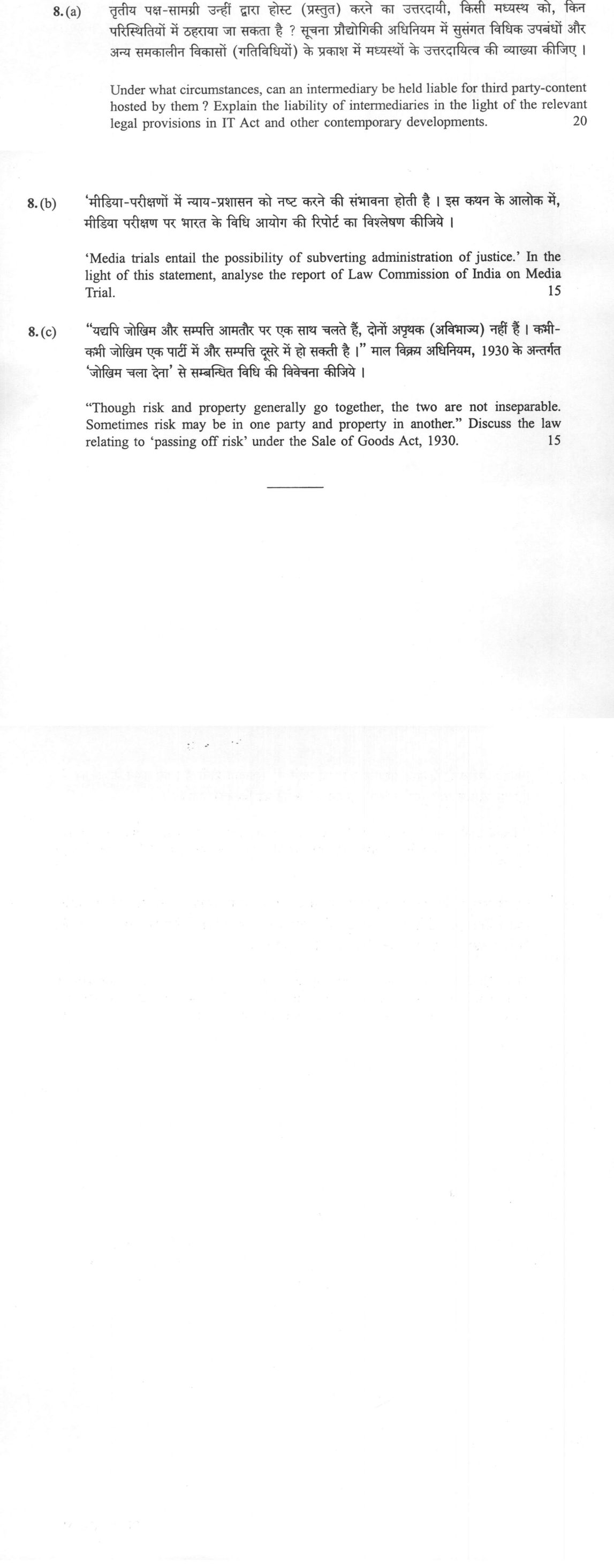
(a) Under what circumstances, can an intermediary be held liable for third party-content hosted by them? Explain the liability of…
Under what circumstances, can an intermediary be held liable for third party-content hosted by them? Explain the liability of intermediaries in the light of the relevant legal provisions in IT Act and other contemporary developments. 20 marks
'Media trials entail the possibility of subverting administration of justice.' In the light of this statement, analyse the report of Law Commission of India on Media Trial. 15 marks
"Though risk and property generally go together, the two are not inseparable. Sometimes risk may be in one party and property in another." Discuss the law relating to 'passing off risk' under the Sale of Goods Act, 1930. 15 marks
हिंदी में प्रश्न पढ़ें
तृतीय पक्ष-सामग्री उन्हीं द्वारा होस्ट (प्रस्तुत) करने का उत्तरदायी, किसी मध्यस्थ को, किन परिस्थितियों में ठहराया जा सकता है? सूचना प्रौद्योगिकी अधिनियम में सुसंगत विधिक उपबंधों और अन्य समकालीन विकासों (गतिविधियों) के प्रकाश में मध्यस्थों के उत्तरदायित्व की व्याख्या कीजिए। 20
'मीडिया-परीक्षणों में न्याय-प्रशासन को नष्ट करने की संभावना होती है । इस कथन के आलोक में, मीडिया परीक्षण पर भारत के विधि आयोग की रिपोर्ट का विश्लेषण कीजिये । 15
"यद्यपि जोखिम और सम्पत्ति आमतौर पर एक साथ चलते हैं, दोनों अपृथक् (अविभाज्य) नहीं हैं । कभी-कभी जोखिम एक पार्टी में और सम्पत्ति दूसरे में हो सकती है ।" माल विक्रय अधिनियम, 1930 के अन्तर्गत 'जोखिम चला देना' से सम्बन्धित विधि की विवेचना कीजिये । 15
Model answer
Written by UPSC Answer Check against this question's marking rubric, to the expected length. UPSC does not publish answers for Mains — this is one way to score well, not an official key.
Intermediary liability An intermediary can be held liable for third-party content when it ceases to be a passive conduit and becomes an active participant by originating, selecting, editing, recommending, or profiting from specific content; when it receives actual knowledge from a court or government order and fails to expeditiously remove or disable access; or when it does not follow due diligence. Section 79 of the IT Act, 2000 provides a conditional safe harbour: the intermediary must not originate or control the information, must observe due diligence, and must act on actual knowledge. Shreya Singhal v. Union of India (2015) struck down Section 66A as overbroad and prevented intermediaries from being treated as publishers merely for hosting. Myspace Inc. v. Super Cassettes (2017) clarified that “actual knowledge” means specific notice of particular infringing content, not general awareness, so there is no vague duty to monitor. The causal chain is: hosting alone does not create liability; specific knowledge plus inaction, or active editorial control, converts the intermediary into a publisher-like actor. Rule 3 of the IT Rules, 2011 required due diligence and grievance redressal. Section 52 of the Copyright Act gives a notice-and-takedown safe harbour to online service providers. Contemporary developments include the IT Rules, 2023 compliance framework, proposed amendments in the Digital India Act, and the DPDP Act, 2023, which regulates personal data rather than third-party content liability, showing parallel but distinct accountability.
Media trials Media trials arise when pre-trial publicity, identification of the accused, or media verdicts prejudice witnesses, judges, or public confidence in sub-judice matters. The constitutional tension is between Article 19(1)(a), which protects free speech, and Article 21, which guarantees a fair trial. In Sakal Papers, prior restraint was held exceptional; in R. Rajagopal, public officials can be reported subject to public interest; in Sahara India, courts can restrain prejudicial reports where prejudice is likely. The Law Commission’s 200th Report (2006) on “Trial by Media: Free Speech vs. Fair Trial Under Criminal Procedure” analysed this risk. It recommended that postponement orders be used sparingly, that contempt powers be calibrated to prevent a real and substantial risk to justice, and that a regulatory body or code of conduct could enforce responsible reporting without prior restraint. The report thus balances press freedom with the accused’s right to an impartial trial. It treats media trial as a subversion of justice only where prejudicial publicity is likely, not as a ban on reporting.
Passing of risk Under the Sale of Goods Act, 1930, risk and property are not inseparable. Section 26 avoids the contract if specific goods perish before risk passes; Section 27 avoids it if specific goods perish after agreement but before risk passes. Sections 28 to 30 allocate risk: prima facie, risk follows property, subject to agreement, retention of disposal rights, and delay attributable to buyer or seller. The maxim res perit domino is therefore modified. The exception to res perit domino appears in delivery on sale or return under Section 24, where risk may pass to the buyer on delivery even before acceptance; goods on approval, where risk and property may be separated by delivery or acceptance; and Sterns Ltd v. Vickers Ltd, where risk passed before property because of the contract’s terms. Thus, the passing of risk depends on contractual allocation, not merely ownership.
Conclusion These rules show that liability and risk follow control, prejudice, and allocation: intermediaries are liable when they control or know of content, media can subvert justice only through likely prejudice, and commercial risk may move independently of property. A proportionate, context-specific approach is the way forward.
What "Explain" is asking you to do
Make the working of something clear — what sets it off, what follows from what, and what it produces. Explain is the Commission's mechanism word: it dominates the technical papers and the “explain why” stems, where the marks sit in the causal chain and not in the label.
Structure that answers it
State what it is → the initiating condition → the chain of cause, step by step → an instance where it plays out → what the chain produces
Where marks are lost
Describing what something looks like instead of why it works that way. Naming the stages without linking them reads as description too.
How this answer will be evaluated
Approach
Framework: Issue > Rule > Authority > Application. (a) explain: definition/context > points in order > small example > short close | (b) analyse: intro > causes > effects > stakeholders/linkages > way forward | (c) discuss: intro > 3-4 dimensions > example > balanced close Full marks: Precise statutory citations, case law, and clear application to the specific legal issues raised.
Key points expected
- Section 79 IT Act safe harbour conditions
- IT (Intermediary Guidelines) Rules 2021
- Notice and takedown mechanism
- Distinction between mere conduit and active participation
- Law Commission 200 report on Media Trials
- Concept of 'trial by media' defined
- Impact on fair trial rights (Art 21)
- Contempt of Court Act relevance
Evaluation rubric
Each sub-part is marked on its own, against the marks and word limit printed on the paper.
- (a) Circumstances of intermediary liability under IT Act and contemporary developments. 20 marks
explain— definition/context → points in order → small example → short close
Must cover
- Section 79 IT Act safe harbour conditions
- IT (Intermediary Guidelines) Rules 2021
- Notice and takedown mechanism
- Distinction between mere conduit and active participation
Loses marks
- Ignoring the 2021 Rules amendments
- Confusing Section 79 with Section 69
- No mention of 'due diligence'
Earns more
- Kishor Kumar v. State of Bihar
- Shreya Singhal v. Union of India
- Section 69A blocking powers
- Due diligence requirements
Extra mark
- Recent Supreme Court judgment on intermediary liability
- Comparison with US Section 230
- (b) Analysis of Law Commission report on Media Trials and subversion of justice. 15 marks
analyse— intro → causes → effects → stakeholders/linkages → way forward
Must cover
- Law Commission 200 report on Media Trials
- Concept of 'trial by media' defined
- Impact on fair trial rights (Art 21)
- Contempt of Court Act relevance
Loses marks
- General discussion without Law Commission reference
- Ignoring the 'subversion of justice' angle
- No mention of specific recommendations
Earns more
- Sub-Committee on Media Trials
- Recommendations for self-regulation
- Distinction between reporting and editorialising
- Judicial activism in media trials
Extra mark
- Specific case cited in Law Commission report
- Reference to 2018 Law Commission report on contempt
- (c) Law relating to 'passing of risk' under Sale of Goods Act, 1930. 15 marks
discuss— intro → 3-4 dimensions → example → balanced close
Must cover
- Section 26: Risk prima facie on seller
- Section 29: Risk passes with property
- Section 30: Risk in transit (CIF/FOB)
- Distinction between risk and property
Loses marks
- Confusing risk with property transfer
- Ignoring Section 26 prima facie rule
- No mention of specific sections
Earns more
- Section 31: Unascertained goods
- Section 32: Goods sent on approval
- Section 33: Goods delivered to carrier
- Section 34: Delivery at named place
Extra mark
- Case law on risk in transit
- Distinction between 'risk' and 'title'
Practice this exact question
Write your answer and it is marked point by point against the model answer above — what you covered, what you missed, what you got wrong.
Evaluate my answer →More from Law 2023 Paper II
- Q5 Answer the following in about 150 words each. Support your answer with relevant legal pro…
- Q6 (a) "The Constitutional courts through their judicial activism have made substantial cont…
- Q7 (a) "'Standard-contracts' contain a large number of terms and conditions in 'fine print'…
- Q8 (a) Under what circumstances, can an intermediary be held liable for third party-content…