Paper II — Q2
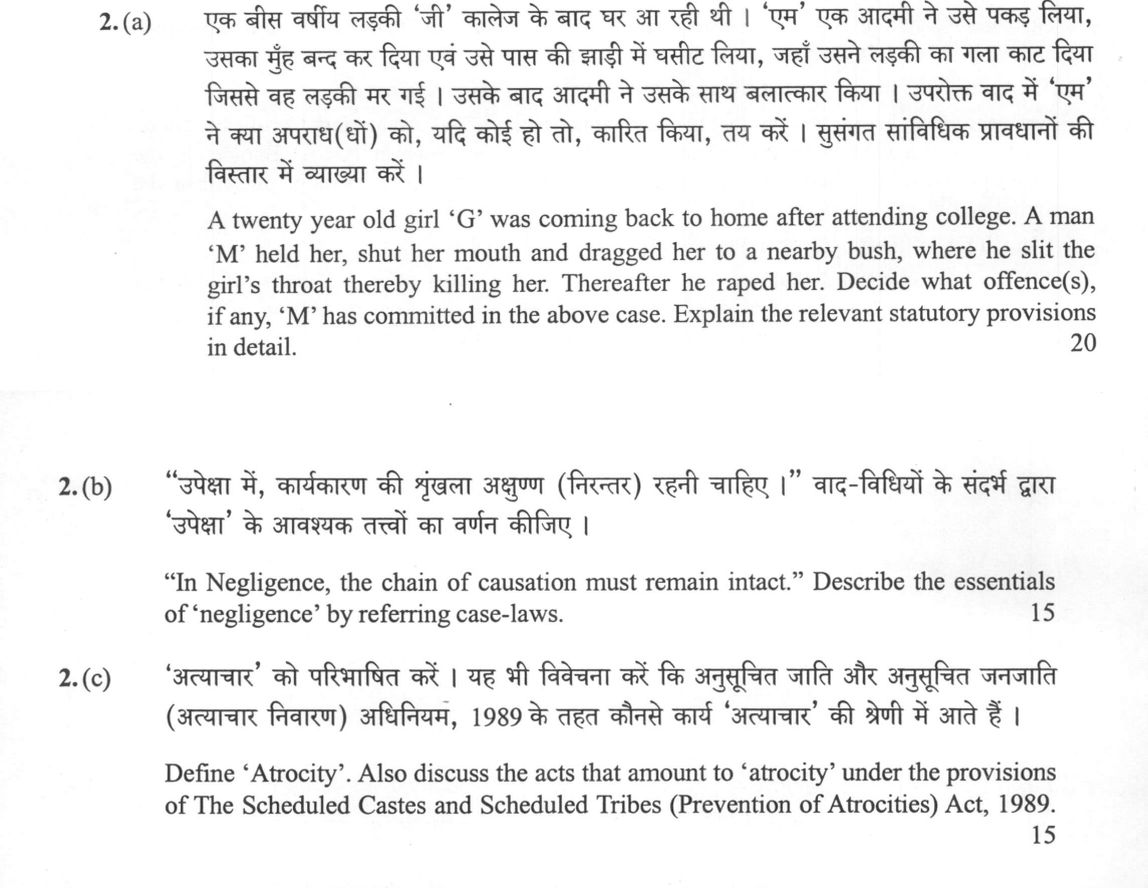
(a) A twenty year old girl 'G' was coming back to home after attending college. A man 'M' held her, shut her mouth and dragged…
A twenty year old girl 'G' was coming back to home after attending college. A man 'M' held her, shut her mouth and dragged her to a nearby bush, where he slit the girl's throat thereby killing her. Thereafter he raped her. Decide what offence(s), if any, 'M' has committed in the above case. Explain the relevant statutory provisions in detail. 20 marks
"In Negligence, the chain of causation must remain intact." Describe the essentials of 'negligence' by referring case-laws. 15 marks
Define 'Atrocity'. Also discuss the acts that amount to 'atrocity' under the provisions of The Scheduled Castes and Scheduled Tribes (Prevention of Atrocities) Act, 1989. 15 marks
हिंदी में प्रश्न पढ़ें
एक बीस वर्षीय लड़की 'जी' कालेज के बाद घर आ रही थी। 'एम' एक आदमी ने उसे पकड़ लिया, उसका मुँह बन्द कर दिया एवं उसे पास की झाड़ी में घसीट लिया, जहाँ उसने लड़की का गला काट दिया जिससे वह लड़की मर गई। उसके बाद आदमी ने उसके साथ बलात्कार किया। उपरोक्त बाद में 'एम' ने क्या अपराध(धों) को, यदि कोई हो तो, कारित किया, तय करें। सुसंगत सांविधिक प्रावधानों की विस्तार में व्याख्या करें। 20
"उपेक्षा में, कार्यकारण की श्रृंखला अक्षुण्ण (निरंतर) रहनी चाहिए।" वाद-विधियों के संदर्भ द्वारा 'उपेक्षा' के आवश्यक तत्त्वों का वर्णन कीजिए। 15
'अत्याचार' को परिभाषित करें। यह भी विवेचना करें कि अनुसूचित जाति और अनुसूचित जनजाति (अत्याचार निवारण) अधिनियम, 1989 के तहत कौनसे कार्य 'अत्याचार' की श्रेणी में आते हैं। 15
Model answer
Written by UPSC Answer Check against this question's marking rubric, to the expected length. UPSC does not publish answers for Mains — this is one way to score well, not an official key.
(a) M committed murder under Section 302 IPC. Holding, gagging and dragging G, then slitting her throat, shows intention/knowledge of death; 302 prescribes death or life imprisonment with fine. The later sexual act is not rape under Sections 375/376 IPC, because rape requires sexual intercourse with a living woman without consent or under vitiating circumstances; a dead woman cannot consent or be threatened. Section 376, which prescribes punishment for rape, is therefore inapplicable; the death preceding the sexual act breaks the statutory chain for rape. In Rangaraju v. State of Karnataka (2023), the Supreme Court held post-mortem sexual intercourse with a woman’s dead body is not rape but may be an unnatural offence under Section 377 IPC, punishable with life or up to ten years and fine. Section 297 IPC is not automatic: it requires intention or knowledge that the act would wound religious feelings or insult religion, which these facts do not establish. Thus M is liable for murder and, if proved, unnatural offence; 297 only if the required mens rea is shown.
(b) Negligence is a tort based on failure to take reasonable care. Its essentials are: first, a legal duty of care, as in Donoghue v. Stevenson, where the manufacturer owed a duty to the ultimate consumer; second, breach of that duty, measured by the reasonable man standard in Blyth v. Birmingham Waterworks Co.; third, causation, where the breach must be both causa sine qua non and proximate cause; and fourth, actual damage. The chain of causation must remain intact: the breach must be a direct, unbroken link to the harm. A novus actus interveniens—an independent, unforeseeable act of a third party, the plaintiff, or nature—can break the chain and defeat liability. In Overseas Tankship (UK) Pty Ltd v. Morts Dock & Engineering Co. (Wagon Mound No. 1), the House of Lords limited liability to reasonably foreseeable damage, thereby preserving the causal chain. In Ratanlal Dhirajlal v. State of U.P., the court examined whether intervening conduct broke the causal link; where the breach directly produced the injury and no independent act intervened, liability followed. In Indian law, the same principle appears in criminal negligence under Section 304A IPC, where the negligent act must be the direct cause of death.
(c) Section 2(a) of the Scheduled Castes and Scheduled Tribes (Prevention of Atrocities) Act, 1989, defines "atrocity" as an offence under that Act or the IPC committed against a member of a Scheduled Caste or Scheduled Tribe with intention to humiliate, intimidate, insult, deprive of rights, destroy property, compel indecent life, force service, or demean caste/tribal identity. Section 3(1) enumerates acts such as voluntarily causing hurt, using criminal force, assaulting a woman to outrage her modesty, insulting or intimidating on caste grounds, obstructing access to public places or water sources, destroying property, forcing noxious substances, beggary or abject labour, and forcing service against will; the 2015 Amendment expanded these, while dedicating women as devadasis was already in the 1989 Act. Section 3(2), as substituted in 2015, deems atrocity where a person fabricates false evidence or document to cause punishment, files a false suit or gives false information, commits caste-based insult, intimidation or abuse, promotes enmity between caste groups, or commits an offence specified in the Schedule. The 2015 Amendment also replaced the earlier Section 3(2) test of IPC offences punishable with ten years or more with the present enumerated categories. In Khurshid Alam v. State of U.P., the Supreme Court held that the nexus with caste or tribal identity must be established; the victim’s SC/ST status alone is insufficient. These provisions protect life, dignity and constitutional equality under Articles 14, 15 and 17.
What "Explain" is asking you to do
Make the working of something clear — what sets it off, what follows from what, and what it produces. Explain is the Commission's mechanism word: it dominates the technical papers and the “explain why” stems, where the marks sit in the causal chain and not in the label.
Structure that answers it
State what it is → the initiating condition → the chain of cause, step by step → an instance where it plays out → what the chain produces
Where marks are lost
Describing what something looks like instead of why it works that way. Naming the stages without linking them reads as description too.
How this answer will be evaluated
Approach
Framework: Issue > Rule > Authority > Application. (a) explain: definition/context > points in order > small example > short close | (b) describe: define > structure or process in order > labelled diagram > significance | (c) define: precise definition > the distinguishing feature > one example Full marks: Precise statutory citations, clear application to facts, relevant case law, and balanced analysis.
Key points expected
- Section 302 IPC (Murder) for slitting throat
- Section 376 IPC (Rape) for post-mortem sexual act
- Section 364 IPC (Kidnapping) for dragging to bush
- Section 34 IPC (Common Intention) if applicable
- Duty of care (Donoghue v Stevenson)
- Breach of duty (standard of care)
- Causation (Remoteness of damage)
- Damage (actual loss suffered)
Evaluation rubric
Each sub-part is marked on its own, against the marks and word limit printed on the paper.
- (a) Identify offences committed by 'M' and explain statutory provisions. 20 marks
explain— definition/context → points in order → small example → short close
Must cover
- Section 302 IPC (Murder) for slitting throat
- Section 376 IPC (Rape) for post-mortem sexual act
- Section 364 IPC (Kidnapping) for dragging to bush
- Section 34 IPC (Common Intention) if applicable
Loses marks
- Failing to identify the specific IPC sections
- Restating facts without legal application
- Ignoring the sequence of offences (murder then rape)
Earns more
- Distinction between murder and culpable homicide
- Analysis of 'post-mortem rape' legal status
- Reference to Section 304 Part II (if intent to kill not proven)
Extra mark
- Reference to Law Commission Report on sexual offences
- Citing recent Supreme Court judgment on post-mortem rape
- (b) Describe essentials of negligence and chain of causation. 15 marks
describe— define → structure or process in order → labelled diagram → significance
Must cover
- Duty of care (Donoghue v Stevenson)
- Breach of duty (standard of care)
- Causation (Remoteness of damage)
- Damage (actual loss suffered)
Loses marks
- Defining negligence without case law support
- Ignoring the 'chain of causation' aspect
- Confusing negligence with intentional torts
Earns more
- Reference to 'chain of causation' concept
- Citing relevant case laws for each element
- Discussion of 'novus actus interveniens'
Extra mark
- Reference to specific modern negligence case law
- Mention of Law Commission recommendations on negligence
- (c) Define 'Atrocity' and discuss acts under SC/ST Act 1989. 15 marks
define— precise definition → the distinguishing feature → one example
Must cover
- Definition of 'Atrocity' under Section 3
- Acts amounting to atrocity (Section 3(1))
- Punishment provisions (Section 5)
- Scope of the Act (SC/ST members)
Loses marks
- Defining 'Atrocity' without statutory reference
- Failing to list specific acts under Section 3
- Confusing 'Atrocity' with general criminal offences
Earns more
- Listing specific acts (e.g., forcing to eat uncleanable substance)
- Reference to Section 3(1)(a) to (x)
- Discussion of 'intentional' nature of acts
Extra mark
- Reference to recent amendments in the Act
- Citing specific case law on 'Atrocity' interpretation
Practice this exact question
Write your answer and it is marked point by point against the model answer above — what you covered, what you missed, what you got wrong.
Evaluate my answer →More from Law 2023 Paper II
- Q1 Answer the following in about 150 words each. Support your answers with relevant legal pr…
- Q2 (a) A twenty year old girl 'G' was coming back to home after attending college. A man 'M'…
- Q3 (a) Discuss the law relating to 'Assault or Criminal force' to woman with intent to 'Outr…
- Q4 (a) "Dishonest Intention is the gist of the offence of Theft." Examine the above statemen…
- Q5 Answer the following in about 150 words each. Support your answer with relevant legal pro…