Paper II — Q5
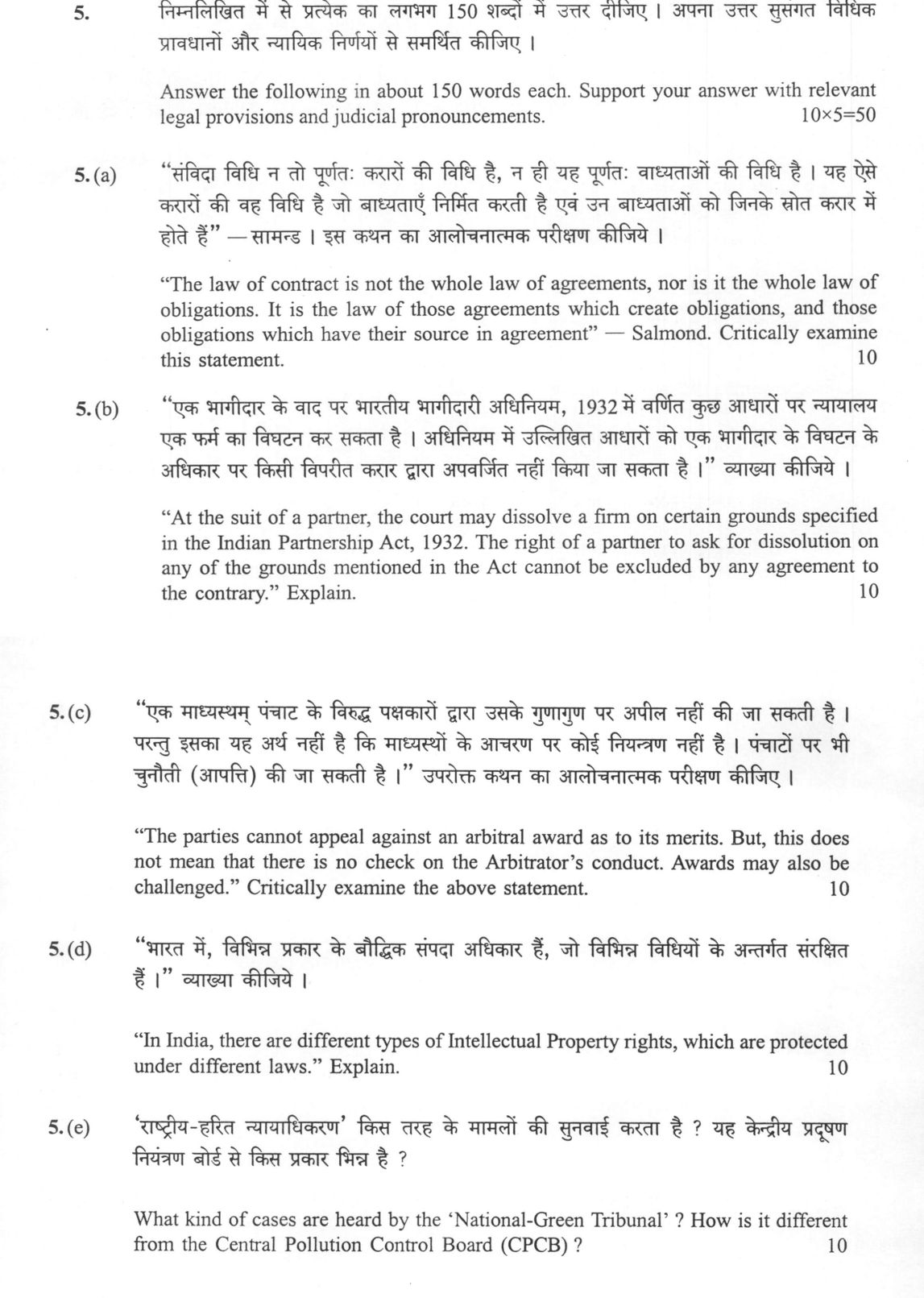
Answer the following in about 150 words each. Support your answer with relevant legal provisions and judicial pronouncements…
Answer the following in about 150 words each. Support your answer with relevant legal provisions and judicial pronouncements. 10×5=50
"The law of contract is not the whole law of agreements, nor is it the whole law of obligations. It is the law of those agreements which create obligations, and those obligations which have their source in agreement" — Salmond. Critically examine this statement. 10 marks
"At the suit of a partner, the court may dissolve a firm on certain grounds specified in the Indian Partnership Act, 1932. The right of a partner to ask for dissolution on any of the grounds mentioned in the Act cannot be excluded by any agreement to the contrary." Explain. 10 marks
"The parties cannot appeal against an arbitral award as to its merits. But, this does not mean that there is no check on the Arbitrator's conduct. Awards may also be challenged." Critically examine the above statement. 10 marks
"In India, there are different types of Intellectual Property rights, which are protected under different laws." Explain. 10 marks
What kind of cases are heard by the 'National-Green Tribunal' ? How is it different from the Central Pollution Control Board (CPCB) ? 10 marks
हिंदी में प्रश्न पढ़ें
निम्नलिखित में से प्रत्येक का लगभग 150 शब्दों में उत्तर दीजिए । अपना उत्तर सुसंगत विधिक प्रावधानों और न्यायिक निर्णयों से समर्थित कीजिए । 10×5=50
"संविदा विधि न तो पूर्णतः करारों की विधि है, न ही यह पूर्णतः बाध्यताओं की विधि है । यह ऐसे करारों की वह विधि है जो बाध्यताएँ निर्मित करती हैं एवं उन बाध्यताओं को जिनके स्रोत करार में होते हैं" — सामंड । इस कथन का आलोचनात्मक परीक्षण कीजिए । 10
"एक भागीदार के वाद पर भारतीय भागीदारी अधिनियम, 1932 में वर्णित कुछ आधारों पर न्यायालय एक फर्म का विघटन कर सकता है । अधिनियम में उल्लिखित आधारों को एक भागीदार के विघटन के अधिकार पर किसी विपरीत करार द्वारा अपवर्जित नहीं किया जा सकता है ।" व्याख्या कीजिए । 10
"एक माध्यस्थम पंचाट के विरुद्ध पक्षकारों द्वारा उसके गुणागुण पर अपील नहीं की जा सकती है । परन्तु इसका यह अर्थ नहीं है कि माध्यस्थों के आचरण पर कोई नियन्त्रण नहीं है । पंचाटों पर भी चुनौती (आपत्ति) की जा सकती है ।" उपरोक्त कथन का आलोचनात्मक परीक्षण कीजिए । 10
"भारत में, विभिन्न प्रकार के बौद्धिक सम्पदा अधिकार हैं, जो विभिन्न विधियों के अन्तर्गत संरक्षित हैं ।" व्याख्या कीजिए । 10
'राष्ट्रीय-हरित न्यायाधिकरण' किस तरह के मामलों की सुनवाई करता है ? यह केन्द्रीय प्रदूषण नियन्त्रण बोर्ड से किस प्रकार भिन्न है ? 10 marks
Model answer
Written by UPSC Answer Check against this question's marking rubric, to the 150-word length. UPSC does not publish answers for Mains — this is one way to score well, not an official key.
(a) Scope of the Law of Contract
Salmond's proposition defines contract law through the intersection of agreements and legal obligations. Not all agreements are contracts: social, domestic, or moral agreements do not generate legal obligations due to the absence of an intention to create legal relations (Balfour v. Balfour), while agreements lacking statutory validity under Section 10 of the Indian Contract Act, 1872—such as agreements by minors (Mohori Bibee v. Dharmodas Ghose)—remain void ab initio. Conversely, many legal obligations arise entirely outside agreements, including tortious liabilities, criminal duties, fiduciary trusts, and quasi-contractual obligations under Sections 68–72 of the Act, which are created by operation of law rather than mutual consent.
Critically examined, while Salmond accurately restricts contract law to consensual vinculum juris, modern legal developments like promissory estoppel and statutory standard-form contracts dilute purely voluntary assent. Nonetheless, his formulation remains conceptually sound: the law of contract governs solely that territory where voluntary agreement generates enforceable legal obligation.
(b) Judicial Dissolution of a Partnership Firm
Section 44 of the Indian Partnership Act, 1932 confers statutory power on the court to dissolve a partnership firm at the suit of a partner. The grounds encompass mandatory or incapacity-based events, such as a partner becoming of unsound mind (Section 44(a)) or permanently incapable of performing duties (Section 44(b)), as well as discretionary and conduct-based grounds, including prejudicial misconduct (Section 44(c)), persistent breach of agreement (Section 44(d)), transfer of whole interest to a third party (Section 44(e)), business running at a perpetual loss (Section 44(f)), and the just and equitable clause (Section 44(g)).
The right of a partner to invoke Section 44 cannot be excluded by any contract to the contrary. An agreement ousting the court's jurisdiction to dissolve a partnership is void under public policy and Section 28 of the Indian Contract Act, 1872 (Rehmat-un-Nisa Begum v. Price). This non-excludability protects minority partners from being trapped indefinitely in oppressive, deadlocked, or unviable associations.
(c) Finality and Judicial Scrutiny of Arbitral Awards
Section 35 of the Arbitration and Conciliation Act, 1996 establishes the finality of arbitral awards. Indian courts cannot sit in appeal over an award to re-appreciate evidence or correct errors of fact on merits (Associate Builders v. DDA). However, this finality is not absolute immunity from judicial control.
The Act provides vital checks under Section 34(2), permitting courts to set aside awards on procedural and structural grounds: incapacity of parties, invalidity of the arbitration agreement, violation of natural justice, disputes exceeding the terms of submission, or improper tribunal composition. Furthermore, awards may be challenged if in conflict with the "public policy of India"—including fundamental policy of Indian law, basic notions of justice, and patent illegality on the face of the record for domestic arbitrations under Section 34(2A). Orders setting aside or refusing to set aside awards are subject to limited appeal under Section 37. Thus, the statutory framework ensures arbitral autonomy while preserving essential judicial oversight against misconduct and illegality.
(d) Spectrum of Intellectual Property Rights in India
India provides a multi-tiered, TRIPS-compliant legislative framework protecting diverse categories of Intellectual Property Rights:
The Patents Act, 1970 protects novel, inventive, and industrially applicable inventions for a term of twenty years. The Copyright Act, 1957 protects original literary, dramatic, musical, and artistic works, cinematograph films, and computer software. Distinctive brand identifiers and trade marks are safeguarded under the Trade Marks Act, 1999 to prevent consumer confusion.
Aesthetic, non-functional visual features of shape, pattern, and configuration applied to articles are protected under the Designs Act, 2000. Goods possessing specific qualities or reputations attributable to their geographical origin receive protection under the Geographical Indications of Goods (Registration and Protection) Act, 1999. Specialised sui generis regimes include the Semiconductor Integrated Circuits Layout-Design Act, 2000 for topographies of microchips, and the Biological Diversity Act, 2002 alongside the Protection of Plant Varieties and Farmers' Rights Act, 2001 for plant varieties and genetic resources.
(e) National Green Tribunal and Central Pollution Control Board
The National Green Tribunal (NGT), established under the National Green Tribunal Act, 2010, is a specialised judicial body exercising original civil jurisdiction (Sections 14 and 15) over substantial questions relating to the environment and appellate jurisdiction (Section 16) over administrative orders and environmental clearances. Its jurisdiction spans disputes arising under the seven environmental statutes listed in Schedule I, including the Water Act 1974, Air Act 1981, Environment (Protection) Act 1986, and Forest (Conservation) Act 1980. It possesses plenary powers to award compensation, order restitution of damaged property, and enforce the 'polluter pays' principle.
In contrast, the Central Pollution Control Board (CPCB) is an executive regulatory statutory body constituted under the Water (Prevention and Control of Pollution) Act, 1974. While CPCB sets emission standards, monitors environmental quality, advises the Central Government, and coordinates State Boards, it lacks judicial authority. The NGT is an adjudicatory tribunal that hears disputes, issues binding decrees, and reviews CPCB's regulatory decisions.
What "Critically examine" is asking you to do
Test the proposition the question puts to you and return a finding on how far it holds. Examine stems carry a claim, or ask whether something has happened, and expect evidence weighed both ways before the extent is stated — often with remedial measures attached. “Critically” is not a section added at the end: name the yardstick you are judging by — the evidence, the stated objective, a constitutional principle, a rival explanation — and let a verdict close each part of the body. Where the question quotes a claim, that verdict must land on the claim itself, accepted, qualified or rejected, and not on the theme in general.
Structure that answers it
Restate the claim as the question frames it → evidence that supports it → evidence that undercuts it → the conditions under which it holds → verdict on how far it stands
Where marks are lost
Merits in one paragraph, demerits in the next, and a conclusion calling for a balanced and holistic approach. That is a survey with the judgement left out and it holds the answer in the middle band. The opposite error is reading “critically” as permission to attack — and with the odd pairings, critically describe or critically explain, the exposition still carries most of the marks, the judgement being a layer on it rather than a substitute for it.
How this answer will be evaluated
Approach
Framework: Issue > Rule > Authority > Application. (a) critique: the claim > its strengths > its weaknesses > your judgment | (b) explain: definition/context > points in order > small example > short close | (c) critique: the claim > its strengths > its weaknesses > your judgment | (d) explain: definition/context > points in order > small example > short close | (e) compare: paired headings or table > key differences > significance > conclusion Full marks: Precise statutory citations, clear distinction between concepts, and relevant case law.
Key points expected
- Distinguish 'agreement' from 'contract' (Sec 2(e), 2(h) ICA)
- Identify non-contractual obligations (torts, restitution)
- Cite Salmond's definition of contract
- Explain 'source in agreement' vs 'source in law'
- Cite Section 32 of Indian Partnership Act, 1932
- List specific grounds (insanity, misconduct, etc.)
- Explain the 'non-excludable' nature of the right
- Mention the court's discretion to dissolve
Evaluation rubric
Each sub-part is marked on its own, against the marks and word limit printed on the paper.
- (a) Critically examine Salmond's statement on the scope of contract law. 10 marks · 150 words
critique— the claim → its strengths → its weaknesses → your judgment
Must cover
- Distinguish 'agreement' from 'contract' (Sec 2(e), 2(h) ICA)
- Identify non-contractual obligations (torts, restitution)
- Cite Salmond's definition of contract
- Explain 'source in agreement' vs 'source in law'
Loses marks
- Confusing 'agreement' with 'obligation' generally
- Failing to distinguish contract from tort
- Restating the quote without analysis
Earns more
- Reference to 'consideration' as a distinguishing factor
- Mention of 'moral obligations' not enforceable
- Reference to 'quasi-contracts' (Sec 68-72 ICA)
Extra mark
- Citation of a specific case on 'agreement without consideration'
- Reference to Law Commission report on contract law
- (b) Explain judicial dissolution of a firm and the non-excludable right of partners. 10 marks · 150 words
explain— definition/context → points in order → small example → short close
Must cover
- Cite Section 32 of Indian Partnership Act, 1932
- List specific grounds (insanity, misconduct, etc.)
- Explain the 'non-excludable' nature of the right
- Mention the court's discretion to dissolve
Loses marks
- Failing to mention Section 32
- Listing grounds without explaining the legal basis
- Ignoring the 'non-excludable' aspect of the right
Earns more
- Reference to 'just and equitable' grounds
- Mention of 'permanent incapacity' as a ground
- Distinction between voluntary and judicial dissolution
Extra mark
- Citation of a case on 'misconduct' leading to dissolution
- Reference to specific judicial interpretation of 'just and equitable'
- (c) Critically examine the limited scope of appeal against arbitral awards. 10 marks · 150 words
critique— the claim → its strengths → its weaknesses → your judgment
Must cover
- Cite Section 34 of Arbitration and Conciliation Act, 1996
- Distinguish 'merits' from 'jurisdictional' challenges
- List grounds for setting aside an award (Sec 34)
- Explain the 'finality' of arbitral awards
Loses marks
- Confusing 'appeal' with 'challenge' to an award
- Failing to mention Section 34
- Ignoring the 'finality' principle of arbitration
Earns more
- Reference to 'public policy' as a ground for challenge
- Mention of 'curable defects' vs 'fatal defects'
- Distinction between 'appeal' and 'challenge'
Extra mark
- Citation of a recent Supreme Court judgment on 'public policy'
- Reference to the 'narrow scope' of judicial intervention
- (d) Explain the different types of IP rights and their governing laws in India. 10 marks · 150 words
explain— definition/context → points in order → small example → short close
Must cover
- List major IP types (Patent, Copyright, Trademark, Design)
- Name the specific Act for each type
- Briefly define the scope of each right
- Mention the governing authority (e.g., CGPDTM)
Loses marks
- Failing to name the specific Acts
- Confusing different types of IP rights
- Ignoring the 'different laws' aspect of the question
Earns more
- Reference to 'Geographical Indications' Act
- Mention of 'Plant Varieties' Act
- Distinction between 'exclusive rights' and 'moral rights'
Extra mark
- Reference to TRIPS agreement compliance
- Mention of 'IP India' as the central authority
- (e) Compare the jurisdiction of NGT with the functions of CPCB. 10 marks · 150 words
compare— paired headings or table → key differences → significance → conclusion
Must cover
- Define NGT's jurisdiction (environmental matters)
- Define CPCB's role (regulatory/advisory)
- Highlight NGT's quasi-judicial nature
- Contrast NGT's powers with CPCB's powers
Loses marks
- Confusing NGT's jurisdiction with CPCB's functions
- Failing to highlight the 'quasi-judicial' nature of NGT
- Ignoring the 'difference' aspect of the question
Earns more
- Mention of NGT's 'expedited' disposal mechanism
- Reference to CPCB's 'monitoring' function
- Distinction between 'adjudication' and 'regulation'
Extra mark
- Citation of a specific NGT order
- Reference to the 'National Green Tribunal Act, 2010'
Practice this exact question
Write your answer and it is marked point by point against the model answer above — what you covered, what you missed, what you got wrong.
Evaluate my answer →More from Law 2023 Paper II
- Q2 (a) A twenty year old girl 'G' was coming back to home after attending college. A man 'M'…
- Q3 (a) Discuss the law relating to 'Assault or Criminal force' to woman with intent to 'Outr…
- Q4 (a) "Dishonest Intention is the gist of the offence of Theft." Examine the above statemen…
- Q5 Answer the following in about 150 words each. Support your answer with relevant legal pro…
- Q6 (a) "The Constitutional courts through their judicial activism have made substantial cont…
- Q7 (a) "'Standard-contracts' contain a large number of terms and conditions in 'fine print'…
- Q8 (a) Under what circumstances, can an intermediary be held liable for third party-content…