Paper II — Q3
(a) Discuss the law relating to 'Assault or Criminal force' to woman with intent to 'Outrage her Modesty' and 'Sexual Harassment'…
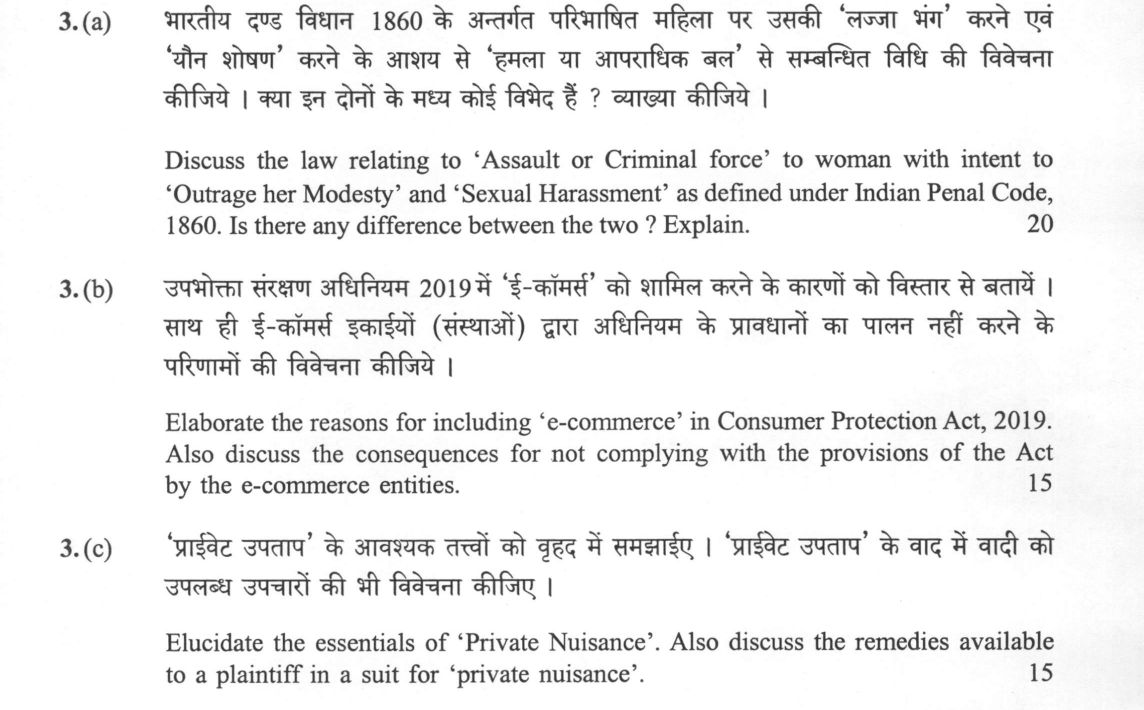
Discuss the law relating to 'Assault or Criminal force' to woman with intent to 'Outrage her Modesty' and 'Sexual Harassment' as defined under Indian Penal Code, 1860. Is there any difference between the two ? Explain. 20 marks
Elaborate the reasons for including 'e-commerce' in Consumer Protection Act, 2019. Also discuss the consequences for not complying with the provisions of the Act by the e-commerce entities. 15 marks
Elucidate the essentials of 'Private Nuisance'. Also discuss the remedies available to a plaintiff in a suit for 'private nuisance'. 15 marks
हिंदी में प्रश्न पढ़ें
भारतीय दण्ड विधान 1860 के अंतर्गत परिभाषित महिला पर उसकी 'लज्जा भंग' करने एवं 'यौन शोषण' करने के आशय से 'हमला या आपराधिक बल' से सम्बन्धित विधि की विवेचना कीजिए। क्या इन दोनों के मध्य कोई विभेद है ? व्याख्या कीजिए। 20
उपभोक्ता संरक्षण अधिनियम 2019 में 'ई-कॉमर्स' को शामिल करने के कारणों को विस्तार से बतायें। साथ ही ई-कॉमर्स इकाइयों (संस्थाओं) द्वारा अधिनियम के प्रावधानों का पालन नहीं करने के परिणामों की विवेचना कीजिए। 15
'प्राइवेट उपताप' के आवश्यक तत्त्वों को बृहद् में समझाइए। 'प्राइवेट उपताप' के वाद में वादी को उपलब्ध उपचारों की भी विवेचना कीजिए। 15
Model answer
Written by UPSC Answer Check against this question's marking rubric, to the expected length. UPSC does not publish answers for Mains — this is one way to score well, not an official key.
Assault, criminal force and sexual harassment Section 354 IPC criminalises a man who assaults or uses criminal force on a woman, intending to outrage or knowing it is likely to outrage her modesty. Rupan Deol Bajaj v. KPS Gill identifies the ingredients: the accused must be a man; he must assault or use criminal force on a woman; he must intend to outrage her modesty or know it is likely; and the act must be of a character likely to insult her modesty. Section 354A, inserted after the 2013 amendment, defines sexual harassment more broadly as unwelcome sexually determined behaviour, whether direct or implied, including following or stalking, demanding sexual favour, making sexually coloured remarks, showing pornography or forcing a woman to watch it, and other unwelcome physical, verbal or electronic conduct. Its culpability often rests on the unwelcome or against-the-will nature of the conduct, not on a uniformly explicit sexualised intent. The difference is therefore in actus reus and mens rea: courts have treated 354 as contact-based, while 354A is a standalone non-contact offence. Both carry imprisonment up to five years, but 354A makes fine mandatory and covers a wider range of conduct. Overlap arises where contact is accompanied by unwelcome sexual conduct; the non-contact limb of 354A fills the gap left by 354.
E-commerce in Consumer Protection E-commerce was expressly brought within the Consumer Protection Act, 2019 because digital markets have expanded rapidly, creating information asymmetry, cross-border transactions, and weaker consumer bargaining power. Section 2(16) defines an e-commerce entity, while Chapter III empowers the Central Consumer Protection Authority and the consumer redressal machinery provides grievance redressal for unfair trade practices, misleading advertisements, defective goods or deficient services across platforms. This was necessary because online sellers and marketplace operators can be distant from the consumer, making traditional redressal inadequate. The Act distinguishes marketplace and inventory-based platforms in its e-commerce liability provisions: a marketplace platform is not automatically liable for every act of a seller, but remains responsible for its own failure to take reasonable steps, while an inventory-based platform is liable as seller. Consequences of non-compliance include CCPA directions for recall or refund under Section 20, penalties for false or misleading advertisements under Section 72, and penalties for non-compliance with orders under Sections 88 and 89. Where the entity is a body corporate, persons in charge and responsible for its conduct may also be liable.
Private nuisance Private nuisance is an unreasonable and unlawful interference with a person’s use or enjoyment of land. The interference must be direct, substantial and not merely trivial, and it must cause damage, whether physical, discomfort or amenity loss. Use of one’s own property is no defence if unreasonable; the locality principle in Sturges v. Bridgman shows that a sensitive use in a noisy locality may not recover for ordinary noise. Damages may be compensatory for past loss, or exemplary where the defendant’s conduct is oppressive, reckless or calculated. An injunction, prohibitory or mandatory, may restrain future interference or require removal of the nuisance. Abatement by self-help is limited to reasonable, temporary action that does not breach the peace or use disproportionate force. Statutory remedies may apply where a statute confers a right, but private nuisance is not ordinarily a representative public-nuisance suit under Section 91 CPC.
Together, these provisions show a common trajectory: criminal law protects bodily and sexual autonomy with graded offences; consumer law extends to digital marketplaces; and tort law balances property rights against unreasonable interference. The way forward is consistent enforcement through police, CCPA and courts.
What "Discuss" is asking you to do
Lay the issue out from more than one side — how it arose, what is claimed for it, what is held against it, and where it now stands. UPSC attaches discuss to broad topics with several live dimensions, so coverage of the dimensions earns more than the strength of your opinion.
Structure that answers it
Set the issue up → the case as it is made → the case against → the dimension both sides leave out → where the balance now lies
Where marks are lost
Listing facts with no thread between them, or arguing one side throughout and calling it a discussion.
How this answer will be evaluated
Approach
Framework: Issue > Rule > Authority > Application. (a) discuss: intro > 3-4 dimensions > example > balanced close | (b) explain: definition/context > points in order > small example > short close | (c) explain: definition/context > points in order > small example > short close Full marks: Precise statutory citations, clear distinctions, and relevant case law.
Key points expected
- Cite IPC Section 354 (Outraging modesty)
- Cite IPC Section 509 (Word/gesture intended to insult)
- Distinguish 'criminal force' from 'words/gestures'
- Mention punishment differences (Sec 354 vs 509)
- Cite Consumer Protection Act, 2019
- Explain 'e-commerce entity' definition (Sec 2(10))
- Mention 'on-platform' vs 'inventory' models
- List penalties for non-compliance (Sec 103)
Evaluation rubric
Each sub-part is marked on its own, against the marks and word limit printed on the paper.
- (a) Compare IPC 354 and 509, highlighting the distinction between physical force and non-physical harassment. 20 marks
discuss— intro → 3-4 dimensions → example → balanced close
Must cover
- Cite IPC Section 354 (Outraging modesty)
- Cite IPC Section 509 (Word/gesture intended to insult)
- Distinguish 'criminal force' from 'words/gestures'
- Mention punishment differences (Sec 354 vs 509)
Loses marks
- Confusing Section 354 with Section 375 (Rape)
- Failing to distinguish the two sections
- Ignoring the 'intent' requirement
Earns more
- Reference to 'intent' as a common element
- Mention of 'modesty' as the protected interest
- Reference to Section 354A (post-2018 amendment)
Extra mark
- Cite 'State of Haryana v. Bhajan Singh' (2014)
- Reference to Law Commission 243rd Report
- (b) Explain the rationale for e-commerce inclusion in CPA 2019 and the penalties for non-compliance. 15 marks
explain— definition/context → points in order → small example → short close
Must cover
- Cite Consumer Protection Act, 2019
- Explain 'e-commerce entity' definition (Sec 2(10))
- Mention 'on-platform' vs 'inventory' models
- List penalties for non-compliance (Sec 103)
Loses marks
- Confusing CPA 2019 with IT Act 2000
- Failing to mention specific penalties
- Ignoring the 'on-platform' model distinction
Earns more
- Reference to 'digital marketplace' expansion
- Mention of 'intermediary' liability
- Reference to 'consumer grievance redressal' online
Extra mark
- Cite 'Amazon' or 'Flipkart' as examples
- Reference to 'E-Commerce Policy' guidelines
- (c) Define Private Nuisance, list its essentials, and discuss available legal remedies. 15 marks
explain— definition/context → points in order → small example → short close
Must cover
- Define 'Private Nuisance' (interference with use/enjoyment)
- List essentials (unreasonable, substantial, interference)
- Mention 'injury' as a prerequisite
- List remedies (injunction, damages, abatement)
Loses marks
- Confusing Private Nuisance with Public Nuisance
- Failing to mention 'unreasonableness' as an essential
- Ignoring the 'injury' requirement
Earns more
- Reference to 'continuing nuisance'
- Mention of 'statutory nuisance' distinction
- Reference to 'public nuisance' contrast
Extra mark
- Cite 'Halsey v. Esso Petroleum' (1961)
- Reference to 'Rylands v. Fletcher' (1868)
Practice this exact question
Write your answer and it is marked point by point against the model answer above — what you covered, what you missed, what you got wrong.
Evaluate my answer →More from Law 2023 Paper II
- Q1 Answer the following in about 150 words each. Support your answers with relevant legal pr…
- Q2 (a) A twenty year old girl 'G' was coming back to home after attending college. A man 'M'…
- Q3 (a) Discuss the law relating to 'Assault or Criminal force' to woman with intent to 'Outr…
- Q4 (a) "Dishonest Intention is the gist of the offence of Theft." Examine the above statemen…
- Q5 Answer the following in about 150 words each. Support your answer with relevant legal pro…
- Q6 (a) "The Constitutional courts through their judicial activism have made substantial cont…