Paper II — Q6
(a) "The Constitutional courts through their judicial activism have made substantial contribution in protecting women against…
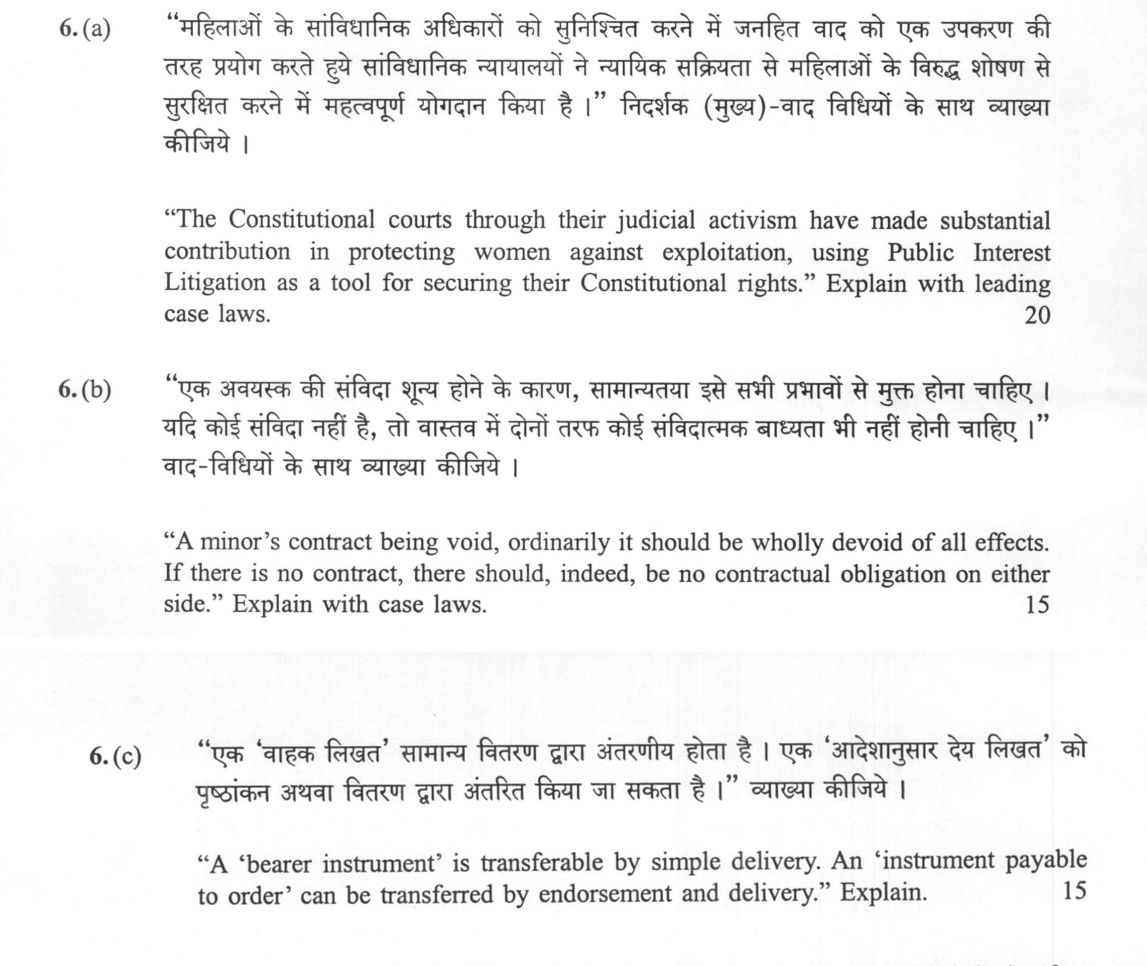
"The Constitutional courts through their judicial activism have made substantial contribution in protecting women against exploitation, using Public Interest Litigation as a tool for securing their Constitutional rights." Explain with leading case laws. 20 marks
"A minor's contract being void, ordinarily it should be wholly devoid of all effects. If there is no contract, there should, indeed, be no contractual obligation on either side." Explain with case laws. 15 marks
"A 'bearer instrument' is transferable by simple delivery. An 'instrument payable to order' can be transferred by endorsement and delivery." Explain. 15 marks
हिंदी में प्रश्न पढ़ें
"महिलाओं के सांविधानिक अधिकारों को सुनिश्चित करने में जनहित वाद को एक उपकरण की तरह प्रयोग करते हुए सांविधानिक न्यायालयों ने न्यायिक सक्रियता से महिलाओं के विरुद्ध शोषण से सुरक्षित करने में महत्वपूर्ण योगदान किया है ।" निर्देशक (मुख्य)-वाद विधियों के साथ व्याख्या कीजिए । 20
"एक अवयस्क की संविदा शून्य होने के कारण, सामान्यतया इसे सभी प्रभावों से मुक्त होना चाहिए । यदि कोई संविदा नहीं है, तो वास्तव में दोनों तरफ कोई संविदात्मक बाध्यता भी नहीं होनी चाहिए ।" वाद-विधियों के साथ व्याख्या कीजिए । 15
"एक 'वाहक लिखत' सामान्य वितरण द्वारा अंतरणीय होता है। एक 'आदेशानुसार देय लिखत' को पृष्ठांकन अथवा वितरण द्वारा अंतरित किया जा सकता है।" व्याख्या कीजिये। 15
Model answer
Written by UPSC Answer Check against this question's marking rubric, to the expected length. UPSC does not publish answers for Mains — this is one way to score well, not an official key.
Role of Judicial Activism and PIL in Protecting Women
The evolution of Public Interest Litigation (PIL), pioneered in cases like S.P. Gupta v. Union of India (1981) by relaxing the traditional rule of locus standi, transformed Constitutional courts into accessible forums for vindicating women’s rights. In Vishaka v. State of Rajasthan (1997), the Supreme Court utilized PIL to address workplace sexual harassment. Operating in a statutory vacuum, the Court drew upon Articles 14, 19, and 21, alongside international conventions like CEDAW, to formulate binding guidelines under Article 141, which later formed the foundation of the POSH Act, 2013.
Judicial activism further dismantled patriarchal norms in Shayara Bano v. Union of India (2017), where the Court set aside the practice of Talaq-e-biddat (instant triple talaq) as unconstitutional on the ground of manifest arbitrariness under Article 14. Similarly, in Indian Young Lawyers Association v. State of Kerala (2018) (Sabarimala Case), the Court eliminated gender-based exclusion by ruling that biological characteristics cannot form the basis for denying women entry into places of worship, subordinating exclusionary customs to the guarantees of Articles 15, 21, and 25. Following the 2012 Nirbhaya case, public interest interventions prompted the incorporation of the Justice J.S. Verma Committee recommendations into the Criminal Law (Amendment) Act, 2013, ensuring rigorous institutional responses to gender-based violence.
Status and Effects of a Minor's Agreement
Under Section 11 of the Indian Contract Act, 1872, a person who has not attained majority is incompetent to contract. In Mohori Bibee v. Dharmodas Ghose (1903), the Privy Council settled the causal effect of this incompetence, ruling that a minor’s agreement is void ab initio rather than merely voidable. Because no contract comes into existence, there are no reciprocal contractual obligations: the rule of estoppel under Section 115 of the Indian Evidence Act cannot operate to validate the agreement, nor can a minor be compelled to make restitution under Sections 64 or 65.
However, statutory mechanisms prevent injustice through quasi-contractual obligations. Under Section 68 of the Act, if a minor is supplied with "necessaries" suited to their condition in life, the supplier is entitled to reimbursement solely out of the minor’s estate, with no personal liability attaching to the minor. As established in Nash v. Inman (1908), the burden lies on the plaintiff to prove that the goods were not only suitable to the minor's station but also necessary for their actual requirements at the time. Furthermore, contracts made exclusively for the minor's benefit, such as contracts of apprenticeship or beneficial service without imposing onerous personal obligations, remain enforceable in the minor's interest.
Bearer Instruments versus Instruments Payable to Order
The Negotiable Instruments Act, 1881, classifies instruments based on the method prescribed for their negotiation under Sections 46, 47, and 48:
Bearer Instruments: Under Section 13, an instrument is payable to bearer when it is expressed to be so payable or when the only or last endorsement is an endorsement in blank. By virtue of Section 47, a bearer instrument is negotiated by mere physical delivery. Possession alone creates the presumption of ownership, enabling swift commercial circulation without formal execution.
Order Instruments: Under Section 13, an instrument is payable to order when it is expressed to be payable to a particular person, without words prohibiting transfer. Under Section 48 read with Section 46, such an instrument can only be negotiated by valid endorsement (signature of the holder) followed by delivery.
This distinction governs the acquisition of title and the status of a Holder in Due Course (HDC) under Section 9. For a bearer instrument, a bona fide transferee taking it for consideration by simple delivery acquires an untainted title free from defects in prior title. Conversely, for an order instrument, a complete and unbroken chain of genuine endorsements is a mandatory condition precedent for a person to claim the status and protections of an HDC.
Thus, while judicial activism and statutory interpretation protect fundamental rights and vulnerable parties like minors, strict statutory mechanisms in commercial law maintain certainty, speed, and integrity in transactional relationships.
What "Explain" is asking you to do
Make the working of something clear — what sets it off, what follows from what, and what it produces. Explain is the Commission's mechanism word: it dominates the technical papers and the “explain why” stems, where the marks sit in the causal chain and not in the label.
Structure that answers it
State what it is → the initiating condition → the chain of cause, step by step → an instance where it plays out → what the chain produces
Where marks are lost
Describing what something looks like instead of why it works that way. Naming the stages without linking them reads as description too.
How this answer will be evaluated
Approach
Framework: Issue > Rule > Authority > Application. (a) explain: definition/context > points in order > small example > short close | (b) explain: definition/context > points in order > small example > short close | (c) explain: definition/context > points in order > small example > short close Full marks: Precise legal analysis with case ratios, statutory references, and clear application to the specific issues raised.
Key points expected
- Define judicial activism and PIL in this context
- Cite leading case laws with their ratio
- Link cases to specific constitutional rights
- Show how PIL secured these rights
- State the legal position on minor's contracts
- Cite case laws supporting voidness
- Explain why no contractual obligation arises
- Address the 'wholly devoid of effects' principle
Evaluation rubric
Each sub-part is marked on its own, against the marks and word limit printed on the paper.
- (a) Explain judicial activism and PIL in protecting women's rights with case laws. 20 marks
explain— definition/context → points in order → small example → short close
Must cover
- Define judicial activism and PIL in this context
- Cite leading case laws with their ratio
- Link cases to specific constitutional rights
- Show how PIL secured these rights
Loses marks
- Outcome-only case citation without ratio
- Discussion without constitutional authority
- Generic statements without case support
Earns more
- Mention specific constitutional articles
- Discuss scope of judicial activism
- Note any dissenting views
- Reference Law Commission reports
Extra mark
- Recent Supreme Court judgment
- Specific statutory provisions
- (b) Explain the voidness of minor's contracts and absence of obligation. 15 marks
explain— definition/context → points in order → small example → short close
Must cover
- State the legal position on minor's contracts
- Cite case laws supporting voidness
- Explain why no contractual obligation arises
- Address the 'wholly devoid of effects' principle
Loses marks
- Outcome-only case citation
- Failure to explain the voidness principle
- Discussion without case authority
Earns more
- Mention exceptions or nuances
- Reference specific statutory provisions
- Discuss restitution principles
- Note conflicting authorities
Extra mark
- Recent Supreme Court judgment
- Law Commission report reference
- (c) Explain transfer of bearer and order instruments. 15 marks
explain— definition/context → points in order → small example → short close
Must cover
- Define bearer instrument and its transfer
- Define order instrument and its transfer
- Explain simple delivery for bearer instruments
- Explain endorsement and delivery for order instruments
Loses marks
- Confusing bearer and order instruments
- Omitting endorsement requirement for order instruments
- No statutory or case authority
Earns more
- Mention relevant statutory provisions
- Provide examples of each type
- Discuss legal requirements for valid transfer
- Note differences between the two modes
Extra mark
- Specific statutory section references
- Practical example of transfer
Practice this exact question
Write your answer and it is marked point by point against the model answer above — what you covered, what you missed, what you got wrong.
Evaluate my answer →More from Law 2023 Paper II
- Q3 (a) Discuss the law relating to 'Assault or Criminal force' to woman with intent to 'Outr…
- Q4 (a) "Dishonest Intention is the gist of the offence of Theft." Examine the above statemen…
- Q5 Answer the following in about 150 words each. Support your answer with relevant legal pro…
- Q6 (a) "The Constitutional courts through their judicial activism have made substantial cont…
- Q7 (a) "'Standard-contracts' contain a large number of terms and conditions in 'fine print'…
- Q8 (a) Under what circumstances, can an intermediary be held liable for third party-content…