Paper I — Q1
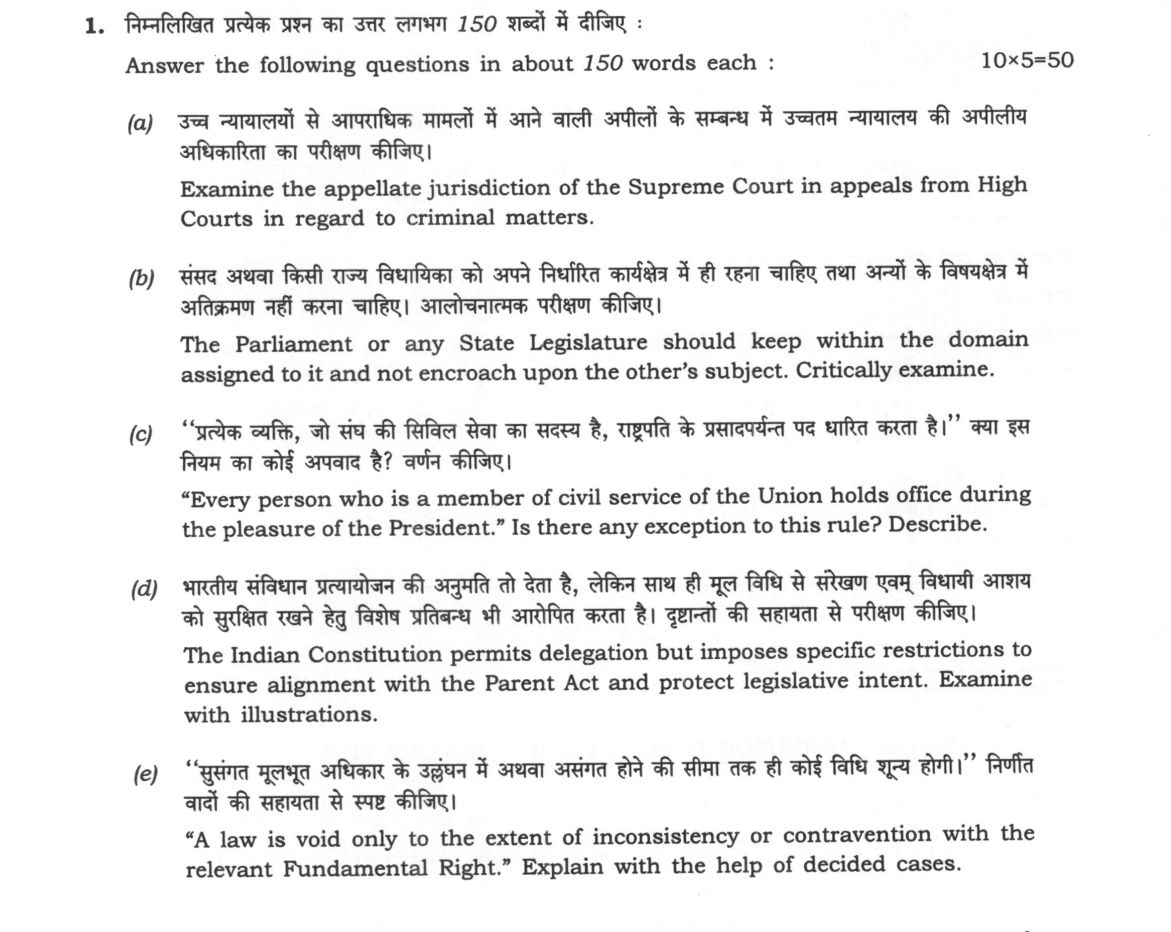
Answer the following questions in about 150 words each: (a) Examine the appellate jurisdiction of the Supreme Court in appeals…
Answer the following questions in about 150 words each:
Examine the appellate jurisdiction of the Supreme Court in appeals from High Courts in regard to criminal matters. 10 marks
The Parliament or any State Legislature should keep within the domain assigned to it and not encroach upon the other's subject. Critically examine. 10 marks
"Every person who is a member of civil service of the Union holds office during the pleasure of the President." Is there any exception to this rule? Describe. 10 marks
The Indian Constitution permits delegation but imposes specific restrictions to ensure alignment with the Parent Act and protect legislative intent. Examine with illustrations. 10 marks
"A law is void only to the extent of inconsistency or contravention with the relevant Fundamental Right." Explain with the help of decided cases. 10 marks
हिंदी में प्रश्न पढ़ें
निम्नलिखित प्रत्येक प्रश्न का उत्तर लगभग 150 शब्दों में दीजिए :
उच्च न्यायालयों से आपराधिक मामलों में आने वाली अपीलों के संबंध में उच्चतम न्यायालय की अपीलीय अधिकारिता का परीक्षण कीजिए। (10 अंक)
संसद अथवा किसी राज्य विधायिका को अपने निर्धारित कार्यक्षेत्र में ही रहना चाहिए तथा अन्यों के विषयक्षेत्र में अतिक्रमण नहीं करना चाहिए। आलोचनात्मक परीक्षण कीजिए। (10 अंक)
"प्रत्येक व्यक्ति, जो संघ की सिविल सेवा का सदस्य है, राष्ट्रपति के प्रसादपर्यंत पद धारित करता है।" क्या इस नियम का कोई अपवाद है? वर्णन कीजिए। (10 अंक)
भारतीय संविधान प्रत्यायोजन की अनुमति तो देता है, लेकिन साथ ही मूल विधि से सरेखन एवं विधायी आशय को सुरक्षित रखने हेतु विशेष प्रतिबंध भी आरोपित करता है। दृष्टांतों की सहायता से परीक्षण कीजिए। (10 अंक)
"सुसंगत मूलभूत अधिकार के उल्लंघन में अथवा असंगत होने की सीमा तक ही कोई विधि शून्य होगी।" निर्णीत वादों की सहायता से स्पष्ट कीजिए। (10 अंक)
Model answer
Written by UPSC Answer Check against this question's marking rubric, to the 150-word length. UPSC does not publish answers for Mains — this is one way to score well, not an official key.
(a) The Supreme Court’s criminal appellate jurisdiction over High Courts is limited. Article 134 gives statutory appeal where a High Court imposes death, takes a case out of a Session Court under Article 223(1) and acquits, or certifies that the case is a fit one for appeal. The first two are appeals as of right; the third is certificate-based. Article 134A permits a High Court, in a criminal appeal, to certify a question of law of public importance and send the case up. Article 136 supplies residual special leave, which is discretionary, not a right. Article 132, which permits appeal on a certified substantial question of constitutional interpretation, illustrates the certification principle; in criminal matters the certificate routes are Articles 134(1)(c) and 134A. Thus regular appeals under Article 134 arise by constitutional mandate in specified cases, while SLP under Article 136 is an exception to correct grave injustice or decide important law.
(b) The claim is broadly correct but qualified. The Seventh Schedule demarcates legislative competence: Union, State and Concurrent Lists. A legislature must stay within its assigned entry, and colourable legislation—where a law is really outside competence but dressed as within it—is invalid. However, the Constitution does not require absolute subject-matter purity. The doctrine of pith and substance, applied in State of Bombay v. F.N. Balsara, asks for the true nature and character of the law, its dominant ingredient, and whether encroachment is merely incidental. In Balsara, the Bombay bidis prohibition was upheld because its pith and substance was public health, not trade. Judicial review thus tests substance, not title or incidental effect. Critically, the doctrine protects federalism by preventing encroachment, but it can also validate wide state laws if the dominant purpose is within competence. The balance requires that the dominant ingredient be genuinely within the legislature’s entry and that incidental encroachment be real, not a device.
(c) Article 310 provides that every member of a civil service of the Union holds office during the pleasure of the President. This pleasure doctrine is not absolute. Article 311(1) requires that no member be dismissed, removed, or reduced in rank without an opportunity of showing cause against the proposed action. Article 311(2) adds safeguards: no such person may be dismissed or removed by an authority subordinate to the appointing authority; and no such person may be dismissed, removed, or reduced in rank on a criminal charge unless found guilty in an inquiry. Article 311(2) also permits exceptions where inquiry is not expedient in public interest, not practicable, or where conduct is established by a service-rule inquiry, provided satisfaction is recorded in writing. These exceptions protect procedural fairness without destroying executive control. The rule therefore means pleasure is subject to constitutional due process, not arbitrary removal.
(d) Delegated legislation is constitutionally permissible because the legislature cannot frame every technical detail. However, delegation must preserve the Parent Act’s legislative intent. Essential legislative functions—making policy and laying down standards—cannot be delegated. Conditional legislation is valid where the legislature fixes policy and conditions, and the executive merely fills in details when those conditions arise. Subordinate legislation is valid where the statute supplies the framework, limits, and standards. In Re Delhi Laws Act, the Supreme Court upheld executive law-making because the parent statute provided sufficient standards and the delegation was not unbounded. In Gwalior Rayon Mills, delegation under the Industrial Employment (Standing Orders) Act was valid because the Act laid down policy and the executive’s rules were confined to its framework. Critically, delegation is a practical necessity, but judicial review controls it: if the executive exceeds the parent Act’s standards or substitutes its own policy, the instrument is invalid.
(e) Article 13(1) makes pre-constitutional laws void to the extent of inconsistency with Fundamental Rights, and Article 13(2) prohibits State laws from taking away or abridging those Rights. The consequence is not automatic total invalidity. The doctrine of severability, applied in R.M.D.C. v. State of Bombay, holds that if the offending part can be separated from the rest without destroying the statute’s purpose, only that part is void. If the invalid part is inseparable, the whole law fails. The doctrine of eclipse, from A.K. Gopalan v. State of Madras, treats pre-constitutional laws as eclipsed rather than dead: they remain inoperative against Fundamental Rights but may revive if the relevant Right is amended. Thus a post-constitutional law that contravenes a Fundamental Right is void ab initio to the extent of inconsistency, while a pre-constitutional law is voidable in the sense of being suspended by the eclipse. The principle protects both legislative purpose and constitutional supremacy.
What "Critically examine" is asking you to do
Test the proposition the question puts to you and return a finding on how far it holds. Examine stems carry a claim, or ask whether something has happened, and expect evidence weighed both ways before the extent is stated — often with remedial measures attached. “Critically” is not a section added at the end: name the yardstick you are judging by — the evidence, the stated objective, a constitutional principle, a rival explanation — and let a verdict close each part of the body. Where the question quotes a claim, that verdict must land on the claim itself, accepted, qualified or rejected, and not on the theme in general.
Structure that answers it
Restate the claim as the question frames it → evidence that supports it → evidence that undercuts it → the conditions under which it holds → verdict on how far it stands
Where marks are lost
Merits in one paragraph, demerits in the next, and a conclusion calling for a balanced and holistic approach. That is a survey with the judgement left out and it holds the answer in the middle band. The opposite error is reading “critically” as permission to attack — and with the odd pairings, critically describe or critically explain, the exposition still carries most of the marks, the judgement being a layer on it rather than a substitute for it.
How this answer will be evaluated
Approach
Framework: Issue > Rule > Authority > Application. (a) examine: intro > how/why with reasoning > evidence > conclusion | (b) critically evaluate: positives > negatives/limits > conditions/safeguards > conclusion | (c) describe: define > structure or process in order > labelled diagram > significance | (d) examine: intro > how/why with reasoning > evidence > conclusion | (e) explain: definition/context > points in order > small example > short close Full marks: Precise Article/case citation, clear application of doctrine, balanced analysis.
Key points expected
- Cite Article 132 of the Constitution
- Define 'substantial question of law' requirement
- Mention certificate requirement under Art 132(1)
- Distinguish from Art 134 special leave
- Reference to Seventh Schedule (Lists I, II, III)
- Explain doctrine of pith and substance
- Mention Article 246 (legislative competence)
- Cite a case on encroachment
Evaluation rubric
Each sub-part is marked on its own, against the marks and word limit printed on the paper.
- (a) Scope and conditions of SC appellate jurisdiction in criminal appeals from High Courts. · 150 words
examine— intro → how/why with reasoning → evidence → conclusion
Must cover
- Cite Article 132 of the Constitution
- Define 'substantial question of law' requirement
- Mention certificate requirement under Art 132(1)
- Distinguish from Art 134 special leave
Loses marks
- Confusing criminal with civil jurisdiction
- No mention of Article 132
- Outcome-only case citation
Earns more
- Reference to Article 133 (civil appeals)
- Mention of Article 134 (special leave)
- Cite a relevant Supreme Court case
- Discuss the 'substantial question' test
Extra mark
- Reference to Law Commission report
- Mention of recent 2023/24 SC judgment
- (b) Analysis of legislative competence and encroachment between Union and State lists. · 150 words
critically evaluate— positives → negatives/limits → conditions/safeguards → conclusion
Must cover
- Reference to Seventh Schedule (Lists I, II, III)
- Explain doctrine of pith and substance
- Mention Article 246 (legislative competence)
- Cite a case on encroachment
Loses marks
- No mention of Seventh Schedule
- Ignoring pith and substance doctrine
- No case law cited
Earns more
- Reference to Article 254 (inconsistency)
- Mention of concurrent list dynamics
- Cite Kesavananda Bharati or similar
- Discuss federalism implications
Extra mark
- Reference to Law Commission report
- Mention of recent 2023/24 SC judgment
- (c) Exceptions to the rule that Union civil servants hold office at President's pleasure. · 150 words
describe— define → structure or process in order → labelled diagram → significance
Must cover
- Cite Article 310 (pleasure doctrine)
- Mention Article 311 (protection from dismissal)
- List specific exceptions (e.g., judges, CAG)
- Explain the 'pleasure' concept
Loses marks
- No mention of Article 310
- Ignoring Article 311 protections
- No specific exceptions listed
Earns more
- Reference to Article 316 (removal of MPs)
- Mention of judicial review limits
- Cite a relevant Supreme Court case
- Discuss the 'mala fide' exception
Extra mark
- Reference to Law Commission report
- Mention of recent 2023/24 SC judgment
- (d) Constitutional validity of delegation of legislative power and its restrictions. · 150 words
examine— intro → how/why with reasoning → evidence → conclusion
Must cover
- Cite Article 12 (definition of law)
- Explain the 'essential features' doctrine
- Mention the 'parent act' requirement
- Cite a case on delegation
Loses marks
- No mention of 'essential features' doctrine
- Ignoring the 'parent act' requirement
- No case law cited
Earns more
- Reference to Article 246 (legislative power)
- Mention of 'ultra vires' delegation
- Cite Delegation of Power case
- Discuss the 'policy' vs 'legislation' distinction
Extra mark
- Reference to Law Commission report
- Mention of recent 2023/24 SC judgment
- (e) Doctrine of severability: law void only to the extent of inconsistency with Fundamental Rights. · 150 words
explain— definition/context → points in order → small example → short close
Must cover
- Cite Article 13 (inconsistency with Constitution)
- Explain the 'severability' doctrine
- Mention the 'blue pencil' test
- Cite a case on severability
Loses marks
- No mention of Article 13
- Ignoring the 'severability' doctrine
- No case law cited
Earns more
- Reference to Article 32 (writ jurisdiction)
- Mention of 'void ab initio' vs 'voidable'
- Cite a relevant Supreme Court case
- Discuss the 'legislative intent' test
Extra mark
- Reference to Law Commission report
- Mention of recent 2023/24 SC judgment
Practice this exact question
Write your answer and it is marked point by point against the model answer above — what you covered, what you missed, what you got wrong.
Evaluate my answer →More from Law 2024 Paper I
- Q1 Answer the following questions in about 150 words each: (a) Examine the appellate jurisdi…
- Q2 (a) The concept of Public Interest Litigation is an exception to the rule of 'locus stand…
- Q3 (a) "Article 194, which is an exact reproduction of Article 105, deals with the State Leg…
- Q4 (a) In recent years, the concept of 'Cooperative Federalism' has played a pivotal role in…