Paper I — Q3
(a) "Article 194, which is an exact reproduction of Article 105, deals with the State Legislatures and their members and…
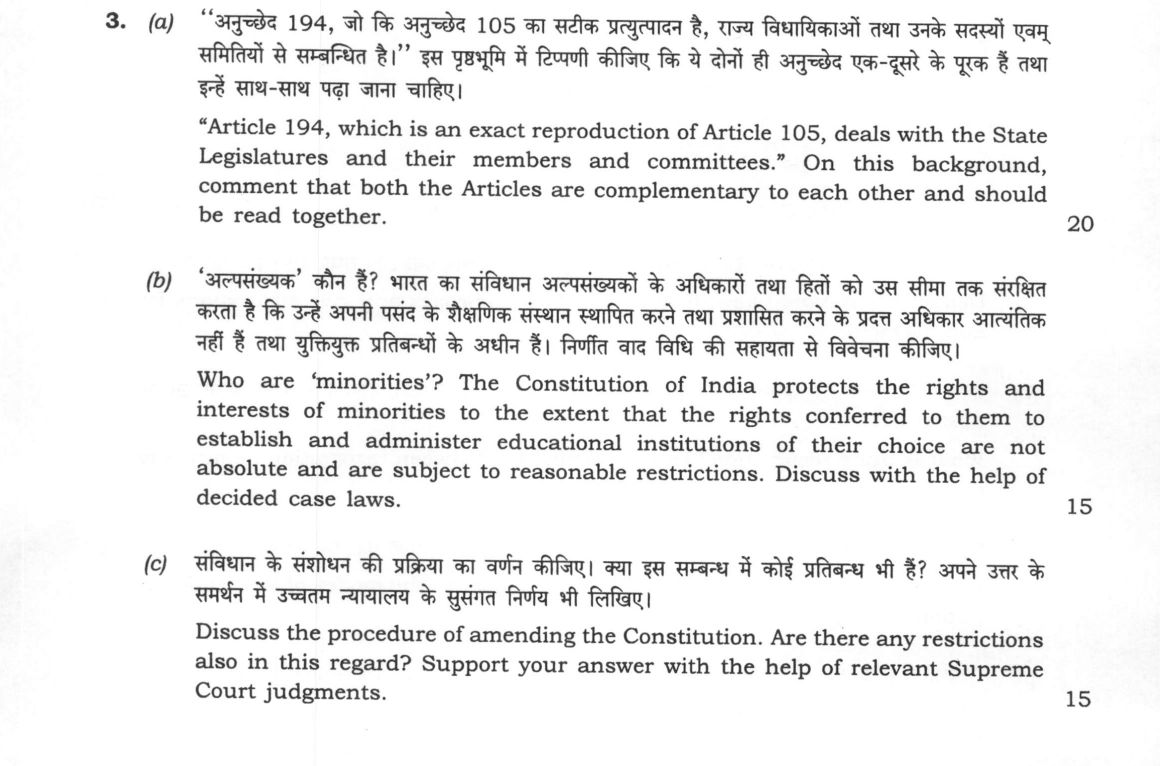
"Article 194, which is an exact reproduction of Article 105, deals with the State Legislatures and their members and committees." On this background, comment that both the Articles are complementary to each other and should be read together. 20 marks
Who are 'minorities'? The Constitution of India protects the rights and interests of minorities to the extent that the rights conferred to them to establish and administer educational institutions of their choice are not absolute and are subject to reasonable restrictions. Discuss with the help of decided case laws. 15 marks
Discuss the procedure of amending the Constitution. Are there any restrictions also in this regard? Support your answer with the help of relevant Supreme Court judgments. 15 marks
हिंदी में प्रश्न पढ़ें
"अनुच्छेद 194, जो कि अनुच्छेद 105 का सटीक प्रत्युपादन है, राज्य विधायिकाओं तथा उनके सदस्यों एवं समितियों से सम्बन्धित है।" इस पृष्ठभूमि में टिप्पणी कीजिए कि ये दोनों ही अनुच्छेद एक-दूसरे के पूरक हैं तथा इन्हें साथ-साथ पढ़ा जाना चाहिए। (20 अंक)
'अल्पसंख्यक' कौन हैं? भारत का संविधान अल्पसंख्यकों के अधिकारों तथा हितों को उस सीमा तक संरक्षित करता है कि उन्हें अपनी पसंद के शैक्षणिक संस्थान स्थापित करने तथा प्रशासित करने के प्रदत्त अधिकार आत्यंतिक नहीं हैं तथा युक्तियुक्त प्रतिबन्धों के अधीन हैं। निर्णीत वाद विधि की सहायता से विवेचना कीजिए। (15 अंक)
संविधान के संशोधन की प्रक्रिया का वर्णन कीजिए। क्या इस सम्बन्ध में कोई प्रतिबन्ध भी हैं? अपने उत्तर के समर्थन में उच्चतम न्यायालय के सुसंगत निर्णय भी लिखिए। (15 अंक)
Model answer
Written by UPSC Answer Check against this question's marking rubric, to the expected length. UPSC does not publish answers for Mains — this is one way to score well, not an official key.
Constitutional Privileges under Articles 105 and 194
Article 194 is an exact textual counterpart of Article 105, governing the powers, privileges, and immunities of State Legislatures in the same terms as Article 105 does for Parliament. Both articles are complementary and must be read together to preserve symmetric federal autonomy and uniform legislative functioning across the Union and the States.
Clause (1) of both provisions confers freedom of speech within the legislature, subject only to constitutional provisions and procedural rules. Clause (2) provides complete immunity against judicial proceedings for any speech made or vote cast in the House or its committees. Clause (3), as modified by the 44th Constitutional Amendment Act, 1978, provides that the privileges of each House shall be such as defined by law, and until so defined, shall be those available prior to the 1978 amendment.
In Special Reference No. 1 of 1964 (Keshav Singh case / U.P. Assembly case), the Supreme Court affirmed that Articles 105(3) and 194(3) must be interpreted harmoniously with fundamental rights, particularly Articles 20, 21, and 32/226. The Court clarified that legislative privileges are not unbridled and are subject to judicial review where fundamental rights are infringed. Furthermore, both articles operate in tandem with Articles 122 and 212 respectively, which bar courts from inquiring into legislative proceedings on grounds of mere procedural irregularity. Reading them together establishes an identical standard of constitutional protection, ensuring that the legislative branches at both levels function with institutional parity and constitutional discipline.
Minority Rights and Permissible Restrictions under Article 30
The Constitution does not explicitly define 'minorities', but Articles 29 and 30 recognize two classes: religious and linguistic minorities. In T.M.A. Pai Foundation v. State of Karnataka (2002), the Supreme Court settled the position that minority status must be determined unit-wise, taking the State as the relevant demographic unit, meaning any community numerically fewer than 50% of the State's population constitutes a minority.
While Article 30(1) guarantees minorities the right to establish and administer educational institutions of their choice, this right is not absolute and is subject to regulatory measures. As ruled in St. Xavier’s College v. State of Gujarat (1974), the right to administer does not include the right to mal-administer; regulations ensuring educational standards, financial probity, public order, and staff welfare are valid. In P.A. Inamdar v. State of Maharashtra (2005), the Court held that while unaided minority institutions enjoy substantial autonomy in fee structure and admissions, the State can mandate a transparent, merit-based admission procedure and permit admission of non-minority students up to a threshold so long as the institution's minority character is preserved. Additionally, Article 30(1A) mandates fair compensation in case of compulsory acquisition of property, and Article 30(2) prevents the State from discriminating against minority institutions in granting aid.
Procedure and Restrictions on Constitutional Amendments
The procedure for amending the Constitution under Article 368 encompasses two formal categories: (i) amendment by a special majority of both Houses of Parliament (majority of total membership and a two-thirds majority of members present and voting) under Article 368(2); and (ii) amendment by special majority along with ratification by at least half of the State Legislatures for matters affecting federal provisions listed in the Proviso to Article 368(2). Minor technical changes (such as under Articles 2, 3, and 169) require only a simple majority and fall outside the scope of Article 368.
Constituent power is not untrammeled. Following the overruling of I.C. Golak Nath (1967) by the 24th Amendment, the constitutional validity of the 24th, 25th, 26th, and 29th Amendments was evaluated in Kesavananda Bharati v. State of Kerala (1973), which established the Basic Structure Doctrine as a substantive limitation on Article 368. Subsequent rulings reinforced this restraint: Indira Gandhi v. Raj Narain (1975) struck down Article 329A(4) for violating free and fair elections and the rule of law; Minerva Mills v. Union of India (1980) invalidated Clauses (4) and (5) of Article 368 (inserted by the 42nd Amendment), upholding judicial review and the balance between Part III and Part IV as basic features; Waman Rao v. Union of India (1981) applied the doctrine prospectively from April 24, 1973; and I.R. Coelho v. State of Tamil Nadu (2007) held that all laws inserted into the Ninth Schedule after that cut-off date remain open to judicial review against the basic structure test.
Together, the complementary privileges under Articles 105 and 194, the regulated fundamental freedoms under Article 30, and the judicial limits on Article 368 demonstrate that the Indian constitutional framework functions through a system of structural checks, federal parity, and constitutional supremacy.
What "Comment" is asking you to do
Take a position on the statement and support it. Comment usually attaches to a quoted line in the short slots, so the reasoning must be compressed — an opening view, a few load-bearing reasons, and the limit of the claim.
Structure that answers it
Unpack what the statement asserts → your stance → two or three supporting reasons → the qualification that limits it
Where marks are lost
Neutral summary; a comment without a stance has not answered. Equally costly is accepting the quoted line wholesale and never testing where it fails.
How this answer will be evaluated
Approach
Framework: Issue > Rule > Authority > Application. (a) comment: context > arguments both sides > judgment > close | (b) discuss: intro > 3-4 dimensions > example > balanced close | (c) discuss: intro > 3-4 dimensions > example > balanced close Full marks: Precise legal analysis with accurate citations and clear application of doctrine
Key points expected
- Define 'privileges' under Article 105 and Article 194
- Identify specific privileges: freedom of speech, immunity from courts
- Explain the 'exact reproduction' of Article 105 in Article 194
- Demonstrate how both articles must be read together
- Define 'minorities' (religious/linguistic) as per Constitution
- Cite Article 30 regarding educational institutions
- Explain 'reasonable restrictions' on these rights
- Cite at least one relevant Supreme Court judgment
Evaluation rubric
Each sub-part is marked on its own, against the marks and word limit printed on the paper.
- (a) Explain the complementary relationship between Article 105 and Article 194 regarding legislative privileges. 20 marks
comment— context → arguments both sides → judgment → close
Must cover
- Define 'privileges' under Article 105 and Article 194
- Identify specific privileges: freedom of speech, immunity from courts
- Explain the 'exact reproduction' of Article 105 in Article 194
- Demonstrate how both articles must be read together
Loses marks
- Treating Article 105 and 194 as independent rather than complementary
- Failing to mention the specific privileges covered
- Ignoring the 'read together' aspect of the question
Earns more
- Mention the scope of 'proceedings in Parliament' vs 'Legislature'
- Discuss the role of committees in both levels
- Reference the concept of 'absolute privilege' in debates
- Note the distinction between central and state legislative powers
Extra mark
- Cite a specific Supreme Court case on legislative privilege
- Reference the Law Commission report on legislative privileges
- (b) Define 'minorities' and discuss the non-absolute nature of their educational rights with case law. 15 marks
discuss— intro → 3-4 dimensions → example → balanced close
Must cover
- Define 'minorities' (religious/linguistic) as per Constitution
- Cite Article 30 regarding educational institutions
- Explain 'reasonable restrictions' on these rights
- Cite at least one relevant Supreme Court judgment
Loses marks
- Defining 'minorities' only by population without constitutional context
- Treating Article 30 rights as absolute without mentioning restrictions
- Citing cases without explaining their ratio
Earns more
- Mention TMA Pai Foundation case
- Discuss the distinction between religious and linguistic minorities
- Reference the concept of 'denominational institutions'
- Note the role of the State in regulating education
Extra mark
- Cite a recent Supreme Court judgment on minority rights
- Reference the Law Commission report on minority education
- (c) Explain the procedure for amending the Constitution and the restrictions on this power. 15 marks
discuss— intro → 3-4 dimensions → example → balanced close
Must cover
- Describe the three types of amendment procedures (Article 368)
- Explain the 'basic structure' doctrine as a restriction
- Cite the Kesavananda Bharati case
- Mention the role of the President in the amendment process
Loses marks
- Failing to mention the 'basic structure' doctrine
- Describing the amendment procedure without mentioning restrictions
- Citing Kesavananda Bharati without explaining its significance
Earns more
- Discuss the 'simple majority' vs 'special majority' amendments
- Reference the Minerva Mills case
- Mention the 'no amendment' clause in the basic structure
- Note the role of the Supreme Court in judicial review
Extra mark
- Cite a recent Supreme Court judgment on constitutional amendments
- Reference the Law Commission report on constitutional amendments
Practice this exact question
Write your answer and it is marked point by point against the model answer above — what you covered, what you missed, what you got wrong.
Evaluate my answer →More from Law 2024 Paper I
- Q1 Answer the following questions in about 150 words each: (a) Examine the appellate jurisdi…
- Q2 (a) The concept of Public Interest Litigation is an exception to the rule of 'locus stand…
- Q3 (a) "Article 194, which is an exact reproduction of Article 105, deals with the State Leg…
- Q4 (a) In recent years, the concept of 'Cooperative Federalism' has played a pivotal role in…
- Q5 Answer the following questions in about 150 words each: (a) Define International Law. Enu…
- Q6 (a) Peaceful settlement of international disputes has been developed on the principles of…