Paper I — Q5
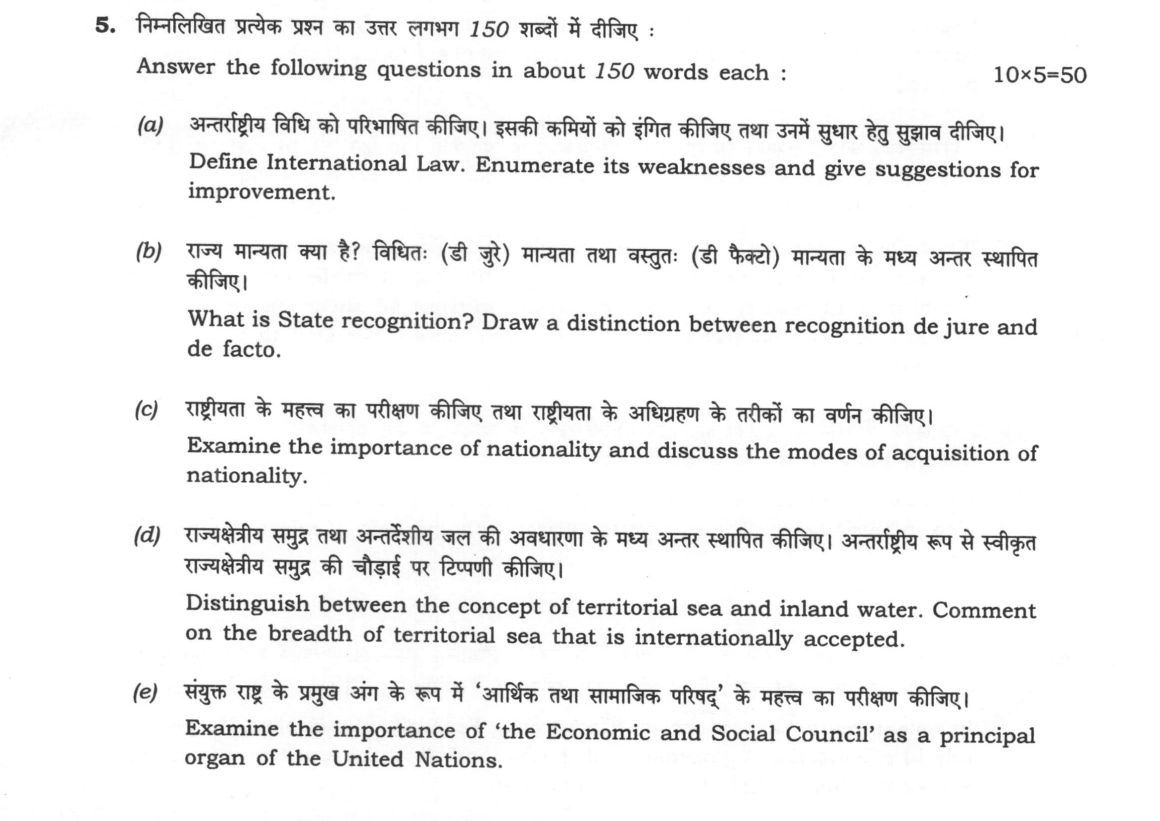
Answer the following questions in about 150 words each: (a) Define International Law. Enumerate its weaknesses and give…
Answer the following questions in about 150 words each:
Define International Law. Enumerate its weaknesses and give suggestions for improvement. 10 marks
What is State recognition? Draw a distinction between recognition de jure and de facto. 10 marks
Examine the importance of nationality and discuss the modes of acquisition of nationality. 10 marks
Distinguish between the concept of territorial sea and inland water. Comment on the breadth of territorial sea that is internationally accepted. 10 marks
Examine the importance of 'the Economic and Social Council' as a principal organ of the United Nations. 10 marks
हिंदी में प्रश्न पढ़ें
निम्नलिखित प्रत्येक प्रश्न का उत्तर लगभग 150 शब्दों में दीजिए :
अंतर्राष्ट्रीय विधि को परिभाषित कीजिए। इसकी कमियों को इंगित कीजिए तथा उनमें सुधार हेतु सुझाव दीजिए। (10 अंक)
राज्य मान्यता क्या है? विधित: (डी जुरे) मान्यता तथा वस्तुत: (डी फैक्टो) मान्यता के मध्य अंतर स्थापित कीजिए। (10 अंक)
राष्ट्रीयता के महत्व का परीक्षण कीजिए तथा राष्ट्रीयता के अधिग्रहण के तरीकों का वर्णन कीजिए। (10 अंक)
राजक्षेत्रीय समुद्र तथा अंतर्देशीय जल की अवधारणा के मध्य अंतर स्थापित कीजिए। अंतर्राष्ट्रीय रूप से स्वीकृत राजक्षेत्रीय समुद्र की चौड़ाई पर टिप्पणी कीजिए। (10 अंक)
संयुक्त राष्ट्र के प्रमुख अंग के रूप में 'आर्थिक तथा सामाजिक परिषद' के महत्व का परीक्षण कीजिए। (10 अंक)
Model answer
Written by UPSC Answer Check against this question's marking rubric, to the 150-word length. UPSC does not publish answers for Mains — this is one way to score well, not an official key.
(a) International law, in Oppenheim’s formulation, is the body of rules which states and other international persons regard as binding in their mutual relations; Brierly similarly describes it as the law of the society of states. Its source is primarily state practice and consent, not a central legislature. Its weaknesses are structural: there is no world government, no general police, and no compulsory enforcement; the ICJ has jurisdiction only with consent, and many states do not accept compulsory jurisdiction; treaty obligations depend on consent and can be avoided by reservations or non-ratification; power politics can override legal norms. Improvement requires strengthening the ICJ by wider acceptance of optional clause and better compliance with judgments, systematic codification through ILC, expanding international criminal law and accountability, and institutionalising dispute settlement in trade, environment and human rights. India’s consistent support to multilateralism and the UN Charter reflects this need.
(b) State recognition is the formal acknowledgment by an existing state that a new entity possesses statehood, usually assessed against the Montevideo Convention criteria: permanent population, defined territory, government, and capacity to enter relations. It is also distinct from UN admission. It may be declaratory, confirming existing statehood, or constitutive, creating legal effects. De jure recognition is full, conclusive and permanent; it confers complete legal standing, diplomatic relations, treaty capacity and immunity. De facto recognition is provisional, based on effective control and factual existence, and may be withdrawn if the entity fails to consolidate. It produces limited legal consequences, such as the validity of acts of the recognised government in municipal courts, as illustrated by the municipal-law effect discussed in Luther v. Sagor. Bangladesh in 1971 provides a typical example: many states first recognised it de facto during the liberation struggle and later upgraded recognition to de jure after independence was secured.
(c) Nationality is the legal bond between a person and a state, giving the person rights and duties and the state jurisdiction and protection. The Nottebohm case emphasised that nationality must be a genuine connection, not merely a formal certificate, for diplomatic protection to be effective. Its importance is central: it determines diplomatic protection, extradition, consular assistance, voting rights, eligibility for public office, and the treatment of persons in state succession and statelessness. Modes of acquisition include birth, naturalisation, marriage, adoption, domicile and reintegration. At birth, states apply jus sanguinis, descent, or jus soli, birth on territory; India follows a mixed system under the Citizenship Act, 1955, with the 2003 amendment restricting jus soli for certain categories. Naturalisation requires residence, good character and oath; marriage may confer nationality in some systems but not automatically in India; adoption and domicile are recognised in limited cases, while reintegration restores nationality lost by choice.
(d) Internal waters, or inland waters, are waters on the landward side of the baseline, including juridical or historic bays, ports, rivers and estuaries; a state’s sovereignty over them is complete, subject to rights such as transit passage in international straits. Territorial sea is the belt seaward of the baseline, up to twelve nautical miles, over which the coastal state has sovereignty but must allow innocent passage by foreign ships. The distinction is one of legal status: internal waters are treated as part of the national domain, while the territorial sea is a zone with qualified sovereignty. The breadth of the territorial sea evolved from the three-mile cannon-shot rule to the twelve-mile limit accepted in UNCLOS 1982. This compromise balanced coastal-state security, resource control and freedom of navigation. India adopted the 12-nm limit through the Territorial Sea, Contiguous Zone, Exclusive Economic Zone and Continental Shelf (Application of Indian Law) Act, 1968.
(e) ECOSOC, established under Articles 61-72 of the UN Charter, is the principal organ for coordinating the UN’s economic and social work. Unlike the Security Council, whose Chapter VII decisions can be binding, ECOSOC recommends, studies and coordinates. Its importance lies in linking development, health, labour, statistics, population and environment through specialised agencies and programmes such as WHO, ILO, FAO, UNESCO and UNDP, with which it works through relationship agreements rather than direct control; the IMF and World Bank retain autonomous governance. It promotes higher living standards, full employment and social progress, and after the 2005 World Summit its reform agenda sought better coordination, less duplication and stronger follow-through. Its role in sustainable development is central: the High-level Political Forum on Sustainable Development, created after Rio+20 by UNGA resolution 67/290 in 2013, operates under ECOSOC to monitor SDG progress. Thus ECOSOC is the UN forum for translating commitments into coordinated action.
What "Define" is asking you to do
Give the precise meaning together with the boundary that separates it from neighbouring concepts. In the optionals a define clause almost always opens a longer part, so it has to be exact and short enough to leave room for what follows.
Structure that answers it
Core definition → essential attributes → what it excludes → example
Where marks are lost
A loose paraphrase. A definition earns its mark by excluding as much as by including.
How this answer will be evaluated
Approach
Framework: Issue > Rule > Authority > Application. (a) define: precise definition > the distinguishing feature > one example | (b) explain: definition/context > points in order > small example > short close | (c) examine: intro > how/why with reasoning > evidence > conclusion | (d) compare: paired headings or table > key differences > significance > conclusion | (e) examine: intro > how/why with reasoning > evidence > conclusion Full marks: Precise definitions, specific legal references, clear distinctions, and well-structured arguments.
Key points expected
- Precise definition of International Law
- List of at least three specific weaknesses
- Suggestions for improvement linked to weaknesses
- Reference to lack of central enforcement
- Definition of State recognition
- Definition of de jure recognition
- Definition of de facto recognition
- Clear distinction between the two types
Evaluation rubric
Each sub-part is marked on its own, against the marks and word limit printed on the paper.
- (a) Definition of International Law, list of weaknesses, and suggestions for improvement. · 150 words
define— precise definition → the distinguishing feature → one example
Must cover
- Precise definition of International Law
- List of at least three specific weaknesses
- Suggestions for improvement linked to weaknesses
- Reference to lack of central enforcement
Loses marks
- Vague definition without sources
- Weaknesses without specific examples
- Suggestions not linked to weaknesses
Earns more
- Mention of ICJ or ILC role
- Reference to customary international law
- Mention of treaty law vs custom
- Reference to state sovereignty issues
Extra mark
- Citation of specific ICJ case
- Reference to specific ILC report
- (b) Definition of State recognition and distinction between de jure and de facto. · 150 words
explain— definition/context → points in order → small example → short close
Must cover
- Definition of State recognition
- Definition of de jure recognition
- Definition of de facto recognition
- Clear distinction between the two types
Loses marks
- Confusing de jure and de facto
- No distinction between the two
- Vague definition of recognition
Earns more
- Mention of declaratory vs constitutive theory
- Reference to legal consequences of each
- Example of de facto recognition
- Mention of diplomatic relations
Extra mark
- Citation of specific state practice
- Reference to specific legal case
- (c) Importance of nationality and modes of its acquisition. · 150 words
examine— intro → how/why with reasoning → evidence → conclusion
Must cover
- Importance of nationality in international law
- Mode: Jus soli (birthplace)
- Mode: Jus sanguinis (descent)
- Mode: Naturalization
Loses marks
- Missing key modes of acquisition
- No discussion of importance
- Confusing nationality with citizenship
Earns more
- Mention of diplomatic protection
- Reference to stateless persons
- Mention of dual nationality
- Reference to specific nationality laws
Extra mark
- Citation of specific nationality statute
- Reference to specific ICJ case
- (d) Distinction between territorial sea and inland water; breadth of territorial sea. · 150 words
compare— paired headings or table → key differences → significance → conclusion
Must cover
- Definition of territorial sea
- Definition of inland water
- Distinction between the two concepts
- Internationally accepted breadth of territorial sea
Loses marks
- Confusing territorial sea with EEZ
- No mention of 12 nautical miles
- Vague distinction between concepts
Earns more
- Reference to UNCLOS 1982
- Mention of 12 nautical mile limit
- Reference to baseline
- Mention of sovereignty over territorial sea
Extra mark
- Citation of specific UNCLOS article
- Reference to specific maritime case
- (e) Importance of the Economic and Social Council as a UN principal organ. · 150 words
examine— intro → how/why with reasoning → evidence → conclusion
Must cover
- Role of ECOSOC in UN structure
- Functions in economic and social fields
- Coordination of specialized agencies
- Promotion of human rights
Loses marks
- Confusing ECOSOC with other UN organs
- No specific functions mentioned
- Vague discussion of importance
Earns more
- Mention of specific ECOSOC resolutions
- Reference to UN specialized agencies
- Mention of sustainable development goals
- Reference to specific ECOSOC committee
Extra mark
- Citation of specific ECOSOC report
- Reference to specific UN development program
Practice this exact question
Write your answer and it is marked point by point against the model answer above — what you covered, what you missed, what you got wrong.
Evaluate my answer →More from Law 2024 Paper I
- Q2 (a) The concept of Public Interest Litigation is an exception to the rule of 'locus stand…
- Q3 (a) "Article 194, which is an exact reproduction of Article 105, deals with the State Leg…
- Q4 (a) In recent years, the concept of 'Cooperative Federalism' has played a pivotal role in…
- Q5 Answer the following questions in about 150 words each: (a) Define International Law. Enu…
- Q6 (a) Peaceful settlement of international disputes has been developed on the principles of…
- Q7 (a) Following 'World War II' destruction, the World Bank and the International Monetary F…
- Q8 (a) Describe the constitution of United Nations Security Council's 'Counter-Terrorism Com…