Paper I — Q7
(a) Following 'World War II' destruction, the World Bank and the International Monetary Fund emerged as two historic institutions…
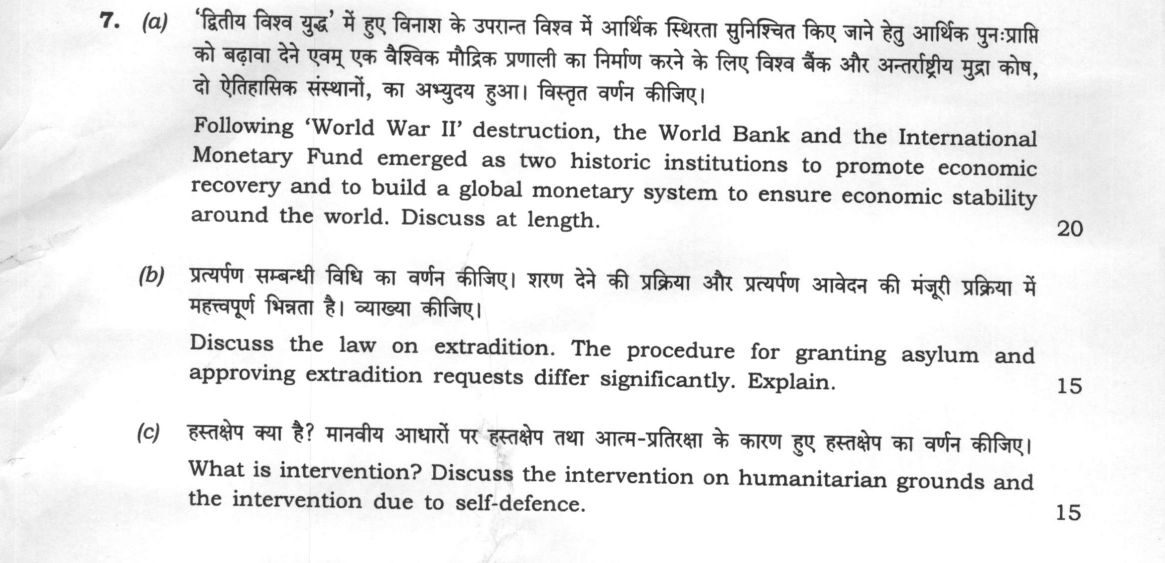
Following 'World War II' destruction, the World Bank and the International Monetary Fund emerged as two historic institutions to promote economic recovery and to build a global monetary system to ensure economic stability around the world. Discuss at length. 20 marks
Discuss the law on extradition. The procedure for granting asylum and approving extradition requests differ significantly. Explain. 15 marks
What is intervention? Discuss the intervention on humanitarian grounds and the intervention due to self-defence. 15 marks
हिंदी में प्रश्न पढ़ें
'द्वितीय विश्व युद्ध' में हुए विनाश के उपरांत विश्व में आर्थिक स्थिरता सुनिश्चित किए जाने हेतु आर्थिक पुनःप्राप्ति को बढ़ावा देने एवं एक वैश्विक मौद्रिक प्रणाली का निर्माण करने के लिए विश्व बैंक और अंतर्राष्ट्रीय मुद्रा कोष, दो ऐतिहासिक संस्थानों, का अभ्युदय हुआ। विस्तृत वर्णन कीजिए। (20 अंक)
प्रत्यर्पण संबंधी विधि का वर्णन कीजिए। शरण देने की प्रक्रिया और प्रत्यर्पण आवेदन की मंजूरी प्रक्रिया में महत्वपूर्ण भिन्नता है। व्याख्या कीजिए। (15 अंक)
हस्तक्षेप क्या है? मानवीय आधारों पर हस्तक्षेप तथा आत्म-प्रतिरक्षा के कारण हुए हस्तक्षेप का वर्णन कीजिए। (15 अंक)
Model answer
Written by UPSC Answer Check against this question's marking rubric, to the expected length. UPSC does not publish answers for Mains — this is one way to score well, not an official key.
The post-war settlement linked economic recovery with limits on sovereignty. The Bretton Woods Conference of 1944 created the IMF and the World Bank to restore monetary stability and finance reconstruction. The IMF operates through a quota system, which determines voting power, borrowing capacity and allocation of Special Drawing Rights (SDRs) that supplement reserve assets. The IMF also provides surveillance and short-term financing to correct balance-of-payments problems. The World Bank’s IBRD lends to middle-income countries, while IDA, replenished by donors, assists the poorest. World Bank projects target infrastructure, health, education and poverty reduction. Their conditionality—fiscal austerity, liberalisation, privatisation and structural adjustment—has been criticised for constraining policy space. Critics argue conditionality can deepen inequality and reduce democratic accountability. India’s 1991 crisis brought it into close IMF and World Bank engagement, leading to liberalisation; post-COVID IMF support and World Bank technical assistance show continuing relevance. India’s voting share has grown with quota reforms, but remains below its economic weight. Such conditionality is economic intervention, contrasting with armed intervention but testing sovereignty.
Extradition and asylum Extradition is surrendering a person to another state for trial or punishment. In India it is governed by the Extradition Act, 1962 and by treaties. Key principles are double criminality and specialty: the offence must be criminal in both states, and prosecution is limited to the extradition offence. Extradition may be refused if the offence is political, if punishment is death or if human rights would be violated. The procedure combines judicial scrutiny of evidence with executive approval. Asylum is different. Article 14 of the UDHR recognises the right to seek and enjoy asylum, but does not create a right to be granted it. Territorial asylum is granted in a state’s territory; diplomatic asylum, normally in diplomatic missions, is exceptional and not generally recognised outside Latin America. Asylum is largely executive and political, often urgent, whereas extradition is a legal process governed by treaties and municipal law. Asylum may be refused where the applicant poses a security threat or is guilty of serious crimes. India’s Mallya and Nirav Modi cases illustrate how dual criminality, treaty status and executive diplomacy shape extradition.
Intervention and self-defence Intervention means one state interfering in another’s internal affairs. Article 2(7) of the UN Charter bars UN organs from intervening in matters essentially domestic; the general prohibition on state intervention is customary, reinforced by Article 2(4)’s ban on force. Humanitarian intervention is the use of force to stop mass atrocities. The 2005 World Summit’s Responsibility to Protect obliges states to protect populations from genocide, war crimes, ethnic cleansing and crimes against humanity, and permits Security Council action if a state fails. Humanitarian intervention without Security Council authorisation raises the problem of who decides, risking abuse. Kosovo in 1999, where NATO acted without a Security Council mandate, remains controversial; the Syria debate shows how politicisation limits humanitarian intervention. Article 51 allows individual or collective self-defence after an armed attack until the Security Council acts. The Caroline test requires necessity, proportionality and immediacy; the Nicaragua case clarified that self-defence requires an armed attack, not mere frontier incidents. The Nicaragua case also rejected collective self-defence without the consent of the attacked state. Preemptive self-defence against an imminent attack is debated, while preventive force against a future threat is generally rejected. India’s position on Ukraine emphasises respect for sovereignty and opposition to unilateral intervention.
Conclusion The Bretton Woods institutions, extradition and asylum, and intervention all show that sovereignty is not absolute. The way forward is to anchor economic conditionality, extradition and humanitarian action in transparent multilateral rules, preserving sovereignty while protecting stability and human rights.
What "Discuss" is asking you to do
Lay the issue out from more than one side — how it arose, what is claimed for it, what is held against it, and where it now stands. UPSC attaches discuss to broad topics with several live dimensions, so coverage of the dimensions earns more than the strength of your opinion.
Structure that answers it
Set the issue up → the case as it is made → the case against → the dimension both sides leave out → where the balance now lies
Where marks are lost
Listing facts with no thread between them, or arguing one side throughout and calling it a discussion.
How this answer will be evaluated
Approach
Framework: Issue > Rule: statute or Article > Authority > Application and conclusion. (a) discuss: intro > 3-4 dimensions > example > balanced close | (b) discuss: intro > 3-4 dimensions > example > balanced close | (c) discuss: intro > 3-4 dimensions > example > balanced close Full marks: Precise legal/institutional references, clear distinctions, balanced analysis, no factual errors
Key points expected
- Bretton Woods Conference 1944 context
- IMF role: balance of payments & stability
- World Bank role: long-term development loans
- Global monetary system & economic recovery
- Definition of extradition law
- Procedure for granting asylum
- Procedure for approving extradition requests
- Significant differences between the two
Evaluation rubric
Each sub-part is marked on its own, against the marks and word limit printed on the paper.
- (a) Intro > 3-4 dimensions > example > balanced close 20 marks
discuss— intro → 3-4 dimensions → example → balanced close
Must cover
- Bretton Woods Conference 1944 context
- IMF role: balance of payments & stability
- World Bank role: long-term development loans
- Global monetary system & economic recovery
Loses marks
- Confusing IMF and World Bank functions
- Ignoring the post-WWII context
- No mention of global monetary system
Earns more
- Mention of fixed exchange rate system
- Distinction between IMF and WB mandates
- Post-war reconstruction focus
- Role in global economic governance
Extra mark
- Reference to specific Articles of IMF/IBRD
- Mention of recent reforms or challenges
- (b) Intro > 3-4 dimensions > example > balanced close 15 marks
discuss— intro → 3-4 dimensions → example → balanced close
Must cover
- Definition of extradition law
- Procedure for granting asylum
- Procedure for approving extradition requests
- Significant differences between the two
Loses marks
- Failing to distinguish asylum from extradition
- No procedural details for either
- Ignoring the 'significant differences' aspect
Earns more
- Mention of political offense exception
- Reference to dual criminality principle
- Role of treaties in extradition
- Human rights considerations in asylum
Extra mark
- Citing a specific extradition treaty
- Reference to a landmark case on asylum
- (c) Intro > 3-4 dimensions > example > balanced close 15 marks
discuss— intro → 3-4 dimensions → example → balanced close
Must cover
- Definition of intervention
- Intervention on humanitarian grounds
- Intervention due to self-defence
- Distinction between the two types
Loses marks
- Confusing humanitarian with self-defence intervention
- No definition of intervention
- Ignoring the distinction between the two grounds
Earns more
- Reference to UN Charter Article 2(4)
- Mention of R2P (Responsibility to Protect)
- Article 51 self-defence provision
- Examples of humanitarian vs self-defence intervention
Extra mark
- Reference to a specific humanitarian intervention case
- Mention of Security Council authorization
Practice this exact question
Write your answer and it is marked point by point against the model answer above — what you covered, what you missed, what you got wrong.
Evaluate my answer →More from Law 2024 Paper I
- Q4 (a) In recent years, the concept of 'Cooperative Federalism' has played a pivotal role in…
- Q5 Answer the following questions in about 150 words each: (a) Define International Law. Enu…
- Q6 (a) Peaceful settlement of international disputes has been developed on the principles of…
- Q7 (a) Following 'World War II' destruction, the World Bank and the International Monetary F…
- Q8 (a) Describe the constitution of United Nations Security Council's 'Counter-Terrorism Com…