Paper I — Q8
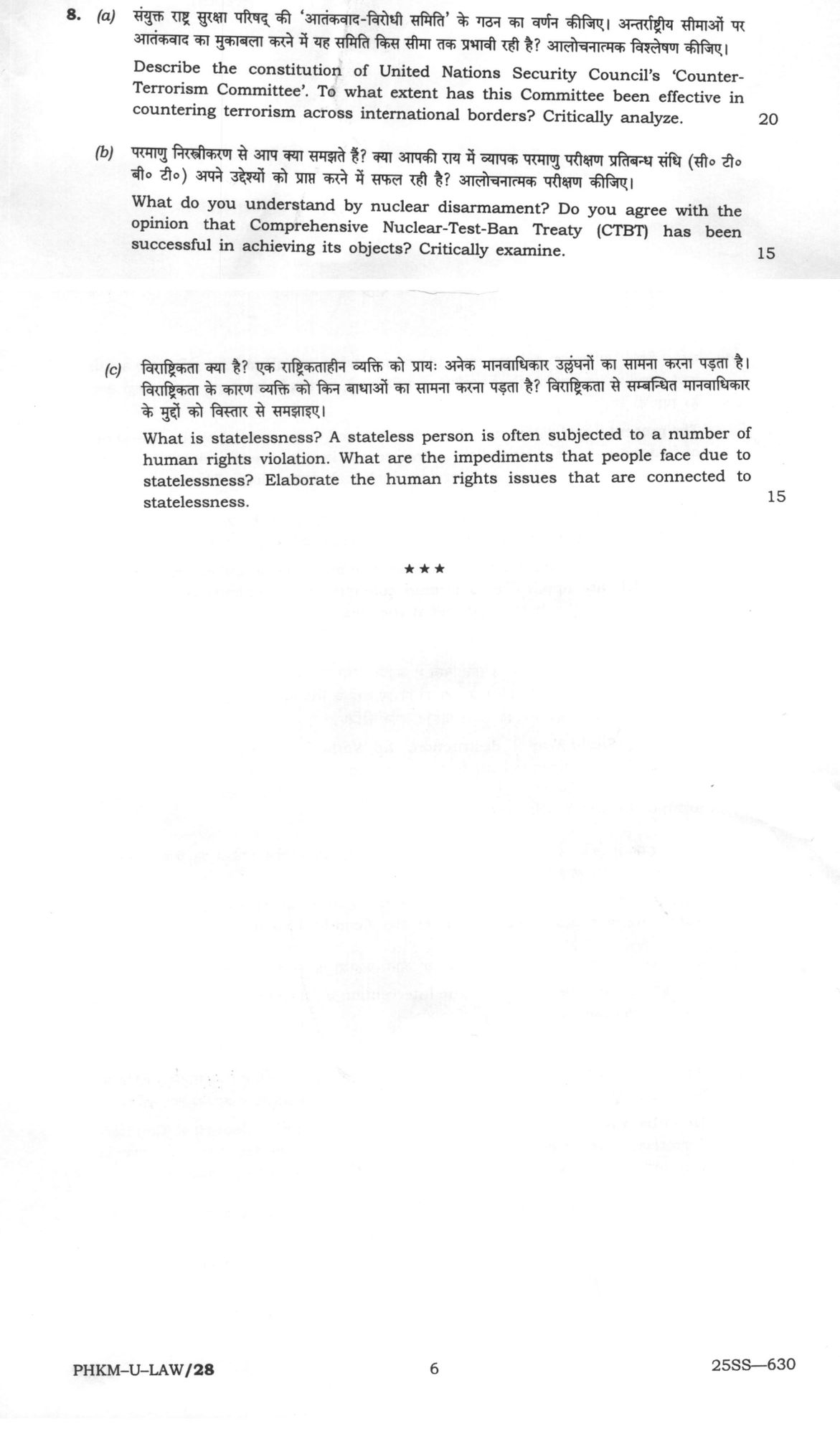
(a) Describe the constitution of United Nations Security Council's 'Counter-Terrorism Committee'. To what extent has this…
Describe the constitution of United Nations Security Council's 'Counter-Terrorism Committee'. To what extent has this Committee been effective in countering terrorism across international borders? Critically analyze. 20 marks
What do you understand by nuclear disarmament? Do you agree with the opinion that Comprehensive Nuclear-Test-Ban Treaty (CTBT) has been successful in achieving its objects? Critically examine. 15 marks
What is statelessness? A stateless person is often subjected to a number of human rights violation. What are the impediments that people face due to statelessness? Elaborate the human rights issues that are connected to statelessness. 15 marks
हिंदी में प्रश्न पढ़ें
संयुक्त राष्ट्र सुरक्षा परिषद की 'आतंकवाद-विरोधी समिति' के गठन का वर्णन कीजिए। अंतर्राष्ट्रीय सीमाओं पर आतंकवाद का मुकाबला करने में यह समिति किस सीमा तक प्रभावी रही है? आलोचनात्मक विश्लेषण कीजिए। (20 अंक)
परमाणु निरस्त्रीकरण से आप क्या समझते हैं? क्या आपकी राय में व्यापक परमाणु परीक्षण प्रतिबंध संधि (सी. टी. बी. टी.) अपने उद्देश्यों को प्राप्त करने में सफल रही है? आलोचनात्मक परीक्षण कीजिए। (15 अंक)
विराष्ट्रिकता क्या है? एक राष्ट्रिकताहीन व्यक्ति को प्रायः अनेक मानवाधिकार उल्लंघनों का सामना करना पड़ता है। विराष्ट्रिकता के कारण व्यक्ति को किन बाधाओं का सामना करना पड़ता है? विराष्ट्रिकता से संबंधित मानवाधिकार के मुद्दों को विस्तार से समझाइए। (15 अंक)
Model answer
Written by UPSC Answer Check against this question's marking rubric, to the expected length. UPSC does not publish answers for Mains — this is one way to score well, not an official key.
Contemporary international peace and security face multifaceted threats spanning asymmetric warfare, weapons of mass destruction, and the erosion of fundamental human rights.
Constitution and Effectiveness of the Counter-Terrorism Committee (CTC)
The Counter-Terrorism Committee was established under Chapter VII of the UN Charter by UN Security Council Resolution 1373 (2001) following the 9/11 attacks. It comprises all fifteen UNSC members. In 2004, the Council adopted Resolution 1535 establishing the Counter-Terrorism Committee Executive Directorate (CTED) to provide expert technical assistance, monitor state compliance, and facilitate capacity building.
The CTC has strengthened global counter-terrorism architecture by harmonising national anti-terror legislations, integrating Financial Action Task Force (FATF) standards on terror financing, and coordinating with the UNSC 1267/1989/2253 ISIL and Al-Qaida sanctions regimes.
However, its operational efficacy across international borders remains severely constrained:
- Lack of Enforcement: The CTC operates as a monitoring and capacity-building body rather than a punitive enforcement mechanism; it lacks independent powers to sanction non-compliant states.
- Politicisation and Double Standards: Geopolitical rivalries within the P-5 lead to selective application and technical holds on designating cross-border terrorists, failing to prevent cross-border attacks such as Mumbai (2008) and Pulwama (2019).
- Absence of Universal Definition: During its tenure as CTC Chair (2011–2012), India highlighted the systemic handicap caused by the lack of a legal consensus, actively advocating for the adoption of the Comprehensive Convention on International Terrorism (CCIT, 1996).
Thus, while the CTC has established normative and institutional frameworks, its cross-border effectiveness remains compromised by sovereignty barriers and political exceptionalism.
Nuclear Disarmament and the CTBT
Nuclear disarmament entails the complete, universal, and non-discriminatory elimination of nuclear weapons, distinct from non-proliferation which seeks merely to prevent the horizontal spread of arms among non-nuclear-weapon states. The Comprehensive Nuclear-Test-Ban Treaty (CTBT, 1996) aims to ban all nuclear weapon test explosions or any other nuclear explosions in all environments, thereby curbing qualitative vertical proliferation.
The CTBT has achieved significant normative success: it has established a near-universal taboo against testing, supported by over 180 signatories, a global testing moratorium since 1998, and an operational International Monitoring System (IMS).
However, as a legal instrument, the CTBT has failed to achieve its primary object because it has not entered into force. Under Article XIV, entry into force requires ratification by all 44 Annex II states; key states including the United States, China, Egypt, and Iran have failed to ratify, while India, Pakistan, and North Korea (DPRK) have not signed. North Korea's recurrent testing—culminating in its 2017 thermonuclear test—exposed this enforcement vacuum. India rejected the CTBT in 1996 on principled legal grounds, viewing it as perpetuating the discriminatory framework of the Non-Proliferation Treaty (NPT) without offering a time-bound commitment to global disarmament. Instead, India maintains a voluntary unilateral moratorium, a 'No First Use' (NFU) doctrine, and a credible minimum deterrence posture.
Statelessness, Impediments, and Human Rights
Statelessness denotes the condition of an individual who is "not considered as a national by any State under the operation of its law" (de jure statelessness, Article 1, 1954 Convention Relating to the Status of Stateless Persons; supplemented by the 1961 Convention on the Reduction of Statelessness). It arises from state succession, discriminatory nationality laws (gender, racial, or religious), arbitrary deprivation of citizenship, and administrative gaps in birth registration.
Impediments Faced: Stateless individuals lack legal personhood—the foundational "right to have rights". They face denial of identity documentation, restricted freedom of movement, total disenfranchisement from political processes, and statutory exclusion from public education, formal employment, property ownership, and social security.
Human Rights Violations: Stateless persons routinely endure arbitrary, indefinite detention in immigration facilities, heightened vulnerability to human trafficking, and violations of the customary international law principle of non-refoulement.
These dynamics are evident in the protracted Rohingya refugee crisis in Myanmar and Bangladesh. In India, legal complexities regarding citizenship are observed in the status of Chakma-Hajong refugees (NHRC v. State of Arunachal Pradesh, 1996) and debates surrounding the Citizenship (Amendment) Act, 2019. Remedial initiatives like UNHCR’s #IBelong Campaign, the Global Action Plan to End Statelessness (2014–2024), and oversight by the UN Human Rights Council and the Special Rapporteur on minority issues remain hindered by the primacy of municipal sovereignty over citizenship laws.
Conclusion
The limitations of the CTC, CTBT, and statelessness protections demonstrate the persistent friction between state sovereignty and collective legal obligations in international law. A rules-based international order requires shifting from selective, state-centric security paradigms to binding, non-discriminatory multilateralism grounded in universal humanitarian norms.
What "Critically analyse" is asking you to do
Break the subject into its working parts and show how they act on each other. The marks are in the interconnections — which factor drives which, and what the resulting structure explains — not in the inventory of factors. “Critically” is not a section added at the end: name the yardstick you are judging by — the evidence, the stated objective, a constitutional principle, a rival explanation — and let a verdict close each part of the body. Where the question quotes a claim, that verdict must land on the claim itself, accepted, qualified or rejected, and not on the theme in general.
Structure that answers it
Define the whole → separate it into its parts → show which part drives which → what that interaction produces → what the structure implies
Where marks are lost
Merits in one paragraph, demerits in the next, and a conclusion calling for a balanced and holistic approach. That is a survey with the judgement left out and it holds the answer in the middle band. The opposite error is reading “critically” as permission to attack — and with the odd pairings, critically describe or critically explain, the exposition still carries most of the marks, the judgement being a layer on it rather than a substitute for it.
How this answer will be evaluated
Approach
Framework: Issue > Rule: statute or Article > Authority > Application and conclusion. (a) analyse: intro > causes > effects > stakeholders/linkages > way forward | (b) examine: intro > how/why with reasoning > evidence > conclusion | (c) explain: definition/context > points in order > small example > short close Full marks: Comprehensive, well-structured, and critically analytical answers with precise legal references and examples.
Key points expected
- Composition and mandate of the Committee
- Mechanisms for countering cross-border terrorism
- Critical analysis of effectiveness
- Linkage to UN Security Council resolutions
- Definition of nuclear disarmament
- Objects of the Comprehensive Nuclear-Test-Ban Treaty (CTBT)
- Critical examination of CTBT's success
- Assessment of CTBT's impact on nuclear disarmament
Evaluation rubric
Each sub-part is marked on its own, against the marks and word limit printed on the paper.
- (a) Constitution of UN Security Council Counter-Terrorism Committee and critical analysis of its effectiveness across borders. 20 marks
analyse— intro → causes → effects → stakeholders/linkages → way forward
Must cover
- Composition and mandate of the Committee
- Mechanisms for countering cross-border terrorism
- Critical analysis of effectiveness
- Linkage to UN Security Council resolutions
Loses marks
- Vague description of Committee's role
- Failure to critically analyze effectiveness
- Ignoring the cross-border aspect
Earns more
- Reference to specific UN Security Council resolutions
- Examples of cross-border counter-terrorism operations
- Mention of Committee's reporting mechanisms
- Discussion of challenges in international cooperation
Extra mark
- Reference to specific recent UN Security Council resolutions
- Mention of specific international counter-terrorism initiatives
- (b) Understanding of nuclear disarmament and critical examination of CTBT's success in achieving its objects. 15 marks
examine— intro → how/why with reasoning → evidence → conclusion
Must cover
- Definition of nuclear disarmament
- Objects of the Comprehensive Nuclear-Test-Ban Treaty (CTBT)
- Critical examination of CTBT's success
- Assessment of CTBT's impact on nuclear disarmament
Loses marks
- Confusing nuclear disarmament with non-proliferation
- Failure to critically examine CTBT's success
- Ignoring the specific objects of the CTBT
Earns more
- Reference to specific provisions of the CTBT
- Examples of countries' adherence to the CTBT
- Discussion of challenges in implementing the CTBT
- Mention of alternative verification mechanisms
Extra mark
- Reference to specific recent developments in nuclear disarmament
- Mention of specific international organizations involved in nuclear disarmament
- (c) Definition of statelessness, impediments faced by stateless persons, and elaboration of connected human rights issues. 15 marks
explain— definition/context → points in order → small example → short close
Must cover
- Definition of statelessness
- Impediments faced by stateless persons
- Elaboration of human rights issues connected to statelessness
- Examples of human rights violations faced by stateless persons
Loses marks
- Vague definition of statelessness
- Failure to elaborate on human rights issues
- Ignoring the impediments faced by stateless persons
Earns more
- Reference to specific international conventions on statelessness
- Examples of stateless persons' experiences
- Discussion of legal frameworks addressing statelessness
- Mention of specific human rights organizations working on statelessness
Extra mark
- Reference to specific recent cases of statelessness
- Mention of specific national policies addressing statelessness
Practice this exact question
Write your answer and it is marked point by point against the model answer above — what you covered, what you missed, what you got wrong.
Evaluate my answer →More from Law 2024 Paper I
- Q5 Answer the following questions in about 150 words each: (a) Define International Law. Enu…
- Q6 (a) Peaceful settlement of international disputes has been developed on the principles of…
- Q7 (a) Following 'World War II' destruction, the World Bank and the International Monetary F…
- Q8 (a) Describe the constitution of United Nations Security Council's 'Counter-Terrorism Com…