Paper I — Q2
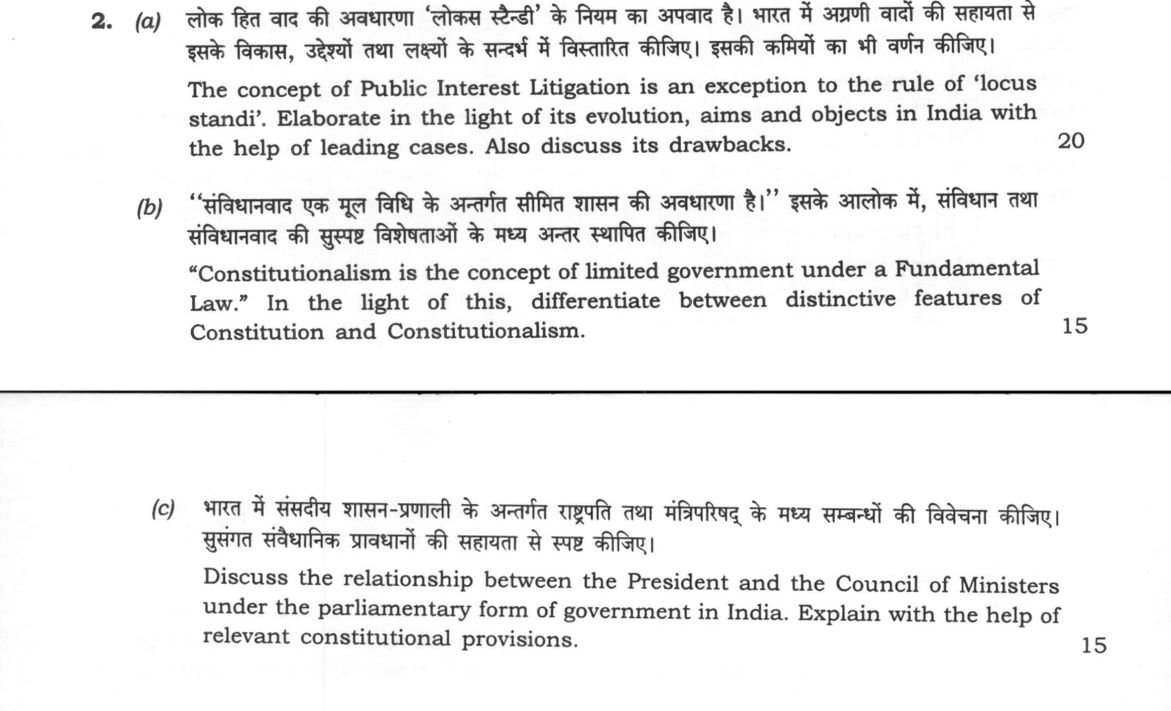
(a) The concept of Public Interest Litigation is an exception to the rule of 'locus standi'. Elaborate in the light of its…
The concept of Public Interest Litigation is an exception to the rule of 'locus standi'. Elaborate in the light of its evolution, aims and objects in India with the help of leading cases. Also discuss its drawbacks. 20 marks
"Constitutionalism is the concept of limited government under a Fundamental Law." In the light of this, differentiate between distinctive features of Constitution and Constitutionalism. 15 marks
Discuss the relationship between the President and the Council of Ministers under the parliamentary form of government in India. Explain with the help of relevant constitutional provisions. 15 marks
हिंदी में प्रश्न पढ़ें
लोक हित वाद की अवधारणा 'लोकस स्टैंडी' के नियम का अपवाद है। भारत में अग्रणी वादों की सहायता से इसके विकास, उद्देश्यों तथा लक्ष्यों के संदर्भ में विस्तृत कीजिए। इसकी कमियों का भी वर्णन कीजिए। (20 अंक)
"संविधानवाद एक मूल विधि के अंतर्गत सीमित शासन की अवधारणा है।" इसके आलोक में, संविधान तथा संविधानवाद की सुस्पष्ट विशेषताओं के मध्य अंतर स्थापित कीजिए। (15 अंक)
भारत में संसदीय शासन-प्रणाली के अन्तर्गत राष्ट्रपति तथा मंत्रिपरिषद् के मध्य सम्बन्धों की विवेचना कीजिए। सुसंगत संवैधानिक प्रावधानों की सहायता से स्पष्ट कीजिए। (15 अंक)
Model answer
Written by UPSC Answer Check against this question's marking rubric, to the expected length. UPSC does not publish answers for Mains — this is one way to score well, not an official key.
Public Interest Litigation: Evolution, Scope, and Drawbacks
The traditional doctrine of locus standi mandates that only an aggrieved person whose specific legal right has been violated can approach the court. Public Interest Litigation (PIL) constitutes a radical departure from this rule, democratizing access to justice by permitting any public-spirited citizen or group to invoke the writ jurisdiction of the Supreme Court under Article 32 or High Courts under Article 226 on behalf of disadvantaged sections.
The evolution of PIL gained traction in Hussainara Khatoon (1979), where the Supreme Court accepted a petition based on newspaper reports to secure the release of thousands of undertrial prisoners. In S.P. Gupta v. Union of India (1981), Justice P.N. Bhagwati formally relaxed locus standi, holding that where a legal injury is caused to a person or class unable to approach the court due to poverty or disability, any member of the public acting bona fide can maintain an action. Epistolary jurisdiction was further cemented in Bandhua Mukti Morcha (1984) to liberate bonded labourers, and Sheela Barse (1983) on custodial rights of women and children. In M.C. Mehta (1986) and Subhash Kumar v. State of Bihar (1991), the court expanded PIL into socio-economic and environmental spheres, reading the right to a wholesome environment into Article 21.
The primary aims of PIL are realizing substantive socio-economic justice, holding public authorities accountable, and enforcing non-justiciable aspirations into justiciable rights. However, PIL suffers from distinct drawbacks:
- Misuse of the forum for private, political, or publicity gains (Private Interest Litigation).
- Judicial overreach, where courts breach separation of powers by issuing policy directives to the executive.
- Compounding judicial pendency, diverting scarce institutional time away from regular litigation.
Constitution and Constitutionalism
While a Constitution is a legal instrument establishing state organs and their powers, Constitutionalism is the normative philosophy of limited government under a fundamental law to prevent authoritarian rule.
A Constitution serves as the formal grundnorm, written or unwritten, providing the framework for governance, legislative competences, and the amending process under provisions such as Article 368. Conversely, Constitutionalism imposes substantive and procedural restraints on state authority. A country may have a Constitution—even an authoritarian one—without practicing Constitutionalism.
The distinctive features of Constitutionalism include the Rule of Law, separation of powers, an independent judiciary, and entrenched fundamental rights acting as negative obligations against state encroachments. The Indian judiciary has enforced these limits through judicial review. In Kesavananda Bharati (1973), the Supreme Court established the Basic Structure doctrine, ruling that Parliament’s constituent power under Article 368 is limited. In Indira Gandhi v. Raj Narain (1975) and Minerva Mills v. Union of India (1980), the court affirmed that limited amending power and judicial review are themselves essential components of Constitutionalism, ensuring that the Constitution remains supreme over state organs.
President and Council of Ministers in the Parliamentary System
The Indian Constitution establishes a Westminster-style parliamentary executive comprising a nominal constitutional head (the President) and a real political executive (the Prime Minister and Council of Ministers).
The relationship is governed by the following core provisions:
- Article 74(1) mandates a Council of Ministers with the Prime Minister at the head to "aid and advise" the President, who "shall, in the exercise of his functions, act in accordance with such advice." The 42nd Constitutional Amendment Act (1976) made this advice explicitly binding. The 44th Constitutional Amendment Act (1978) introduced a proviso allowing the President to return advice once for reconsideration, but made the reconsidered advice strictly binding.
- Article 75(3) incorporates the bedrock of parliamentary democracy by rendering the Council of Ministers collectively responsible to the Lok Sabha.
- Article 78 imposes a constitutional duty on the Prime Minister to communicate all executive decisions and legislative proposals to the President, preserving the President’s right to be informed, to encourage, and to warn.
The judiciary has consistently maintained that executive power is exercised by the cabinet. In Ram Jawaya Kapur v. State of Punjab (1955), the Supreme Court held that the President is the formal head, whereas real executive power vests in the Council of Ministers. In Samsher Singh v. State of Punjab (1974), a seven-judge bench ruled that the President exercises constitutional powers solely on the aid and advice of ministers, save for marginal situations such as appointing a Prime Minister in a hung Parliament or dismissing a government that has lost legislative majority.
Thus, procedural innovations like PIL, substantive limits through Constitutionalism, and ministerial responsibility under Articles 74 and 75 collectively ensure that state authority in India remains accountable, limited, and democratic.
What "Elaborate" is asking you to do
Give the full detailed account the question has compressed into a line — every dimension of it, with specifics. Elaborate rewards completeness and detail rather than clarification or argument: the examiner is checking whether you can fill out a topic without being told what its parts are.
Structure that answers it
State the proposition → first dimension in detail → second dimension in detail → the part the statement leaves implicit → the consolidated picture
Where marks are lost
Repeating the statement at greater length instead of adding substance. Elaborate also punishes narrowness: omitting a whole dimension costs more here than anywhere else in this family.
How this answer will be evaluated
Approach
Framework: Issue > Rule > Authority > Application. (a) explain: definition/context > points in order > small example > short close | (b) compare: paired headings or table > key differences > significance > conclusion | (c) discuss: intro > 3-4 dimensions > example > balanced close Full marks: Precise legal citations, clear differentiation, balanced analysis with specific examples
Key points expected
- Define PIL as exception to locus standi
- Trace evolution via leading Indian cases
- State aims and objects of PIL
- Discuss specific drawbacks of PIL
- Define Constitution as a document
- Define Constitutionalism as a concept
- List distinctive features of Constitution
- List distinctive features of Constitutionalism
Evaluation rubric
Each sub-part is marked on its own, against the marks and word limit printed on the paper.
- (a) Explain PIL as an exception to locus standi, covering evolution, aims, and drawbacks. 20 marks
explain— definition/context → points in order → small example → short close
Must cover
- Define PIL as exception to locus standi
- Trace evolution via leading Indian cases
- State aims and objects of PIL
- Discuss specific drawbacks of PIL
Loses marks
- Outcome-only case citation without ratio
- Discussion without constitutional authority
- Ignoring the 'drawbacks' requirement
Earns more
- Cite S.P. Gupta v. Union of India
- Cite M.C. Mehta v. Union of India
- Mention Article 32 or 226
- Discuss misuse of PIL
Extra mark
- Reference Law Commission report on PIL
- Cite recent Supreme Court judgment on PIL
- (b) Differentiate distinctive features of Constitution and Constitutionalism. 15 marks
compare— paired headings or table → key differences → significance → conclusion
Must cover
- Define Constitution as a document
- Define Constitutionalism as a concept
- List distinctive features of Constitution
- List distinctive features of Constitutionalism
Loses marks
- Treating terms as synonyms
- No clear differentiation of features
- Vague definitions without substance
Earns more
- Mention 'limited government' concept
- Reference Fundamental Law
- Contrast static vs dynamic nature
- Mention rule of law
Extra mark
- Cite specific constitutional scholar
- Reference specific constitutional provision
- (c) Discuss relationship between President and Council of Ministers in India. 15 marks
discuss— intro → 3-4 dimensions → example → balanced close
Must cover
- Explain President's role in appointing PM
- Explain Council of Ministers' role in advising President
- Cite relevant constitutional provisions
- Explain parliamentary form of government context
Loses marks
- Ignoring constitutional provisions
- Confusing presidential and parliamentary systems
- No discussion of actual relationship dynamics
Earns more
- Mention Article 74
- Mention Article 75
- Discuss collective responsibility
- Mention President's discretionary powers
Extra mark
- Cite specific case law on President's role
- Reference specific constitutional amendment
Practice this exact question
Write your answer and it is marked point by point against the model answer above — what you covered, what you missed, what you got wrong.
Evaluate my answer →More from Law 2024 Paper I
- Q1 Answer the following questions in about 150 words each: (a) Examine the appellate jurisdi…
- Q2 (a) The concept of Public Interest Litigation is an exception to the rule of 'locus stand…
- Q3 (a) "Article 194, which is an exact reproduction of Article 105, deals with the State Leg…
- Q4 (a) In recent years, the concept of 'Cooperative Federalism' has played a pivotal role in…
- Q5 Answer the following questions in about 150 words each: (a) Define International Law. Enu…