Paper I — Q6
(a) Peaceful settlement of international disputes has been developed on the principles of International Law concerning friendly…
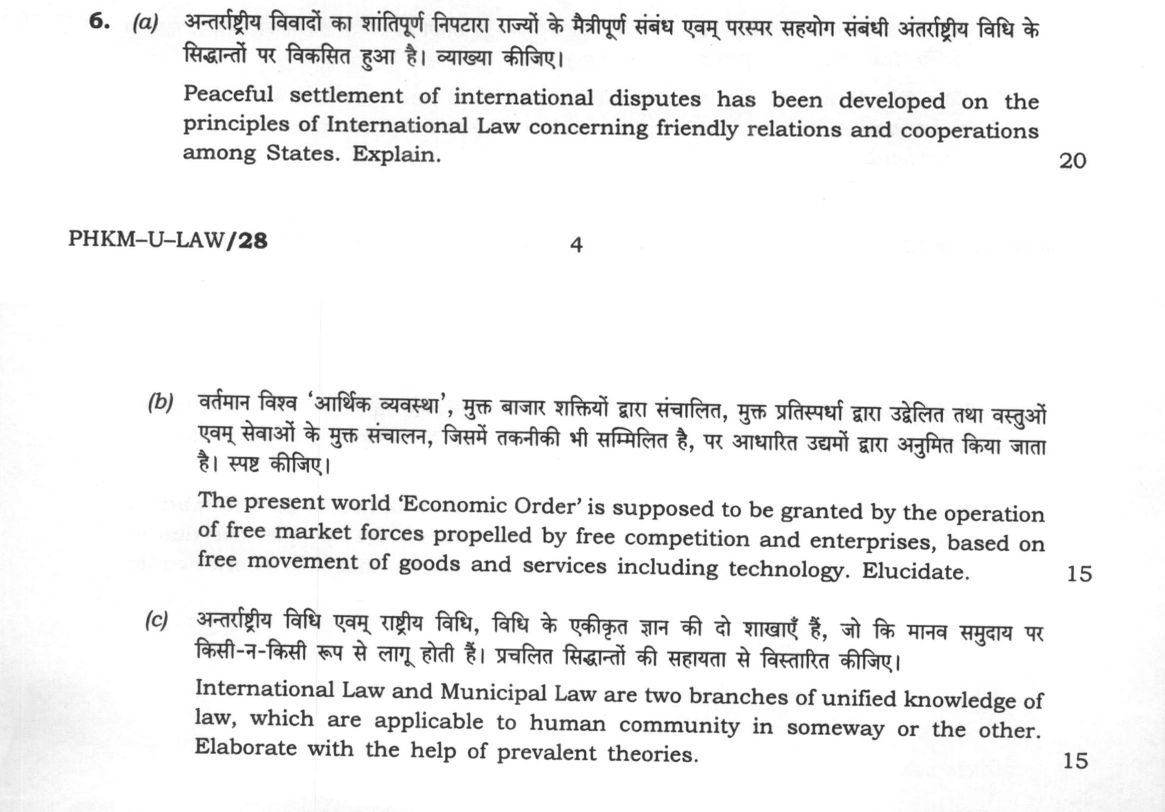
Peaceful settlement of international disputes has been developed on the principles of International Law concerning friendly relations and cooperations among States. Explain. 20 marks
The present world 'Economic Order' is supposed to be granted by the operation of free market forces propelled by free competition and enterprises, based on free movement of goods and services including technology. Elucidate. 15 marks
International Law and Municipal Law are two branches of unified knowledge of law, which are applicable to human community in someway or the other. Elaborate with the help of prevalent theories. 15 marks
हिंदी में प्रश्न पढ़ें
अंतर्राष्ट्रीय विवादों का शांतिपूर्ण निपटारा राज्यों के मैत्रीपूर्ण संबंध एवं परस्पर सहयोग संबंधी अंतर्राष्ट्रीय विधि के सिद्धांतों पर विकसित हुआ है। व्याख्या कीजिए। (20 अंक)
वर्तमान विश्व 'आर्थिक व्यवस्था', मुक्त बाजार शक्तियों द्वारा संचालित, मुक्त प्रतिस्पर्द्धा द्वारा उद्देलित तथा वस्तुओं एवं सेवाओं के मुक्त संचालन, जिसमें तकनीकी भी सम्मिलित है, पर आधारित उद्यमों द्वारा अनुमित किया जाता है। स्पष्ट कीजिए। (15 अंक)
अंतर्राष्ट्रीय विधि एवं राष्ट्रीय विधि, विधि के एकीकृत ज्ञान की दो शाखाएं हैं, जो कि मानव समुदाय पर किसी-न-किसी रूप से लागू होती हैं। प्रचलित सिद्धांतों की सहायता से विस्तारित कीजिए। (15 अंक)
Model answer
Written by UPSC Answer Check against this question's marking rubric, to the expected length. UPSC does not publish answers for Mains — this is one way to score well, not an official key.
Peaceful settlement Peaceful settlement is the Charter-based duty of States to resolve legal or political disputes without threat or force. Article 2(3) obliges States to settle disputes by peaceful means; Article 2(4) prohibits force and is the clearer jus cogens norm. Chapter VI, especially Articles 33–38, assigns the Security Council primary responsibility to encourage parties to negotiate, mediate, use good offices, arbitration or judicial settlement. The General Assembly may recommend peaceful measures under Articles 10–14 and 35. The means are political—negotiation, mediation, conciliation, good offices—and legal—arbitration and the ICJ. Under Article 36 of the ICJ Statute, States may submit disputes by special agreement, treaty clause or optional clause; jurisdiction remains consensual. The 1970 Friendly Relations Declaration, a UNGA resolution, is not a treaty codification but an authoritative statement reflecting customary principles, including free choice of means. The obligation is one of conduct: States must seek peaceful settlement, not guarantee a particular result. It has an erga omnes dimension because it protects the collective interest in peace, though it is not generally treated as peremptory like the prohibition of force. Examples include the Indus Waters Treaty arbitration between India and Pakistan and the South China Sea arbitration, illustrating compulsory arbitration where consent existed.
Economic order The post-1945 economic order rests on Bretton Woods institutions—the IMF and World Bank—and the trade architecture that began as GATT and was transformed in 1995 into the WTO, with GATT 1994 as an annexed agreement. Its core is free movement of goods, services and technology through most-favoured-nation treatment, national treatment and tariff bindings, which reduce discrimination and create predictable markets. This causal logic assumes that competition and enterprise generate growth, which then spreads through trade and investment. The New International Economic Order and the 1974 Charter of Economic Rights and Duties of States, along with dependency theory, argued that formal market freedom often reproduced North-South inequality by allowing capital mobility while restricting development policy space. India has pressed for flexibility in TRIPS, agriculture subsidies and special and differential treatment, while also seeking rules on digital trade and technology transfer. Thus the present order is not a neutral free market but a negotiated structure in which liberalisation coexists with developmental exceptions.
International and municipal law The relationship between international and municipal law is explained by monism, dualism and transformation. Monists such as Kelsen, through the grundnorm, and Lauterpacht saw international law as part of one legal order; dualists such as Triepel and Anzilotti treated them as separate systems requiring domestic adoption. Transformation theory, closer to Indian practice, holds that international obligations bind States internationally, but domestic effect depends on constitutional procedure. India is dualist in form: treaties are not automatically enforceable as municipal law. Article 51(c) directs the State to respect international law, while Article 253 gives Parliament special overriding legislative competence to implement treaties on matters that may otherwise fall within state competence, not an exclusive power. In Vishaka v. State of Rajasthan (1997) and Vellore Citizens’ Welfare Forum v. Union of India (1996), the Supreme Court used international norms to interpret fundamental rights and fill gaps where no inconsistent domestic law existed, without treating treaties as self-executing. The automatic versus legislative incorporation debate persists, though recent judgments show a trend of harmonious construction, using unimplemented treaty principles as interpretive aids, as in PUCL v. Union of India (2014), while preserving parliamentary supremacy.
Together, these themes show a layered order: peaceful settlement supplies the political-legal framework, the economic order supplies material rules, and the international-municipal interface determines how global norms enter domestic life. The system is neither fully unified nor fragmented; it operates through consent, institutions and judicial interpretation.
What "Explain" is asking you to do
Make the working of something clear — what sets it off, what follows from what, and what it produces. Explain is the Commission's mechanism word: it dominates the technical papers and the “explain why” stems, where the marks sit in the causal chain and not in the label.
Structure that answers it
State what it is → the initiating condition → the chain of cause, step by step → an instance where it plays out → what the chain produces
Where marks are lost
Describing what something looks like instead of why it works that way. Naming the stages without linking them reads as description too.
How this answer will be evaluated
Approach
Framework: International Law: Principles of Friendly Relations (UNGA 2625) & Theories of Legal Pluralism. (a) explain: Definition of Peaceful Settlement > Principles of Friendly Relations (UNGA 2625) > Methods (Negotiation, Mediation, Arbitration, ICJ) > Conclusion | (b) explain: Definition of World Economic Order > Role of Free Market Forces > Movement of Goods/Services/Tech > Critique/Elucidation | (c) explain: Definition of International vs Municipal Law > Theory of Monism > Theory of Dualism > Conclusion Full marks: Precise legal citations, clear theoretical application, and balanced analysis.
Key points expected
- UNGA Resolution 2625 (1970)
- WTO and GATT
- Theory of Monism
- Theory of Dualism
- Free movement of goods and services
- Peaceful settlement of disputes
Evaluation rubric
Each sub-part is marked on its own, against the marks and word limit printed on the paper.
- (a) Link dispute settlement methods to the specific principles of the 1970 Declaration. 20 marks
explain— Definition of Peaceful Settlement → Principles of Friendly Relations (UNGA 2625) → Methods (Negotiation, Mediation, Arbitration, ICJ) → Conclusion
Must cover
- Cite UNGA Resolution 2625 (1970)
- Principle of non-intervention in domestic affairs
- Principle of good faith in treaty obligations
- Distinction between political and legal disputes
Loses marks
- General discussion of war without legal principles
- Ignoring the 'Friendly Relations' aspect of the prompt
Earns more
- Reference to ICJ Statute Article 33
- Mention of the 'Pactum de Judicando'
- Role of the UN Security Council (Chapter VI)
Extra mark
- Cite the Nicaragua v. USA case
- Reference to the 1994 UN General Assembly Declaration
- (b) Analyze the legal and economic basis of the current global order. 15 marks
explain— Definition of World Economic Order → Role of Free Market Forces → Movement of Goods/Services/Tech → Critique/Elucidation
Must cover
- Role of WTO and GATT
- Concept of 'Free Competition' and 'Enterprise'
- Free movement of technology and capital
- Critique of the 'New International Economic Order' (NIEO)
Loses marks
- Purely economic description without legal framework
- Ignoring the 'free movement' aspect of the prompt
Earns more
- Reference to the 1974 UN Declaration on NIEO
- Mention of TRIPS agreement (technology)
- Discussion of 'Comparative Advantage' theory
Extra mark
- Reference to the Doha Development Round
- Mention of the 'Singapore Issues'
- (c) Compare International and Municipal Law using Monism and Dualism. 15 marks
explain— Definition of International vs Municipal Law → Theory of Monism → Theory of Dualism → Conclusion
Must cover
- Theory of Monism (Kelsen, Duguit)
- Theory of Dualism (Oppenheim, Triepel)
- Relationship between the two systems
- Application to human community
Loses marks
- Defining the laws without discussing their relationship
- Ignoring the 'unified knowledge' aspect of the prompt
Earns more
- Reference to the Lotus Case (ICJ)
- Mention of the 'Transformation' theory
- Discussion of 'Direct Effect' of international law
Extra mark
- Reference to the 'Supremacy' of International Law
- Mention of the 'Constitutional' aspect of International Law
Practice this exact question
Write your answer and it is marked point by point against the model answer above — what you covered, what you missed, what you got wrong.
Evaluate my answer →More from Law 2024 Paper I
- Q3 (a) "Article 194, which is an exact reproduction of Article 105, deals with the State Leg…
- Q4 (a) In recent years, the concept of 'Cooperative Federalism' has played a pivotal role in…
- Q5 Answer the following questions in about 150 words each: (a) Define International Law. Enu…
- Q6 (a) Peaceful settlement of international disputes has been developed on the principles of…
- Q7 (a) Following 'World War II' destruction, the World Bank and the International Monetary F…
- Q8 (a) Describe the constitution of United Nations Security Council's 'Counter-Terrorism Com…