Paper I — Q4
(a) In recent years, the concept of 'Cooperative Federalism' has played a pivotal role in constitutional governance of the nation…
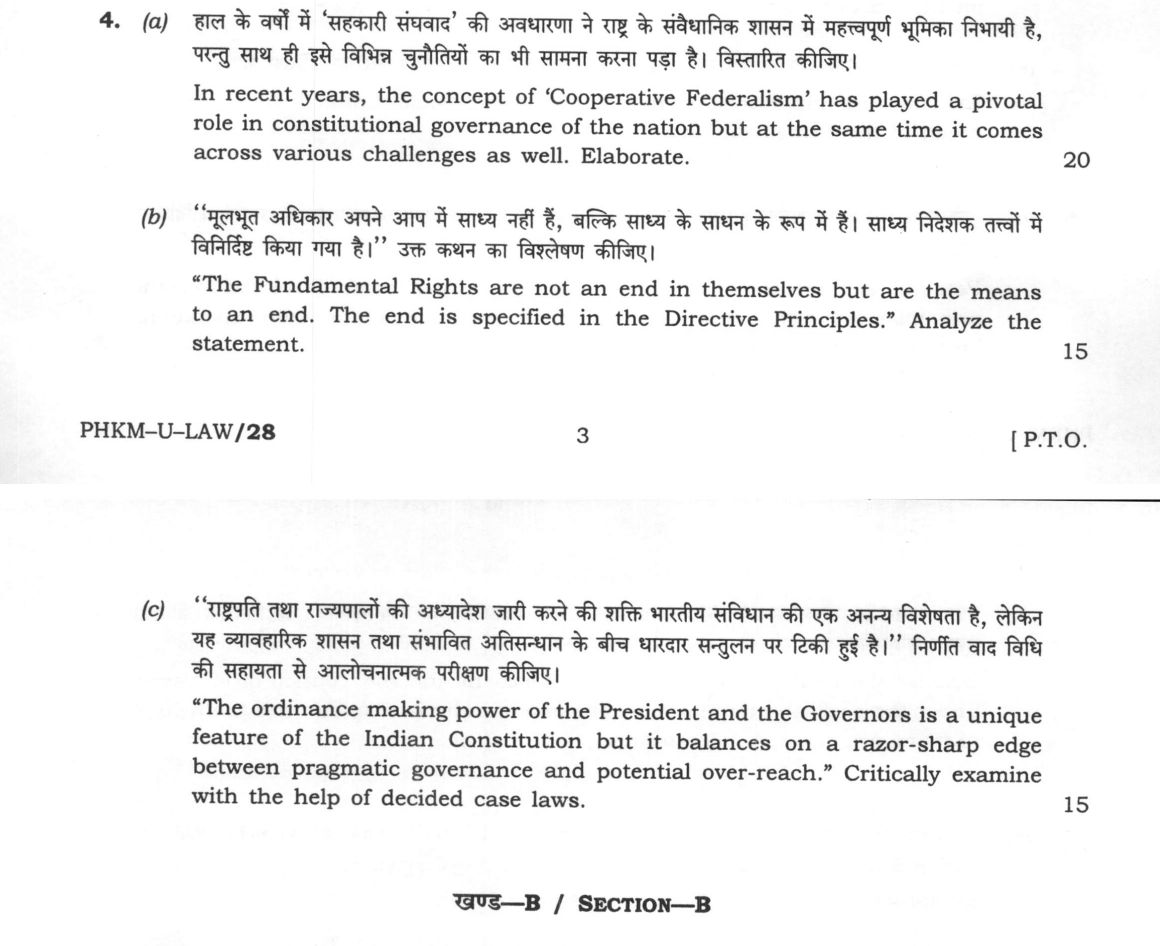
In recent years, the concept of 'Cooperative Federalism' has played a pivotal role in constitutional governance of the nation but at the same time it comes across various challenges as well. Elaborate. 20 marks
"The Fundamental Rights are not an end in themselves but are the means to an end. The end is specified in the Directive Principles." Analyze the statement. 15 marks
"The ordinance making power of the President and the Governors is a unique feature of the Indian Constitution but it balances on a razor-sharp edge between pragmatic governance and potential over-reach." Critically examine with the help of decided case laws. 15 marks
हिंदी में प्रश्न पढ़ें
हाल के वर्षों में 'सहकारी संघवाद' की अवधारणा ने राष्ट्र के संवैधानिक शासन में महत्त्वपूर्ण भूमिका निभाई है, परन्तु साथ ही इसे विभिन्न चुनौतियों का भी सामना करना पड़ा है। विस्तारित कीजिए। (20 अंक)
"मूलभूत अधिकार अपने आप में साध्य नहीं हैं, बल्कि साध्य के साधन के रूप में हैं। साध्य निर्देशक तत्त्वों में विनिर्दिष्ट किया गया है।" उक्त कथन का विश्लेषण कीजिए। (15 अंक)
"राष्ट्रपति तथा राज्यपालों की अध्यादेश जारी करने की शक्ति भारतीय संविधान की एक अनन्य विशेषता है, लेकिन यह व्यावहारिक शासन तथा संभावित अतिसंविधान के बीच धारदार संतुलन पर टिकी हुई है।" निर्णीत वाद विधि की सहायता से आलोचनात्मक परीक्षण कीजिए। (15 अंक)
Model answer
Written by UPSC Answer Check against this question's marking rubric, to the expected length. UPSC does not publish answers for Mains — this is one way to score well, not an official key.
The Indian constitutional framework envisions a dynamic equilibrium balancing federal cohesion, socio-economic transformation, and institutional checks and balances.
Cooperative Federalism: Dynamics and Challenges
Cooperative federalism reflects an interdependent relationship between the Union and States to achieve national objectives. Institutional mechanisms facilitating this include the GST Council (Article 279A), NITI Aayog, the Inter-State Council (Article 263), and Statutory Zonal Councils. Recent collaborative imperatives are evident in joint pandemic management under the National Disaster Management Act, and centrally sponsored schemes like PM-KISAN and Ayushman Bharat.
However, operational challenges strain this architecture. Fiscal asymmetry persists due to the rising share of Union cesses and surcharges outside the divisible pool and disputes over GST compensation cess settlements. Policy centralization through national frameworks like NEET and the National Education Policy generates friction with state autonomy. Historically, political friction surfaced via the misuse of Article 356, though curbed after S.R. Bommai v. Union of India (1994), which recognized federalism as part of the basic structure, refining the initial centralized reading in State of Rajasthan v. Union of India (1977). Furthermore, aggressive competitive federalism occasionally undermines horizontal interstate solidarity, demanding institutional revitalisation through regular Inter-State Council deliberations.
Fundamental Rights and Directive Principles: Means and Ends
The relationship between Fundamental Rights (Part III) and Directive Principles of State Policy (Part IV) embodies the synthesis of political democracy with socio-economic justice. Initially, State of Madras v. Champakam Dorairajan (1951) and Golak Nath v. State of Punjab (1967) posited the subordination of DPSPs to Part III.
This hierarchy was dismantled through constitutional amendments and judicial interpretation. Kesavananda Bharati v. State of State of Kerala (1973) and Minerva Mills v. Union of India (1980) established that the harmony and balance between Parts III and IV constitute an essential feature of the basic structure, likening them to two wheels of a chariot. Article 31C shielded laws giving effect to the egalitarian mandates of Article 39(b) and (c) from challenges under Articles 14 and 19.
The doctrine of harmonious construction transformed DPSPs into the moral and substantive core of Part III. In Mohini Jain (1992) and Unni Krishnan (1993), the Supreme Court read the mandate of Article 45 into Article 21, which culminated in the constitutionalization of the Right to Education via Article 21A. Thus, Part III provides the protective means, whereas Part IV establishes the transformative end of an egalitarian welfare state.
Ordinance-Making Power: Pragmatism versus Executive Overreach
Articles 123 and 213 empower the President and Governors to promulgate ordinances during legislative recess to address unforeseen exigencies. While indispensable for administrative continuity, excessive reliance creates a democratic deficit by bypassing legislative deliberation.
The judiciary has incrementally circumscribed this extraordinary power. In R.C. Cooper v. Union of India (1970), the Supreme Court held that the President’s satisfaction regarding the necessity for immediate action is open to judicial review on grounds of mala fides. In D.C. Wadhwa v. State of Bihar (1987), the Court struck down the practice of mechanically repromulgating ordinances without legislative tabling, characterizing it as a subversion of parliamentary democracy.
This jurisprudence culminated in the seven-judge bench ruling in Krishna Kumar Singh v. State of Bihar (2017), which held that the mandatory requirement to place ordinances before the legislature is a constitutional necessity. The Court ruled that repeated re-promulgation constitutes a fraud on the Constitution and that executive satisfaction is justiciable. Recent controversies surrounding ordinances on contentious subjects like the farm laws underscore this tension. The power under Articles 123 and 213 remains an emergency valve, permissible strictly as an exception rather than a parallel track of executive lawmaking.
What "Elaborate" is asking you to do
Give the full detailed account the question has compressed into a line — every dimension of it, with specifics. Elaborate rewards completeness and detail rather than clarification or argument: the examiner is checking whether you can fill out a topic without being told what its parts are.
Structure that answers it
State the proposition → first dimension in detail → second dimension in detail → the part the statement leaves implicit → the consolidated picture
Where marks are lost
Repeating the statement at greater length instead of adding substance. Elaborate also punishes narrowness: omitting a whole dimension costs more here than anywhere else in this family.
How this answer will be evaluated
Approach
Framework: Issue > Rule > Authority > Application. (a) discuss: intro > 3-4 dimensions > example > balanced close | (b) analyse: intro > causes > effects > stakeholders/linkages > way forward | (c) critically evaluate: positives > negatives/limits > conditions/safeguards > conclusion Full marks: Precise Article/Case citations, balanced analysis, clear structure, no generic statements.
Key points expected
- Define Cooperative Federalism and its constitutional basis (Art 263, 266, 282)
- Identify 3-4 specific challenges (e.g., fiscal asymmetry, inter-state disputes)
- Cite specific institutional mechanisms (Zonal Councils, GST Council)
- Provide a balanced conclusion on the concept's future
- Explain the 'Harmonious Construction' doctrine (Art 37)
- Identify the 'End' (social justice) and 'Means' (individual liberty)
- Cite a case law balancing FRs and DPSPs (e.g., Minerva Mills)
- Analyze the specific linkage between a right and a principle
Evaluation rubric
Each sub-part is marked on its own, against the marks and word limit printed on the paper.
- (a) Elaborate on the role and challenges of Cooperative Federalism in constitutional governance. 20 marks
discuss— intro → 3-4 dimensions → example → balanced close
Must cover
- Define Cooperative Federalism and its constitutional basis (Art 263, 266, 282)
- Identify 3-4 specific challenges (e.g., fiscal asymmetry, inter-state disputes)
- Cite specific institutional mechanisms (Zonal Councils, GST Council)
- Provide a balanced conclusion on the concept's future
Loses marks
- Generic discussion without naming specific Articles
- Listing challenges without mapping them to solutions
- Ignoring the 'challenges' aspect of the prompt
Earns more
- Reference to 14th/15th Finance Commission recommendations
- Mention of specific inter-state water disputes
- Discussion of the GST Council's role
- Reference to the 73rd/74th Amendments
Extra mark
- Citation of a recent Supreme Court judgment on federalism
- Reference to a specific Law Commission report
- (b) Analyze the relationship between Fundamental Rights and Directive Principles as means and ends. 15 marks
analyse— intro → causes → effects → stakeholders/linkages → way forward
Must cover
- Explain the 'Harmonious Construction' doctrine (Art 37)
- Identify the 'End' (social justice) and 'Means' (individual liberty)
- Cite a case law balancing FRs and DPSPs (e.g., Minerva Mills)
- Analyze the specific linkage between a right and a principle
Loses marks
- Treating FRs and DPSPs as mutually exclusive
- Failing to identify the 'End' as social justice
- Outcome-only case citation without ratio
Earns more
- Reference to the 42nd Amendment changes
- Discussion of the 'Basic Structure' doctrine
- Mention of specific DPSPs (e.g., Art 39, 41)
- Reference to the 'State Policy' nature of DPSPs
Extra mark
- Citation of a dissenting opinion on the hierarchy
- Reference to a specific Law Commission report
- (c) Critically examine the ordinance-making power of President and Governors using case laws. 15 marks
critically evaluate— positives → negatives/limits → conditions/safeguards → conclusion
Must cover
- Cite D.C. Wadhwa v. State of Bihar (1987) ratio
- Cite T. Harishankar v. State of Karnataka (2019) ratio
- Discuss the 'Razor-sharp edge' between pragmatism and over-reach
- Evaluate the role of the Governor vs President in ordinance making
Loses marks
- Failing to cite D.C. Wadhwa or T. Harishankar
- Treating ordinance power as absolute
- Ignoring the 'Governor' aspect of the prompt
Earns more
- Reference to the 112th Law Commission Report
- Discussion of the 'Satisfaction' test for ordinance making
- Mention of the 'Ordinance Re-promulgation' issue
- Reference to the 'Legislative Competence' of the state
Extra mark
- Citation of a recent High Court judgment on ordinances
- Reference to a specific Law Commission report
Practice this exact question
Write your answer and it is marked point by point against the model answer above — what you covered, what you missed, what you got wrong.
Evaluate my answer →More from Law 2024 Paper I
- Q1 Answer the following questions in about 150 words each: (a) Examine the appellate jurisdi…
- Q2 (a) The concept of Public Interest Litigation is an exception to the rule of 'locus stand…
- Q3 (a) "Article 194, which is an exact reproduction of Article 105, deals with the State Leg…
- Q4 (a) In recent years, the concept of 'Cooperative Federalism' has played a pivotal role in…
- Q5 Answer the following questions in about 150 words each: (a) Define International Law. Enu…
- Q6 (a) Peaceful settlement of international disputes has been developed on the principles of…
- Q7 (a) Following 'World War II' destruction, the World Bank and the International Monetary F…