Paper II — Q1
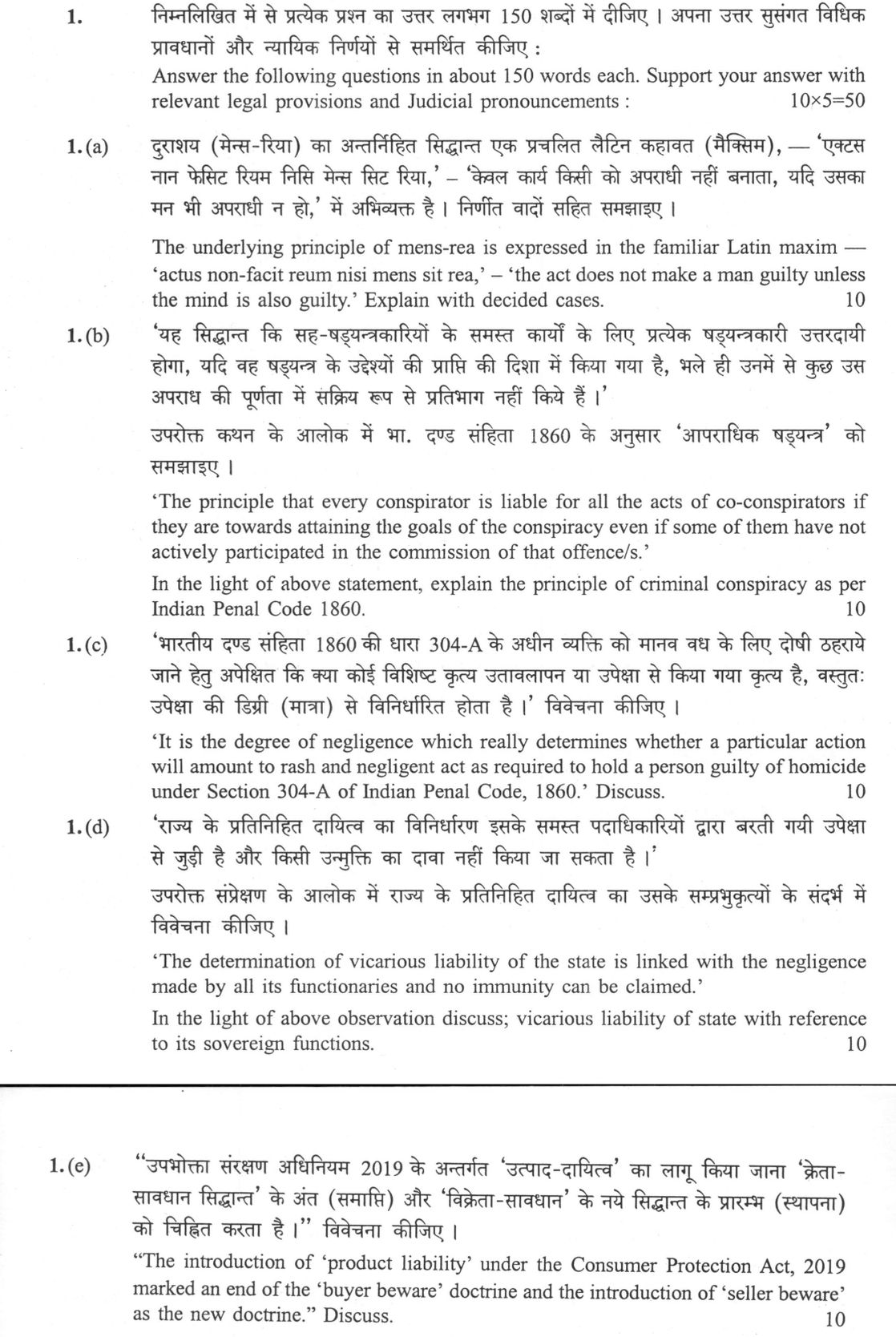
Answer the following questions in about 150 words each. Support your answer with relevant legal provisions and Judicial…
Answer the following questions in about 150 words each. Support your answer with relevant legal provisions and Judicial pronouncements : 10×5=50
The underlying principle of mens-rea is expressed in the familiar Latin maxim — 'actus non-facit reum nisi mens sit rea,' – 'the act does not make a man guilty unless the mind is also guilty.' Explain with decided cases. 10 marks
'The principle that every conspirator is liable for all the acts of co-conspirators if they are towards attaining the goals of the conspiracy even if some of them have not actively participated in the commission of that offence/s.' In the light of above statement, explain the principle of criminal conspiracy as per Indian Penal Code 1860. 10 marks
'It is the degree of negligence which really determines whether a particular action will amount to rash and negligent act as required to hold a person guilty of homicide under Section 304-A of Indian Penal Code, 1860.' Discuss. 10 marks
'The determination of vicarious liability of the state is linked with the negligence made by all its functionaries and no immunity can be claimed.' In the light of above observation discuss vicarious liability of state with reference to its sovereign functions. 10 marks
"The introduction of 'product liability' under the Consumer Protection Act, 2019 marked an end of the 'buyer beware' doctrine and the introduction of 'seller beware' as the new doctrine." Discuss. 10 marks
हिंदी में प्रश्न पढ़ें
निम्नलिखित में से प्रत्येक प्रश्न का उत्तर लगभग 150 शब्दों में दीजिए। अपना उत्तर सुसंगत विधिक प्रावधानों और न्यायिक निर्णयों से समर्थित कीजिए : 10×5=50
दुराशय (मेन्स-रिया) का अन्तर्निहित सिद्धान्त एक प्रचलित लैटिन कहावत (मैक्सिम), — 'एक्टस नान फैसिट रियम निसि मेन्स सिट रिया,' – 'केवल कार्य किसी को अपराधी नहीं बनाता, यदि उसका मन भी अपराधी न हो,' में अभिव्यक्त है। निर्णीत वादों सहित समझाइए। 10
'यह सिद्धान्त कि सह-षड्यन्त्रकारियों के समस्त कार्यों के लिए प्रत्येक षड्यन्त्रकारी उत्तरदायी होगा, यदि वह षड्यन्त्र के उद्देश्यों की प्राप्ति की दिशा में किया गया है, भले ही उनमें से कुछ उस अपराध की पूर्णता में सक्रिय रूप से प्रतिभाग नहीं किये हैं।' उपरोक्त कथन के आलोक में भा. दण्ड संहिता 1860 के अनुसार 'आपराधिक षड्यन्त्र' को समझाइए। 10
'भारतीय दण्ड संहिता 1860 की धारा 304-A के अधीन व्यक्ति को मानव वध के लिए दोषी ठहराये जाने हेतु अपेक्षित कि क्या कोई विशिष्ट कृत्य उतावलापन या उपेक्षा से किया गया कृत्य है, वस्तुतः उपेक्षा की डिग्री (मात्रा) से विनिर्धारित होता है।' विवेचना कीजिए। 10
'राज्य के प्रतिनिहित दायित्व का विनिर्धारण इसके समस्त पदाधिकारियों द्वारा बरती गयी उपेक्षा से जुड़ी है और किसी उन्मुक्ति का दावा नहीं किया जा सकता है।' उपरोक्त संप्रेषण के आलोक में राज्य के प्रतिनिहित दायित्व का उसके सम्प्रभुकृत्यों के संदर्भ में विवेचना कीजिए। 10
"उपभोक्ता संरक्षण अधिनियम 2019 के अंतर्गत 'उत्पाद-दायित्व' का लागू किया जाना 'क्रेता-सावधान सिद्धांत' के अंत (समाप्ति) और 'विक्रेता-सावधान' के नये सिद्धांत के प्रारम्भ (स्थापना) को चिह्नित करता है।" विवेचना कीजिए। 10
Model answer
Written by UPSC Answer Check against this question's marking rubric, to the 150-word length. UPSC does not publish answers for Mains — this is one way to score well, not an official key.
Mens rea The maxim actus non facit reum nisi mens sit rea means that a prohibited act becomes a crime only when accompanied by a guilty mind; the causal mechanism is that the State punishes the blameworthy mental state, not mere conduct. Under the IPC, most offences require intention, knowledge, reason to believe, or motive, while Sections 76–79 supply general exceptions where the act is innocent or legally justified. The rule is not absolute. In R v. Prince, taking an unmarried girl under sixteen was criminal even if the accused believed she was older, because the statute made the act itself wrongful; in Sherras v. De Rutzen, a licensing offence was held to be one of strict liability where the legislature intended to protect the public. Thus mens rea is the general principle, displaced only by statutory language or public-policy exceptions.
Criminal conspiracy Section 120A IPC defines conspiracy as an agreement of two or more persons to do an illegal act, or to do a lawful act by illegal means; Section 120B makes it punishable. The liability mechanism is that once the agreement exists, any act done by a conspirator in furtherance of the common intention is attributable to all, even if some did not actively participate. This differs from Section 34 IPC, which deals with a criminal act done by several persons in furtherance of the common intention of all; active participation is not required, and presence with shared intention may suffice. In Mirza Akbar v. King-Emperor, a conspirator is liable for acts done in pursuance of the conspiracy. State of Tamil Nadu v. Nalini reinforced that liability follows from participation in the common design and acts done in its furtherance. Thus conspiracy criminalises the collective decision and the acts flowing from it.
Rashness and negligence Section 304-A IPC punishes causing death by a rash or negligent act not amounting to culpable homicide. The degree of negligence is decisive: rashness involves conscious taking of an unjustifiable risk, while negligence is the failure to take reasonable care. The causal mechanism is that the accused’s mental attitude to risk determines the gravity of the act. In Jacob Mathew v. State of Punjab, the Supreme Court held that isolated or minor lapses do not amount to criminal negligence; there must be gross negligence, wilful neglect, or wanton disregard of patient safety. Kurban Hussein v. State of Maharashtra similarly linked conviction to the degree of carelessness and its causal connection with death. Thus, not every mistake is criminal; only the degree of negligence that shows a serious departure from the standard of a reasonable person attracts Section 304-A.
Vicarious liability of State Vicarious liability of the State arises when its functionaries, in the course of employment, commit negligence causing harm. Article 300(1) makes the State liable for acts or omissions of its servants. Kasturilal Ralia Ram Jain v. State of UP held that the State is not liable for torts committed in the exercise of sovereign functions, as sovereign immunity protects essential State duties. However, the post-constitutional position narrowed this shield. Nilabati Behera v. State of Orissa held the State liable for non-sovereign functions, such as commercial activities, where it acts like a private body. Common Cause v. Union of India further confined immunity, holding that sovereign functions are those only the State can perform, and that the State is liable for negligence in their performance. Thus, while sovereign functions remain a category, no blanket immunity can be claimed; liability follows from functionaries’ negligence and the nature of the function.
Product liability The Consumer Protection Act, 2019, through Section 2(34) and Chapter VI, introduced product liability, replacing the 1986 Act’s caveat emptor position where consumers had to prove deficiency or negligence. The causal mechanism is that the manufacturer, service provider, or product seller is liable for death or personal injury caused by a defective product or deficient service, as they control production, warnings and supply. However, the Act does not impose blanket strict liability on all parties. Section 84 makes a product manufacturer liable for defect or deficiency; Section 85 makes a product seller liable only in specified cases, such as unidentifiable manufacturer, alteration, or failure to warn. Section 86 provides exceptions, including consumer misuse, normal wear, compliance with mandatory standards, and development risks. Indian Medical Association v. VP Shantha extended consumer protection to services, showing that liability follows from deficiency in service. Thus, the 2019 Act shifts the burden toward the supply chain, creating seller beware, while preserving fault-based and statutory exceptions.
What "Explain" is asking you to do
Make the working of something clear — what sets it off, what follows from what, and what it produces. Explain is the Commission's mechanism word: it dominates the technical papers and the “explain why” stems, where the marks sit in the causal chain and not in the label.
Structure that answers it
State what it is → the initiating condition → the chain of cause, step by step → an instance where it plays out → what the chain produces
Where marks are lost
Describing what something looks like instead of why it works that way. Naming the stages without linking them reads as description too.
How this answer will be evaluated
Approach
Framework: Issue > Rule > Authority > Application. (a) explain: definition/context > points in order > small example > short close | (b) explain: definition/context > points in order > small example > short close | (c) discuss: intro > 3-4 dimensions > example > balanced close | (d) discuss: intro > 3-4 dimensions > example > balanced close | (e) discuss: intro > 3-4 dimensions > example > balanced close Full marks: Comprehensive, well-structured, with precise legal citations and case law.
Key points expected
- Define mens rea and actus reus
- Cite the maxim 'actus non-facit reum nisi mens sit rea'
- Cite at least one relevant case (e.g., R v. Cunningham)
- Explain the necessity of guilty mind for criminal liability
- Define criminal conspiracy under Section 120A IPC
- Explain the principle of joint liability for co-conspirators
- Cite a relevant case (e.g., K.N. Ganeshan v. State of Tamil Nadu)
- Discuss the requirement of an agreement to commit an offence
Evaluation rubric
Each sub-part is marked on its own, against the marks and word limit printed on the paper.
- (a) Explain the principle of mens rea using the Latin maxim and decided cases. 10 marks · 150 words
explain— definition/context → points in order → small example → short close
Must cover
- Define mens rea and actus reus
- Cite the maxim 'actus non-facit reum nisi mens sit rea'
- Cite at least one relevant case (e.g., R v. Cunningham)
- Explain the necessity of guilty mind for criminal liability
Loses marks
- Defining mens rea without case law
- Restating the maxim without explanation
- Confusing mens rea with actus reus
Earns more
- Mention strict liability exceptions
- Reference specific IPC sections requiring mens rea
- Discuss the 'guilty mind' concept in detail
Extra mark
- Cite a recent Supreme Court judgment on mens rea
- Reference a Law Commission report on criminal intent
- (b) Explain the principle of criminal conspiracy under IPC 1860, focusing on liability for co-conspirators' acts. 10 marks · 150 words
explain— definition/context → points in order → small example → short close
Must cover
- Define criminal conspiracy under Section 120A IPC
- Explain the principle of joint liability for co-conspirators
- Cite a relevant case (e.g., K.N. Ganeshan v. State of Tamil Nadu)
- Discuss the requirement of an agreement to commit an offence
Loses marks
- Defining conspiracy without mentioning Section 120A
- Failing to explain the liability for co-conspirators' acts
- Confusing conspiracy with abetment
Earns more
- Mention the distinction between conspiracy and abetment
- Reference the 'in furtherance of' clause in Section 120B
- Discuss the mental element in conspiracy
Extra mark
- Cite a recent Supreme Court judgment on conspiracy
- Reference a Law Commission report on criminal conspiracy
- (c) Discuss the role of negligence in determining rash and negligent acts under Section 304-A IPC. 10 marks · 150 words
discuss— intro → 3-4 dimensions → example → balanced close
Must cover
- Define rash and negligent acts under Section 304-A IPC
- Explain the degree of negligence required for liability
- Cite a relevant case (e.g., State of Haryana v. Bhajan Singh)
- Discuss the difference between rashness and negligence
Loses marks
- Defining negligence without mentioning Section 304-A
- Failing to explain the degree of negligence required
- Confusing rashness with negligence
Earns more
- Mention the 'gross negligence' standard
- Reference the 'reasonable man' test
- Discuss the mental state in rash and negligent acts
Extra mark
- Cite a recent Supreme Court judgment on negligence
- Reference a Law Commission report on criminal negligence
- (d) Discuss the vicarious liability of the state with reference to its sovereign functions. 10 marks · 150 words
discuss— intro → 3-4 dimensions → example → balanced close
Must cover
- Define vicarious liability of the state
- Explain the concept of sovereign functions
- Cite a relevant case (e.g., State of Rajasthan v. Gundu)
- Discuss the immunity of the state for sovereign acts
Loses marks
- Defining vicarious liability without mentioning sovereign functions
- Failing to explain the immunity of the state
- Confusing sovereign and non-sovereign functions
Earns more
- Mention the distinction between sovereign and non-sovereign functions
- Reference the 'respondeat superior' doctrine
- Discuss the scope of state liability
Extra mark
- Cite a recent Supreme Court judgment on state liability
- Reference a Law Commission report on state liability
- (e) Discuss the introduction of 'product liability' under the Consumer Protection Act, 2019, and its impact on the 'buyer beware' doctrine. 10 marks · 150 words
discuss— intro → 3-4 dimensions → example → balanced close
Must cover
- Define product liability under the Consumer Protection Act, 2019
- Explain the shift from 'buyer beware' to 'seller beware'
- Cite a relevant case (e.g., Indian Oil Corporation Ltd. v. Veerendra Kumar)
- Discuss the implications for manufacturers and sellers
Loses marks
- Defining product liability without mentioning the 2019 Act
- Failing to explain the shift from 'buyer beware' to 'seller beware'
- Confusing product liability with service liability
Earns more
- Mention the 'strict liability' standard
- Reference the 'defect' definition in the Act
- Discuss the role of consumer forums
Extra mark
- Cite a recent Supreme Court judgment on product liability
- Reference a Law Commission report on consumer protection
Practice this exact question
Write your answer and it is marked point by point against the model answer above — what you covered, what you missed, what you got wrong.
Evaluate my answer →More from Law 2024 Paper II
- Q1 Answer the following questions in about 150 words each. Support your answer with relevant…
- Q2 (a) "Justification for introduction of 'plea-bargaining' in India was that it will reduce…
- Q3 (a) "It is the mode of acquiring possession of property of other party with/without his c…
- Q4 (a) 'If an enterprise is permitted to carry on any hazardous or inherently dangerous acti…