Paper II — Q5
Answer the following questions in about 150 words each. Support your answer with relevant legal provisions and Judicial…
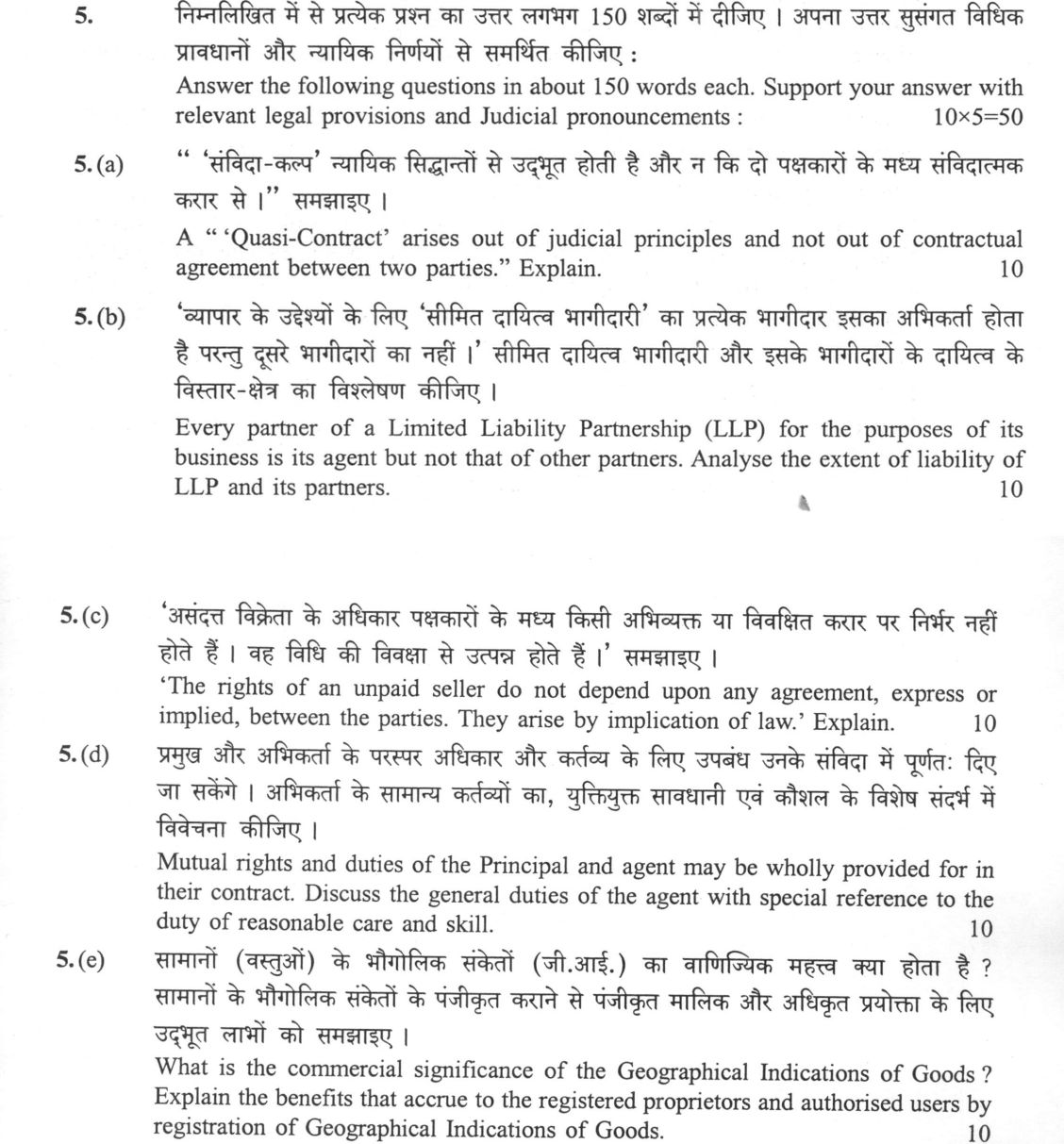
Answer the following questions in about 150 words each. Support your answer with relevant legal provisions and Judicial pronouncements : 10×5=50
A "'Quasi-Contract' arises out of judicial principles and not out of contractual agreement between two parties." Explain. 10 marks
Every partner of a Limited Liability Partnership (LLP) for the purposes of its business is its agent but not that of other partners. Analyse the extent of liability of LLP and its partners. 10 marks
'The rights of an unpaid seller do not depend upon any agreement, express or implied, between the parties. They arise by implication of law.' Explain. 10 marks
Mutual rights and duties of the Principal and agent may be wholly provided for in their contract. Discuss the general duties of the agent with special reference to the duty of reasonable care and skill. 10 marks
What is the commercial significance of the Geographical Indications of Goods ? Explain the benefits that accrue to the registered proprietors and authorised users by registration of Geographical Indications of Goods. 10 marks
हिंदी में प्रश्न पढ़ें
निम्नलिखित में से प्रत्येक प्रश्न का उत्तर लगभग 150 शब्दों में दीजिए । अपना उत्तर सुसंगत विधिक प्रावधानों और न्यायिक निर्णयों से समर्थित कीजिए : 10×5=50
"'संविदा-कल्प' न्यायिक सिद्धांतों से उद्भूत होती है और न कि दो पक्षकारों के मध्य संविदात्मक करार से ।" समझाइए । 10
'व्यापार के उद्देश्यों के लिए 'सीमित दायित्व भागीदारी' का प्रत्येक भागीदार इसका अभिकर्ता होता है परंतु दूसरे भागीदारों का नहीं ।' सीमित दायित्व भागीदारी और इसके भागीदारों के दायित्व के विस्तार-क्षेत्र का विश्लेषण कीजिए । 10
'असदत विक्रेता के अधिकार पक्षकारों के मध्य किसी अभिव्यक्त या विवक्षित करार पर निर्भर नहीं होते हैं । वह विधि की विवक्षा से उत्पन्न होते हैं ।' समझाइए । 10
प्रमुख और अभिकर्ता के परस्पर अधिकार और कर्तव्य के लिए उपबंध उनके संविदा में पूर्णतः दिए जा सकें । अभिकर्ता के सामान्य कर्तव्यों का, युक्तियुक्त सावधानी एवं कौशल के विशेष संदर्भ में विवेचना कीजिए । 10
सामानों (वस्तुओं) के भौगोलिक संकेतों (जी.आई.) का वाणिज्यिक महत्व क्या होता है ? सामानों के भौगोलिक संकेतों के पंजीकृत कराने से पंजीकृत मालिक और अधिकृत प्रयोक्ता के लिए उद्भूत लाभों को समझाइए । 10
Model answer
Written by UPSC Answer Check against this question's marking rubric, to the 150-word length. UPSC does not publish answers for Mains — this is one way to score well, not an official key.
Quasi-Contract and Constructive Obligations
The concept of quasi-contract, or "implied-in-law contract," operates as a judicial remedy to prevent unjust enrichment, distinct from consensual agreements. Under Sections 68 to 72 of the Indian Contract Act, 1872, the law imposes obligations where one party receives benefits at the expense of another without a valid contract. This is not a true contract but a legal fiction. In Moses v. Macferlan, the House of Lords established that such obligations arise from principles of equity and good conscience. Similarly, in State of West Bengal v. B.K. Mondal, the Supreme Court affirmed that the State cannot retain benefits received without consideration, invoking Section 70. Thus, quasi-contracts are remedial instruments created by judicial principles to ensure that no one profits at another’s loss, independent of any prior agreement.
Liability in Limited Liability Partnerships
Section 26 of the Limited Liability Partnership Act, 2008, stipulates that every partner is an agent of the LLP for business purposes but not of other partners. This structure provides a corporate veil, limiting partners’ liability to their capital contribution. However, this shield is not absolute. Section 28(3) explicitly states that a partner remains personally liable for their own wrongful acts or omissions. Furthermore, Section 30 imposes unlimited liability on partners for fraud or wrongful acts committed in the LLP’s name. In In re: Aarav LLP, the courts have reinforced that while the LLP is a separate legal entity, partners cannot use the structure to shield personal misconduct. Therefore, liability is limited for business debts but unlimited for personal torts or fraud, balancing limited liability with accountability.
Rights of an Unpaid Seller
The rights of an unpaid seller are statutory and do not depend on express or implied contractual terms. Sections 45 to 54 of the Sale of Goods Act, 1930, grant these rights by implication of law. These include the right of lien, stoppage in transit, and resale. In Reynolds v. Dooley, the court held that these rights operate automatically upon the seller becoming unpaid, regardless of the contract’s specific clauses. The rationale is to protect sellers from the risk of non-payment, ensuring that property rights align with payment status. Consequently, even if a contract states "cash on delivery," the seller retains statutory rights if payment fails, demonstrating that these protections are inherent in the law of sale, not derived from party negotiation.
Duties of an Agent
While the principal-agent relationship is primarily contractual, the Indian Contract Act, 1872, imposes statutory duties. Section 211 mandates that an agent must conduct business with the same care as a person of ordinary prudence. This is a duty of reasonable care and skill, not strict liability. In Keppel v. Wheeler, the court emphasized that agents must exercise reasonable diligence. If an agent breaches this duty through negligence, they are liable for resulting losses, but not for mere failure to achieve results without fault. Section 212 further requires agents to avoid conflicts of interest. Thus, the agent’s liability is fault-based, requiring proof of negligence or breach of fiduciary duty, rather than automatic liability for any adverse outcome.
Geographical Indications and Commercial Value
Geographical Indications (GIs) protect products with specific qualities due to their origin. Under the Geographical Indications of Goods (Registration and Protection) Act, 1999, Section 21 confers exclusive rights to use the GI on both registered proprietors and authorized users. This registration provides commercial significance by creating a brand identity linked to terroir, enhancing export premiums. In Darjeeling Tea v. Darjeeling Tea Association, the Supreme Court recognized the economic value of protecting such distinctive names. Benefits include preventing misuse by non-origin producers, ensuring quality standards, and boosting tourism. For authorized users, registration grants legal protection against infringement, allowing them to market products with a certified origin label, thereby increasing consumer trust and market value.
What "Explain" is asking you to do
Make the working of something clear — what sets it off, what follows from what, and what it produces. Explain is the Commission's mechanism word: it dominates the technical papers and the “explain why” stems, where the marks sit in the causal chain and not in the label.
Structure that answers it
State what it is → the initiating condition → the chain of cause, step by step → an instance where it plays out → what the chain produces
Where marks are lost
Describing what something looks like instead of why it works that way. Naming the stages without linking them reads as description too.
How this answer will be evaluated
Approach
Framework: Issue > Rule > Authority > Application. (a) explain: definition/context > points in order > small example > short close | (b) analyse: intro > causes > effects > stakeholders/linkages > way forward | (c) explain: definition/context > points in order > small example > short close | (d) discuss: intro > 3-4 dimensions > example > balanced close | (e) explain: definition/context > points in order > small example > short close Full marks: Precise statutory citations, clear distinction of concepts, relevant case law, and structured argument.
Key points expected
- Cite Section 68-72 of the Indian Contract Act, 1872
- Define 'quasi-contract' as a legal fiction
- Contrast with consensual contractual agreement
- Mention 'unjust enrichment' as the underlying principle
- Cite LLP Act, 2008 (specifically S. 3 or 25)
- Explain 'limited liability' of partners
- Distinguish partner liability from firm liability
- Address the 'agent of firm, not partners' rule
Evaluation rubric
Each sub-part is marked on its own, against the marks and word limit printed on the paper.
- (a) Distinguish quasi-contract from contract via judicial origin. 10 marks · 150 words
explain— definition/context → points in order → small example → short close
Must cover
- Cite Section 68-72 of the Indian Contract Act, 1872
- Define 'quasi-contract' as a legal fiction
- Contrast with consensual contractual agreement
- Mention 'unjust enrichment' as the underlying principle
Loses marks
- Treating quasi-contract as a true contract
- Failing to mention the statutory basis (S. 68-72)
Earns more
- Cite Mohan v. State of U.P. or similar case
- Reference restitutionary nature of the obligation
Extra mark
- Mention Law Commission Report on restitution
- (b) Examine agency and liability limits in LLP structure. 10 marks · 150 words
analyse— intro → causes → effects → stakeholders/linkages → way forward
Must cover
- Cite LLP Act, 2008 (specifically S. 3 or 25)
- Explain 'limited liability' of partners
- Distinguish partner liability from firm liability
- Address the 'agent of firm, not partners' rule
Loses marks
- Confusing LLP with General Partnership liability
- Ignoring the statutory basis of the agency rule
Earns more
- Mention exceptions to limited liability (fraud/misconduct)
- Reference judicial interpretation of LLP agency
Extra mark
- Cite a specific Supreme Court judgment on LLP liability
- (c) Establish statutory origin of unpaid seller's rights. 10 marks · 150 words
explain— definition/context → points in order → small example → short close
Must cover
- Cite Sale of Goods Act, 1930 (S. 43-55)
- Define 'unpaid seller' as per the Act
- Explain rights as 'statutory' not 'contractual'
- Mention lien, stoppage in transit, or resale
Loses marks
- Attributing rights to contract terms
- Failing to cite the Sale of Goods Act
Earns more
- Cite a case on 'implied by law' rights
- Distinguish from common law rights of seller
Extra mark
- Reference specific judicial pronouncement on S. 43
- (d) Detail agent's duties, focusing on care and skill. 10 marks · 150 words
discuss— intro → 3-4 dimensions → example → balanced close
Must cover
- Cite Indian Contract Act, 1872 (S. 211-212)
- Define 'reasonable care and skill' standard
- List other general duties (obedience, diligence)
- Distinguish skilled vs. unskilled agent duties
Loses marks
- Ignoring the 'skill' aspect of the duty
- Failing to cite the specific sections (211-212)
Earns more
- Cite a case on 'reasonable skill' standard
- Mention duty to avoid conflict of interest
Extra mark
- Reference Law Commission view on agency duties
- (e) Outline commercial value and benefits of GI registration. 10 marks · 150 words
explain— definition/context → points in order → small example → short close
Must cover
- Cite Geographical Indications of Goods Act, 1999
- Define 'commercial significance' of GI
- List benefits for registered proprietors
- List benefits for authorised users
Loses marks
- Confusing GI with Trademark protection
- Failing to distinguish proprietor vs. user benefits
Earns more
- Mention specific examples (e.g., Darjeeling Tea)
- Reference international recognition (TRIPS)
Extra mark
- Cite a specific Supreme Court judgment on GI
Practice this exact question
Write your answer and it is marked point by point against the model answer above — what you covered, what you missed, what you got wrong.
Evaluate my answer →More from Law 2024 Paper II
- Q2 (a) "Justification for introduction of 'plea-bargaining' in India was that it will reduce…
- Q3 (a) "It is the mode of acquiring possession of property of other party with/without his c…
- Q4 (a) 'If an enterprise is permitted to carry on any hazardous or inherently dangerous acti…
- Q5 Answer the following questions in about 150 words each. Support your answer with relevant…
- Q6 (a) Discuss the rules which are taken into account by the courts while awarding damages f…
- Q7 (a) "The principle of arbitral autonomy is an integral element of the ever evolving domai…
- Q8 (a) "There is, in recent years, a feeling which is not without any foundation that 'publi…