Paper II — Q4
(a) 'If an enterprise is permitted to carry on any hazardous or inherently dangerous activity for its profits, the cost of any…
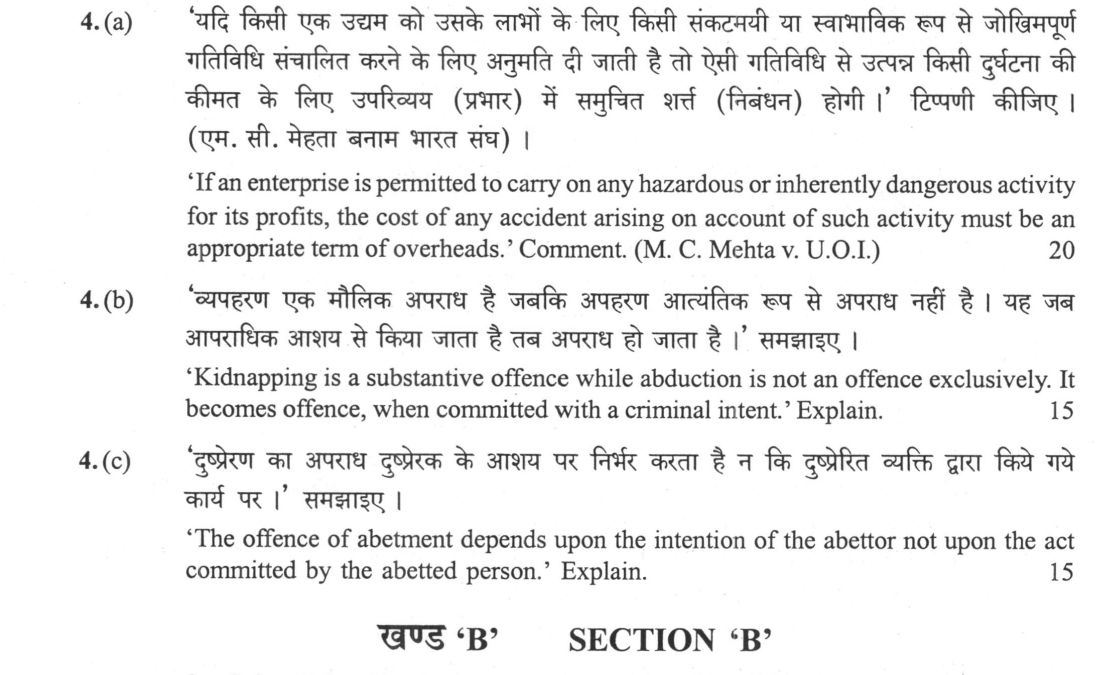
'If an enterprise is permitted to carry on any hazardous or inherently dangerous activity for its profits, the cost of any accident arising on account of such activity must be an appropriate term of overheads.' Comment. (M. C. Mehta v. U.O.I.) 20 marks
'Kidnapping is a substantive offence while abduction is not an offence exclusively. It becomes offence, when committed with a criminal intent.' Explain. 15 marks
'The offence of abetment depends upon the intention of the abettor not upon the act committed by the abetted person.' Explain. 15 marks
हिंदी में प्रश्न पढ़ें
'यदि किसी एक उद्यम को उसके लाभों के लिए किसी संकटमयी या स्वाभाविक रूप से जोखिमपूर्ण गतिविधि संचालित करने के लिए अनुमति दी जाती है तो ऐसी गतिविधि से उत्पन्न किसी दुर्घटना की कीमत के लिए उपरिव्यय (प्रभार) में समुचित शर्त (निबंधन) होगी ।' टिप्पणी कीजिए । (एम. सी. मेहता बनाम भारत संघ) 20 marks
'व्यपहरण एक मौलिक अपराध है जबकि अपहरण आत्यंतिक रूप से अपराध नहीं है । यह जब आपराधिक आशय से किया जाता है तब अपराध हो जाता है ।' समझाइए । 15
'दुष्प्रेरण का अपराध दुष्प्रेरक के आशय पर निर्भर करता है न कि दुष्प्रेरित व्यक्ति द्वारा किये गये कार्य पर ।' समझाइए । 15
Model answer
Written by UPSC Answer Check against this question's marking rubric, to the expected length. UPSC does not publish answers for Mains — this is one way to score well, not an official key.
Absolute liability The statement is substantially correct. In M.C. Mehta v. Union of India (1987), the Supreme Court held that an enterprise carrying on hazardous or inherently dangerous activity for profit is absolutely liable for injury caused by it. The liability is no-fault, non-delegable and non-defensible; even reasonable care, act of God or third-party fault does not excuse it. The Court distinguished Rylands v. Fletcher, where strict liability was limited to non-natural use and allowed defences, as inadequate for modern industrial hazards. The constitutional basis is Articles 21, 47 and 48-A, requiring protection of life, public health and the environment. The “deep pocket” theory makes the enterprise, not the victim, bear the cost, because it can spread the loss through insurance, pricing and safety investment. Thus the accident cost is a social overhead that must be internalised. The Oleum Gas Leak case (1996) reinforced this, treating compensation as a term of doing business; later environmental jurisprudence treats industrial harm as a cost of production. Profit from hazard must therefore carry its risk.
Kidnapping and abduction Kidnapping under Sections 359 to 361 IPC is a substantive offence because the law attaches criminality to the act itself. Section 359 criminalises taking or inducing a person to go, or confining him, with intent to send him beyond India or to confine him for an offence, terror or any unlawful purpose. The specific intent to remove or confine unlawfully makes kidnapping substantive; the age distinction—minor under 16/18, and, in the relevant kidnapping provisions, a woman of any age—makes consent irrelevant; kidnapping from lawful guardianship under Section 361 is complete without any further act such as murder or ransom. Abduction under Section 362 IPC is only compelling a person to go by force or inducing him to go by deception. It is not an offence exclusively; it becomes an offence only when coupled with the criminal intent specified in Sections 364 to 369, such as abduction for murder, ransom, theft, or outrage to modesty. Thus kidnapping has inherent criminality, while abduction acquires criminal character only through the purpose for which it is done.
Abetment The offence of abetment under Sections 107 to 120 IPC depends on the intention of the abettor, not on the act committed by the abetted person. Section 107 defines abetment as instigating, conspiring, or intentionally aiding an offence. The abettor’s mens rea—knowledge, intention or reckless disregard of the probable consequence—is the sole determinant of liability. Illustration (a) to Section 107 shows that A who abets B to commit suicide is liable for abetment of suicide even if the act is not completed in the ordinary sense. Section 108 makes the abettor liable when the abetted person is incapable, the act is not done, or it is done but no offence is committed, provided the abettor had the requisite intention. This independence was affirmed in Faguna Kanta Nath v. State of Assam (1959) and Sanju v. State of M.P., where the Court held that abetment is a distinct offence and does not require the principal offence to be completed. It differs from criminal conspiracy under Section 120B, an agreement to commit an offence; abetment may exist without prior agreement, and conspiracy without overt abetment.
Conclusion These doctrines balance individual rights and social interests. Absolute liability makes hazardous enterprise pay for the risks it creates; kidnapping and abduction protect personal liberty and lawful guardianship; abetment punishes dangerous intention that facilitates crime. The statement in part (a) is therefore correct, while parts (b) and (c) show that criminal law distinguishes inherently wrongful acts from acts that become wrongful only through intent.
What "Comment" is asking you to do
Take a position on the statement and support it. Comment usually attaches to a quoted line in the short slots, so the reasoning must be compressed — an opening view, a few load-bearing reasons, and the limit of the claim.
Structure that answers it
Unpack what the statement asserts → your stance → two or three supporting reasons → the qualification that limits it
Where marks are lost
Neutral summary; a comment without a stance has not answered. Equally costly is accepting the quoted line wholesale and never testing where it fails.
How this answer will be evaluated
Approach
Framework: Issue > Rule > Authority > Application. (a) comment: context > arguments both sides > judgment > close | (b) explain: definition/context > points in order > small example > short close | (c) explain: definition/context > points in order > small example > short close Full marks: Precise statutory citations, clear distinction of concepts, and balanced legal analysis.
Key points expected
- Cite M.C. Mehta v. Union of India (1987)
- Define strict liability and absolute liability
- Explain the 'overheads' principle for hazardous activities
- Provide a balanced judgment on the statement
- Define abduction under Section 362 IPC
- Define kidnapping under Section 359 IPC
- Explain abduction as a substantive offence
- Explain abduction as a component of other offences
Evaluation rubric
Each sub-part is marked on its own, against the marks and word limit printed on the paper.
- (a) Context of strict liability, arguments for/against, and judgment on the overheads principle. 20 marks
comment— context → arguments both sides → judgment → close
Must cover
- Cite M.C. Mehta v. Union of India (1987)
- Define strict liability and absolute liability
- Explain the 'overheads' principle for hazardous activities
- Provide a balanced judgment on the statement
Loses marks
- Confusing strict liability with absolute liability
- Failing to cite the specific case name
- Restating the quote without legal analysis
Earns more
- Mention the Oleum Gas Leak case facts
- Reference the 'deep pocket' theory
- Discuss the 'polluter pays' principle
- Cite the 1996 Supreme Court judgment
Extra mark
- Reference Law Commission Report on environmental liability
- Mention the 1996 Supreme Court judgment
- (b) Definition of abduction vs kidnapping and the role of criminal intent. 15 marks
explain— definition/context → points in order → small example → short close
Must cover
- Define abduction under Section 362 IPC
- Define kidnapping under Section 359 IPC
- Explain abduction as a substantive offence
- Explain abduction as a component of other offences
Loses marks
- Treating abduction as a standalone offence
- Failing to mention the 'criminal intent' requirement
- Confusing abduction with wrongful restraint
Earns more
- Cite Section 361 IPC (abduction from lawful guardianship)
- Mention the 'without consent' element
- Distinguish abduction from wrongful restraint
- Provide a small example of abduction
Extra mark
- Reference the 2023 IPC amendment
- Mention the 'criminal intent' element
- (c) Explanation of abetment liability based on abettor's intent, not abetted act. 15 marks
explain— definition/context → points in order → small example → short close
Must cover
- Define abetment under Section 107 IPC
- State that abettor is liable even if abetted act fails
- Explain the 'intention' element of abetment
- Distinguish abetment from conspiracy
Loses marks
- Failing to distinguish abetment from conspiracy
- Confusing abetment with the abetted act
- Failing to mention the 'intention' element
Earns more
- Cite Section 114 IPC (abetment of offence)
- Mention the 'aiding' element of abetment
- Provide a small example of abetment
- Reference the 'mens rea' requirement
Extra mark
- Reference the 2023 IPC amendment
- Mention the 'aiding' element of abetment
Practice this exact question
Write your answer and it is marked point by point against the model answer above — what you covered, what you missed, what you got wrong.
Evaluate my answer →More from Law 2024 Paper II
- Q1 Answer the following questions in about 150 words each. Support your answer with relevant…
- Q2 (a) "Justification for introduction of 'plea-bargaining' in India was that it will reduce…
- Q3 (a) "It is the mode of acquiring possession of property of other party with/without his c…
- Q4 (a) 'If an enterprise is permitted to carry on any hazardous or inherently dangerous acti…
- Q5 Answer the following questions in about 150 words each. Support your answer with relevant…
- Q6 (a) Discuss the rules which are taken into account by the courts while awarding damages f…
- Q7 (a) "The principle of arbitral autonomy is an integral element of the ever evolving domai…