Paper II — Q7
(a) "The principle of arbitral autonomy is an integral element of the ever evolving domain of arbitration law .... The basis of…
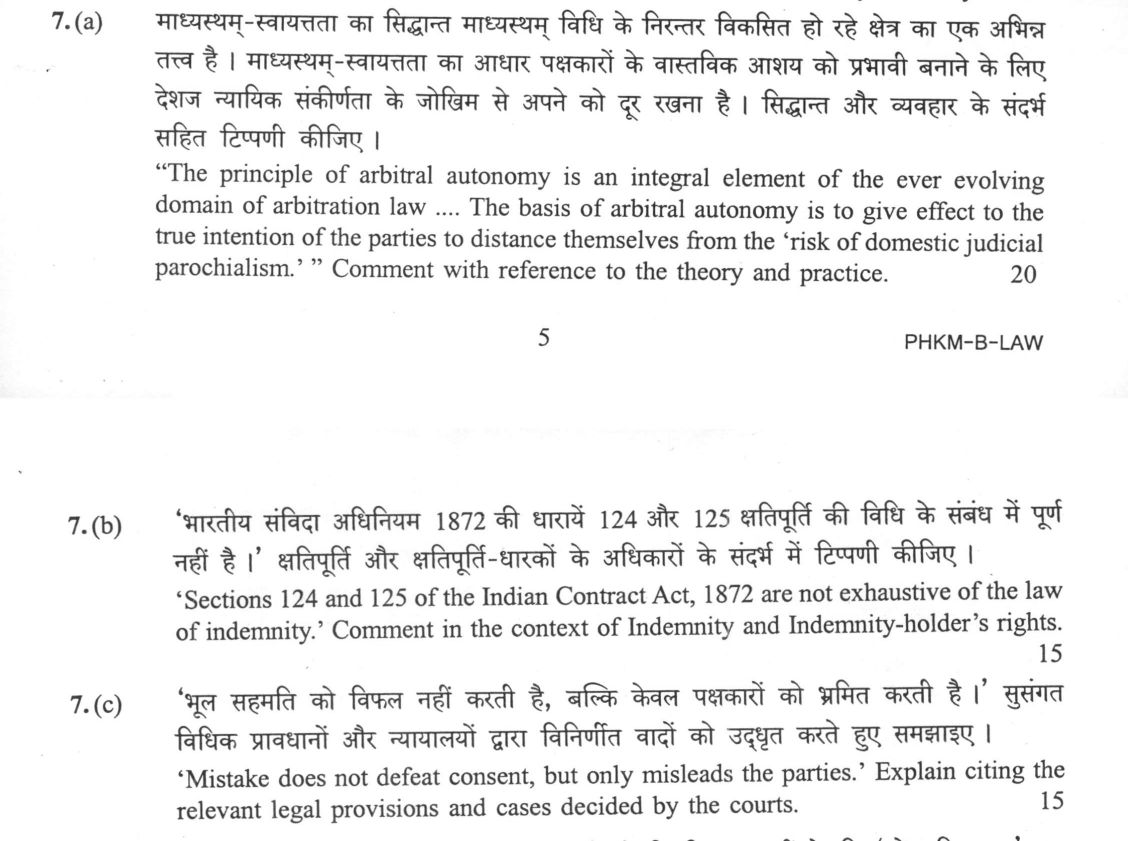
"The principle of arbitral autonomy is an integral element of the ever evolving domain of arbitration law .... The basis of arbitral autonomy is to give effect to the true intention of the parties to distance themselves from the 'risk of domestic judicial parochialism.' " Comment with reference to the theory and practice. 20 marks
'Sections 124 and 125 of the Indian Contract Act, 1872 are not exhaustive of the law of indemnity.' Comment in the context of Indemnity and Indemnity-holder's rights. 15 marks
'Mistake does not defeat consent, but only misleads the parties.' Explain citing the relevant legal provisions and cases decided by the courts. 15 marks
हिंदी में प्रश्न पढ़ें
माध्यस्थम्-स्वायत्तता का सिद्धान्त माध्यस्थम् विधि के निरन्तर विकसित हो रहे क्षेत्र का एक अभिन्न तत्त्व है । माध्यस्थम्-स्वायत्तता का आधार पक्षकारों के वास्तविक आशय को प्रभावी बनाने के लिए देशज न्यायिक संकीर्णता के जोखिम से अपने को दूर रखना है । सिद्धान्त और व्यवहार के संदर्भ सहित टिप्पणी कीजिए । 20
'भारतीय संविदा अधिनियम 1872 की धाराएं 124 और 125 क्षतिपूर्ति की विधि के संबंध में पूर्ण नहीं है।' क्षतिपूर्ति और क्षतिपूर्ति-धारकों के अधिकारों के संदर्भ में टिप्पणी कीजिए। 15
'भूल सहमति को विफल नहीं करती है, बल्कि केवल पक्षकारों को भ्रमित करती है।' सुसंगत विधिक प्रावधानों और न्यायालयों द्वारा विनिर्णीत बादों को उद्धृत करते हुए समझाइए। 15
Model answer
Written by UPSC Answer Check against this question's marking rubric, to the expected length. UPSC does not publish answers for Mains — this is one way to score well, not an official key.
(a) Arbitral autonomy is the recognition that parties may choose arbitration and insulate their dispute from domestic courts. It rests on party autonomy, separability, and kompetenz-kompetenz: the arbitration clause is distinct, and the tribunal may rule on its jurisdiction. Sections 5, 16 and 34 of the Arbitration and Conciliation Act, 1996 give effect to this: courts intervene only on limited grounds. The UNCITRAL Model Law and ICC Rules follow the same supervisory model. The phrase ‘domestic judicial parochialism’ is apt: excessive interference converts arbitration into a second trial. Indian practice has oscillated. In Vodafone International Holdings BV v Union of India (2012) 1 SCC 661, in an ICC arbitration, the Supreme Court confined Section 34(2)(b) public policy to international public policy. Ssangyong Engineering & Construction Co. v NHAI (2019) 1 SCC 1 and Perkins Eastman Architects v State of UP (2019) 10 SCC 576 mark the boundary: courts will not re-argue merits, but will set aside awards contravening mandatory law or public policy. Autonomy must yield to mandatory law and public policy, but those exceptions must be narrow. The principle is integral, though Indian judicial activism has sometimes constrained it; the trend is minimal intervention.
(b) Sections 124 and 125 of the Indian Contract Act, 1872 do not exhaust the law of indemnity. Section 124 defines indemnity as a promise to keep another harmless from loss caused by the conduct of the indemnifier or another person, or by an event; Section 125 regulates the indemnifier’s liability and the indemnity-holder’s recovery of reasonable expenses, judgments and settlements. They are a limited statutory definition, not an exhaustive code: they do not use ‘solely’ or exclude implied indemnities. Indemnity is also distinct from guarantee: it is a primary promise to keep harmless, whereas guarantee is a secondary promise to answer for another’s debt. In Secretary of State v. Bank of India, the court recognised that an indemnity may arise from the relationship and conduct, not only from an express contract. The indemnity-holder’s rights are broader than the statutory text: apart from Section 125, he may claim damages, specific performance where capable, and equitable relief such as injunction or restitution. Thus, the sections frame the core position but leave room for implied, equitable and remedial extensions.
(c) Mistake does not automatically defeat consent; it vitiates consent only when operative. Section 20 of the Indian Contract Act voids an agreement only where both parties are under a mistake as to a matter of fact essential to the agreement, requiring consensus ad idem. A unilateral mistake, or a mistake as to value, motive, quality or future events, is generally non-operative. Section 21 provides that a mistake as to Indian law does not render a contract voidable, while a mistake as to foreign law is treated as fact; Section 22 excludes mistake as to value. In Noorudeen v. Kanniammal (2013) 4 SCC 400 and Tarsem Singh v. Sukhminder Singh (2016) 15 SCC 464, the Supreme Court treated mistake as non-operative where it did not go to an essential fact, holding that it merely misleads the parties. The same distinction appears in Bell v. Lever Bros [1932] AC 161 and Great Peace Shipping Ltd v Tsavliris [2002] EWCA Civ 1407, where a mistake as to motive or a non-essential fact was held not to make the contract void. Where the mistake is operative, the agreement is void ab initio, not merely voidable; the parties may claim restitution under Section 64 and, where the instrument misrecords the true agreement, rectification under the Specific Relief Act, 1963. Thus, mistake defeats consent only where it destroys the meeting of the minds on an essential fact; otherwise it remains a non-operative error.
What "Comment" is asking you to do
Take a position on the statement and support it. Comment usually attaches to a quoted line in the short slots, so the reasoning must be compressed — an opening view, a few load-bearing reasons, and the limit of the claim.
Structure that answers it
Unpack what the statement asserts → your stance → two or three supporting reasons → the qualification that limits it
Where marks are lost
Neutral summary; a comment without a stance has not answered. Equally costly is accepting the quoted line wholesale and never testing where it fails.
How this answer will be evaluated
Approach
Framework: Issue > Rule > Authority > Application. (a) comment: context > arguments both sides > judgment > close | (b) comment: context > arguments both sides > judgment > close | (c) explain: definition/context > points in order > small example > short close Full marks: Precise legal definitions, accurate statutory citations, relevant case law with ratio, and clear application to the specific question.
Key points expected
- Define arbitral autonomy as a core principle of arbitration law
- Explain the concept of 'domestic judicial parochialism'
- Discuss the theoretical basis: party autonomy and true intention
- Analyze practical application: separation of arbitral process from local courts
- State the scope of Section 124 (definition of indemnity)
- State the scope of Section 125 (obligations of indemnifier)
- Identify rights of the indemnity-holder not covered in these sections
- Explain the legal basis for the 'not exhaustive' claim
Evaluation rubric
Each sub-part is marked on its own, against the marks and word limit printed on the paper.
- (a) Contextualize arbitral autonomy and evaluate its role in avoiding domestic judicial parochialism. 20 marks
comment— context → arguments both sides → judgment → close
Must cover
- Define arbitral autonomy as a core principle of arbitration law
- Explain the concept of 'domestic judicial parochialism'
- Discuss the theoretical basis: party autonomy and true intention
- Analyze practical application: separation of arbitral process from local courts
Loses marks
- Defining autonomy without linking it to 'judicial parochialism'
- Discussing arbitration generally without focusing on the autonomy principle
- Ignoring the 'true intention of the parties' aspect
Earns more
- Reference to UNCITRAL Model Law or Arbitration and Conciliation Act, 1996
- Mention of 'ever evolving domain' of arbitration law
- Discussion of the balance between autonomy and judicial oversight
- Citation of relevant international or domestic arbitration cases
Extra mark
- Reference to a recent Supreme Court judgment on arbitral autonomy
- Mention of a specific Law Commission report on arbitration
- (b) Explain why Sections 124 and 125 are not exhaustive regarding indemnity and indemnity-holder's rights. 15 marks
comment— context → arguments both sides → judgment → close
Must cover
- State the scope of Section 124 (definition of indemnity)
- State the scope of Section 125 (obligations of indemnifier)
- Identify rights of the indemnity-holder not covered in these sections
- Explain the legal basis for the 'not exhaustive' claim
Loses marks
- Restating Sections 124 and 125 without explaining their limitations
- Failing to mention the indemnity-holder's specific rights
- Confusing indemnity with other contract concepts
Earns more
- Reference to Section 126 (rights of indemnity-holder in suit)
- Reference to Section 127 (indemnity-holder's right to indemnity)
- Citation of a case law interpreting the scope of indemnity
- Distinction between indemnity and guarantee
Extra mark
- Reference to a specific Supreme Court case on indemnity rights
- Mention of a Law Commission report on contract law
- (c) Explain the legal effect of mistake on consent, citing relevant provisions and cases. 15 marks
explain— definition/context → points in order → small example → short close
Must cover
- Define 'mistake' in the context of contract law
- Explain how mistake 'misleads' rather than 'defeats' consent
- Cite relevant legal provisions (e.g., Sections 20-22 of Indian Contract Act)
- Cite at least one relevant case decided by the courts
Loses marks
- Defining mistake without linking it to the effect on consent
- Citing cases without explaining their relevance to the specific claim
- Failing to distinguish between different types of mistake
Earns more
- Distinction between mistake of fact and mistake of law
- Reference to 'mutual mistake' vs 'unilateral mistake'
- Explanation of the 'consensus ad idem' requirement
- Citation of a case where mistake was held to be material
Extra mark
- Reference to a recent Supreme Court judgment on mistake
- Mention of a specific Law Commission report on contract law
Practice this exact question
Write your answer and it is marked point by point against the model answer above — what you covered, what you missed, what you got wrong.
Evaluate my answer →More from Law 2024 Paper II
- Q4 (a) 'If an enterprise is permitted to carry on any hazardous or inherently dangerous acti…
- Q5 Answer the following questions in about 150 words each. Support your answer with relevant…
- Q6 (a) Discuss the rules which are taken into account by the courts while awarding damages f…
- Q7 (a) "The principle of arbitral autonomy is an integral element of the ever evolving domai…
- Q8 (a) "There is, in recent years, a feeling which is not without any foundation that 'publi…